Bus Bunching

When a delay occurs on the line, and buses get bunched together, it is important to understand that how the bigger queues of people waiting at a stop can influence whether this delay get worse or better. Wise are the riders on the Geary, Mission, and California lines who know on a regular basis, that being first does not mean being best. Or most comfortable. These regular riders know to look to see how crowded a bus is inside before boarding, and also look down the street to see if another coach is coming less than two blocks away.  This one act of looking in and behind a bus saves falls on board, fights on board, and squeeze play delay in the aisle and in looking for seats. The lead bus falls farther behind, as do those behind it.

The biggest help in keeping buses evenly spaced is receiving a switch from TMC central control. By turning back the second bus at a short line terminal, and asking the  leader  to complete a full trip, normal headway can be established quickly. The key is to allow bus number three to leave on time from the next terminal and give the leading coach a break. But the orders for even headway appears to be a forgotten art. 

Roving street inspectors are to put the line back on time after a delay, but this can sometimes take two hours to correct. If you look at each trip being an hour, and a delay occurs in the middle of the line, it is reasonable to expect that the line should be back on time in 30 minutes.  

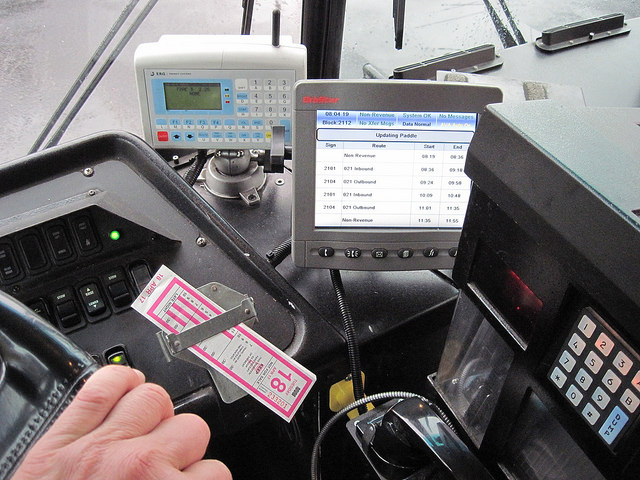
Radio procedures are now being updated with the new software tied to our new radios being installed in our new equipment. We now have the ability to request a headway adjustment and ask for a reroute simply by our touchscreen. 

I am a firm believer that technology holds  many keys in helping smooth operations.  Without these simple communication procedures, the delays of buses did lead to an abysmal on time rating of 60 percent. Knowing when and how to ask for this crucial information can pay dividends.

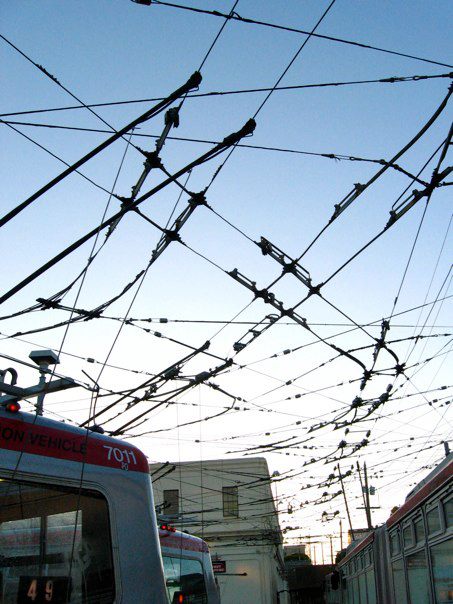
I recently reported damage to the overhead using the new radio system. I entered in the message of mechanical electrical on the radio touch screen as a marker to my emergency call request. I got called back immediately and described the problem. The best part was that operations sent me back a message saying ‘thank you.’ I felt satisfaction in being heard and recognized. This is a huge step in the right direction in communication between operations and the operator on the street.

Bus bunching occurs and continues if no open communication exists and leads to anger and delay between staff and the riding public. Losing Zen is  easy to sort if no solution appears on the radio.

https://fineartamerica.com/featured/2010-muni-fast-passes-douglas-griggs.html?product=tote-bag

Retarder Control

One aspect of driving a large vehicle is the larger number of lights and controls on the dash. In a tour bus there is sometimes a retarder control joystick that assists braking.   On a city transit bus, the retarder control is built into the service brake. We transit operators can see a retarder light illuminate on the dash after the service brake light goes on. There is usually a delay in braking when the retarder engages. Retarder control is extremely helpful for our long term physical stress on our legs and knees, which can also end up being read by our body as an emotional stress. 

Unfortunately, humans, unlike animals, cannot turn off stress as soon as a fight or flight situation ends. But I do appreciate the fact that our continuous stopping and starting at every corner keeps us city transit operators alert and on our toes, literally. The long uninterrupted freeway driving of a tour bus driver is not necessarily any easier when the miles turn into hours on the long slow graceful grade of an interstate highway.

Before being a transit operator I had the fun of driving the tour bus on the freeways. I say fun cautiously. Bay area highways are no longer that much fun. Traffic slowdowns and backups no longer give the feeling of freedom of being on the open road. As most drivers in the city come to realize, city streets, even with stop lights, become less stressful than highway driving that comes to a standstill. At least, the hope goes, the arterial keeps moving.

This accordion logic to traffic comes into play with how smooth a braking system we have on our coach. The great news is that within two years, all city transit buses will have the newest braking systems called regenerative braking. These brakes are not unlike the retarder controls on the highway tour buses I drove before taking a job in city transit. 

As a young man I thought nothing of any possible stress a bus driver would have. Seemed easy enough to just be sitting in a padded seat and not having to lift anything. But the idea and action of repetitive stress that was lost upon my youth has started to catch up to me as I approach my sixties and my twenty-year mark behind the wheel. 

Anytime new equipment is added to the fleet, I sigh a breath of relief.  I am so grateful my last years behind the wheel will be with brand-new equipment and smooth braking systems!

https://fineartamerica.com/featured/muni-bacarri-worm-livery-douglas-griggs.html

Use a Black Pen

Describe something you learned in high school.

I learned not to use a different colored pencil when filling out an alcohol drug survey in math class. Ms. All-rabid started failing me on quizzes when she realized what I had done wrong by drinking beer and smoking pot and cigarettes several times a week-according to my honest answers in the survey.

Instead of getting the help I needed in the counseling department, I got burned in applying to engineering school because of the one semester of an average grade. Susan Wokeman showed me her quiz with the same mistake I made, but she didn’t get dinged and got an A.

Kitty Corner

“Is this the way to Powell Station?” intenders ask as I open the door.  I tell them they need to take the bus in the other direction. This question gets asked often at Steiner and Hayes across from the Painted Ladies at Alamo Square. They have arrived at the park from the crosstown 22 Fillmore or 24 Divisadero, and are not familiar with where to stand. “Just wait over there,”  I jest, knowing from experience that it won’t help. 

Pointing to the rear of the coach and telling them to cross to the other side to go inbound, results in a polite smiles of thanks, but when I pull away, seven of ten times, they walk in the wrong direction, or stand transfixed, looking to ask again. 

Most United States born and raised folks get it when I say, “Kitty-corner.” Not so with visitors unfamiliar with our common US phrases. The blank stare I receive means I did not get through. Back to geometry class: “The opposite adjacent angles, are not only congruent, by going the other way, but on the oblique corner .”  If this doesn’t compute, then I need to be willing to pop the brake, step down on the sidewalk, and point like a hound dog’s tail right next to them, so there is no doubt. It may not be the patience in stalled traffic that is the hardest trait to master as an operator, but being gentle in answering repetitive questions throughout the day, world without end! Getting my ass out of the seat solves so many problems so fast, I would do well to get the concrete out of my britches, for when I do, my legs give thanks, and I am energized to be in service mode.

This would never happen on Market Street or at Kearny because of a desire to get out of the zone as soon as possible. More runners are coming from the underground and any delay at the door means rear doors that won’t close, pickpockets can flourish, and other trolleys will back up from behind on Third Street.  We gotta go.

Not true on the 21 Hayes, mostly. God bless the Muni lines that still give us time to chat and not shut the door and rush away. At Union Square, however, a large visitor group can throw off the beats to pull away from the curb, and I have to keep it short and simple. Our perceived rudeness is not a personal affront.  It is because of the beats of the traffic, and holding back other trolleys or streetcars behind us in the queue. Cyclists are moving in a pack from the last light at a speed too fast for lane change judgment by motorists. The rails, when wet, can become deadly. The front wheel of a bike fits nicely into the groove and all bike momentum in the front stops.

The simplest way to convey kitty corner then, is to say, “You must cross both streets behind me and wait on the other side of this street.  Choosing Zen to Happy Destiny means I can remain gentle knowing my work is never done. And shall be done again. And again. World without end. Amen.

1976 Flyer turning on to Market Street 2016

Summertime in the City

The inability to see or read the head sign of a bus, or to know where to stand based upon stalled traffic or double parked vehicles notwithstanding, one detail that usually does not escape notice in our fair city is when our air temperature is not fair. The afternoon fog moves in, the temperature drops and those who do not live here become obvious to even the denizens of sidewalk cracks, the suits leaving a tower of high finance, and unfortunately, the thieves and pickpockets looking for quick takes. 

As I drive my bus past the humanity walking by, I point out to visitors on board my bus how we spot tourists instantly. They are curious as to how I know they are not residents of our city when I pick them up. True, the ability to read others becomes fine tuned within our senses as the years add up behind the wheel, but it can also be much simpler.  We key in on what you are wearing.

If an entire family is wearing brand-new hoodies and sweat tops with Alcatraz images, it is obvious the ferry ride over to the famous prison island caught them unawares of how cold our sea breeze hits the skin. Especially true when traveling the rails of a boat over the bay or waiting for a bus on a hill.  

The current gold rush becomes apparent. The gold is not in the hills at Sutter’s Mill. The gold is found by selling hoodies and sweat shirts to tourists at Fisherman’s Wharf; or out of a blanket atop Twin Peaks.  It can even be mined from a handbag held side saddle with a wide-open top or side pocket.

Not limited to the wharf, other places, such as tour bus vista stops, also become a bazaar for clothing sales. In order to bypass permits, vendors have all the shirts and gear lying on large blankets and sheets. If the spotter sees police cars coming up the hill on the road below, they quickly wrap the garments in the blanket and throw them over the rail. The clothing becomes invisible to the police in the patrol car when it passes by the vista point area. 

Most crime occurs because the police never exit their vehicle.  Beat patrols are always requested, but hard to fill. I argue with others that it is not more cops we need, but pavement pounders on the beat. We are not a car culture city. Our streets have not changed when it comes to foot traffic.  In fact, more people are walking than ever before. This is one reason we become slender after living here for a few years.

July is the number one month for visitors: Central Valley residents are beating the heat, Europeans are using their generous vacation time, and the occasional and occasional Midwestern family is visiting a young family member just moved into the city. It’s fun to watch a new city resident train their family on how to pay the fare and ride the bus. I really have to watch my self to make sure I don’t go overboard on being a driver guide instead of a city transit operator, but it makes for a fun ride.

Great places for selfies and shots with friends are the Hearts of San Francisco on the corners of Union Square. Alamo Square by the Painted Ladies has landscaping of new trees and freshly sodded green grass. New plumbing for sprinklers and a bathroom have also been upgraded. The Victorian beauties abound around the 4 block square, and look great as a backdrop for a picture. 

I like to point out the four different styles of the turn-of-the-century architecture, and to see where a house lost a complete story in the ’06 earthquake, and if the rounded windows in the cupola were replaced by conventional flat windows. Lots where a newer house stands, point to a fire, where an old house didn’t survive with its’ neighbors. Our city history is chock full of these old hotspots. Not so with the afternoon temperatures in July!

If you want to cool off on a vacation in July, San Francisco is the place to be! 

https://www.amazon.com/Dao-Doug-Trolleybus-Happy-Destiny-ebook/dp/B0BNN6PZSG

Great Expectations

I pick up a runner crossing from the far-side corner after I turn the corner and wait for him to come to the rear door as I toggle the rear door open.  A little boy with tears in his eyes giving the constant low moaning wail of not getting something he wants, lights up and goes quiet when I hand him a transfer for being a big boy. A late boarder slips in a dollar and takes a transfer from the top of the fare box and moves back down the aisle without showing the discount card.  

Sounds like a commendation on the way for being an expert operator, right?  Fat chance.  In fact, these actions may work against me in the long run, especially with my coworkers.  The common thread in these three examples, and many such others is this: I am creating great expectations.  The most cunning baffling and powerful demon facing a transit operator within this City by the Bay are unrealistic expectations from the service provided by the SFMTA.

Allowing large tour buses to use our bus zone for pickup for a dollar a day is an unrealistic expectation from our elected leaders about the value and worth of this curb space real estate, and keeping the city bus running on time. Not reading the head-sign of our coach, and asking questions after boarding and passing the yellow line, create distractions and delays. This need not be if the questions were asked at the bus stop while waiting. Separating yourself from those waiting for ride shares and shuttles, and those who have not bathed for several weeks also helps in getting our front door by your side.

Texting on a phone or wearing earbuds cuts off this important connection between riders.  All of this has a theme: a lack of willingness, coupled with great expectations, leads to failure of service. The failure to make a ride on the bus.

Here are some tips: if you can’t make it to the bus stop by judging the coach speed, don’t run away from where you are. Moving targets are hard to hit! Move to the corner where there is a stop sign. We don’t want to make an extra stop, and if you are by a crosswalk, stay there.  Step down, when safe, and raise your arm to hail us. The biggest mistake is that late runners run toward the coach, shortening reaction time to make a stop. If anything, walk in the same direction of travel as the bus, extending stopping time, and then raise your hand and stand still. Step down where we can see you, and create a fixed point.

You don’t have to run across to a far side stop, just wait at the near side corner, and smile. Most stoplights are short in cycle, and we’ll probably get a red by the time we get there. When you are in the Zen and remain calm and project dignity, you will appear attractive. We don’t want to pickup distracted and annoyed energy. Pounding on the door does not increase your chances if you want to get on the bus.

Tree Trimming

Of all the calls I make to TMC, (Transit Metro Control), none is more gratifying than seeing the response to a tree trimming request. Homeowners are required to trim the trees in front of their home or business, but this has created some disparity in when limbs and leaves get cut away from our overhead wires. The decision to make property owners responsible for tree trimming has created a dead beat culture that makes for a disparity of time of when a tree gets its branches cut away from our traveling wires. Fortunately, our overhead crew responds quickly, and when they cut down limbs, any complaints from the landlord or tenants about the manner of tree cutting, falls on deaf ears when ‘life and limb’ is made under a public safety action. Fortunately our crew does a good pruning job so as to not distort the tree’s canopy. Even so, trees are forced to grow in a way that is somewhat unnatural as they cannot overhang our wires.

If a building on a corner has doors that open onto two different streets, and only one address is used for the mail, the owner can discount the tree by the door that is not officially recognized as a mail stop and say that the address does not exist, and hence not their responsibility to pay for tree trimming by the unused entrance.  

The delay in maintenance we renters face in our older rent controlled buildings is astonishing. This is matched only by our denial or hesitancy to report or call in a problem to the owner via a building manager. Hence, most repairs come in the nature of an emergency. This can be disruptive, especially regarding water leaks and electrical hazard, and elevator repair. So much of our maintenance culture has shifted to an emergency case only.

The only thing more shocking is the cost of a rent increase in a vacant unit.  Some say that doing away with rent control would bring down rents overall, but most of us don’t believe it in a second. As long as a shortage of housing exists, rent control at least keeps some of us in a stable or more realistic budget to survive in San Francisco. If an exodus of population occurs, such as what happened in 1999, in what we call the dot com bomb, large leaseholders just keep units vacant so as to keep rents up, to wait out the cycle until the next boom. This city has a history of boom and bust, and the siphoning swindle of taking cash from unsuspecting newcomers or visitors. So too goes the escape from responsibility with tree trimming. 

Transit Metro Control no longer asks us for an address for a tree trim request, as the mandatory owner responsibility law for tree trimming can create more problems in a lack of action necessary for safety. When my poles come down from a tree, I do get results very quickly now that the law seems to be off the books, at least unofficially. This is how most city departments work. We can only guess what the current modus operandi is, with or without a law on or off the books! On and off changes baffle even the best of us with what the current Standard Operating Procedure is in play.

The one good thing about major street construction, when pipes for a sewer or water line upgrade occurs, are that trolleys are moved temporarily to a curb lane and all the overhanging branches get cut down.  I guess this is because eminent domain and public safety are much more obvious to point, hence the fear of litigation remains close to zero. A huge overhanging limb on Hayes was finally cut down because pipeline installation is on the way. Other smaller tree limbs have been cut so we can travel in the curb lane without threat from tree limbs. 

Indeed, as any bobtail delivery or pickup driver can attest, trees on the curb get damaged or cause damage when attempting to park properly by the curb. The fear of tree and vehicle damage make for a double park situation that cuts off free travel in a lane. Tree trimming helps all large vehicle drivers great and small; including trolleybuses, because our poles fall off of the wires when the tap the branches, especially after a heavy rain when the limbs droop lower, laden with water.

A branch from a gum tree inadvertently fell in front of my trolleybus by the corner Walgreens at O’Farrell and Divisadero. Luckily, no one was hurt, and I saw it in time to stop nearside at O’Farrell and call it in. Just a few moments later, a cyclist was hit up the street in the other direction so the line was blocked. Because of this delay with the tree branch, I was put out of harms’ way from the distracted cyclist that got knocked off his bike by another bus. I felt a wonderful feeling of Providence as the tree protected me from harm, from another accident. My gratitude for the shade they provide is immense, and I felt as though this love came back to me by this gum tree.

The Fire Department came in ten minutes to direct traffic, and our Overhead Crew arrived in fifteen minutes. I love it when passengers and bystanders marvel at how fast our city responds to an emergency. In less than half an hour, I was on my way, with all the branches cut down and cleared to the curb. 

A poem follows about our median trees making way for the BRT on Van Ness. I am not saying cutting them down was a bad thing, I am just thanking them for their existence on a hot summer day. I also thank the Friends of the Urban Forest for planting new ones, and can’t wait to pitch in when I have more time when I retire. Hah.

Being in the Zen in transit means the overhead crew has trimmed branches, or we get an immediate response when we make a call after de-wiring!     

Tree Trimming

Thanks for your service,

In the middle:

Noticed very little,

By the by,

Many in the Cars,

The Trucks, the Buses,

Have passed you on the way:

To bars

And you stood quietly,

Giving us fresh air,

As we didn’t seem to care,,

Now that you are bare,

More aware,

Of your trunks, and your twisted

Arms,

Your swaying branches and course,

Oh

—-A lone man takes a photo,

And gives a hug.

It’s Driver Doug!

And he won’t forget that hot

July in stopped traffic,

Where he did stop–

Under your shadow’s shade.

A Glade! A Glad,

Gladiator,

Preventing another radiator,

Overflow.

Go. Go. Go.

Slow.

And wave goodbye.

https://www.amazon.com/Dao-Doug-Trolleybus-Happy-Destiny-ebook/dp/B0BNN6PZSG

A Rose by any Name

One of the subtle aspects of joy about being a transit operator are the many people we see on a regular basis.  We may never talk to them or get to know their name.  They inadvertently become a part of my friends and acquaintance list, even though I have no written list, or what would qualify you to get on it.  After about three ‘visits’ or if I catch you twice in one day as I pass by your routine more than once, you may be unconsciously put on the list. 

At the 33 line terminal on weekends, I would see a nice lady tending to roses behind a narrow fenced “yard” between a house and the sidewalk along our terminal. The rose bushes were mature as they had a thick trunks and looked like they had been pruned many times over the years. She wore a scarf and gloves as she tended to her rose garden. My thoughts turned to my grandma and her sister and the gardening techniques my mom taught me as I paused during my day at this bus terminal. Gardening was one joyful gift my mom taught me as we worked together in a rare moment.

Then, working one weekend assigned to the 33, which I hadn’t signed on to for several years, I noticed weeds and grasses had grown up taller than the rose bushes, and it looked like the yard had not been groomed in this growing season. I was overcome with sadness for my grandma passing, and was sure the unkempt garden was a sign that she too, had passed.*   *editors note: she was evicted, and is still alive at this reading.

A few weeks later, when I did the 33 on OT for a Sunday, the garden was completely gone: no weeds, but no roses either. I wistfully departed, wondering if anyone knew the story of what happened to the garden. There was a big raccoon that would stare back at me from the fence line when the garden was in full swing.  I would pass by after dark, in the wee hours before pull-in, but he wouldn’t talk to me, and I never saw him or her again.

Losing the Zen garden of roses was a sad day on the 33 Ashbury. https://www.amazon.com/Dao-Doug-Trolleybus-Happy-Destiny-ebook/dp/B0BNN6PZSG

Rider Alert

Nothing is more disconcerting than seeing people waiting for a streetcar that isn’t coming. Especially in the afternoon when the fog is rolling in and visitors are caught in shorts and without jackets. If you plan to visit San Francisco between the Fourth of July and Labor Day, prepare for early spring/winter conditions. Even though century mark temps are only a few miles away from San Fran’s city limits, maritime conditions prevail in the city. Mark Twains phrase, “The coldest winter I ever spent was the summer I spent in San Francisco.” applies to July and August in the city. If you are dying of the heat back east and in our Central Valley,  then do come and enjoy our natural air-conditioning!  I am familiar with the challenge of packing in hot weather back home, going to ‘sunny’ California, but not here between the ocean and the bay.

When I do the 21 Hayes, I travel down Market Street and see all the tourists waiting for the streetcar to take them to Fisherman’s Wharf. They pack in to the cars like sardines and creep towards the Ferry Plaza. Little do they know, they can take any bus or trolley down the street to Kearny and take an 8 to Chinatown, Coit Tower, and then Pier 39. 

Any disruption on the rails can block the track and cause a large queue of intending passengers on the islands on Market Street, particularly at Fifth, Fourth, and Main.  At these times it pays to take a 6, 21, or 31 to Ferry Plaza and transfer to the ‘E’ Embarcadero streetcar. An express 8X bus crossing Market at Third to Kearny is a great crosstown ‘shuttle’ to pier 39 and helps to clear the islands and get you moving to have fun.

The SFMTA posts “Rider Alert” signs in red and white, or orange, to let you know when stops and streets are closed to traffic. It’s important to notice these a day or two before an event. Indeed, many who find a never again attitude about transit is because of a lack of communication about rider alerts. This is where an Amber Alert type message can and should be adapted to our smart phones and with GPS technology developed by Uber and driverless car coding. 

Rather than stymie new creative GPS tech, Muni should work with Uber to track not only their own rideshare cars, but with buses. This would open up bus stops to ride share pickups when no buses are arriving or departing. Minutes go by when it is safe to use a bus zone, and this priceless curbside real estate can be easily shared with GPS tech. So too, could the large tour bus shuttles, also be included with this zone sharing. The key here is that transit is being administered as a unified body of vehicles, not separate entities fighting and blocking each other.

As a governmental body, our transit department just had another resignation, and now brings the vacant manager positions to eight. Coordination is lost. Creative new ideas are vacant because self-preservation mode is on, and no bigger picture can be established, much less horizon goals of integration as a whole.

Eventually, Rider Alerts could be all done electronically from an application rather than to have to manually park a vehicle and go out and attach a laminated alert sign to a bus shelter. The labor to then go ahead and remove all the signs would be a thing of the past: Remember, with a sense of community, anyone lacking a smart phone could be instructed by those nearby who do have a transit app on their phones. I ask all the time when I am at a shelter with others who are on their phones.

When Rider Alerts, Next Bus arriving times, and trip template suggestions all match to real time GPS and bus timetables.  Interactive GPS system can suggest changes to avoid congestion and blocking at transit stops. This is really an exciting time to be in a manager position to integrate stoplights, trip tracking, and headway adjustments between Uber, driverless tech, and transit schedules. Transit Metro Control (TMC) needs not be in the dark about conditions and buses. It can see what Uber customers see, inclusive of buses, including the Silicon Valley shuttles.

Being in the Zen means asking others about Rider Alerts and Next Bus arriving times when I am without the phone or application to be in the know. The same goes for tourists on the islands waiting to go to the wharf!

https://www.amazon.com/Trolleybus-Happy-Destiny-Dao-Doug/dp/1723329134