Alpha Dog

People watching is the greatest job benefit of being a transit operator in the Baghdad-by- the-bay. Friends and family always ask about the great benefits a that civil service worker must have in being a government employee. I usually mention the post office as having the best defined contribution plan or pension. But in the day-to-day flow of ants moving to and from the anthill that are the skyscrapers built on the bones of boats in the bay downtown, it isn’t a column of numbers in the year-to-date tab on a paycheck that is a job perk in being a bus driver over and in the arteries flowing from the heart of San Francisco that make for daily job benefits behind the wheel: The benefit is not being stuck inside an office. 

It is feeling as though you are on the outside. Yet when the fog is freezing the bones, the wind is whipping through your layers, the bus is like a shelter from the elements. To comfort those at the mercy of the weather, it becomes important to stop close to the alpha dog in the queue on the sidewalk, so all can enter the bus as soon possible, without blockage at the gate.

Visitors are easy to spot as the alpha dog always holds all the transit passports in their hand for all of the group. They usually follow at the end of the queue. When a large family passes-by the fare box without paying, the alpha comes up the steps at the end with the fares. Sometimes, a large group passes, and there is no alpha with no fare! To keep my ambassadorial role as a representative of the city, I don’t say anything. When I do, they usually have their fare, buried in the back of their backpacks. This is another example of how we fail the city. No one assumes responsibility to inform them on how to ride, where to stand, or how to validate their passes.

A fare only becomes valid once the month and the day or days are scratched off on the passport sheet which is not unlike a lottery scratcher ticket. Fortunately, the 21 Hayes is a great bus line which permits the time to teach visitors. Other arterial lines are not such. Rear door boarding is allowed and little time for conversation is allowed between the rider and the driver. Crosstown buses are best for enlightenment and understanding.

Many times the person asking the questions is in front, and the ticket holder is at the rear. I can usually tell who they are. If they are asking a question I don’t understand,  I ask them where they are going. If they can’t answer this, I then switch over to intuitive mode and say yes and ask them to step up. When this fails, I beckon them with my  hand.

When this fails, it’s because I have put too much expectation and hesitation in my voice, and I have to let it go. A simple nod is all I need. Then, if it turns out they are going the wrong way, there is usually a better transfer point down the line that will get them on the right bus with less confusion. I need to remember when I was new to the city and I did not know inbound from outbound because tall hills or the fog  make it impossible to know which way is downtown or east versus west.

Talking to just one person, the alpha dog as Zen master, is best to keep the herd in line!

https://www.thriftbooks.com/w/the-dao-of-doug-3-the-trolleybus-of-happy-destiny/38040606/all-editions/

Welcome to my collection of Stories: CAR CLEANERS

I am sure these coworkers have stories to tell!  I can only imagine what sorts of things they have had to pick up, wipe up, or mop up in their day.  If there be any sequel to this missive, I am sure the experience of a graffiti cleaner, a floor sweeper, or those that pick up the trash have some interesting tales.  

Dipping dots and chicken bones are not high on my list of favorites.  Neither are the empty cups of mixed iced coffee or smoothies.  Open containers of soda or beer are the biggest bummer, especially when not completely empty.  They can fall from the small platform next to the rear seats and get kicked around on the floor, sending a trail of sticky fluid halfway up the aisle.  We are supposed to do a walk-through to the back of the coach at every terminal. This is important to see if anyone has left anything by their seat.  

I once found a paperback with 500 dollars in an envelope as a bookmark at 14th Avenue and Quintara on the number 6 Line.   I put the book up on the dash before I left the outbound terminal.  Sure enough, when I started back down the hill to 9th and Judah, two young men rushed into the street in front of the bus and  started screaming and waving for me to stop.  This was on a dark moonless night.  I opened the door and held the book up in hand.  

“Envelope?  What envelope?”  I couldn’t resist.  “The money is still there.”  They were relieved to say the least.  It was rent money.  Paying rent by cash in San Francisco is common on grandfather long term leases, but can add to drama and problems when  the money disappears!  

The other big ticket item was a laptop computer.  Fortunately, there was a name and phone number in the case and I was able to call the owner immediately.  They were so happy to get that one back.  With cell phones, too.  I can usually find a recently called number that is a friend of the owner and let them know I have it.  In all these cases, I call Central Control as soon as I know I have something, such that when the lost and found passenger calls Muni, Central lets them know when my bus will pass back in their direction.  They are so happy to see me coming.  

This is probably the nicest feedback and recognition I receive at this job.  It can come so quick and simple, and all I have to do is make a sweep of the coach at the end of the line.  Not only can this result in the most rewarding gratitude from a passenger, but can prevent a nasty, sticky mosaic of soda or beer in the aisle from the back seat to the front seats!   Ice cream on hot day really creates a sticky hazard on the floor.  The cone or stick can become stuck to the floor like crazy glue.  Once a little girl dropped her ice cream ball atop her cone right on to the lap of a nicely dressed woman going to a job interview.  Words to the wise:  when going to an interview, take a cab!  Or at least bring some detergent wipes, just in case!  

And then there is the full cup of joe without a lid.  One person tripped up the steps and doused me and my shirt with coffee.   Oh well, at least the color matches the uniform!  We are allowed to go out of service for up to two hours to get a new shirt, but I kept on going.  Here was the opportunity to state why bringing drinks on the bus was not a good idea, and it stuck!

Newly hired car cleaners have been present on the track and in my coach before I pull out in the morning.  I see them applying the finishing touches on the windows and cockpit.  The floor is freshly mopped.  The bus is spotless.   

I pick up my first passenger just outside the gate. She quickly noted the wet floors as a potential hazard.  I grinned.  Enjoy it while it lasts! You’re on a clean bus!

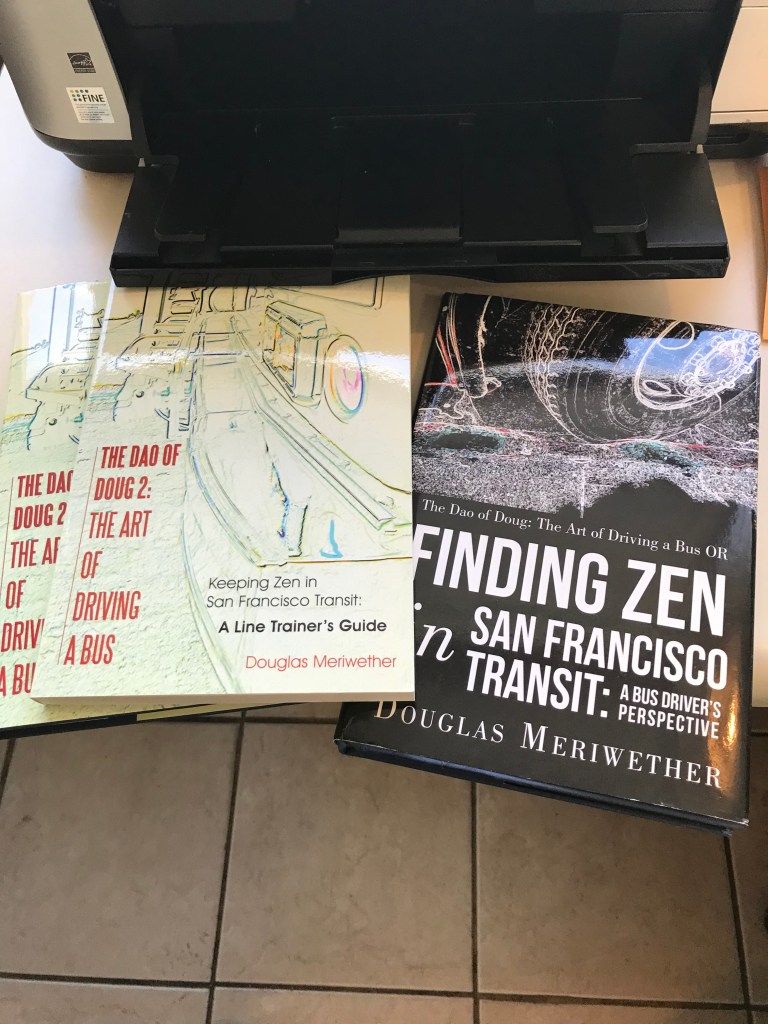
The Dao of Doug 2: Keeping Zen in San Francisco: A Line Trainer’s Guide Glossary 2

 kneeler: pneumatic pistons installed at the front door of a coach that can lower the steps for those needing assistance in placing a load or themselves on to the first step

   lift:  another device located below the front steps of a bus that extends from the bus and on to the sidewalk to allow for a rolled object such as a wheel chair, grocery cart, or stroller to be loaded up to the aisle elevation without needing to go up the steps

   avenues:  numbered streets located out by Ocean Beach in the Sunset and Richmond neighborhoods of San Francisco

   streets:  numbered roads close-in to the city in the Financial District, the Mission, and area South of Market, or SOMA

   islands:  a set of land tips in the most remote location of the world, in the center of the Pacific Ocean, where a stressed out bus driver sometimes goes to in his mind, renamed since established in the Western world, by the Earl of Sandwich. Or:  those concrete medians on Market Street that have a bus stop that takes you south of Golden Gate park to the Inner and Outer Sunset, or take you to an inbound terminal short of the Ferry Plaza.

   curbs: referring to the stops on Market Street, downtown, that take you north of Golden Gate park, and can get you west much faster than the islands when on a weekend with a special event

   crunch zone:  a time and place to avoid on Muni, as items may get picked, or a fight or altercation may arise.  the chances of a bus breakdown are high.

   over there: a phrase to be avoided when addressing an operator. An answer of yes or no still results in no clarity about where to stand.

   flat tire:  a blemish or flattened tread in a city transit bus tire that can create a thumping noise at speeds over 15 mph

   hot lunch:   excreted body fluids on a seat or floor on a Muni bus

   running time:  the amount of time allowed spent on a treadmill at the gym on lunch break: or, that amount of time it takes to complete a trip on a run

   leaving time: used by operations’ central control to mark a time for a revenue or shop appointment for an in-service coach, usually by the inbound terminal.  This commonly refers to time on paddle that denotes time for a coach to start a trip, inbound or outbound

   splits: day shift that allows for a two hour break in the middle of the shift

   feng shui:  literal translation is “wind-water,”  that ancient practice of harmonizing with invisible energies

   straight through: a shift with no break, save for some recovery time written-in on the paddle, which may or may not be true in reality.

   owl: run that works from 9 p.m. to 6 a.m.

   open run:  no operator scheduled in front of you.  (see: ‘Ninth Level of Hell’, or ‘Packed, Stacked, and Racked,’ in first book, Finding Zen)

   timed transfer: a vanishing point, but still followed on the 22 Fillmore at Mission at night.  22’s will wait and see if a 14 is coming, so you can make the transfer.  the 38 and 90 seldom make this, as with the L and 90.  Get that run number!

   Lojong:  the mind training practice in Tibetan Buddhist tradition that treats disaster or adversity as a way to overcome trouble and pain by using the 59 Slogans.

   the wiggle:  a well marked bike route connecting the Panhandle with Market Street, avoiding any hills

   e p u : auxiliary or battery mode whereby a trolley is not connected to the wires

   l p o : late pull-out

   a p c : automatic passenger counter,  can be spotted by the red laser lights on either side of the steps, or above the door by the courtesy lights

   v t t : verified transit training, in which a professional class b operator within a city transit system is re-qualified on bi-annual basis, as is a distinction from tour bus endorsement which carries no v t t card

   range sheets: posted in the Gilley room at the barn where the line and run and bus pulls-out

   g s u : general sign-up whereby an operator can change report barn and may mean use of different equipment or mode

Driver Doug is a twenty-nine year resident of the City by the Bay, and has been a transit operator for the San Francisco Municipal Railway for almost 20 years. His current run is on the 21 Hayes trolleybus line from the Ferry Plaza to Golden Gate Park. His interests include photography and writing, and this latest book, The Trolleybus of Happy Destiny, is a composition including anecdotes and photo illustrations from his experience behind the wheel of a city transit bus.

The Dao of Doug: Finding Zen in San Francisco Transit: A Bus Driver’s Perspective (Dao 1)

Glossary 1

paddle: our timetable or schedule that we pick up in the receiver’s office that comes with our defect card and books of transfers. This entire bundle is called an outfit.

pre-op: usually done on a track in the bus barn and is a term for checking mirrors, lights, radio, horn, doors, wheelchair lift, kneeler, bike rack, collectors, poles, retrievers, operator chair and the set up of the fare box. Operators are given 15 minutes to ready a coach for revenue service.

pull-out: pre-opping a coach on a track at the bus barn to prepare the coach for revenue service. Denoted on a run schedule by an asterisk * These coaches cut-in on a line somewhere on the middle of a line.

pull-in: going home. Coaches are taken out of revenue service, somewhere in the middle of the line. Example: 14 Mission line coaches pull-in at 11th Street, usually outbound and on 25th Street inbound. Coaches on the 49 line pull-in at Market outbound, or 25th Street inbound. 49 line coaches may also pull-in on 11th Street, 14th Street or even 18th Street.

leader: the run and coach in front of you

follower: the run and coach behind you leader’s leader: the run and coach two buses ahead of you follower’s follower: the run and coach two headways behind you not-out: a run not scheduled to pull out, usually a four hour period on your run of schedule

pole-dropper: a coach whose bushings are stiff and locked in an unfavorable position, usually when a coach makes a right turn, so that the poles drop off the overhead wires.

slack brakes: a coach with an abrupt braking transition to the dynamic braking at 3 m.p.h. from the air brakes

hill holder: a toggle switch that holds the coach on a hill without the necessity of applying the service brake.

master: the on/off switch that also has a park charge setting for recharging the coach overnight service or courtesy lights: the lights that come on when the doors are open. The green light over the rear doors means it is safe to step down to activate the rear doors.

run sign: the three digit number in the lower left of the curbside windscreen, denoting what run number is assigned to the coach and operator at the time the coach is in or out of service.

road call: maintenance assistance from the shop to service a vehicle and bring it back in to revenue service.

sick on the run: going out of service in the middle of an operator’s scheduled run

daily detail: a posting of all runs not held by the usual operator

rdo: regular day off

ci: classified industrial: an operator out on leave due to illness or injury on the job

hol: operator’s day off due to legal holiday move up: given by street operations by street inspector or operations central control, and gives permission to leave early from terminal.

pre-empt: a tripper mechanism located in a small box in the wires, favoring a green for an oncoming coach.

far side: not a Gary Larson cartoon, but a bus zone after crossing an intersection

nearside: a bus zone located before an intersection.

bus bulb: a bus zone mid-block where the sidewalk is moved out from the curb lane.

flag stop: made without the bus coming to the curb, usually because another vehicle is in the zone, or a regular bus stop made by or between parked cars. Example: 17th and Kansas is a flag stop both inbound and outbound on the 22 Fillmore.

coach stop: any location where a yellow marker indicates the line number of where you can pick up a coach by signaling for a stop.

multiple line stop: a bus stop serviced by more than one line. Always a good idea to indicate to the operator before approach to the stop that you want to board the coach indicated on the head sign. Looking away is a sign you want another line coach.

head sign: the line and destination of an approaching coach located on the front, sides, and rear of the coach.

destination sign: next to the line sign indicating the coaches’ final stop. Always good to be mindful of short line pull-in coaches having a different destination as peak period ends, usually from 5:45 p.m. to 7:45 p.m.

line sign: the first sign on the head sign that shows you the line number of a coach. If blank, yellow, or red, usually means that coach is short line and pulling-in somewhere in the middle of the line. New coaches display, “Ask Driver.” 

transfer: issued after fare is paid, good for ninety minutes to board another coach to reach your destination. Note: all lines finish one trip in about 45 minutes, so the time given allows you to go to the end of the line and still have time to catch another coach to get to your destination.

headway: the time in minutes between coaches, and changes every four hours.

transfer point: a place where two or more lines cross or meet.

inbound: a bus headed downtown or to fisherman’s wharf. Jackson and Fillmore, Aquatic Park, Pier 39, and Fort Mason are considered inbound destinations.

outbound: a bus headed away from downtown, or from fisherman’s wharf. The Avenues, Dog patch, Potrero, and Third Street are considered outbound destinations.

peak period: that four hour headway between 6 a.m. and 10 a.m. in the morning, and 4 p.m. to 8 p.m. in the evening. Many coaches go out of service in the middle of the line before 8 p.m., which creates the illusion more buses are going in one direction than the other.

streetcar: any number of cars that run on rails and can be the new Breda Light Rail Vehicles, Milan Historic streetcar, or PCC

trolley: an electric bus with rubber tires that has evolved from the box-like vehicle that used to run on rails.

articulated trolley: commonly referred to as a double bus, these electric buses are sixty feet in length and have a joint between the front and rear section.

getting the swerve on: shaving every second of every minute to move up after being delayed, such as by a slow leader.

Muni: short for San Francisco Municipal Railway

Zen zone: that joyful and meditative space on the bus when all is calm.

Suggested Categories/Genres

for the above series of my books

Behind the Yellow Line

“Please move back. I need you to step back behind the yellow line while the coach is in motion.” I state, when the coach is full: Or, if someone does not have their fare ready and they are looking in their pockets or hand bag for change, I say, “I can’t see my mirrors.” The fare box is in a place such that we cannot see our curbside mirrors when someone is standing by the fare box. 

I understand why you guys do this. You’re trying to lock your body in to the yellow hand rails so you can keep stable if the bus takes off from the curb. You are trying to pay and not hold up the bus, so I can go. Unfortunately, it is not a good idea to pull away from the curb without checking to see if there are runners coming up from the back, or if someone is smoking a cigarette or talking on a cell phone too close to the curb, and looking away from the bus. We have several blind spots from our seat, and this is one of them. Our rule is to not move until all fares are paid.

The good news is, some lines have enough time to follow this rule throughout the day.  The 2 CIement has time all day, as does the 21 Hayes. The 31 Balboa and 41 Union are usually OK, as is the 45 Union, but some lines such as the 3 Jackson and 24 Divisadero only have the time to wait for someone to move back and sit in the morning.

The 1 California does not, even in the wee hours of the morning, or late at night. This glaring inequity surfaces as running hot. We are told over and over by managers and from the training department, operators are running ahead of schedule on the 1 California. For the first time since I began, I heard this innocent question asked at a safety meeting, “Why are we running hot?” No one answered. 

I know why. It is because we don’t have the time to run on schedule and take recovery at the inbound, peak period terminal. If we wait too long to leave at Clay and Drumm on the 1, the standing load we will have in store for us begins at our first stop outbound at Davis and Sacramento. 

Because the other terminal inbound at Howard and Main was removed, all persons great and small must walk from Embarcadero BART and Market Street to Embarcadero Building 3 to pickup the 1, so there is no load share to split outbound. The yellow line comes into play as we climb to Nob Hill past Chinatown. The operator of the lead coach with extra headway must skillfully negotiate drop-offs and pass-ups to split the load with his or her follower so the yellow line remains clear.

I lost my conscious contact with experience in projecting my confident vibe while working overtime last Saturday, on the 1 line, and I lost control over keeping the yellow line clear at Grant Street. I was overwhelmed by the number of intending passengers, and did not pass up Kearny as I had no coach directly behind me. I forgot to wait and see if my follower would turn the corner behind me at Davis. Big mistake. 

Weekends have fewer coaches in service, and this makes pass-ups difficult. Keeping the front door closed is the only way to keep the front clear. If someone wants to get off, I need to find that out before I cross to the far side. I can kneel the bus and let them out nearside, so I don’t have to open the front door at the bus stop. This is scorned by those who direct us to follow the rules, but they are not facing the yellow line dilemma. They are sitting behind a desk and not a wheel. One can hope for a “caution and re-instruct” letter, and not time off. 

I can also wait to make sure everyone is sitting down before I roll. The new buses have a new twist because the stairs are located in the aisle behind the second or third doors, and it takes a few moments for passengers to make their way to the back seats. The timing is such that, as they reach the stairs, I am ready to pull away, and this can throw off their balance, especially because they are putting their wallet away, or taking off a bag to get ready to sit. I love the 21 Hayes because I have the time to wait.

Not all lines afford this luxury. The 1 California does not. We ‘walk the baby’ and slowly start to move as the passenger adjusts to find a seat; or in most cases, when the bus is full, to stand and find a hand hold. It is already obvious to us who the newbies are because they are not ready at the fare box. We are aware of the chronics who never have a clipper card, and always pay cash. 

When empty, near the terminal, the other problem is musical chairs”  in which a person cannot decide which seat to take. Use of the rear interior mirror is essential in keeping out of the Superintendent’s Office. Our regular riders are smooth and smart on how to pass by the yellow line and sit. On “weekends, when most new operators work—out-of-towners—and others new to riding—make up a higher percentage of riders, and we must be on the lookout for these wild cards, and stack the deck with a good hand, so we don’t loose the trick.

You can’t teach an old dog a new trick, but you can teach a new dog an old trick. I don’t believe Muni wants new operators to learn the old tricks this old dog has, but I have continually found I have lost or forgotten old tricks, and I am amazed at relearning the rules I never took in to account in the years that passed by.  Moving back has never been a problem for me on my coach, but moving forward has. Our new interior convex mirrors are great for a complete view of the rear. All hail the new Flyer trolleys!

Afghanistan Banana Stand

The US and the UK now have lagging world currencies with real interest rates below inflation – and have money that has lost more value against gold than any other BRICS nation.

all rights belong to their respective owners maneco60 on his YouTube channel, and graphs displayed by fxtop

Mirror, mirror, on the wall, who [has] the fairest [currency] of them all?

c1937 Disney Pictures, from Grimm Faierie tales, Snow White and the Seven Dwarfs

Perhaps the Seven Dwarfs are the G-7 nations of the west? In the above YouTube video by Marios–comes the stunning revelation that Mexico and Brazil did the right thing by raising interest rates in mid-2021 when inflation started moving up–and that now both Mexican nationals and Brazilians–have savings rates well above today’s inflation rates because they don’t face the steep wall of rising interest rates.

Rates like those in the US, coming due on commercial real estate resets and the 1031 dance real estate holders can use to reduce their taxes on depreciation by simply buying another building to offset capital gains. Unlike the liquid LA market, Florida has fewer big time players to smooth out real estate market cap rates, and those residents are really being shocked by inflation’s effects on real estate. Recent bank failures are also a result of the mismatch of Mark-to-Market bond yields of 2021 versus the percent of short term debt bonds now at much higher rates.

Stand by for the reverse repo debt swap facility to blow up above the current overnight volume of 2.5 tn. Yes, you heard correctly, Two-point-Five-Trillion USD.

Sakude!

Sakude su sombrilla de aqua afuera! Please shake the water off your umbrella before entering the coach! A friend and coworker who experienced his first major rainfall wondered if I had any tips to keep the windscreen and mirrors clear. Baby heat in the coach climate control, and baby heat for the cab climate, are key to creating the correct temperature on the glass from hazing. 

The key to preventing fogging is to not let the water in the coach in the first place. Simple, right? But not easy. Asking boarders to shake off the water is challenging because it can quickly start an argument and disrupt concentration in watching for traffic. This begs the question of why anyone would carry an umbrella in San Francisco in the first place. 

Umbrellas, are, for all intents and purpose, useless. Rare is the San Franciscan who can maintain umbrella integrity during a storm and not have the ribs invert in the wind. This is accomplished by not having it open in the first place! Either that or using both hands to hold the umbrella from levitating and taking off. This makes for showing fare or reaching into a pocket for change also impossible. So what do people do? They bring their water logged sombrilla up the steps and into the bus! Did you ever hear of hooded rain jackets or gortex waterproof rain gear? Of course not. This is California and we live in a desert with drought conditions!

Umbrellas can become projectiles to fly into someone else on the street. We see crushed umbrellas on the streets and in the crosswalks. Palm fronds detach to create obstacle courses, and tree limbs drop on parked cars. If not airborne, they also are a hazard simply by walking with them open on any busy sidewalk even if the wind is calm. The tips tap oncoming users, and the different elevations of the holder come into play. One has to pay attention to who is passing on the sidewalk, else the Brock can be launched from your grip.

A business man questioned me on my first umbrella of the day with heavy rain. Are you going to ask everyone boarding to shake their umbrella? Yes, I am. And so on with day, stopping everyone at the steps to shake it. There are the pitiful attempts at holding the umbrella like a dead duck and slowly moving it up and down to no effect. There are those who shake it on the steps, creating a larger water slick than if I had not asked. Finally, there is the dip and twirl, followed by a shake that can win the passenger of the day! 

At some point I have to concede the battle and lose the war. My emotional sobriety behind the wheel takes precedent over the foggy windows and slippery steps. When I pop the brake to dry off the interior windscreen and go outside to wipe the mirrors, this can serve as a guided discovery to the bozos, um, passengers, why bringing water into the bus is not a good idea. 

I wait for the clue from the passengers when it is time to give it a rest.  It is just a matter of time.  A Chinese American woman does not understand English and my request for her to shake her umbrella outside. Hand signs are no avail with the dull cow eyes staring back. After the fifth request with sign language, I let it go. Sure enough, a woman in back, late for work, scolds me to get going and stop harassing the woman.  OK, I’m done. No more umbrella shake requests today. OK, the rain begins to mellow to an intermittent patter.

As fate would have it, the Bird-man gets on at Sixth. He starts crowing like a large pterodactyl. It is very disruptive and annoying. The woman going to work, fearing I’ll take the coach out of service begins to warn the man to stop his chirping. A big grin takes over my face as I see my reflection in the rearview mirror. 

Hey Bird-man, do you like the rain?  I do, he beams back. Do you ever carry and umbrella? I ask. No way. Never! he replies. The whole bus erupts in laughter. The woman going to work gets off at Third with a big smile. Yes! Another victory on the bus! I got to put out one final request to shake the water, and have it end without a negative consequence! Tip of the monsoon: don’t bring the umbrella!

The Sisters of Charity

Some groups of non-SFMTA employees get to ride for free. Police, patrol special police, auxiliary police reserve, peace officers, and firefighters may ride for free if in full uniform after showing proper identification. The key phrase being, showing proper identification. I guess bus drivers, bartenders or bouncers are best versed in excuses offered as to why proper ID is so hard to produce.

Happy is the day when a uniform or costume precludes an ID. The lively students boarding by USF are easy to spot on the 21, 31, and 33, even if they don’t show their student ID. University of San Francisco and the Academy of Art are two schools that have their Muni pass built-in to their student ID. Like the Sisters of Charity, they stand out, especially at the beginning of the semester when they are riding transit for the first time. 

The Sisters of Perpetual Indulgence are also clear to see from a block away during a special event such as the Folsom Street Fair, or the Castro Street Fair. White-masked and dutifully festooned with a unique collage of makeup, jewelry, and costume, I enjoy according these Sisters a free ride as allowed by the nuns of the Most Holy Roman Catholic Church!

It gets interesting when a fire fighter, highway patrolman, or police officer enters at the front and I have difficulty in knowing if they are actually an on-duty civil servant, or in costume for a party or contest!  We have such a density of artists in this city and costumes are no exception to the attention to detail that separates reality from fantasy!

Volunteers for crowd control and security during a parade or street fair are also welcomed to pass by the fare box as we migrate the masses to and from downtown or Golden Gate Park.  The cast of characters from Bay to Breakers, Santa Sunday, or other such costume event parties make for never a dull day behind the wheel of a bus in San Francisco. When the Wheel of Fortune and the Wheel of a Bus become one in the same in conscious energy, I have achieved my Zen in driving Muni! 

Just as important are also those in the city for the first time, seeking assistance with direction to get the help they need in being able to survive here. After a while, it can become intuitive to know where people need to go based upon repetition of request and the hand held note with an address of the building they need to get to. 

Humility and the aspect of remembering what it was like when I was new to San Francisco helps keep me on the right side of Charity as a Transit Operator in the City by the Bay. 

Today the Super Bowl is not being hosted here. Our team is not going to be on the field in competition. Traffic is light. Everyone is from in town. Today is a day when we can feel as though we are home and go about our routine as a native sons or daughters. The Sisters of Charity, the outreach workers and drug and substance abuse counselors are the heroes on the bus. 

The happy road of destiny can be found inside a bus carrying service workers to their place of duty in finding solutions for those who are lost and in need. God bless a sanctuary city such as here in San Francisco.

Ho’o Pono Pono

The sins of the father will fall upon the children

In Oceania–of the many Samoan, Hawaiian, and New Zealand cultures–guilt caused by error–makes one sick. Harmony and health–to both the body and the land–can be healed by confessing the error, especially of sexual misconduct, in the tribal circle. Ho’o is to put to rights, to make right, such as in preparing to catch a wave. Indeed, my Pono, or uprightness needs be reviewed and adjusted to tidy up or make neat, my life. I am unable to catch a wave at Waikiki Beach, and this was not always the case when I was young. I caught every single wave I could hear arising behind me. Something happened. Something isn’t right. Prayer and Meditation points me in the right direction today.

In the fellowship of Alcoholics Anonymous, so too is this Spiritual Principle made to heal the alcoholic from drinking, only by confessing and releasing anger and resentments against other persons, places, or things–to amend, or make good–a future path of a healthy life.

On many YouTube videos, there are many one-to-three hour podcasts with experts and best selling authors. They promote their practices to help one become abundant, wealthy, and productive.

I would like to distill the many ancestral and religious practices into a short list of areas in one’s life that need an honest light to sweep upon our shortcomings like a lighthouse over dark rocky shoals.

A lei made from the fruit of the pandanus tree was bequeathed after the completion of ho’oponopono in the tradition of kahuna Makaweliweli of Moloka’i.*

* Etymology defined by the Hawaiian Dictionary and second section of wikipedia.org

In a fourth step inventory of one’s self, there is a list of columns with which an alcoholic or an addict is to divide to find first–the person, place or thing one is angry about. Column two is to be the cause, column three is the aspect of what part of our natural God-given instincts have gone awry, and then, four, what could we do differently, in living an amended life.

I’ll concentrate on the third column, as many sponsors and sponsorees become slow to admit to find the area of life that is–or has been–damaged such that escape through drugs and alcohol is a recurring trap from which their appears to be no escape save for jails, institutions, or death. Here are the items for column three:

Personal security How often do we feel threatened by gossip or bullying by another, and how does this erode the fabric of our life with others. Especially time spent in getting even.

Social instinct We all observe herds, coveys, schools, and packs among the animals, as so too do we humans cluster themselves in groups and organizations. Note how we tend to sit in the same seat in a classroom or movie house. How we tend to be like birds of a feather and attract like-to-like.

Pocketbook Indeed, finance, or lack of money, is a big part of resentment of who got what, or how do I get mine? Keeping up appearances and looking good all create a false facade that can come crashing down when we don’t get honest with another about our true motives.

Self-esteem High Unrealistic expectations, entitlement, or having a huge ego with no respect for self, hence no respect for other people, places, or institutions. Look at Peter Quill’s dad in Guardians of the Galaxy 2.

Self-esteem Low This can manifest in hidden sex relations and codependency and in being what is called an enabler. Family mascots abound with titles of caretaker, black sheep, golden boy, and troublemaker.

Pride and ambition Pride leads the procession as we always live in regrets of the past or the worry of the future–never in the gift of the present. Plans for the future is another good way to phrase this aspect.

Personal relations To assess that other’s were wrong were as far as most of us got. We never realized that the victor only seemed to win, and that the only one losing was us, whenever we tried revenge.

Emotional security Think about it. If we were emotional secure, wouldn’t we be attractive to others? Isn’t that what we admire in someone we like? And yet, we fail to take the advice we freely give to others.

Financial security If you sit in a barber shop long enough, you’ll get a haircut. Hang out with millionaires, and your chances of becoming one improve dramatically. Most poverty consciousness comes from being taught like this from our family of origin–hence why upwardly mobile families strive to move to better neighborhoods, just like Trevor Noah’s story and his off the record tour!

Sex desire Gameboy-playing and porn-watching does not a successful sex addict make. I’ll never forget the lost soul kicked out by his boyfriend holding a black plastic trash bag full of his porn. He chose porn over a live human being. What a shocker before going through the gate to an SAA meeting!

Material security Frothy emotional appeal seldom suffices in trying to convince an addict or alcoholic to work the steps by Trusting God, Cleaning House, and Helping Others. It is so simple. Honesty. Open-mindedness. Willingness. With these we are well on our way to material security!

Ask yourself when you become upset what is the fear associated with the reactive behavior. For me it usually boiled down to: There isn’t enough. There isn’t enough time to find a parking space. There isn’t enough time to wait for the light to cross the street or checkout at the convenience store–or to write a letter or email. There isn’t enough time. There isn’t enough love: I better run away now before I get dumped or get my feelings hurt. These are all fears of scarcity. Indeed my worries and my anxiety depressive tendencies were numbed by alcohol, then marijuana, then cocaine, and then meth.

Ta Da! I’m an alcoholic. Once an alcoholic, always an alcoholic, ’cause a pickle can never be turned back into a cucumber. Knowing this, I don’t have to pick up–no matter what.

Gratitude List

If I am depressed and feeling like something isn’t just right, I can do a gratitude list. I can make a list of things for which I am grateful. If I feel heavy and hard against making such a list, I know I need to do one. I did one for finding my perfect apartment. My place hits these bullseyes:

  • It has to be rent controlled.
  • A coffee shop has to be right there.
  • A grocery store has to right around the corner.
  • There must be at least two closets, three is better.
  • On a bus line and with more than one line and cross street.
  • Safe passage to my lobby door after dark.
  • Has recessed ceiling lighting.
  • Has two bedrooms separate from a living room or one huge studio space.
  • Shared space with a roommate brings cost lower than a studio for one.
  • Has onsite manager and laundry.
  • Good mailboxes.
  • Classic lobby look.
  • Orientation of windows is correct for sun or winds.
  • Has an elevator if over three flights.
  • Window array is good for quiet or view.
  • Has office space for voice recording for audiobooks.
  • Built-ins in closets, bathroom, kitchen or dining.
  • Beamed ceilings.
  • Windows facing street for Christmas lights or a tree.
  • Could play my instrument without disturbing neighbors, or have loud soundtrack movies on tee vee.

I feel better already. I don’t hate looking for an apartment now.

Other more common gratitude lists are for the things I have gained by staying sober:

  • my iMac
  • my Samsung phone
  • A’s share at H.H. for writing a list of 100 things to be grateful about!
  • Edgar Cayce’s A.R.E. flyer
  • My vacation trip fixed after a double booking.
  • Two commitments of service to others in place of not working.
  • Vitamin C and Ester C
  • The Beach
  • My Fins and Snorkeling gear and bag
  • R’s visits
  • JB’s story of being found at my bus door while working on the 22 Fillmore
  • My bike and a safe place to store it.
  • I can sing.
  • I can play.
  • I can pray.
  • I am aging gracefully.
  • I know when to be silent.
  • I can be tactful.
  • I have a loving home group and family.
Stand for Something Fall For Anything