Stop Request–Old Dog New Tricks

One defect that does not usually appear on the defect card is that of stop request.  Most of the time, we as operators, become so familiar with our routine on our run that we almost don’t need the stop request lights or bell, to know where and when people are getting off the bus.  Likewise, we know where we must stop and open the doors, even if it first appears that no one is intending in the zone.  Hospital stops are a no brainer for coming to stop and lowering the kneeler automatically.  Certain places around  corners and with limited sight distance are also a good place to stop even if we hear no ring.  Hermann is such a stop on the 22.  Also Kansas before turning toward Seventeenth.   

Recent changes to our operating rules through voter initiatives, and with technology, have given a strong voice to our riding public and given managers’ tools to enforce the rules and make those of us who operate the buses, more accountable to our actions.  It used to be you guys were just as tired and fed up (as we were) when you were on your ride home, that no way were you going to find the Muni number, and dial on your land line to an office that was now closed, about being passed up by a Muni bus.  Today, with cell phone in hand, and a simple 3-1-1 on speed dial,  a call can be placed immediately and a written record and ID number generated on the spot.  When I was being observed, I received a call from central control about someone I had passed up three stops back. Wow!  That is a big change from the first ten years I spent behind the wheel with only the land line number 673-M.U.N.I.  

The bottom line I learned from all this was that not observing the one block spacing rule can get me in trouble when my leader is close in front, and another bus, such as the 14 is behind me.  I have to realize that new riders are not hip on how to signal a coach at a multiple line stop.  Not “being ready” is not a valid excuse as a pass-up.  The only one needed to be “taught a lesson” was me! 

Twelfth and Otis is one of those “around the corner” stops that need be made, even if we don’t see anybody waiting as we turn the corner from the 49, or cross-over 101, on Mission.  A coworker recently commented on a PSR he got as a pass-up at this stop.  No one was waiting at the stop and he kept on going.  I too, have done this many times, but have been written up for accumulating too many of these non stop, bus stop actions.  Coaches send digital information from their onboard mother board about how many times we open the doors, and for how long and at what stop.  Every action on the bus is recorded including PA announced stops.   

With the simplicity in calling a three digit number, 3-1-1, and a digital camera file in cloud storage, not on a seventy-two-hour loop (that erases and re-records,) those of us who have been around for ten plus years, must adapt to this change and realize that pass-ups we make to manage our passenger load or headway, must be made, even if this causes delay.    Coming to the curb and opening the door may no longer be enough to satisfy the requirement of making a stop.  Moving away from the curb can only be made if there is no billboarding from other large vehicles. 

This change is hard to make to override  a habit I have developed over a period of time.  I have been so obsessed with continuing to make the schedule at all costs, that I have reduced dwell time in the zone at certain stops.  I am overcoming this by trying to stay in one place and keep my doors open longer.  Even still, there are some late runners who don’t make it in time, and I have to let go of the outcome.  I must be clear of fear, as to whether the latecomer will call in on 3-1-1 and complain that I passed them up.  There appears to be an invisible ledger of karma that can keep trouble at bay, if I have waited for runners.  Same is true for right-of-way with other cars.

There seems to be an increased perception from those that miss my bus, that I am not doing my job when I do not stop.  I have accumulated too many pass-up notices within a three month time frame.  Once again, our mirrors only  capture a small zone alongside our bus, and we may not see someone running from across the street or perpendicular to where our coach is standing.  As a passenger, just yesterday, I saw this happen several times while I was sitting in the last seat at the back of the bus:  People would run from the BART station steps on the side of the bus, and I could see them running, but the operator could not see them and pulled away.   This makes us look  bad, but we aren’t intentionally passing them up.  This hasn’t been easy.  Especially with new riders.

Some seasoned riders still have trouble with transfers and the stop request. They desire to get on a 1 California bus going all the way to Thirty-Third Avenue and Geary outbound and do not believe they should re–board a short line coach to Presidio Avenue, and then re-board the Thirty-Third Avenue coach at Presidio. During peak period, they get the thumb from passing Presidio destination operators, only to be passed-up by the full terminal coach—passing in the second or third place—after a parade of short line coaches.

Getting angry and calling 3-1-1 is a passive-aggressive result not solving the pass-up. This complaint was posted on a general bulletin board in the division, as a method of communicating to all drivers.  The solution is as simple as boarding the first coach and riding to Presidio, or moving to a stop where the Thirty-Third Avenue coach invariably stops. The problem is where the intender is trying to board, and not communicating with the driver of the bus they need. I know who and where this occurs, and all she needs to do to change the problem, is talk to the operator of the coach she boards, and then talk to the Thirty-Third Avenue operator when she transfers. 

I know this woman, because ten years ago she was having the same problem! I asked her to board my short line coach and then transfer. She refused. She said she would wait for “her bus”. Her failure to change her behavior for a different result has not materialized in a decade! Complaining to the third-party call center never brought about the change she needed. Her scowling face and hostile attitude waiting on the pass-up corner, just reinforced the surety from the passing operators to stay clear of ‘the problem’ intender. Not honoring the one block spacing rule is usually to cause of this problem. This is how management can solve the problem. An inspector at Polk should do the trick. 

To be sure, she should not have to board a Presidio coach: the expectation to ride only one coach to the end is reasonable; but this hasn’t happened while I was away at Potrero for 8 years, so I qualify this as insane thinking on the part of the passenger. Doing—or not doing—the same thing over and over—expecting different results—means there is no willingness to change. Extra board daily details, a shortage of operators, vacations and the like—clouds the responsibility and discipline of who, what, or when and where. 

What she doesn’t understand is that Thirty-Third Avenue coaches inbound get delayed by the extra work they do inbound. Short line operators outbound have an easy time of it, and, at first blush, stop to pick her up. But when she says over and over, “No, I want Thirty-Third.”—the next time they see her on another day, they give her the thumb. The Thirty-Third Avenue operator sees her angry stand, and stays clear. Dear Rider, you attract more bees with honey, not as a fly in the ointment! 

Good luck! 

I’ll be on the 1 again this summer, and I am not going to repeat my missive to you as I tried to explain to you ten years ago. Either you’re in or you’re out; just like Danny Ocean to Linus in the movie Ocean’s Eleven!

I hope I am not considered too old a dog,  so I can be taught new tricks!  But tricks ain’t happening, at least not in the Superintendent’s office and looking at file footage of an incident from a complaint!  I have to do what has been suggested:  slow down and not worry about a full bus.  “Let them wait.” is the affirmation I need in my mind to stay fit. These are the two biggest demons I have had to fight on the job with headway changes. If I can cross the retirement ribbon  finish line with my operator status in good standing, I will have crossed victorious!  Keeping Zen is all the challenge I will ever need.   And it is a basic as this topic and the action in a stop request inside or outside the coach. Editor’s note: Driver Doug did it! 

So I have been reborn with awareness about the pass-up and the stop request.  The computer registers every time we open the door, and for how long.  Dwell time in the zone is captured and recorded.  APC coaches, marked on the front windscreen, count how many board and depart at each stop.  APC stands for automatic passenger counter.  You can see these as a passenger by those red lights reflecting like a laser beam at the top of the stairwells.  

When I am assigned such a coach I make sure I capture that extra person running from a transfer coach at a transfer point from another line.  I wait for the 1 California, the 2 Clement, and the 5 Fulton.  The gratitude I receive when I wait for runners is worth the wait!   I know I am having a good day at the ‘office’ when I have room to wait.  Increasing the time I have by servicing the zone with an APC coach in keeping the doors open helps keep the Zen of the Trolleybus of Happy Destiny going on the job!
Gate Hoppers

So in talking to a young man on my bus who lives in a far away suburb, about why he doesn’t show a pass to ride, is because he isn’t concerned about the financial health of our railway budget, but only of his income. He transferred from a restaurant in Antioch, a suburb a good 45 minutes away from center city because he got better tips working for the same franchise in the city. 

He would hop the gates on BART, and get on Muni for free, in essence, making the bigger tip income, but not showing any gratitude for riding mass transit. He was traveling an hour for free in both directions on two railways, and not paying anything. The reason people aren’t tipping in Antioch is probably because all their income is going to house payments that are more “affordable” than those in the city. Those restaurant patrons are probably so exhausted from their commute to and from the city, they don’t have the time to cook, nor the extra income to eat out with gratitude. All this seems like a vicious circle where out the outset, it seems like a doable idea, but in reality, it just makes the short worse.

Indeed, if our most regular riders want to use the system without paying, there is little hope from those who have and commute in cars to make mass transit better. If our riders don’t support us by regularly paying, and our city officials don’t ride, there really isn’t any political capital to be had in being a bus driver.  

I believe this is why many of our new hires leave, and why we cannot retain operators. There isn’t any support from any quarter to keep the system sustainable. This gate hopping attitude could be one reason morale suffers so bad within the ranks. Minutes are cut from recovery time, union representatives offer the reason as running ahead of schedule, in which we are trying to maintain a schedule without overloading our coach. 

When that heavy coach has fare jumpers and fare evaders, it becomes disheartening to see those faithful in paying get bumped off a seat by those who do not contribute. The Trolleybus of Happy Destiny can only be found when I leave fare evaders alone, and  turn it over to God. Lord knows I cannot control anything outside of me, including Gate Hoppers.

https://daoofdoug.com

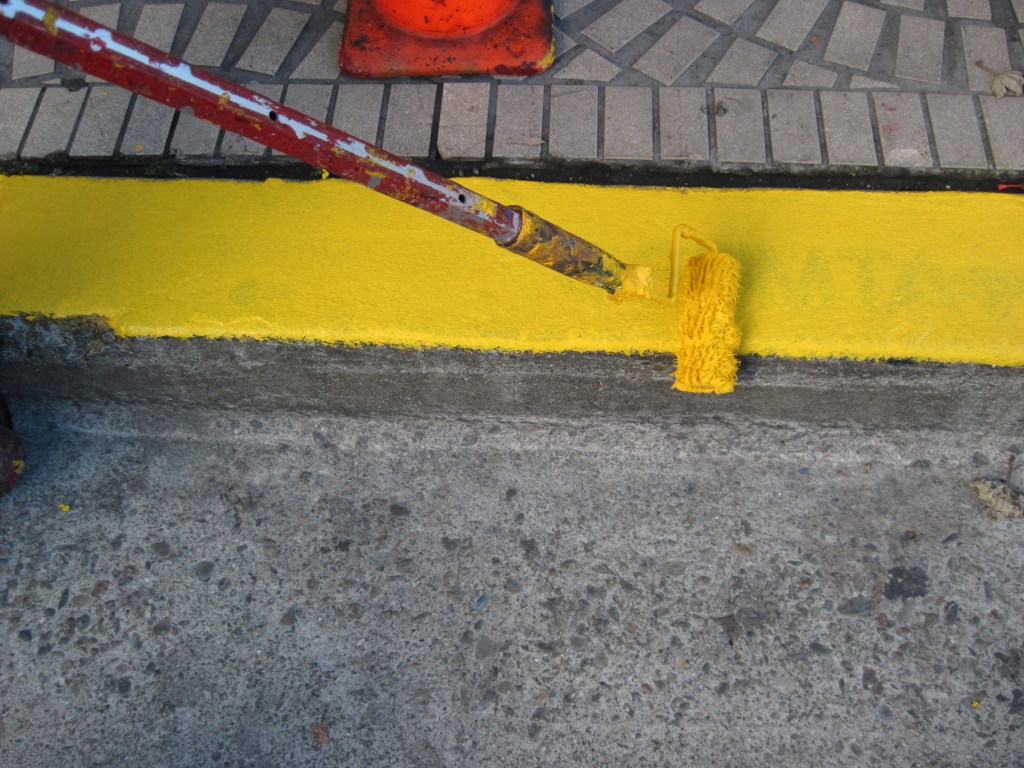
Behind the Yellow Line

: Behind the Yellow Line

“Please move back. I need you to step back behind the yellow line while the coach is in motion.” I state, when the coach is full: Or, if someone does not have their fare ready and they are looking in their pockets or hand bag for change, I say, “I can’t see my mirrors.” The fare box is in a place such that we cannot see our curbside mirrors when someone is standing by the fare box. 

I understand why you guys do this. You’re trying to lock your body in to the yellow hand rails so you can keep stable if the bus takes off from the curb. You are trying to pay and not hold up the bus, so I can go. Unfortunately, it is not a good idea to pull away from the curb without checking to see if there are runners coming up from the back, or if someone is smoking a cigarette or talking on a cell phone too close to the curb, and looking away from the bus. We have several blind spots from our seat, and this is one of them. Our rule is to not move until all fares are paid.

The good news is, some lines have enough time to follow this rule throughout the day.  The 2 CIement has time all day, as does the 21 Hayes. The 31 Balboa and 41 Union are usually OK, as is the 45 Union, but some lines such as the 3 Jackson and 24 Divisadero only have the time to wait for someone to move back and sit in the morning.

The 1 California does not, even in the wee hours of the morning, or late at night. This glaring inequity surfaces as running hot. We are told over and over by managers and from the training department, operators are running ahead of schedule on the 1 California. For the first time since I began, I heard this innocent question asked at a safety meeting, “Why are we running hot?” No one answered. 

I know why. It is because we don’t have the time to run on schedule and take recovery at the inbound, peak period terminal. If we wait too long to leave at Clay and Drumm on the 1, the standing load we will have in store for us begins at our first stop outbound at Davis and Sacramento. 

Because the other terminal inbound at Howard and Main was removed, all persons great and small must walk from Embarcadero BART and Market Street to Embarcadero Building 3 to pickup the 1, so there is no load share to split outbound. The yellow line comes into play as we climb to Nob Hill past Chinatown. The operator of the lead coach with extra headway must skillfully negotiate drop-offs and pass-ups to split the load with his or her follower so the yellow line remains clear.

I lost my conscious contact with experience in projecting my confident vibe while working overtime last Saturday, on the 1 line, and I lost control over keeping the yellow line clear at Grant Street. I was overwhelmed by the number of intending passengers, and did not pass up Kearny as I had no coach directly behind me. I forgot to wait and see if my follower would turn the corner behind me at Davis. Big mistake. 

Weekends have fewer coaches in service, and this makes pass-ups difficult. Keeping the front door closed is the only way to keep the front clear. If someone wants to get off, I need to find that out before I cross to the far side. I can kneel the bus and let them out nearside, so I don’t have to open the front door at the bus stop. This is scorned by those who direct us to follow the rules, but they are not facing the yellow line dilemma. They are sitting behind a desk and not a wheel. One can hope for a “caution and re-instruct” letter, and not time off. 

I can also wait to make sure everyone is sitting down before I roll. The new buses have a new twist because the stairs are located in the aisle behind the second or third doors, and it takes a few moments for passengers to make their way to the back seats. The timing is such that, as they reach the stairs, I am ready to pull away, and this can throw off their balance, especially because they are putting their wallet away, or taking off a bag to get ready to sit. I love the 21 Hayes because I have the time to wait.

Not all lines afford this luxury. The 1 California does not. We ‘walk the baby’ and slowly start to move as the passenger adjusts to find a seat; or in most cases, when the bus is full, to stand and find a hand hold. It is already obvious to us who the newbies are because they are not ready at the fare box. We are aware of the chronics who never have a clipper card, and always pay cash. 

When empty, near the terminal, the other problem is musical chairs”  in which a person cannot decide which seat to take. Use of the rear interior mirror is essential in keeping out of the Superintendent’s Office. Our regular riders are smooth and smart on how to pass by the yellow line and sit. On “weekends, when most new operators work—out-of-towners—and others new to riding—make up a higher percentage of riders, and we must be on the lookout for these wild cards, and stack the deck with a good hand, so we don’t loose the trick.

You can’t teach an old dog a new trick, but you can teach a new dog an old trick. I don’t believe Muni wants new operators to learn the old tricks this old dog has, but I have continually found I have lost or forgotten old tricks, and I am amazed at relearning the rules I never took in to account in the years that passed by.  Moving back has never been a problem for me on my coach, but moving forward has. Our new interior convex mirrors are great for a complete view of the rear. All hail the new Flyer trolleys!

Helter Skelter Shelter – Rear Door Boarding

My views are based upon my years of experience and may go contrary to my union’s view, based upon many operators with much experience. Union members are elected by the group of operators, and my chapter essays are only taking my personal view into account. My star-cast and life reading from the Cayce society point out I must find my own personal leadership style but must consider helping groups of others or find intimate mates to assist in love and service rather than be my own captain of the ship. 

A friend asks on Facebook, “What can be done about the homeless encampment that is a bus shelter stop at Leavenworth and Post?”  I hesitate to answer this question in the comment box in response to his post about Post. This is where it is a good place to state, “The views contained herein do not necessarily reflect the views or rules of the SFMTA or it’s employees.”

Indeed, these missives bound together in a book are all from self, with my exclusive point of view, usually done without running it through a coworker. I found out the hard way that editing with another pair of eyes, for example, is a necessary standard in helping an author I could not admit.

Rear door boarding is an issue many of my coworkers did not agree with, but I did. Rocking down the Mission, I was able to easily keep to the schedule and reduce dwell time in the zone by clicking open all doors. The largest complaint I get at the fare box is from riders who question what I am to do about checking the fare of those who do not pay by boarding in the rear. 

I was a strong advocate for rear door boarding and it seems management acceded to this request, to the behest of the union, and nowhere does this become more apparent than at a shelter stop where the shelter has become a shelter for homeless, street druggies, and drug dealers. To be sure, minimizing open rear door dwell time can prevent drama from those who do not pay. To me, the open door policy minimizes drama and confrontation, and speeds running time down the line. To others, if feels like loss of control and opening pandora’s box. This is a tough one to reconcile.

So when confronting the dilemma of unclean or blocked seats at a bus shelter, I must tread carefully, and seek wise counsel about what to do. Based on calls to TMC (Transit Metro Control) on the radio, when two or more calls come in to the radio operator, action is taken. 

So my solution to a dirty shelter encampment would be to have my friend get other neighbors in his building, or those he sees at the bus stop, to call 3-1-1 and put in a service request to clean the shelter. Another point would be to bring up health and safety. These are two golden words that make a difference. All shouting, pouting, and profanity on the phone lines to our call center are not as effective as saying in a detached voice and tone, “For health and safety.” 

We are continually reminded from inspectors on the street, and over the radio and in training mode that safety is our highest and first priority. This is the the golden rule I present to the riding public and reader of this tome. Use the golden rule to have and effect and affect change.

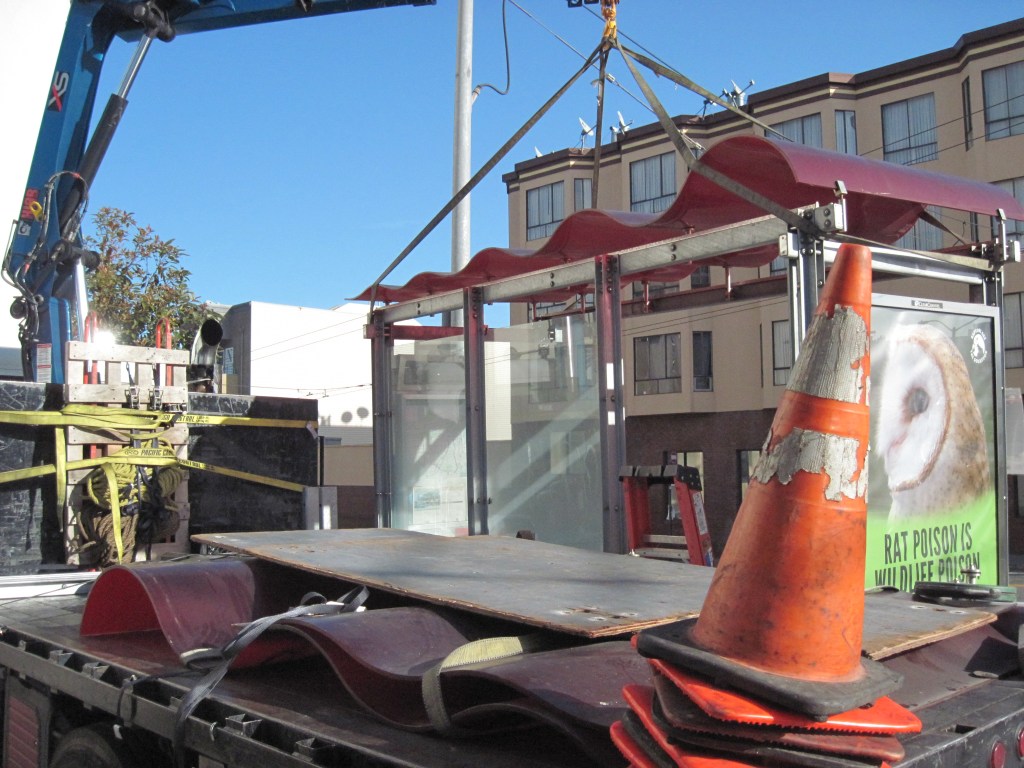
I came up with this chapter topic because I had some cool photos of some shelters being installed by our barn on Presidio Ave. Soon after I took photos of a brand new shelter, youth running from police in presumably a stolen car, took out that shelter. I got a picture of this newly installed shelter and it’s short lived life. 

Indeed, the road to happy destiny takes many rough turns. Bus mirrors hit the shelter, wheel chairs get caught between the poles, and crack heads crack all the glass all the time. The shards can be resold as ‘ice’ to unsuspecting ‘forty niners’ new to the city. 

Just like panning for gold, the instinctive street wary denizen can sell useless broken glass as a new wonder drug to the latest techie going down from a crystal meth or heroin binge fueled by the bounty of VC: in this era, not the Viet Cong, but venture capital. And so goes the boom and bust cycle of San Francisco. Like the helter skelter in the life of a bus shelter, it goes up and it comes down. 

Just like sitting at the dock of the bay watching the tide, the road to happy destiny does have it victories and defeats.

driverdoug, “Back Door!”

Twenty Questions

This is a fun game to play, as is Charades, in a large group at a party. But if that party is a waiting queue on Market Street on Fourth or Fifth, the game becomes no fun real fast as the lights go red again, and the buses back up behind the red lane in the middle of the street. I am currently in a dilemma about how to come to the end of the game fast enough to get the party moving!

The quickest solution, as any experienced improvisation comedian will attest, is to agree with anything! The secret to improv is to agree with your antagonist in the audience or on stage, to keep the train moving, usually with hilarious inventive add ons. The same could be said with giving directions in a crowd of visitors. 

“Do you go to the Piers?” Yes. 

“Do you go the Wharf?” Yes. 

“Do you go to the Bay?” Yes.

 “Do you go to Market?” Yes. 

Should not that be the end of it? Unfortunately, no. More questions to follow. So here is where I have to get the flock moving. Hmm. We know from Animal Planet and the Discovery Channel that huge numbers of birds take flight when a threat is perceived. 

That’s it! I need to give them a threat to get them moving! But I need to stay calm and friendly.

Get them moving–calm and friendly!


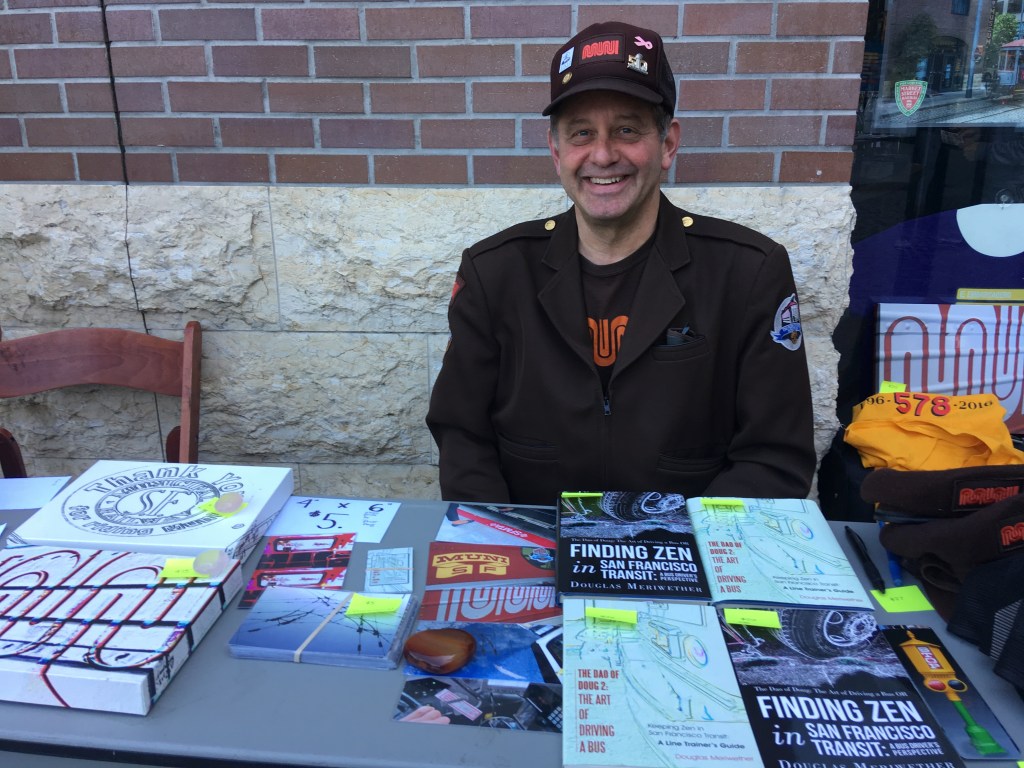
https://www.amazon.com/s?k=douglas+meriwether+dao+of+doug&crid=1HXF5Y38G2L9R&sprefix=douglas+meriwether+dao+of+doug%2Caps%2C171&ref=nb_sb_noss

Flu Shot

It is understandable in this busy bustling city why we forget to do certain things we need to get done for our own well being. Some years I miss getting my free flu shot at The Permanente Medical Group because I never slow down enough to review my day or prioritize deadlines. The good news is that anyone riding Muni on a daily basis may need not get a flu shot. Riding the bus qualifies! 

There are enough fluids in the aisle and on the seats to qualify for any quarantine protocols.  Airborne cough particles, or the degassing of body odor, cigarette smoke, methadone leaching, and any number of party and play inhalants greet our nose upon entry. And the age old angst against all prayer is: Why do you have to sit directly behind the cockpit? “Please move back.” “I am handicapped.”

So the one drawback a disciplinary video playback can never show is the olfactory component! A blessed homeless woman gave me her secret tonic to kill all smells. It was in a cologne bottle but it wasn’t glass. It was a non-breakable Muni-proofed rounded plexiglass container with a killer spray nozzle. One spray, when aimed correctly at the seat behind the cockpit could buy insurance for at least two trips down Mission Street! 

I was doing the 22 Fillmore with triple headway on a regular basis when the stinker of all stinkers got on at Eddy headed towards the Marina and Pacific Heights. No way was I going to put up with this smell all the way through sweet upper class  Grandmas and seniors going to Jackson or Union. I started to pray. There were two very well dressed executive types who also boarded at Eddy at the same time this awful smelling guy got on. This is when my overthinking head really gives me serious emotional pain. I have so much invested on what you think of me and how I look while doing my job. My fear of telling off the stinker and how to get rid of him, versus doing nothing ignoring the smell, as if I didn’t care for the welfare of riders new to mass transit, had me in that rock and hard place not unlike Alcatraz Island.

The prayers worked. At Geary, I saw in my rearview courtesy mirror a stirring in his seat behind me that signaled he was getting off! Whew! But my hours of being on edge with extra headway finally exploded. I got up out of my seat as he started down the stairs. Oh I think you forgot something. I took out my secret weapon and sprayed the back of his coat as he went out the door. Thank God he’s gone!

This was one time the video playback worked in my favor. My superintendent and those in the office at the time laughed so hard at what they saw that I didn’t get in trouble. The nice looking executive types had called in on me to complain. I could never figure out how they were unaware of his smell, but my boss couldn’t bring herself to write me up over this incident.  

I avoided a “Passenger Service Review” simply by the humor of having another operator as a boss, and not someone unfamiliar with what we go through. She got it. Unfortunately, she got promoted and I had to start all over with a new boss. This starting over is actually one of the most difficult aspects of discipline with Muni. Having to prove myself to someone new almost negates all the stink of past passengers!

It’s an old Scottish saying, What doesn’t kill you makes you stronger. The same could be said of riding the bus in San Francisco!

Past Half Way

Passengers using the rear door button to board in the rear must remember all coaches are not equal. Some buses require that you hold the button until the doors are opened at least half way. On other buses, the doors will slam shut and the chance to board may end right there.

The three-tap rule, or the three-second rule, generally means that the door will stay open long enough for you to climb the steps and tag in.

If you are standing alone in a Tenderloin bus shelter, come to the front door, especially if we stop and open it where you are standing. Wearing ear buds, or not seeing double-parked cars or construction barriers, may mean you will be passed up if you do not board at the front door. 

Yes, back door boarding is allowed, but you have to understand we don’t want tailgaters with soiled clothing and bad body odor, talking to themselves, to enter behind you. You may find the green light is not on to push and board rear. This is a security issue! Please be aware of who is in the immediate area! 

https://fineartamerica.com/featured/2230-mack-drink-pepsi-douglas-griggs.html

Why Be A Driver?

If you want to hire a business major, you can get one for $50,000 a year easy because there are thousands of them. If you want a skilled truck driver or city bus driver, you better start asking at $150,000 per annum. Why? Because no one wants to do it!

Many ask this question, and we driver’s know who you are. Someone who has never driven for a living before. There are many negatives to being a driver, but not usually what you may think if all you’ve ever known is an office. In almost all respects, an office job is a superior job, unless you are like most drivers, and don’t work well with office politics. Indeed, the life of a driver does involve politics to some degree, but only in a larger sense like city government’s rules and regulations such as parking tickets or moving violations. If you work for the government, as a civil service employee, then the politics of parking and fee violation threat are somewhat reduced, as you are driving city property on city streets, and the police are your coworkers.

No, the life of a driver is one more like that of a writer: interest in the people who cross your path. Tour bus driver guide, shuttle driver, taxi driver, and even in delivery services, we get in get out, and have command of our own ship, so to speak.

We learn the art of understanding dispatchers and how to get a signature. We know what paths not to take during certain times, and secrets about how to cut delays. We have a many times thankless job, but we still have our own independence and ability to keep to ourselves when all is quiet.

There is no age limit on being a driver. Very few companies discriminate against us because they need us more than we need them. There are so many avenues of approach for a job, that our warm body behind the seat is very valuable. I see this every time I learn a new short cut from an experienced driver who can get me to a destination five minutes faster and three dollars cheaper by the road less traveled. That’s what makes San Francisco so intriguing. There are so many ways to get from A to B.

I could not understand why many experienced bus drivers were getting the cold shoulder or disinterest in seeking other jobs with the city. It’s because Human Resources knows we are of most value to the city by keeping our job. A job title or job class number may seem higher or like a promotion, but the fact of the matter is, our experience is our gold. Not being fazed by the crazies, or knowing how or when to write a report becomes a key that can’t be entered into an hourly rate. We drivers are a class unto ourselves. Only those who have driven a bus before us understand the how and why of our thinking, and have compassion for our split second decision-making that can appear incorrect from the black and white on a desk.

As long as our vision is clear and our hearing is good, we are good to go. With blood sugar and blood pressure in a normal range, we can continue in service as long as we shall live, so help us God.  We can stay behind the wheel for as long as we shall live. And, of course, stay within the health guidelines setup to make sure we don’t lose attention by low blood sugar, lack of rest, or have cholesterol levels in an unhealthy range. Stress on our bodies over the years, then, is our final enemy. 

And when I (finally) see I am this enemy of my worst self, lest I think I have a new trick to try to keep and love as my own, the trolleybus of happy (or crappy) destiny awaits us at any corner and on any track!

One Armed Bandit

I picked up my papers for my second part and the superintendent, who was by the second desk, commented on my holding a cup of coffee in my right hand and, paddle in the left. He suggested that I not bring personal items into the dispatcher’s office while doing business.

I smiled, as I remembered what I was told that morning by a crewman in the tower. An operator got into trouble by holding a cup of coffee in one hand while using his other hand on the wheel, turning a corner. I have seen enough training videos to know that whenever I am turning or coming to an area of conflict, I must keep both hands on the steering wheel at the ten o’clock and two o’clock positions. 

A few days earlier, acting as if I was being watched, I put my coffee cup down right before a left turn, because I knew the rideshare shuttle might pull-away right as I was turning past him. Sure enough, the vehicle pulled out right in front of me and would have run into me if I had not anticipated his inability to see me from his left mirror. Wow, This is not a safe situation, I thought.

An accident occurred soon after by someone else; the superintendent was in counsel mode with me in the dispatch office, because he knew I was in violation, even though I didn’t get into an accident, and put my cup down before potential conflict. My intuition sensed they were watching me when this near miss occurred. This knowing happens often, and I wonder if I should put in a miscellaneous form for our safety meeting; if I can have any affect on our safety record.

If the drive camera is activated by contact or an abrupt stop, actions before and and after an event are recorded. I must keep returning to good posture and hand placement on the wheel so as to demonstrate awareness in the event a ‘what if’ situation becomes a reality. It is this demand of continually scanning left-right-left, anticipating conflict, that seems not understood by  planners or schedule makers.  We operators need a mental break every hour, but some lines on some schedules don’t allow us this time if we are to remain on schedule.

Headway was extended to twelve minutes on the 22 line four years ago, and I some how managed to stay out of trouble by only registering one minor passenger complaint about moving too soon before allowing a senior to sit. 

Twelve minutes was double the headway between buses and my leader and leader’s leader wasn’t having it. They, the drivers of the two buses in front of me,  would go out of service on a regular basis such that my effective headway time was tripled to thirty-six minutes. This went on for over eight months. At no time did I do the “one armed bandit.” 

One blessing occurred in the middle of this sign-up. A sweet grandma, somewhat confused, decided to stand up between two stops, and fell. She could not decide if she wanted medical attention. After calling the inspector and waiting for her decision to call for an ambulance to be taken to the hospital, I got the break I needed. My follower pulled around me and I was relieved from having to make thirty-six minute headway on a school trip to the marina. 

The cameras showed I was driving in a safe manner and was not making any sudden or abrupt turns. I was safe from discipline. Both of my hands were on the wheel, and I made a safe turn into the terminal. These kinds of “almost accidents” can plague our thought process and fears about our driving record or disciplinary action.

During my next classroom-verified transit training, I smiled when I heard an instructor make a remark I will always treasure whenever I am unsure about what penalty may come my way from an injured or angry motorist or passenger. 

He said, “The real truth about our skill level and experience comes not from what is recorded as an accident, but from all the accidents we avoid and prevent.  We, as operators, do far more in saving the company from damages and expense than in what we cause.” This was the most incredible compliment I could ever receive from the training department, and put me at such ease. Here was someone who knew what we go through.

Keeping both hands on the wheel and keeping an alert posture is the best defense against a fall on board. The jackpot from a one-armed bandit shall not come in the form of a lawsuit payout to a passenger. It comes invisibly as in keeping my job to retirement!

https://fineartamerica.com/featured/2010-muni-fast-passes-douglas-griggs.html?product=tote-bag

WOW Lenora Street in Belltown District

The Romanized version of Tao can be spelled Dao. I did this to be alliterative to my name as Driver Doug. Below is a link to my artist writer YouTube channel now updated from the Dao of Doug and rail transit blog to Walks on Waikiki –videos about walking, transit, and bikes.

Seattle looking good. I was reminded of San Francisco in the mid-2000’s: tech employees wearing name badges carrying around trays of lunch from food trucks.

Check out my latest walk in Belltown Seattle.

Back to the future from SF to SEA