Special Events

Finding the Zen zone during special events can be a challenge. Such as doing the 21 Line by Golden Gate Park on the weekend of a major concert or running event that ends or lets out near the Polo Fields in the park.

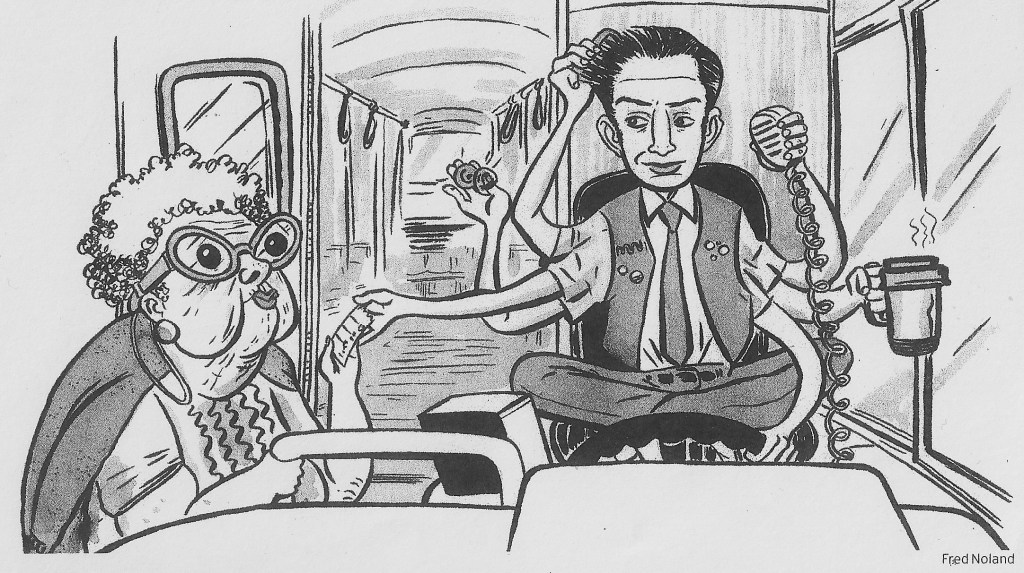
I had made a wise choice to work the 21 line on weekends in the summer because I vowed never again to do the number 5 on summer weekends, ever. And so while I was waiting to leave my terminal by the park, I saw a number 5 packed with people pull up beside me. The operator was hollering she was not going to Market, and to get on my bus. Truth was, she was going to Market, just not to Powell Station. All the concertgoers could just as easily walked to Civic Center station or to Powell from her short terminal at Jones and Mc Allister, but she wasn’t having it. No one was listening and no one was getting off her bus. She was experiencing that part of Packed Stacked and Racked where no one moves or listens because, they were lucky enough to get on a bus and be damned if they got off their lucky ticket to ride.

Feeling her pain, and not upset about taking on her passengers, I got out of my bus to coax some of those on her bus to get on mine which was traveling in the same direction to Market Street. But no one was biting. I had a completely empty bus but no one would get off. Here is where past experience about being passed up by full buses, puts lead in the feet of all passengers, and no amount of verbal instruction helps. These folks were able to “cheat death” and fit on to her bus, beating out who knows how many unlucky souls. And they would be damned if they were going to be suckered off of a coach they had so victoriously boarded. No, in this case, no one was falling for it. They knew they were going downtown, and that was the end of it!

I tried to get the operator to change her statement about going to Market, or to relax about her announcement, but the only thing that would have had let people off her coach would be to go out of service. In hindsight, this is what I should have proposed to her by her drivers’ side window. “Oh, look your air is low and you can’t legally proceed. Ask everyone to board my coach.” That would have given her breathing room to start picking up with an empty bus, and I could have continued with my shorter distance, full, but not in an agitated state of mind. I have always sought to give a break to an operator who is overwhelmed because I know there are times when I am in that predicament, and nothing good comes from it. Learning how to give and gain the respect of my coworkers is perhaps the most and last challenging aspect of staying in the Zen of driving transit in San Francisco.

On Your Marks. . .

Splash Page at my daoofdoug website.

The first thing to do when a fight looks ready, is to open the rear doors and pop the brake. The sound of the brake let’s everyone know we aren’t moving. The rear door open gives an out to one of the people in the argument. Since impatience is usually the prevailing mood, one of the party leaves. If they don’t, I can ask one of the folks to come up to sit by me. Or state there is another coach in a few minutes, and you might find this to be a more comfortable ride.

All in all, I have to check my mental state and ask myself am I being of service to those in the coach, or do I have an agenda based on some sort of fear about what I think may or may not happen. But a word of advice: Don’t feed the pigeons. That is, don’t feed into a senseless argument. Do not respond to the Borg. Resistance is futile.

As time has given me insight, I do have an intuition about how far people are traveling on the coach. I can spot the problem child before they board. And I can guess where they will most likely get off. Their destination on the Mission is: 16th Street. A rush to the door usually results when they see their dealer on a nearby street. “Is this an emergency?” I ask. When they shout, “Yes!” I can use the rules to my advantage, and get rid of them, being careful there is no threat of an oncoming skater or cyclist. This impatience energy is one full of mishap and accident. By asking them to come to the front door, I interrupt that energy and make it safer. But only if getting them off the coach will improve the mood of the coach of everyone else riding. It is when the request for a back door is out of synch with the lights and the traffic, that I move the coach forward, a little bit, to bring the doors to a safe place while signaling to traffic behind me I am not moving away.

Usually people get loudest before they depart. If they are arguing when they get on, I have to let it settle right then and there, or avoid them getting on in the first place. I have learned when the music or the voices get the loudest it is either a cry for help, or a deep need to be heard. Or a revolutionary protest and rage against the machine, in this case, the Municipal Railway, for which gratitude has been lost. We now return you to The Art of Driving a Bus, already in progress!

The White Lie

https://fineartamerica.com/profiles/douglas-griggs/collections/usual+excuses

Because San Francisco is such a small, compact city with water on three sides, our crosstown bus routes intersect with every line that goes downtown inbound, or out to a beach on the ocean or by the bay in the opposite direction. Since we also have a large visitor population, we get asked about directions at the front door when we pull up to a stop. In order to maintain a relaxed Zen-like posture and relaxed state of mind, I have finally learned what the visitors are really asking, based upon what stop they are standing at, and that the white lie saves time and confusion even though what I am saying to them is not literally true.

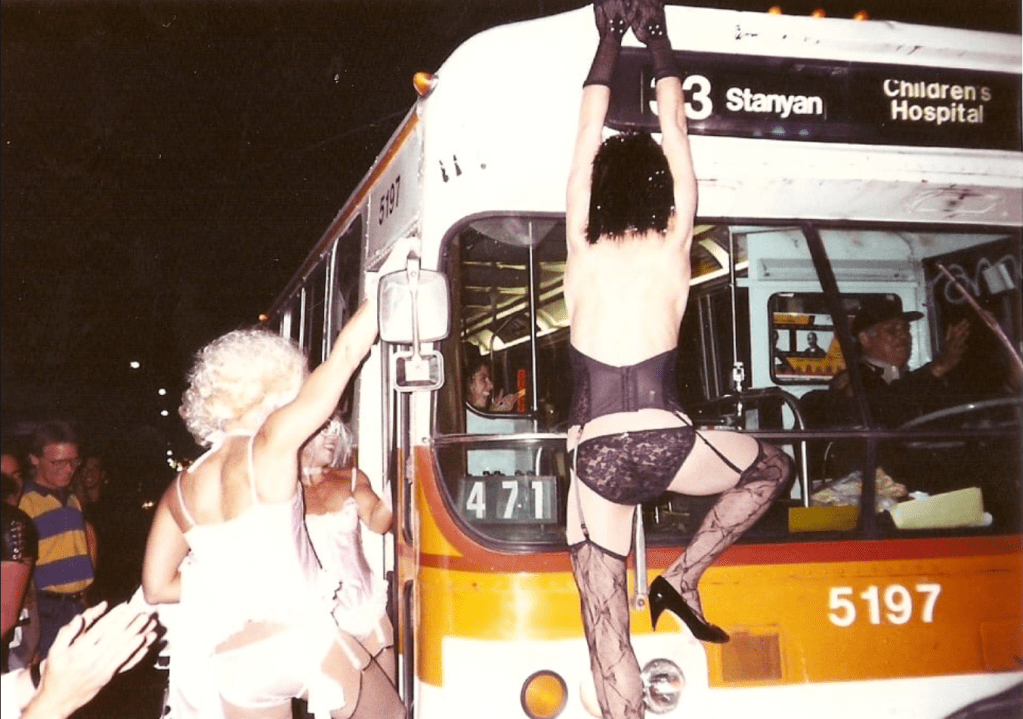
On the crosstown 33 Stanyan, I head inbound on Haight Street for four blocks before I turn-off on Ashbury to go over the Twin Peaks, Clarendon hill, on my way to the Castro, the Mission, and Potrero, which are all non-downtown neighborhoods. But my direction is outbound, even though I am heading inbound on Haight. The question asked continuously by at least one party of visitors, on Stanyan and Clayton at Haight is, “Do you go to Market Street?” The honest answer is yes. The helpful, not literally true answer is no. After coming down the Clarendon hill, the 33 turns on to Market at it’s uppermost point when it becomes renamed as Portola, at what I like to call Dead Man’s Curve. We turn almost 180 degrees on a hairpin turn with a vista of downtown and the East Bay. It is a dramatic turn with a very scenic twist. But there are no major destinations or points of interest at this hairpin turn, save for the lovely view.

No worries

We then travel down upper Market for about two blocks, and then head for Castro village, which does place us one block from the Market and Castro underground line (Castro Station). Boarding underground connects easily to all downtown areas and eventually to BART. So if they don’t appear rushed, and are in sightseeing mode, I say yes, to take them to the hairpin vista. If it is p.m. rush and they have shopping bags, I say no. “Do you go to Market?” really means, “Do you go downtown?” They aren’t specifying where on Market they want to go. After asking time and time again where on Market they want to go, I have come to the conclusion they mean somewhere along 4th or 5th and Market, and Powell Station.

So I have learned to say no, and ask them to wait for the 7R. Or walk down to Masonic for the 6, especially if a 7R has just passed. If I am without a leader, and I am running heavy and late, I always say no. This is how we can control our load when carrying passengers who would normally have boarded the coach in front of me.

Same is true on Potrero Blvd., which is like the old business loop highway that was the main road before the freeway was built. People ask along the thoroughfare if I go to Market. Once again, after much experience, I have found the simplest way to move along is to say no. Wait for the number 9. Which really means I don’t go downtown to the Union Square area. The 33 does go to Market and 18th Street, but this is not downtown: it is a residential area miles from downtown. So yes, I do go to Market, but not downtown.

So I find myself having learned what people need by their questions, to answer no, and save time by not going through other questions that add to a delay. Experience with the time of day, how they are dressed, and the regularity of the same question over and over, keeps me talking less, and in a mode to help those who have a destination along my crosstown route. I default to the nearest stop when they ask the open question of a specific business, such as the golden arches. I pass-by two golden arches, three Safeway grocery stores, and three hospitals. I can answer yes, and call out the first one I pass-by.

Usually, most people recognize where they are when they get to the stop they need. Describing the landmarks is usually unnecessary. I don’t need to use sarcastic humor, because it can backfire and lead to a bad experience. I learned early on there will never be an end to the same questions being asked over and over, so conserving my response is the easiest way to staying in the Zen zone.

The Black Hole

The  seat  opposite  “shotgun,”  behind  the  operator’s  seat,  is unofficially called, “the black hole.” Folks who sit here become invisible. They cannot see to the front of the bus because their view is blocked. And there is no pull string to activate the chime or stop request. Acoustics are very poor because of the wall behind our driver’s seat, and if the blowers are on, it is next to impossible to hear them speak.

There is a large distance in most coaches past the first two hand holds or poles that connect from the ceiling to the seat. If the first four seats on either side are full, especially with passengers with bags, or a walker, a baby, or odd carry-on, it is time to make sure the interior mirror is set to view the no man’s land.

Add to this the various nationalities and accents from the melting pot which is San Francisco, and you have a perfect recipe for failure in passing up their request. So, when I have a working mirror which I can point to the black hole, all the better. I can also turn off the blower, or wait until I am stopped to ask them again where they are going, or what stop they need. I have found out the hard way that it is what I can do to fill their need, rather than go in to twenty questions about what I do. This was the solution to fill the black hole.

We’ve also added a roll bar of sorts to the flip up seats mid coach, so we now have a handhold for those sitting in the flip-up seats by the rear door. This is a godsend for those with groceries and carrying bags. Our new coaches even have a leg rest for someone in a leg brace or on crutches!

And so goes the Muniverse! And staying in the Zen!

Visit: http://www.daoofdoug.com for more about the Muniverse!

Daily Writing Prompt – Who is Driver Doug?

Daily writing prompt
How would you describe yourself to someone?

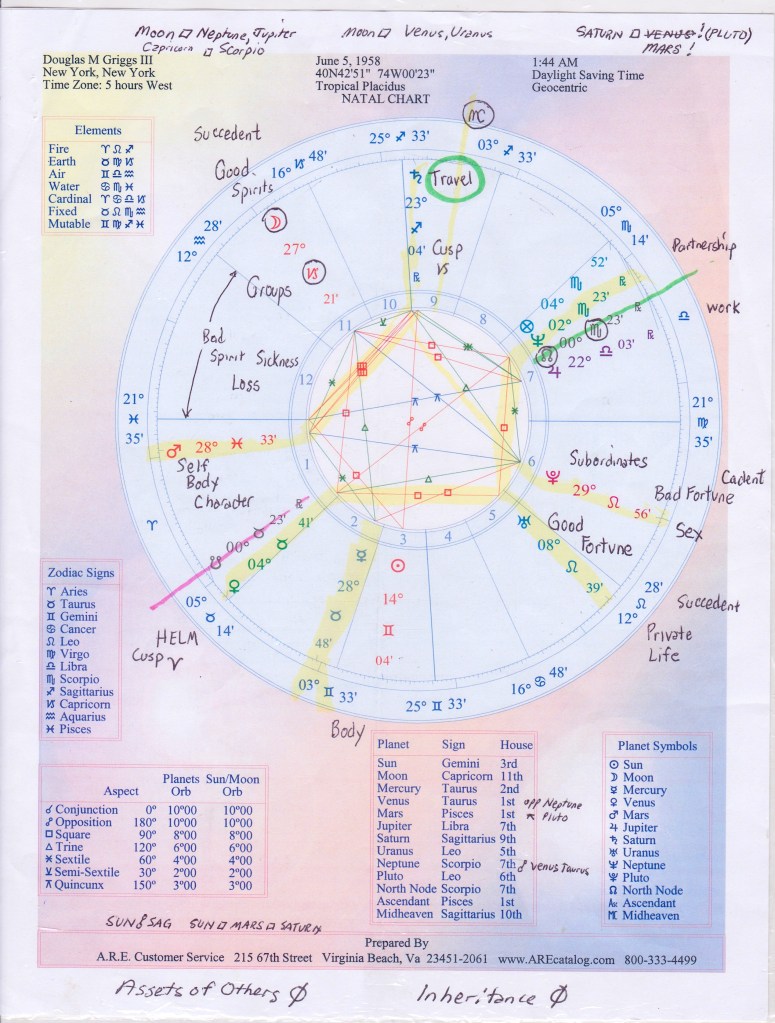
I’m serious about work and my coworker relationships, and the bounty has flowed as an abundance that has served me well–although I have bad fortune with subordinates and with my private life sexual excursions.

Glib, quick-witted and able to read a group and others when I am still and quiet–is a rarity in and of itself, and rarely lasts very long–as I am on to the next topic and issue and relationship.

My biggest anger-maker is when someone withholds information. Lies I can deal with. People get mad at me because they think I am a flippant waffler, but this is far from who I really am. As a Gemini Sun, with my ruler Mercury in Gemini, I see both sides, and can’t understand why people get so angry when their beliefs or way of doing things are challenged. I would make a good ambassador and negotiator, though I rarely get the chance because people don’t take me seriously. I do have a perfected side-out rotate method of attack which catches an enemy off guard, when I go in for the kill–to teach a lesson that won’t be forgotten. Everyone is usually too impatient with their agendas to hear what a long term solution could be that works out best for everyone–because they are too focused on the short term.

Indeed, I have a long-sighted horizon. This is usually at odds with what looks like a quick fix. If you want what you want, you have to be willing to completely change everything at the autonomic reactionary level of first blush. And far be it from me to tell you. What goes around comes around does seem to be the long term healer of heels.

Anyway, I do love lithe lean artists and writers, dancers and doers, bakers and candlestick makers. Upper management and office politics bore me. I like being in the trenches. Or in the kitchen or on the line.

Lest I seem too much like Brainiac*

Silver Age DC Comics

*The first Brainiac/Kandor comic book story in Action Comics #242 (July 1958) was based on a story arc in the Superman comic strip from April through August 1958. In the comic strip story, Superman’s foe was named Romado, who traveled the cosmos with a white alien monkey named Koko, shrinking major cities and keeping them in glass jars. The strip’s Kryptonian bottled city was named Dur-El-Va.[4] This cross-continuity conflict was not unprecedented; in 1958 and ’59, editor Mort Weisinger used the comic strip to prototype a number of concepts that he planned to introduce in the book, including Bizarro and red Kryptonite.[5]

Brainiac is a bald, green-skinned humanoid who arrives on Earth and shrinks various cities, including Metropolis, storing them in bottles with the intent of using them to restore the then-unnamed planet he ruled.[6] He was originally notable only for having shrunk the bottle city of Kandor with his shrinking ray and for using a force field.[7] In his initial story, he also traveled with a white alien monkey named Koko; the monkey also appears in a 1960 Superman story retelling the story of Kandor’s disappearance (Superman #141 (November 1960)). Koko was quickly dropped from Brainiac’s stories, but a version of the monkey has made sporadic appearances as the villain’s pet in the series Justice and the 2008 storyline “Brainiac” in Action Comics. The villain’s descendant Brainiac 5 also had a pet named Koko for several stories in the 1990s.

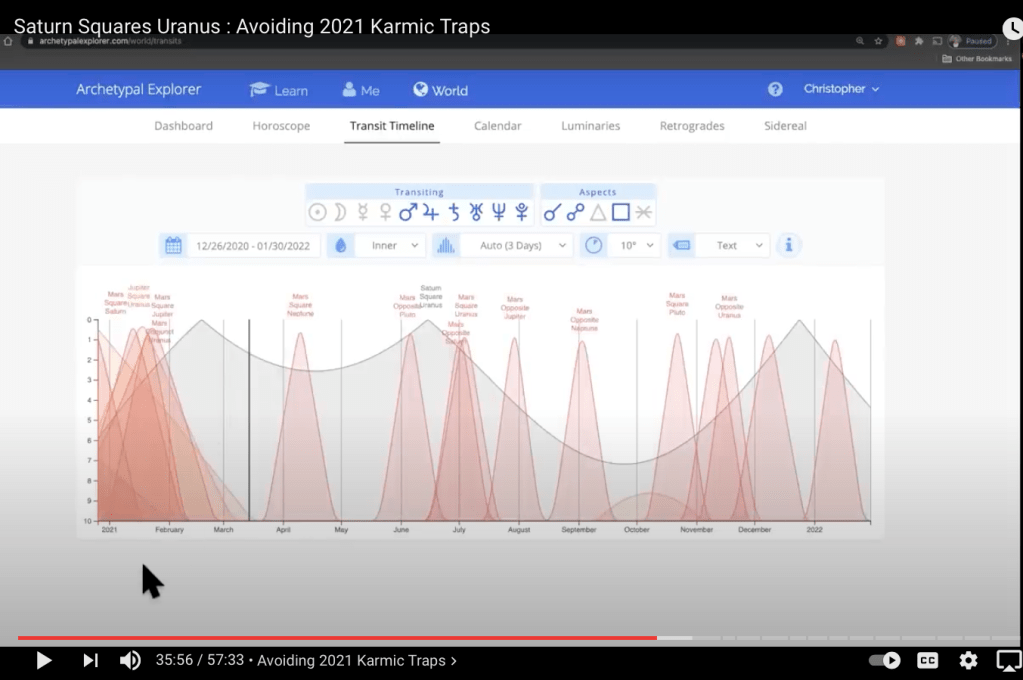
Archetypal Explorer is an incredible view of planetary effects by graphic depiction

Christopher Witecki

Note Brainiac’s debut occurred just as I was born in New York City in June of 1958. I was three weeks early.

Let me assure you–I fail and I fail monumentally. My favorite theme song is Tom Petty’s “Free Falling.” –and it ain’t a rising meteor or shooting star!

From the Training Vault 2

Best of the Dao of Doug Training Vault

Knowledge is Power and Income

The Late Ring

Nothing can get a passenger angrier than passing up a stop. I can tell a lot about their day by how they respond when I pass-by where they wanted to get off. Intuition does come in to play when I am in the beat of the flow, and I know to stop and open the doors even if their was no ring or verbal request. We transit operators joke we don’t have eyes in the back of our head or possess supernatural powers to mind read the desires of our passengers. But actually, we do have these extraordinary skills or abilities. With the experience that comes from years of driving the various lines and routes, at all different times of day and night, we do kick-in to an automatic pilot mode that remembers where and when to stop, and how many people will be getting off and on, but we never let on to this because ignorance, although not an excuse during a disciplinary hearing, is bliss. Contrary to the blissful ignorance we master through the years, is the expectation of need from our riders, without any verbal communication at all. This is the Zen of driving a bus.

As soon as we see something out of the ordinary, we immediately file it away in our head as a possible yellow flag. This ability to flag an abnormality to our flow, such as a distracted passenger, or the time it takes for someone to sit down, and where they sit when they first board, is a way in which we prepare for a possible mind read situation when the person is ready to get off.

And if the boarding passenger goes in to the black hole, the seat behind us, where we cannot see or hear them, the risk of a pass-up or late ring goes way up. If they are in a large party and are talking among themselves, particularly tourists, then the late ring pass-up increases dramatically. How a person passes us by at the fare box is a key to understanding the drama of how they leave the coach. No eye contact or acknowledgement of our existence increases the intensity of anger they may express when they attempt to leave. No courtesy or recognition of us doing our job, and fare evasion, go hand in hand with nasty name calling at the end of this boarding event. The attention to detail when a person boards is the secret to having the magic of mind reading or eyes in the back of our head.

Some operators never use the interior center or aisle mirror located in front of us above the windscreen, but by scanning this mirror as we are directed to scan left-right-left on our exterior mirrors, passenger problems can go to near zero. Also the small mirror in the corner by the front door is perfect for aiming at the black hole. Thus I can see everyone in the seats toward the back door, and the two seats directly behind the cockpit, should someone shift their body position in anticipation of the stop. And can I get the heads up if someone is falling asleep, or inattentive to where the bus is headed. By standing up and letting a would be sleeper know this is their stop, helps prevent a lost cause at my next terminal or pull-in. If a chime cord is not working, or the dash light indicating a stop request is not lighting up, the mirrors come to the rescue of what can be a Zen breaker, usually resulting in name calling and verbal abuse.

But the danger I have in appearing unconcerned with someone who wants to get off, is that I get so complacent in knowing the rhythm of my day, I don’t allow for differences in my passenger requests. If I have passed up a baby stop at a certain time week after week, my automatic pilot fails me if I haven’t been scanning my rear interior mirror. And hence my Zen is broken by an angry stop request. “Back door!” is a friendly reminder of my remiss, but nasty name calling has me usually proceeding to the next stop. And the anger with which someone directs to me, the longer the next stop may be. I have to fight the demons of resentment within me to stop when someone is very angry. Anger doesn’t usually work with me. I like to strike back with indifference to meet their expectation. Hey, if I am a blind idiot or a moron, than it fits I continue on to the next stop, as any faithful moron would! But if that God-given break in parked cars is available, I stop when safe to do so. It is when there is no place to safely stop that drama crescendos in a late ring. But I do recover from such name calling a lot faster now then when I was new.

And if the late ring is from someone who needs the curb, I do feel bad when I can’t find a safe spot a short distance from the regular bus stop. Even though other passengers may come to my rescue by agreeing there was no ring, it has little comfort to the angry passenger. All I can do is file the incident away as another awareness point as a problem time and place, and recall where the offending passenger boarded, so as to prevent the late ring from happening again in the future. By stopping next time around at the same stop even though I have no request, I find this helps to make the problem go away. Interestingly, someone from the back will come forward to the front door and request the next stop. This is a nice check from the universe this problem has been put to bed because I have not resisted the late ring. I have to be willing to make the stop. And when I am, all is well and the Zen of driving a bus returns.

https://www.amazon.com/s?k=dao+of+doug&crid=3MMEJF4JRUFHY&sprefix=dao+of+doug%2Caps%2C219&ref=nb_sb_noss

A Bus Driver’s Perspective on the 22 line at Valencia

Secure the Coach

Part of testing a new operator in being qualified by a state inspector is coach securement. As this book is written by a trolley operator, the added requirement of coach securement is in cradling the poles by the hooks near the harp at the back of the coach. Many a day goes by where a coach is taken out of service on the line and the operator fails to secure the coach in a timely fashion. Of course, there could be a lot of argument about what qualifies as timely fashion, but the bottom line is no coach can stay on the wires from behind an unsecured trolley with its poles still on the overhead wires.

Hell No!

When my leader goes out of service with a full coach on my time, I am glad I remember the one block spacing rule and not get too close. I can drop my poles and go around: Nothing worse than double headway and a full load. Hell no! I am not going to continue for the rest of the trip with angry intending passengers waiting at the curb and have a full bus with no room. Hell no! means I can pass by the coach and continue on to the next stop without missing a beat. My follower can take all of his people, and I can pick up all of my leader’s people still waiting at the next bus stops. This causes minimal disruption to the line and keeps buses spaced properly.

This is against the rules which state pass ups are only after an unusual delay and another bus with the same destination is one block behind. I will roll past an out of service bus as an unusual delay, and pass up those passengers so I don’t drag down the line and make the gap even bigger. This is a violation of the letter of the law, but the letters don’t account for the emotional tension that comes on board a few stops later when I am full and cannot pick up. I choose the path of least resistance.

Show how it’s done.

When there is no bus behind me I have an obligation to pick up those stranded by the bus that went out of service. It is these times I get my swerve on and take care of business. As long as I have no one in front of me, I have a clear shot to move up and put an end to the dragging coach. As I don’t work with my hands like a construction worker, it is harder to get a sense of satisfaction in seeing a finished project. The day is a great one if I can get to a terminal before my leaving time: Just a ‘thank you’ as the last person departs! Just the hope of a thank you from the last passenger getting off at the end of the line. “Step down here for a great walk along the waterfront of Aquatic Park and check out the swimmers in the bay. Alcatraz views are plenty so make sure your camera is handy. Ghirardelli hot fudge sundaes are also only two blocks away!” These statements of gratitude are the only ‘things’ I get to ‘make.’

If and when we get help and the shop or an inspector on the scene, there actually is a friendly pat on the back!. The shop or inspector taps our rear below the last window to let us know our poles are placed back on the wires and we are clear to use the power pedal and continue on our way on the wires. “Nice day.”

https://www.amazon.com/s?k=dao+of+doug&crid=3MMEJF4JRUFHY&sprefix=dao+of+doug%2Caps%2C219&ref=nb_sb_noss

Pulling Poles

When a coach becomes disabled after an accident or a security incident, if the operator is occupied with the police or an inspector, it is important they are not blocking traffic or other trolleys coming up from behind.

It is embarrassing to me when a transit bus appears to be the problem in causing a traffic delay. Practicing defensive driving, if practiced on a daily basis, almost down to the minute-to-minute decision making choices we make on the road, can make the difference between smooth flowing traffic and gridlock.

The experience from the inspector called to a post-accident scene also provides valuable lessons about how to keep my side of the street clear. Since inspectors meet with operators time and time again, post accident, their directness about getting to point quickly is an art I have always admired. And when their report matches my description, I know I have taken a valuable lesson with me.

If I am coming up from behind, I have learned being of service not only means keeping my passengers informed, but I can pop the brake and help another operator who is blocked or out of service. But pulling poles is an opportunity to respect boundaries and to check-in with the other operator to find out if they need my help.

And I see this principle in many situations. If a senior appears to be having difficulty in getting up the steps, it is also important to ask them first if they need help. Sometimes, no help is desired, and by touching them without permission, bad feelings result. I want to be left alone, or I do not need any help because I am able, are two big reasons why seniors don’t desire assistance, and it is hard to know this simply by looking at their climb up the steps. Most times, though, if I see a heavy load, all my angst melts away when I offer to help. And so it is also true if another bus is blocking with the poles up on the wires and not moving, I must first ask, “Do they need my help?” The next question, which is usually my first question when I am in the swerve, is where the hell are they? If the operator has gone to the store, or gone the bathroom, then I can pull their poles and go around without having to drop mine. The time cuts on the 49, when severe, make for a tight terminal situation, and getting around can sometimes be a drag. If I arrive on my leaving time, and I desire another nice trip without overcrowding, I can zip by my leader and go. But my attitude really checks what kind of day I have when it comes to pulling poles.

Some operators, using the rear view mirrors as directed, see me coming and drop their poles by using the poles down button, or coming to the rear of their coach and cradling them. Others expect to not be bothered, and if I want to avoid stink eye and a nasty vibe, it is up to me to get around, even if I don’t have a poles down button. If at a terminal with more than one track, such as North Point, I scan across the way to see if the operator is present in the coach. If not, I can stay on the left track and bypass without any hassle. This is the one saving grace at terminals with two sets of wires (the 22 Fillmore and 24 Divisadero at Third Street could use this extra set of wires) But throw in tourists in rental cars holding the famous freebee Fisherman’s Wharf map, and a backlog of 30 Stockton coaches which share the terminal, and all bets are off!

One of the biggest, nastiest paybacks is when the number one coach is waiting its time at the terminal when you are the follower and ready to pull-in. Add some rain or wind, and passengers who have been waiting twenty minutes for a bus, and the decision to wait it out and pull-in late becomes the better option. Oh well, so much for that meeting or movie or dinner after work. Even if no payback situation exists, there is nothing worse than seeing on the first day of a new sign-up, who your leader is, at your final pull-in terminal. This can either be icing on the cake (they pull their poles) or one more straw on the camel’s back. Of course, usually by the time you get to your last terminal, you already know what kind of a leader you have! Which is another way of saying, who is doing the work?

Getting to the respect of my coworkers was one of the hardest and longest lessons I needed to get at work. The traffic, the passengers, and the equipment were no longer a problem. Even the angry addict at 16th and Mission pulling poles to steal my transfers while I walked back to put up the poles, were no longer a deal. It was getting right with my coworkers who took the longest time to find my Zen. The only way this can happen is if I love myself.