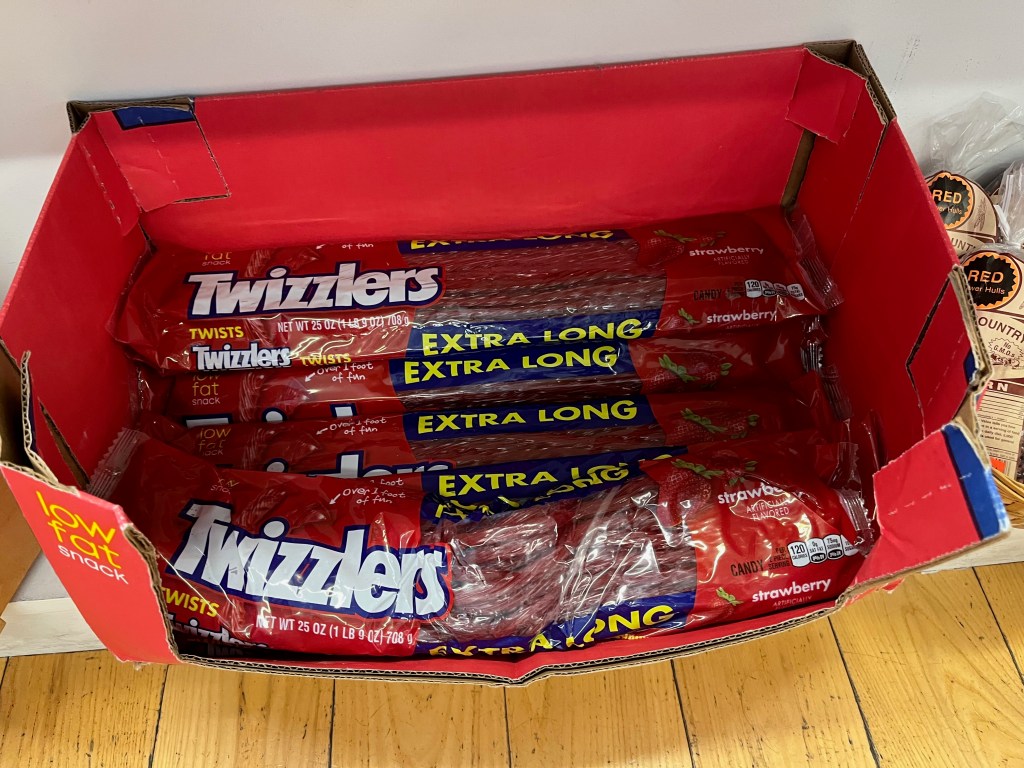
Half the fun of candy is how you eat it. Think of the possibilities of twirling, gnashing, sucking and licking–offered by these licorice sticks–kinda like the ‘ruffles have ridges’ counterpart to the–“No one can eat just one.” – of Lays fame! Daresay do.
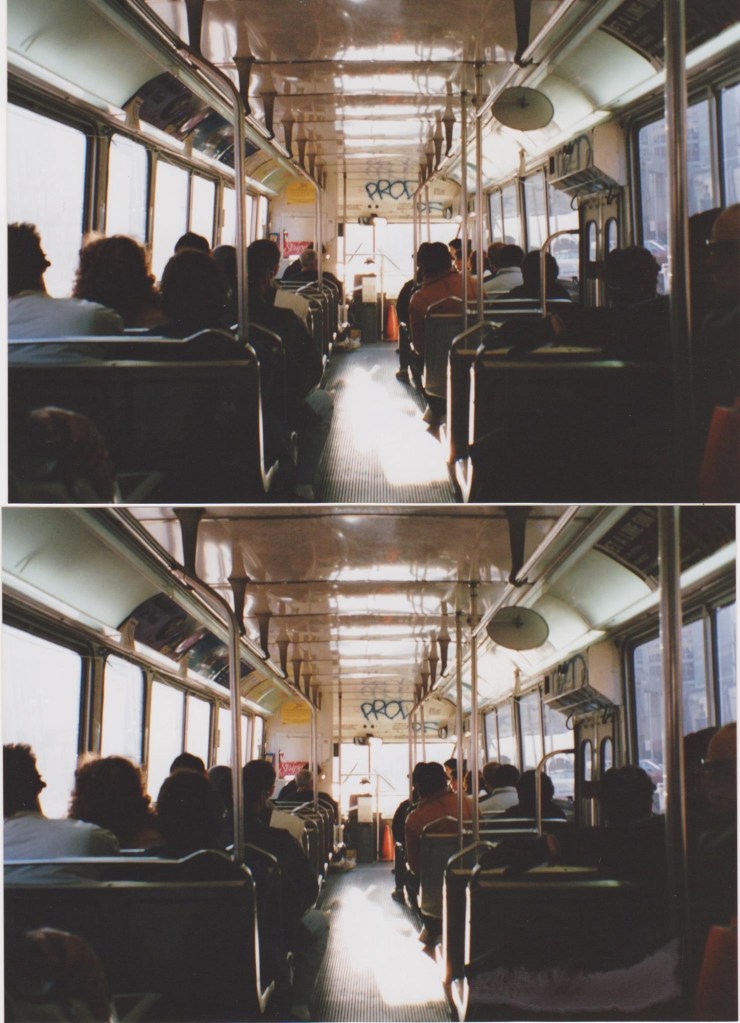
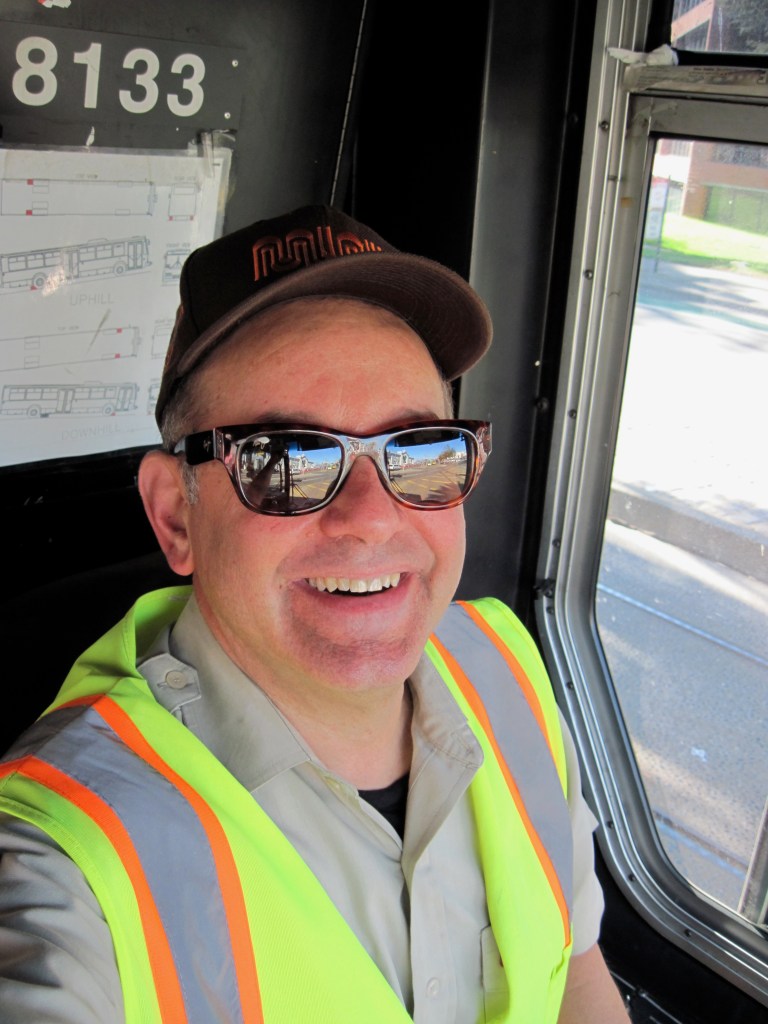
But as a public service announcement, with a lifetime of civil-service as a bus driver–I must remind this captive reading audience, that other considerations should be given to the top ten candy list: i.e. The damage done to theatre floors, trolleybus seating, and all the other post digestive aftermath effects of errant eaters!
Litterbugs – excerpted from my book, “Trolleybus of Happy Destiny” on Amazon below
I had a group of youngsters bringing in food at the back door after I asked them to take their trash with them when they depart. My comment fell on deaf ears as they went to the back door with their ice cream sandwich and candy bars. Being a bully and demanding an action has never worked in the past, so I simply make a request in a calm monotone voice and let my control over any situation die after I take the action of a neutral toned statement and let the cards (ice cream, soda cans, juice bottles, fried chicken) fall where they may.
Transfer points with fast food stores are the places were food gets brought on the bus. It isn’t too hard to see where the trash comes on board. Once I understand this, I can ask intending passengers to take their food or trash with them, and if they board at the front, I get a positive response. I see them take their bags and cups with them when they get off. The Seven-Eleven at 30th and Mission, and Popeye’s at Divisadero and Hayes are the key litterbug stops on the 24 and 21 respectively.
Yesterday, I had an off duty operator, riding my coach inbound on the 21, alert me that the man who just got off at 8th and Market dropped a full coffee cup on the back seat and the spill was creeping down the floor to the back steps. Cream and sugar, mixed with coffee make for a gross floor and sticky mess that can be tracked throughout the bus over the following hours of service. I had five more trips to make on this day, so the spill was going to affect all the commuters going home after a long day. No one likes to be forced into a sticky seat or floor when all seats are taken on the peak period commute home. Litterbugs don’t understand the effect they are having on all those who come after them on the bus.
I asked the riding operator to get a newspaper at the news rack on the corner, and he gave me a some copies at my window, and I popped the brake. I went to the back and laid the papers down on the floor where the streams of goo were moving and absorbed the coffee off of the seats that were affected.
“Let’s go!” demanded one of the youth. “Not until I clean this mess, look here, there is an ice cream wrapper on the floor.” I responded. “All these seats and aisle are unusable as this coach will be out of service to wait for the car cleaners, and everyone will have to wait longer for the next bus. I am keeping this coach in service.” They begrudgingly got off the bus.
My follower on the 9 San Bruno behind me honked at the delay created by missing a light at the inbound stop. I was holding up the line. Losing a light was a small price to pay to keep my headway intact. I returned to the cockpit and left on the next green. I let the paper absorb all the sticky coffee, and then at the next stop where a trash can is right at the corner, I picked up the wet paper and throw it into the can. The mess is gone.
We operators do have the ability to call for the car cleaners to come and fix the mess, but what these youth and old man seem not to understand, is the delay in coming to clean the coach means my bus blocks the terminal for my follower, who now has double headway. This one spill, along with the wrappers, gets dropped off in a second, but causes hours of dirty shoes and clothes by those who follow, or a delay in service that lasts over an hour. The best lesson I can give for change is to set an example by doing a spot cleaning when it happens and when they are on the bus.
It was made obvious to me from the operator who witnessed the spill, that the old man intentionally dropped his coffee cup and had an attitude. I recall this was not the first time he did this. I file this away in my brain, and be alert for his boarding next time. Last time, I discovered the mess after a full trip to my second terminal.
Indeed, I do find many interesting articles when I do the rear board walk through at the end of the line, as our rulebook suggests. If a spill has occurred, as we may not be able to see the mess when the bus is crowded. It is important to understand a rider can make a difference by letting the operator know . This was the case on this day, as I couldn’t see what happened. At the end of the line I whipped out my window cleaner pads and got the seats shiny and bright and then used the pads to clean the floor where the shoes would rest.
It took two minutes to make the final wipe, and I left Ferry Plaza on time. Snap. Can I get an amen in here?
The youth may believe it’s cool to ride for free and eat on the bus, without a second thought, but the old man should know better. He was probably an operator who was let go, and is now a hater. He knows the rules, but in an odd twist, a resentment is nursed and fed about how they ‘did it’ to him, how unfair the outside world has treated him. I know his line of thought all too well, and I don’t have to react to it. I can insert a positive action of example, and keep myself on a higher plane. Or bus!
Signs and posters for litterbug fines don’t seem to get through. Positive action does. We now return you to the Trolleybus of Happy Destiny, complete with clean seats and floorspace!
My first time I wanted to get away from negative feelings, I signed-up to be a Marine, and moved to Virginia.
Eagle, Globe, and Anchor
Old Ironsides, made from original stand forest timber, is so strong and impenetrable, nothing can get through and sink her.
I figured if I could get strong physically, with a world renowned military group, I would become impenetrable to withstand negative feelings. That helped a lot – but only for awhile.
For all the Honor and Glory
That ended in a Leadership Failure after a – No Tell, Please Don’t Ask – exit interview. Two years later, I found out all my platoon buddies were killed from a car bomb in Beruit on October 18, 1983. Well, okay, I’m still alive, even though I’m a failure–now what?
Oh, I know, I’ll move to San Francisco and sit at the dock of the bay and drop in and tune out!
In the journey of life, failure often acts as a catalyst for growth and success. This theme resonates deeply within my experiences as a bus driver in San Francisco, a role that has not only shaped my professional identity but also provided profound insights into the interconnectedness of service, community, and personal development.
Embracing Service as a Foundation
When I embarked on the path of becoming a bus driver, my primary motivation was rooted in a commitment to service. This intention aligns with the idea that “we are all here to do what we are all here to do,” as articulated by the Oracle in The Matrix. My goal was to share my knowledge and experiences, helping both fellow operators and the public better understand the complexities of public transportation. However, my initial attempts were fraught with challenges. Misunderstandings arose, and complaints about service were common. Instead of feeling defeated, I realized these failures presented opportunities to deepen my understanding of the job and improve my communication with passengers.
The Learning Curve of Interpersonal Dynamics
Driving a bus is not just about operating a vehicle; it involves navigating a multitude of interpersonal dynamics. Every interaction with a passenger is an opportunity to either build rapport or encounter friction. Early in my career, I often found myself responding defensively to complaints, feeling as though my integrity and professionalism were under attack. However, these moments of conflict forced me to reflect on my tone and approach. It became clear that misunderstandings often stemmed from preconceived notions rather than the actual service being provided. Here, I learned the invaluable lesson of maintaining composure and empathy, turning failures in communication into lessons that enhanced my effectiveness as a driver.
The Power of Perspective
My book aims to provide future bus operators with a higher vantage point from which to view their roles. It addresses the common pitfalls that can lead to service complaints and emphasizes the importance of understanding both the operator’s and the passenger’s perspectives. By sharing my experiences, I hope to foster a sense of interconnectedness, encouraging conversations around what works and what doesn’t in our daily interactions. This shift in perspective has been instrumental in transforming failure into a platform for success, as it allows for the creation of solutions rather than dwelling on problems.
Finding Joy in the Journey
As I navigated the challenges of my role, I began to find joy in the small moments of connection with passengers. Whether it was a shared laugh or a moment of understanding, these instances reminded me that I was in the right place at the right time. This realization helped me to embrace my failures as stepping stones rather than setbacks. It reinforced the notion that success is not merely about achieving an end goal but is also about the journey and the relationships built along the way.
Conclusion
The narrative of my experiences as a bus driver in San Francisco illustrates how failure can set the stage for later success. Each challenge faced has contributed to my growth, shaping not only my professional skills but also my personal philosophy. By embracing failures as learning opportunities, I have been able to cultivate a deeper understanding of service, improve communication, and find joy in the everyday interactions that define my role. In sharing these insights through my writing, I hope to inspire others to view their own failures as integral components of their success stories, paving the way for a more compassionate and understanding society.
Let us support one another in our journeys, recognizing that failure is a natural and essential part of the process. Together, we can transform challenges into pathways for success and create a more compassionate and understanding environment for everyone.
It’s nice to be in Hawaii on Standard time. Many business entities are tied-in to California–and they run on California time. This means we change from a two-hour time difference to a three-hour time difference–and back again, whether we “Fall Back,” or “Spring Ahead.”
Phoenix, in the state of Arizona, also remains on standard time. It’s very confusing when we reset the clocks, especially from Honolulu and Phoenix. Don’t get me started on Indiana, Terre Haute, and the Wabash River!
If we don’t change the law–oh well. It depends on if your a morning person or an evening person.
I needed two MacBook Pros to keep the logic board from overheating.
How I tried to start a series of books by using Joseph Campbell’s epic template of Greek Tradition:
Muni Gods – Leaving Time – Fare Box – APOTHEOSIS
Brake Test – ENTER THE CAVE
Crunch Zone – COURAGE
Flip-Up Seats – BELLY OF THE WHALE
Over There – Flat Tire – Hot Lunch – FIRST CROSSING
Car Cleaner – Safe Driver – RESCUE One
Kneeler – Blind Spot – RESCUE Two
Late Ring – Stop Requests – TESTS
Avenues or Streets – Islands and Curbs – MAGICAL FLIGHT
Timed Transfers – Late Night DRAGON BATTLE
Lost and Found – TREASURE
The Tower – Relief Time – WASTELAND
Central Control – Open Run – Follow My Leader – The Long and Short of It – THE CALL
Big Mouths and Cry Babies – Stop Request – Late Ring – RELUCTANT HERO
Power Failure – High Winds – Report to the Dispatcher – Removed From Duty – SEPARATION
We’ve Been Waiting an Hour – Open Trench – Jay Walkers – Bike Rack – FEAR
Road Call – The Overhead – Drop and Rack – SECOND CROSSING –
Service Dogs – Faux Pas 117 – MAGICAL HELPER
Rolling Delay – Blocked Zone – Headway Spacing – ROAD OF TRIALS
Owls and Twilights – Pulling In – NIGHT SEA JOURNEY
Not My First Rodeo – Another Bozo on the Bus – ADVENTURE
Song of the Trolley-man – I’d Never Do Your Job – Dust Cover Jacket – INITIATION
Possible Journey Cycle for the Dao of Doug Screenplay Chapter Ideas for each 1 minute screen time of about 120 mins to 145 mins / pages of Screen action play.
TAKE 1 – LEAVING TIME ANGRY – SCENE ONE – ACTION
SHOT FROM OUTSIDE STANDING BUS AT VAN NESS AND MARKET
NARR: My leader went out of service in front of me at the biggest transfer point on Market Street. An angry mob piled out of her bus and onto mine. Her poles were still up, and I pulled into the zone right behind her.
Crowded queue at the bus front door backed up with an assortment of angry intending patrons.
NARR: The choice to fill out a miscellaneous or make a radio record sometimes baffles me as to whether or not it is an advantageous action or a waste of time. These choices make life as a transit operator interesting, to say the least. And, if there is one distinction we make as veteran operators of Zen within the railway, it is that distinction between interesting and surprising. Interesting makes for a good day. Surprises just won’t do. Surprises are for birthday parties at home or under the tree on the December 24th. They are not welcome when it comes to making an appearance at the bus barn, even when they are supposed to be good surprises. For a bus driver, the best surprise is no surprise.
INT. SHOT ZOOM UP-CLOSE TO SHOW STANDEES AT FARE-BOX
PSGR 1: (middle-aged woman in hair net and large bag)
“When is the next 47?”
PSGR 2: (young tech male) Interrupting
“Can I take you to the train station?”
EXT. SHOT FROM OUTSIDE BUS TERMINAL AT AQUATIC PARK SHOWING TWO BUSES PARKED ON THE CURB – BUS ONE BUS DRIVER IS SEEN CRADLING POLES – AFTERNOON
INT. BUS DRIVER IS WOLFING DOWN SANDWICH OR FINISHING AN APPLE LOOKS UP TO SEE HE NOW HAS NO LEADER AS LEAD BUS DRIVER SHRUGS SHOULDERS – CONTINUOUS
NARR: I knew that, no matter what I said or did in my passenger complaint review, I wasn’t going to get off without some form of time-off or discipline. I have learned not to argue or blame others during times like this. I have also learned not to get defensive. Having seen this response in others, the effect it creates is one of guilt and denial. My approach is to give the “devil” what he wants and hope he moves on to greener pastures. The devil in this case being in the details of why I left late and how impossible it is to argue a point when no one listens.
SHOT BACK TO FRONT DOOR MOB AS INT 2. ZOOM CLOSE
WOMAN WITH CANE AND BAGS FALLS DOWN FRONT DOOR STEPS or TRIPS FIRST STEP UP
SHOT: INT. BACK AT BUS BARN FILLING OUT ACCIDENT REPORT WITH DISPATCHER AT SECOND DESK LOOKING OUT ABOVE GLASSES
NARR: Most of us have been given the incorrect model on how to affect change. Heck, I can’t even spell the distinction correctly! Do you desire an effect or an affect? We believe that expending a burst of loud, hostile energy is a fast way to make change happen. Or, anger can be harbored for years, yet nothing changes. We become comfortable with our anger, nursing and polishing it into a fine object that can become attractive to all who encounter it. I know I have loved my deepest and longest-held resentments against a large organization and loved telling others about these over happy hour!
SHOT EXT. IMPATIENT MID AGED MAN LOOKING AT RUN SIGN AND OR CAP NUMBER OFF OF DRIVER DOUG’S SHOULDER PATCH
NARR: Your desire to catch that trolley bus actually hinges, not on the caricature of one massive entity called a Municipal Transit Agency, but rather on an individual seated behind the wheel of a car. Yes, we call coaches or cars by their number, and it is okay to call a bus a car, such as car number 5505. If you are aware of car numbers, chances are you have a good handle on understanding the system. If your awareness extends to run number, car number, cap number, and line number, then your status is elevated to that of a Muni god. By reading this book, you, too, can be elevated unto that heavenly status. Gods can get angry. Gods can cause major damage. Gods can cause a rush of change. But when they are benevolent as angels, good things can happen.
SCENES 2, 3, 4, and 5:
SCENE 2 – THE WOUNDED KITTY
NARR: Aw, poor baby. Are you all alone on the cold, wet corner without a warm, dry bus for shelter? This works if I have room and time, and I know there is no bus behind me. A smile at the last minute works great if timed correctly. A Homer Simpson “d’oh” or one loud, profane exclamation also works if timed just as the front door passes by. This technique works great when traffic is light or nonexistent. Twilights and Sundays are good prospect times for wounded kitty. If you’re not young and pretty, a sigh of sadness with quivering cane uplifted to an invisible Kaiser also works. Dropping the shoulders Charlie Brown-style after Lucy also works wonderfully. But note that these all require the eye contact of acknowledging that it is a person driving a bus, and not just a bus.
SCENE 3 – THE PLEA BARGAIN
This was used in the movie Speed. Annie makes it to the doomed bus as Sam, the bus driver, jokes that this boarding point is not at the bus stop. I have expanded this with the train and plane analogy of questions: “Where do you catch a train?” “At a train station.” “Where do you get on a plane?” “At an airport.” “And where do we get a bus?” Some of you latecomers are so puffed up with pride that you may never get on a bus. But if you pronate yourself, as if praying to the Muni god of nigh, the transit operator, grace has been known to open the back door (occasionally). This would be a good chapter for a movie. I wish I could call up some clips on the plea bargain. The plea bargain can come silently with the eyes, or with a huge, loud, profane word. The more over-the-top, the better!
SCENE 4 – THE DIGNITARY
NARR: This only works with blessed folk, those who attend church regularly and have a comfortable sense of self-righteousness that does not infringe on others. Those who pray regularly without self-centered fear can stop a bus from any location just by a simple turn of the head and a smile. It is always a wonderful rush to pick up someone like this-rare indeed, but all the more meaningful. Quality, not quantity is definitely the Dao of this pick-up.
SHOT: NICE ELDERLY WOMAN DRESSED FOR CHURCH WITH HAND UP WALKING UP TO BUS STOP WITHOUT EVEN LOOKING AT BUS AND BUS DRIVER. (Smiles really big)
SCENE 5 – THE LOST PUPPY
NARR: Unfortunately, these are the most dramatic and visceral because of their stand-alone nature. If you are traveling from the East Bay for a job interview, for example, and are new to the system, the time you are allowing for transfers may be inadequate. The image of successfully dashing across the street to a streetcar from a trolley is easy to get, especially if you have heard our service is frequent.
SHOT EXT. BUS DRIVER STEPPING OFF COACH AND POINTING ACROSS THE STREET TO TOURIST HOLDING A MAP AND LOOKING CONFUSED
TAKE 2 – INT. BUS OPERATOR GOING AROUND BUS DOING PRE-OP
CUT TO:
INT. BUS OPERATOR GOING AROUND BUS DOING PRE-OP
Mirrors have a good view? Check. Doors open and close okay? Check. Rope tension firm? Check. Seat adjustable? Check. Air and brakes okay? Check. The best defense is a good offense. This is run 379 calling for a radio check. Loud and clear. Check.
NARR:
Mirrors: I will adjust them later. Tires: I cannot have retread, regrooved, or recapped ones on the front, but I can on the back, and they must be the same size, same type. I would check between the rear tandem tires to see if there is debris. If I had a mallet, I would check air pressure. Do not kick the tires. This does not gain extra credit.
For the front of the coach, a W pattern from ID lights to the wipers and across works best. Looking down the side of the coach, verbalize that you are checking the windows to make sure they are secure.
Upon entering the coach and after checking aisles, windows, ER exit latches, roof hatches, chime cords, hand holds, seats and stanchions, wheel chair area, fire extinguisher, wheel blocks, safety cone, close the door and put on your seatbelt. Important things to remember on a daily basis are to check the rope tension on the poles in the back of the trolley. The poles have a specific slot at forty-five degrees from the angle on the roof whereby the pole can be lowered to inspect the collectors, the carbon in the brasserie, and the shunt wires and swivel rotation of the collector. The collectors are the two swivels at the end of the pole that collect the power. The shunt wires are the two wires that move this power down the pole to the inverter so the bus system can be powered.
It quickly becomes obvious that other fixed objects can block you from lowering the pole to eye level, so whenever checking this (even on a track in the yard), you may have to move to a more favorable location. It’s important to have both wires down when doing this, unless you want to see how far you can fly off the ground when your body becomes the ground for the 600 volts of direct current. Not a good idea to be doing this in a puddle of water in the rain with metal toe guards in your shoes.
Setting up the coach in the seat requires more than what you are taught for pre-op by the state test. You do need to see if master control is in the correct setting if the bus has been turned on by the yard starter and that the fare box is not blocked. Setting the pattern, the destination, and the run sign all take time each morning or at relief. These procedures are not part of regular training to pass the test.
If the DVAS (Digital Voice Activated System) is making a recurring announcement, the run sign may not update. Also, if the buttons on the DVAS are sticky or picky, it may take extra time to get displays correct. The wheel blocks and cones are a big deal. If you have no cone or wheel block, that is a warning sign that the bus may be trouble. If the bus needed these during the last shift, why are they missing now? Did the shop take them? Were they used somewhere else? The odds you will need them go way up if the bus is missing them.
The air brake test can be stressful, especially if memorization skills are rusty. The acronyms, COLA, and SALT POSSE, helped me get the air brake check lined up in the correct order so the qualified state inspector would be put at ease and would, therefore, put me at ease to increase the chances of passing the test.
Knowing that COLA is the first part of the air brake test, C stands for cut-in, O for cut-out, L for LAWD, the low air warning device, and A for air or the beginning of the air leakage rate tests.
C-After chocking the rear wheel on the right, turn on master control, and between pumps in the service brake, you are lowering the air on the needle to get the compressor to cut-in and begin restoring air to the tanks. The cut-in should occur at or slightly below 85 psi (pounds per square inch), and the cut-out should be at 125 psi. During the test, you must state that you are seeing the needle start to rise to confirm that the air governor has cut in. O-Stop pumping the brake to bleed the air, and then wait for cut-out. To confirm this and to pass the test, you must say, The needle has stopped rising. This occurs at 125 psi.
L-Now comes the low air warning device. Continue to pump and bleed so that the needles drop out of operating range and down to 55-to-75 psi. This is when an alarm should sound. Continue until the parking brake pops up at around 40 psi.
A-This is an automatic safety feature that will hold the coach when air is dropping. Let the air rebuild, and get ready to perform the air leakage rate tests, S.A.L.T. Always state air in pounds per square inch and not just say the number 85 or 125, but 85 psi or 125 psi.
SALT is an acronym for the standard air leakage test. This begins by turning off master control and placing your foot on the service brake for one minute and watching the air gauge needle to see that it does not drop more than 3 psi. [The minimum brake test, for example, where we put our foot down on the power pedal to see if the bus won’t move with the parking brake on, has been cut. The equipment from the Czech Republic, the ETI Skoda, fails this test, as the hill climber was built into the points of power on this bus. The hill climber helps us up steep hills.]
We then go on to POSSE: I am going to check my air leakage for the P, parking brake, the O, open lines, the S, static air leakage test, the S, service brake, and the E, emergency brake. The last two, S and E, are called the rolling brake tests where you accelerate and use the service brake in a smooth, controlled stop and in an abrupt stop. The emergency brake test is applied to see if the coach is held by the brakes; it used to be a part of the minimum brake test whereby you would put on the parking brake and then depress the power pedal to see if the bus would roll or not. But if you do state the items of POSSE to the instructor, you let him know that you’ve been around a while and have knowledge of the requirements of previous years.
Inevitably, what is not checked is missing or is what you will need later on in the day. Keep your Zen! Keep your job!
TALE 3. COURAGE IN THE CRUNCHZONE
On the 14 Mission, the crunch zone exists between 16th Street and 7th inbound in the morning, and Fourth and Eleventh outbound in the afternoon. The sequence of events is so repetitive and coincidental that one could plot a graph of predictability on an actuarial table for an insurance company. Come to think of it, the City of San Francisco is an insurance company. I don’t know how this would help with claims, but like this man who was on my coach, avoiding the problem areas makes for an easy ride, even if it means traveling beyond the shortest distance between two points.
On the 49 line, the crunch zone exists between 16th Street and Eddy inbound, and from O’Farrell to Otis outbound. Load factors and working leaders influence the zone by making it longer or shorter, but in general, I have to make sure people boarding do the right thing by sitting or standing in such a way as to prevent fights or arguments at the following stops. Crunch zones also lie in the Inner Mission between 18th and 30th outbound in the p.m. Also, before 24th St. BART inbound in the morning commute. People listen better before their space is threatened.
I picked up a man in a wheelchair near downtown at Third Street outbound and was amazed at how smooth and fast he boarded and locked in. I could tell he was a regular rider. Instinctively, I knew he was going to get off at 16th and Mission, and sure enough, when I asked, he stated he was going to 16th. I told him I was glad to have a regular rider who knew how to ride Muni. He talked about his learning curve on how to work the flip-up seats and about where to get on and get off. If there was any heartfelt strength of purpose to distribute this book to the masses, it is not about the money or the power or the vanity of being an author, but to get out the wisdom about how to ride, so that the bus system moves faster and creates fewer headaches for those getting around. Nowhere is this wisdom needed more than in the crunch zone.
At first, I wanted to call this chapter, “Crunch Time,” as it pertains to the operation of a bus from 3:30 p.m. to 6:30 p.m. However, the pattern of movement between two stops was as predictable as the time frame, and I realized a more accurate description of gridlock was in certain zones between stops. And the idea for this chapter was born in the conversation with this wheelchair rider as he glided away from downtown with me in a calm, roomy coach. If there is an opposite to being in the Zen zone, this chapter is it. I found out he wanted to go up Van Ness to Geary, but was passing up the transfer point by four blocks. Now I know why. He was avoiding having to board a trolley in the crunch zone.
This is a golden key to the crunch zone. I, too, have a better vibe and tone if I ask someone to move before the crunch zone hits.
And when those who have moved see that those I next pick up need the first two seats, the message has hit home in a way that is not threatening or defensive. Score one for the Zen!
TAKE 4 – BELLY OF THE WHALE – FLIP UP SEATS
SCENE 40
FOLLOW MY LEADER
It seems like a quiet Friday today, I think to myself. The bus has several seats open; no one is standing in the aisle. The bus is most definitely in the Zen zone, even though we are halfway through the trip in the middle of the line. How can this be? The answer is usually right in front of your eyes. If you scan through the windscreen (windshield) a few blocks ahead, you should see the tail lights of another trolley running late or on my time. Until recently, I thought this was a form of heaven on earth, a time to make good money without the fight over a seat or space.
But with GPS, DVAS, and computer technology on the bus recording every door opening and every stop, I realized I must adapt more acutely to this record-keeping by observing the one block spacing rule. Following too closely is a no-no that can generate a citation from an officer of the law if contact is made at a stop sign or light when rear-ended by another car. As bus drivers, we can also receive a written warning based upon the actions of our operation if we stay too close to our leader-the bus in front of us. If the DVAS clock display is off by six minutes, I must call Central for a time check.
The problem for me is mental. I am in such a runner’s mode, having been trained on the Mission lines without a leader, that I am preprogrammed to shave every unnecessary second off of dwell time in the zone. I can move up four minutes without leaving early from the terminal. And when Central gives me orders to move up four, I have to signal this to my follower so as not to create a hole in time behind me.
I am grateful I learned the job when our division had over ninety daily hours of stand-by time. Now there are less than five hours of stand-by on the range sheet totals. (See the chapter on Range Sheets to understand all these other types of non-driving time.)
Pulling in on this particular holiday weekend Friday at my last stop at Ninth Street, a man refused to get up out of his seat, sitting in the Black Hole right behind the cockpit. My holiday weekend was being held up by an angry man who claimed I passed him up at a stop no one on board requested. Could I get him off the bus without incident, without damage to the front doors, or without causing a major medical emergency? Fortunately, he departed, but not without a rage-filled discourse. Whew! I called Central to clear a line delay, and my favorite operator wished me a good weekend. Yes! A friend at Central Control!
TAKE – 14. RELUCTANT HERO – Big Mouths and Cry Babies
“Big mouths run hot.” So says our elected leader in the receiver’s office before picking up my outfit one morning. Apparently, a common thread running through arguments rebutting a write-up for running ahead of schedule is that of complaining about other persons, places, or things like our equipment as causes for running ahead of schedule. But it doesn’t take much to understand the simplicity of why a bus is ahead of schedule; it’s the operator behind the wheel.
And I have found myself in big-mouth mode often. In fact, before a suspension hearing, my union rep repeated to me (as he does every time I am in trouble), “You talk too much,” or “You ask too many questions.” And he is right. I find myself asking how I got into this mess, and in retrospect, it becomes clear that I just need to shut-up or say that I don’t know. Others are trying to help me by giving hints or obvious clues to tip off silence, but my monkey-Gemini mind seems incapable of holding back.
And holding back is a valid technique to avoid running hot. Running hot is running ahead of schedule by more than one minute. Most of my friends and riders give a look of disbelief when they hear that we are not allowed to run one minute ahead of schedule. With on-time performance so low, I understand why this rule may seem over the top, and I agree. But, like my manager says, the first step to run on time is to leave on time and not to run ahead of schedule. There seems to be less of a concern from management in running late, but as someone in the seat out on the road, running late has many consequences, none of which is as uncomfortable as the seat in the superintendent’s office.
As passengers, you would do well to look and see if another bus is coming. Use the clock inside the shelter to see if one is following in a few minutes. It is the use of this kind of resource that can make our railway run more smoothly. Please stop and take a look at this aspect of passenger load on the operator and the drama that ensues when no more seats or aisle space is available. Whether it is an operator crying at the barn or a passenger screaming in the aisle, use the next bus clock to your advantage. Good things come to those who wait.
SCENE 44 ANGRY MOB WAITING AT BUS STOP AT GOLDEN GATE PARK
“Where the hell have you been?”
A)”The pizza delivery boy was late and apologized, so I got a free pizza and ate it all at the terminal. You don’t expect me to wolf it all down in five minutes, do you? I am not allowed to use my phone while I am driving, so I had to call my order in after I got to the end.”
B)”The brakes failed, and I had to wait for the shop after filling out an accident report for the three beamers I took out rolling down Russian Hill.
The shop wanted me to fill the bus up with as many people as possible to see if the brakes would hold.”
C)”I did some shopping at Fisherman’s Wharf and don’t want you to rain on my parade. Wait here for the next bus right behind me so I can pick up the folks at the next stop. Since you’ve waited an hour already, another fifteen minutes is nothing.”
D)”I’m terribly sorry for this delay. I am in a hurry with a triple load and don’t have time to argue with you. You can get on the next bus right behind me.” Shut the door and drive off.
The correct answer is, of course, B). This gains sympathy from the angry mob and gives an accurate view of the equipment and service. Also, it hints that affluent owners of hi-end vehicles will get their due. This unites the angry mob in a can-do attitude.
Although this may not be an actual verbatim test question provided during the civil service exam, the insight provided here may improve your skill score. As a transit professional, you are required to handle difficult situations quickly and respond to questions without hesitation. While some books on the subject of driving a bus may provide guidance as to how to remain calm in a dense, congested city such as San Francisco, let’s face it, we may not have the patience or time to assume a lotus position and meditate.
TALE 15 – SEPARATION REMOVED FROM DUTY
O.S.
I learned early on that if I saw any construction bulletins in my paddle when I pull out in the morning, I had better check to see if my coach has APU (auxiliary power unit.) If battery fluids are checked regularly, then a coach has strong battery power. But if the batteries run dry, the energy storage becomes weak, and entire sets of batteries need to be reordered. This can get expensive. Our trolleys contain racks of batteries. So, looking at the battery gauges during pre-op is always a good idea. If you don’t, finding out about battery storage in the middle of a construction zone right off of a freeway exit ramp can really tie things up.
EXT.
All that matters as a trolley man intent on getting the next paycheck is to check left-right-left on my thirteen mirrors, all hopefully pointed to one space above my shoulders in the driver’s seat. I may have to do a “Sugar Ray” and bounce my head back and forth a bit if the rocker arms on the side of the bus have been frozen out of alignment by the wash rack at the barn. All-in-all, the moments after closing the doors are as important as becoming the next blog on social internet or front page news in the paper. All I ask is that you make some noise if you are crossing from behind my mirrors in my blind spot. Please and thank you!
This space cushion we are trained to keep around our bus at all times goes a long way toward explaining why we are splitting the lane or driving down both lanes of traffic in the Mission or on Van Ness. We are avoiding car doors, skaters, bike riders, and the person with the door open at their parked car. We can’t answer your question right now because we are busy looking at the show in front of, and up to, one-to-two blocks ahead. Now sit down and be still, please. Or as you sometimes say to us, “Shut-up and drive the bus,” and “Just do your job.” Surprise, surprise. We are and you’re not helping!
I am continually returned to the state of abashment at the attempts to destroy the self-possession or self-confidence of my integrity and job experience. Someone enters and alights before I have a chance to answer and complains of discourtesy. A motorist rushes ahead, only to block the lane to wait for a parking space. A “fixie” on his bike passes on the right and stands in the crosswalk, preventing a right turn on red. It’s an assigned penalty in a love letter that proposes no solution. The other reason for this book is to respond to the continual bombardment from the press, the public, and those in “authority,” of our operators’ response, “Try a week, a day behind the wheel, and then tell me what you think!”
END OF ACT ?????
Anyway, I am down with motor coaches and don’t mind going over to Woods to pick up one. I actually like the ride over on my bike. The Dogpatch behind Potrero Hill is actually an interesting neighborhood that seems like it is in the country, miles from the city. And yet the skyline is right there in front of you when you look down from the hill. This is where much filming takes place because of the dramatic, unobstructed view of skyline. The movie Bullet was shot on Pennsylvania Avenue just up from Dogpatch on Potrero Hill. When I say up, do I mean up! The escarpment here, from the ramp and the bay to the vistas of downtown, is dramatic, as is the over-crossing on 280 Freeway on the 22 line. We climb from Dogpatch to Potrero Hill. This is definitely a place to keep the Zen!
TAKE 16 FEAR
Many times the construction guys are unfamiliar with how much operating room we need to pass a lane closure. If the cones are set down between the hash marks separating the closed lane, we can make it through. But we cannot pass by an area with one-and-a-half lanes closed off if there is a nearby turn, or the wires are slightly to the right of center of the closed- off lane.
The details of the permit become imperative. Because at the railway, we need to know if we will have to make a battery-powered pass of a lane closure or open trench. Timing is also a key factor regarding peak period and traffic conditions. What may be okay during lunch may be a long delay during rush hour. Or because traffic density can be hard to guess, what should be no big deal can create an awful bottleneck if just one trolley gets blocked or dewires too far from the power lines and has no battery power.
The first question a motorist or pedestrian would do well to understand is, Am I blocking transit by stopping here? By using the mirrors and scanning every five-to-eight seconds, it soon becomes clear what distinguishes a professional driver from an unskilled motorist. Likewise, cyclists who are new to riding a bike in the city become apparent at a red light or bus zone.
When a new curb clear is installed on a corner, and a new ramp is cut at the crosswalk, I make the call to Central to create a record about a corner that has not yet been painted red. A curb clear is that red zone on a trolley turn needed to complete a turn without crossing into the oncoming lane. Motorists begin parking on a curb clear that is not marked in red, and this creates problems for clearance in turning.
But here in San Fran, we are a part of the wild, wild, West where “Every which way but loose” (to coin a phrase from a favorite Eastwood flick) applies. As any passenger and driver can attest, pedestrians here are among the most entitled of any city in the world. This fact can lead to daredevil, death-defying acts in traffic and at intersections. It’s almost as though the new countdown crosswalk clocks are a stopwatch and starting gun to begin the race to the other side. For others, the line drawn in the sand-the crosswalk-is about as important as attempting to mark the high tide mark on a beach where the waves have left their foam outline.
The flashing stop hand does not mean wait at the corner. Your time has passed. It actually means run like hell, especially if I keep my front door open at the corner. Or, if jaywalking casually across Van Ness, the stop lights and crosswalk signals mean absolutely nothing. And the dance is simply to pause between vehicles rushing by. Perhaps they will stop, perhaps they will honk, or perhaps you will finger them or hit them hard with your fist.
MAKING CONTACT BEEP BEEP GOES THE RADIO – “SEE THE DISPATCHER WHEN YOU PULL-IN”
Oh my God, what is it this time?
Did the skateboarder who ran into the side of my bus turning at Haight Ashbury get seen in my side camera? It looked like he was able to get his skateboard back up from the curb after I passed.
Was it Ben Taco who got off the back door then tried to walk in front of my bus as I turned when the light turned green?
Was it the couple who came from outside my view and off the crosswalk who walked in front of the coach on my stale green?
The agony of wonder what new paperwork I am going to get in the office after I pull in after a long twilight straight thru!
TAKE 17. SECOND CROSSING – OVERHEAD FLASH Lines Crossed
Retrievers
These are the two bulbs that sit on the back of the trolley below the back window. In the ETI coaches, the spools are hidden in the back compartment below the rear window. Some coaches have a lever to reset them; others can be reset by pulling on the rope and de-spooling some slack. The retrievers all have different tensions and different points of reset and click. During pre-op, I find it a good idea to tug on the ropes to see how much tension a spool has and how sensitively it would retrieve the rope and bring down the pole should the retriever spring be activated. If a spool is slightly bent, it can cut the rope quick and abruptly.
Many a shoulder or back injury has resulted in not knowing the strength or tension on the rope from the retriever. I have been blessed by not getting caught with a bad one. Always better to follow the rules and place one rope at a time back on the wires, especially when the collectors don’t want to pivot to follow the wire. I have learned to never stand under the wire when I put my pole back up, particularly when wet. The nasty black stain of carbon that drops on my hat or uniform may never come out. It can be a long time before a new uniform part can be ordered.
Gone are the days when passengers would be asked to step outside and help push the bus through an intersection or dead area at a breaker crossing. Before bicycle racks were mounted on the front bumper, we could push a dead-in-the-water trolley from behind with another trolley.
Truth be told, some switches activate for no apparent reason. No matter how meticulous a pan is installed to shield a nearby trolley coach from inadvertent trigger, switches activate on their own. I have looked at my switch control dial in the normal position, only to see that the semaphore has changed, or I hear the click of the switch changing even before I am over the doughnut. As a line trainer, this is a mandatory lesson about what makes a trolley operator differ from a motor coach operator. We must listen to what the overhead is telling us, especially when we need to turn on a switch.
SCENE 65 PULLING DOWN THE OVERHEAD – There was no click
No Power in the wires and Overhead truck taking hours to re-energize the trolley power. OMG I am in trouble.
SCENE 66 NO VIDEO
When Management doesn’t show the inter coach video at a possible disciplinary hearing after a major accident, breathe easy–it means I didn’t do anything wrong!
I Later found out that because I was wearing my safety vest, I wasn’t up for termination. Whew.
Other than a smile from an inspector, comes the reading of the “riot act.” This is a very intense scold about a rules infraction and the threat of: I could write you up. I was very taken aback by this, until an old timer told me that this verbal riot act is a friendly reminder that I probably won’t be written-up because they are telling it like it is at the time I pass-by. It’s a contra-indication like when we get the complaint from a passenger that is passive aggressive. The quiet ones that don’t say anything are who you have to be wary of. Anyway, where was I? Oh yes, the order to drop and rack. In most cases we, the operator, must do this ourself. The posting of an inspector is a luxury.
In any event, the one block spacing rule becomes very apparent when a drop and rack situation exists. Also very important to take in to consideration is the notion of, if I should lose all my air, and be unable to move, can I use gravity or battery power while I still have it, to move to a space in parked cars or away from an intersection, to make it easier for others to pass by? An operator busy with getting people off of the bus, but with poles up on the wires, can make a bigger jam if following trolleys can not get around.
A successful drop and rack is not is easy as it sounds, and when done smoothly and in timely fashion is a great way to keep the Zen inside the bus, and may result in applause once clear of delay!
Once the power went out at busy 16th and Mission and I immediately switched to battery power because I knew there was a separate power block on the other side of 13th. Sure enough, I passed all the other stopped trolleys and when I got through the three blocks of dead wire, the 600 volt hum returned. I had a wheelchair that needed to get downtown to 6th, and they made it without any delay.
CUT TO BAY TO BREAKERS SCANTILY CLOTHED USF STUDENTS ALL IN TOGAS
Toga! Toga! Toga! Already primed for Bay-to-Breakers, I pick up a full bus load of students ready to shuttle to the starting line downtown for a fun run to the beach at Golden Gate Park! Now that’s having fun!
TAKE 18. – MAGICAL HELPER – SERVICE DOG
Or should I say service animals? All creatures, great and small, do we see on a day as an operator of trolleys. As a new operator, it takes getting used to all of the various creatures that qualify as service animals. I would like to see the permit of that pit bull or that boa constrictor, but we are trained by the blow-back from the owner not to question their integrity, lest we violate the rules of the Americans with Disability Act.
We are only allowed one non-service dog per coach. If a small dog can be contained in the arms of a passenger, it is usually okay. But if another large dog enters that is a service dog, it has priority. Trained service dogs are expected to behave in a respectful manner. But some passengers are calling their dogs, service dogs that do not behave as I would expect a service dog to behave. Muni permits any number of service dogs on one coach, but I would expect their owners to be mindful of where they sit, especially if another dog comes on board. If you bring on a puppy, I would expect you to carry newspaper for any “accident.” Hopping off the bus after a tinkle does not seem to be responsible, and I resent those who seem unaware of their effect on other passengers remaining on board. Car cleaning is not in my job description, but I have learned how to keep in service with extra newspapers.
NEED INPUT FROM SCREENWRITER
Can we have a magical helping service animal vignette here?
TALE 19 – ROAD OF TRIALS
Faux pas 117 is demanding to board a coach in a wheelchair, even after the operator suggests taking a following bus. As a bus driver, I am always concerned for your comfort. My suggestion to wait for the next coach is based on the experience of the condition of the equipment, the passenger load, the headway, and the weather and traffic. (These last two conditions are on the civil service test.) All these have their corresponding number on the faux pas list, but none seems as simple as 117, which is to simply wait for the next bus if your boarding requires use of the accessory power and secondary use of the AC inverter. Having to wait for a tow truck or for the shop can take up to forty minutes. If the shop arrives in twenty minutes and the repair person can’t unstick your wheelchair from the lift or from inside the coach, another delay may exist in waiting for the tow truck guy to build air back up in the coach.
Being a Muni bus driver forever changes how we stop behind another vehicle. The division instructor’s reminder to always leave enough of a space cushion in front of us to pull around any vehicle in the zone becomes painfully clear when our leader secures the coach. The distraction and safety rules in handling a situation on the bus can mean that the operator cannot go to the back of the bus and cradle the poles. Staying back behind the crosswalk on the nearside of an intersection is an ace in the hole when this happens. It gives us pause to determine what action to take next without being blocked in.
At certain places, even though a buttonhook turn is the textbook style for making a right turn, there are those intense corners where the simplicity of the flag stop becomes the default stop. This is so because of intending transfer passengers, late to the cue, who wish to board from the crosswalk and expect the door to reopen. I repeat. They expect the door to reopen after the “train” has left the “station.”
O great Buddha. O angels and archangels and all the company of heaven. SaLuSa, Metatron, Hilarion, St. Germaine, Jesus the Christ, Galactic Federation, The High Council of Orion, The Andromeda Council, The Council of Twelve, all ascended masters, all light workers, and all way- showers, to all do I pray.
As do my brethren behind the wheel of a Muni bus in San Francisco and those who watch the contrasts we experience every day. Let the riding public know that there are traffic considerations, the beat, the pulse of the city that can create a delay in reopening the front door. For it is sometimes not just for one that the door cannot be reopened. It is for all those who see that the door is open and come from all directions. It is the shuttle or zip car that cannot wait for two seconds that pull around from the left and block the door as they attempt to turn right.
TAKE 20. – NIGHT SEA JOURNEY OWLS AND TWILIGHTS
Owls are runs which start around 5:00 p.m. and go to 6:00 a.m. the next morning. Some late twilights start around 4:00 p.m. and get off in the wee hours of the morning. When starting these late shifts, a relief is made during a busy time. The bus is full and the air is stale. The coach is fully warmed-up and ready to go. Usually a quick check of the mirrors is all it takes. The day starts out busy, but traffic thins as the shift goes on; this makes for less stress as the shift continues. Less traffic means less stress, and fewer people riding means less stress on the right leg and knee working the power pedal and service brake. Less riders mean fewer stops. I can go past more than two bus stops (skip stops) because no one rings and no one is waiting.
[Develop Antagonist]
And so, as of this day, I will stop portraying myself as a victim of the schedule and see what happens. After all, when I hear my passengers playing the victim role about the schedule, I can see how they are being blind to their part in creating the problem. So, too, must I follow this example and not play a part in my own hell. Running time is what it is, and if it really is that bad, my coworkers will ask me about it. I just need to wait to see if my opinion is being solicited. The fact that the timetable does not match actual conditions is something to which I must adjust. I can only control what I can-my leaving time.
Most bike riders are fast to load their bike on the bike rack that drops down over the front bumper. They tag-in and are gone to the back of the coach. I can guess where they are going to get off, but it is a good idea to let operators know where they plan to take the bike off of the rack. Many a day when I pull in, I find bikes waiting in the Lost and Found area. These are bikes left on the rack when the bus pulls in.
It’s also good to check for sleepers before I pull-in. Surprising a car cleaner with a youth sprawled out on the back floor is not going to go well at my next hearing.
SCENE 86: Showing the Fire Department having to strap a drunk on a wheelchair style gurney down the back steps as he is powerless to try to get up and leave the scene on his own.
TAKE 21. – ADVENTURE – NOT MY FIRST RODEO
SCENE 65 DAY EXT. Showing Our Hero inspecting his coach and smiling with his first passenger pick up.
NARR O.S
Dents and dings notwithstanding, one can tell how much time one has behind the wheel by looking no further than the defect card after making relief. Senior operators can roll with whatever they have been given. Others take safety to levels seen only at the National Security Agency. The biggest variable in accepting equipment is the personality and style of the person behind the wheel. We have terms for the style of movement an operator has during his or her run. I have a reputation as a runner. With Mars in Aries and my ascendant house rising in Leo, I have a charismatic demeanor that may come across as nondiplomatic, though I love to show my sunny side. In training, the only hint at personality is within the three points affecting safety: weather, traffic, and operator. This is an answer on the civil service test that can be remembered by the acronym WTO.
I noticed early on in my bus riding days, bus drivers looked relatively relaxed. Nothing seemed to bother them. Conditions permitting, some were actually fun to talk to. As the fog lifted in my brain, I began to get a design for living and set goals for the first time in my life.
As a Gemini sun sign, transportation and continual movement fits my sign. In doing my inventory, I recalled my 4th grade art project, “What do I want to be when I grow up?”, I drew a picture of the silver GM coaches that serviced the NY Port Authority from Jersey during the 60’s. Bus driver was a job I have considered since the fourth grade watching ‘The Honeymooners’ on television live from Miami Beach. I heard those who are successful in their jobs, had a passion for those activities or skills from an early age.
“Do you have a car?” you may ask. Yes, I do, and you’re sitting in it! Today’s car number is 5481. I get a new car every day, and I can hold up to sixty people at once. I get to take you where you want to go and get paid to do it. I don’t have to worry about parking, and I can call on my radio for help from crews of people set up to keep me going. I don’t have to pay for gas because this car uses free power from the O’Shaunessy Dam at the Hetch Hetchy Reservoir. Parking is free, and I have a camera to send a bill to someone blocking my parking space. If there is any trouble, I can call for help from my phone, and it can be here in three minutes. The police are my friends; coworkers are also here to help.
I sold my truck when I moved to San Francisco to pay for the deposit on my apartment, and I haven’t had to pay for tires, batteries, gas, parking, or insurance since I got rid of it. My employer is my insurance company. The money is coming in-not going out.
I enjoy driving very much and am glad that I am not polluting the air while I’m driving you to where you need to go. It’s kind of like the ultimate in ride share without any carbon emission. Thanks for riding in my car today!
SCENE 66 NIGHT – BUS YARD of Winking lights as Hero Departs the Yard on Foot.
TAKE 22. INITIATION SONG OF THE TROLLEYMAN sic.[WALT WHITMAN}
O.S. NARR with expert drone and Pano shots throughout the beautiful SF Skyline and Street Scenes
THE SONG OF THE TROLLEYMAN (and woman) by DRIVER DOUG
I’ve seen them all:^Young and bold^Appear like a spark,^Then depart as I start^To read the latest tag^In the back rag^By the half-drunk can^Wrapped in a bag.^The ancient ones,^Full of mold and scold^Or just plain old,^Short and fat,^Or pleasantly plump.^Mind the start, mind^The bump.^As I walk the dog and creep away^From the curb; do not disturb,^Says the pass around the neck.^“Wait till I sit!”^(Prevent a fit.)^That says, I made it Up the steps!^“Step up, please!”^“Yes sir, yes ma’am!”^I’ve seen them all:^Short and fat,^Thin and tall,^Soft, rosy cheeks,^Eyes of merriment,^Eyes of distress,^Eyes of joy,^Eyes that are coy.^Yokes and cuts,^Blokes and mutts,^Bosoms and bubble butts,^Grannies, Mujercitas^On the Mission.^Grasping sometimes,^Clutching the rail.^With the smile of a mile,^The old Filipino men^Of Mac Arthurs’s song:^I will return, I’ ll be back,^Their ball caps proud.^Or wait for the next bus,^If too large a crowd.^A Gemini refrain:^Girls, these buses are like men^In life;^Don’t worry,^There’s always another one coming along!^“Hey, that ‘music is too loud!^Turn it down!”^With a trolley man’s frown— ^Stare, actually,^The moonie, stone face^Reaching that far-off place^We go to … we go^To return to sane,^To alleviate the pain^Of a thousand greasy wheels,^Of a thousand scratchy windows^Of a thousand aimless fluids^Transmuted by a thousand asses^Sitting on a thousand dirty seats.^I sing the song of the Trolley Man.^Oh, you got your^Sunflower seeds^On the floor^By the door.^Cigarette butts,^Bubble gums wrapped,^A transfer in a thousand dirty pieces,^A day pass, Golden Arches remnants,^Taco Bell, dipping dot hell,^Coffee cups, coffee lids, coffee stirrers,^Needle bent, Condom spent,^Tiny zip-lock bags once containing^A fifteen-year relapse.^To keep the tweak (or) ^The wake up (for),^To keep the freak At Bay^(Or) The Marina^(Or) The Trans bay^(Or) The Ferry Plaza^(Or) Wherever, whenever the hell^They go.^Like cockroaches when the lights come on.^I see all, give a ride^To all.^I am the Trolley Man.^The walk of shame in the morning after,^The dark, bug-eye glasses,^The hide of the passes,^Or^The hall of fame after winning another game,^A high-five as victors!^I am the vicar, the mayor, the^Bus Driver,^Who picks you up^Or wakes you up,^At the end of the line.^Engine, engine 49^Going down the Van Ness line.^If the trolley goes off the track,^Do you want your money back?^“Last stop people!”^I go no further ^Than the truth^Of your ability to read ^My head sign,^My sun sign,^By design.^Shall I put up Garage?^Isn’t it great^To put in a request?^I’ve ordered a grande refill^Sitting at my table^At Starbucks.^The current ambiance:^Off-day convenience.^Ah, the buzz^Of the only pleasure left.^No punctuation worries, ^No schoolmarm duress^Of creative process.^And so I sing the song^Of the trolley woman ^Of the trolley man ^From the barn,^Where expert operators ^Remain.
^Potrero,^Which is Spanish ^For little field^Or meadow—^A patch of brown grass^Near a freeway by-pass, ^A hillock, actually, ^Near Union 76 gas, ^Firm on Serpentine^Like a Chinese fire drill— ^The New Year’s Dragon. ^Do we gracefully^Glide^Down the old Mission trail. ^Hidalgo’s brave stand^From Hermosillo and Sonora ^All the way to Yerba Buena^Towards the Mission of San Rafael. ^Delores, do we glide^Our sixty-foot trolleys ^Side-by-side^With lo-riders, Subarus,^And asshole SUVs ^With TCP stencils. ^Trafico,^Trafico,^The Ebb and Flow: ^Keeping our pride ^And our asses^Away from the curb. ^Not to lose the wires, ^Not to drop our poles, ^And so it goes^The operators ^Of Potrero in ^Turns and twists^Born from new lists ^To exist,^Not resist.^To be regrooved, ^Retread, reworn, ^Reshod anew— ^To Sit Back^And Watch the Show!^
Oh, I got this one! In the data-and-text only marketing, a flip phone in the late nineties and early two thousands were fantastic. They had a flip that protected the screen, didn’t have charging port jack obsolescence built-in like endless Apple rebuys–and it was a phone that was a phone. People were holding the cute and comfortable hand-held as a phone–and texting was quick, simple, and short. People crossed streets with heads-up–and got stink-eye stares on the bus if you were talking on it.
If I could un-invent attention deficit disorder by taking Facebook and Tik-Tok off of handhelds, genuine conversations with real people would still have hope. Now, we’re lured into spending $799 to $999 to carry with us without a desktop at home–for many of us. The flip phone was only $49.99! Oh, yeah, you can trade in the old one and stay on contract:
In a way, our lack of attention feels a lot like the early American motto: “Don’t Tread On Me.” . . .
Keanu Reeves, in a DVD Feature Menu from the Matrix Series, is caught on an unrehearsed clip between takes–as saying, “Be Here Now.” The Director and crew were trying to limit Keanu’s meandering on what he thought was needed–in a retake of a scene just completed on the set. We don’t really know what they were talking about, but I found it cool that our hero Neo was caught in a candid moment as himself–and that he was just as human as we all are.
The real answers found in this question are in not comparing how much time we spend thinking about the past and future–between the nostalgia and regrets of the past and the glorious fantasies and projections of our plans for the future–but–(and it could be a big one)–versus– Being in the Present!
As true to my sun sign Gemini, I will now answer the question “correctly.”
I spend more time thinking about the future. I want my MSTR to take-off and ride the Bitcoin wave!
I believe that as we get older, we can spend more time in the past, and less in the future–if we have no worries. The memory complex becomes like data filling up a Dropbox or iCloud storage space. We have so much more to reflect on and recall in our hard drive, that we, especially with our conditioning with lock-downs during COVID–decide to just stay at home as we work from home–and become at risk of isolation and despair.
The other side of the argument would be that we live in constant fear that what we have–will be taken away. Our savings, if any, is evaporating, and the cost of everything is skyrocketing. A vivid example of this is of seniors living in condos in South Florida–who are having to pay large make-up HOA fees in the aftermath of the Surfside collapse. Many folks, as they age, may be in perpetual fears of not having enough, such that money and income issues take up all thoughts primarily about the future.
Oddly, the solution to both these imbalances is to be in the present. To at least, try again in this new month of a new year 2025, to plan to set aside time to pray and meditate. Clearing our mind takes practice. And Practice makes Progress.
PS: A good start is to throw out old ideas: You Know the one–Practice make Perfect!
Ride the balance in the wave of thoughts and enjoy the ride!