On my trail to be fired by my previous employer for poor job performance, I was given an ultimatum: Show up at EAP (Employee Assistance Plan) office at 9 a.m. sharp on Monday, or be fired. I rang the security bell at 8:58 a.m., and no one answered. I re-rang at 8:59 a.m., and still no answer. I left with my tail between my legs. Two weeks later I received my termination letter for failing to appear. But I showed up, I said. No, you were instructed to show up at 9 a.m.— they must have really wanted me to go! Talk about being on a schedule!
So about two weeks later, I got up the courage to file a grievance with our union rep. She got on it right away, and she had an urgency to her voice. Sure enough, the time to file a grievance was within two weeks of the fire date. Fortunately, the Thanksgiving Holiday happened to fall within this two week period—and the contract states ten business days: The Holiday didn’t count as a business day! I successfully saved my old job!
Sure enough, almost to the day, I got the new job at Muni two years later. This timing of coincidence was incredible. I heard an inner voice that told me my time with the old employer was done. What’s all this got to do with sitting back and watch the show? It means as long as I keep my purpose clear and my direction and motives honest, nothing but good follows. This spiritual law seems to hold as true as water seeking its own level, and the law of gravity dropping an apple off of a tree. I have become adept at valuing my physical laws, but spiritual laws are just as valid. We are spiritual beings in a physical body. So when I pause to sit back and watch the show, I can avoid dramatic choke points.
And this concept of watching the show can be applied in the macro world of our life goals. I don’t know how many times I applied to jobs because I was in a financial crunch and dumbed down just to get a job I could get right away to pay rent. To be sure, there is a wisdom in this: Get immediate needs met, then go on to bigger and better later on. I never seemed to get this. Once employed, I became too busy to think bigger. But as the months turned in to years, I realized I was content to maintain my status quo by rationalizing that life’s simple pleasures as a worker among workers was enough. I never gave a thought to moving upstage in my goals.
As long as happy hour beckoned after shift, that was enough. Until my life got hit with a reboot at age 39, I began to get a place where I could actually, sit back. Not lazy, as some would say, but to avoid the drama without being the lead actor on stage. I finally made the split between getting a job for paying rent now, and to put in for a job that would take longer to get and pay more with a long term future. My answer was to be a civil service worker in the Department of Transportation in the City and County of San Francisco.
I was always too worried about what others were doing and always sought the lowest common denominator rather than bring up the equation to a new, more aware level. Its been found that when an angry or pessimistic person enters a room with a group of people, such as a break room early in the day, productivity is reduced by all for the rest of the day. The energy I bring to a bus full of people can sometimes make a difference. Is riding the bus a drag, or is it fun?
I noticed early on in my bus riding days, some drivers looked relatively relaxed. Nothing seemed to phase them and some were actually fun to talk to. There did seem to be a way in which to make their work look easy and relaxing, and yet at a high paying job. So the seed was planted early on that this might be a good job for me. As a Gemini sun sign, transportation and continual movement fits my sign. My 4th grade art project, What do I want to do when I grow up?, was a picture of the silver GM coaches that serviced the NY Port Authority from Jersey during the 60’s. Bus driver was a job I wanted to do since the fourth grade. I have heard those who are successful in their jobs later in life, had a passion for those activities or skills from an early age.
Sure, it would take some doing, but in the mean time, why not put in for it and wait and see what would happen? I got menial easy jobs in the meantime, construction delivery, housecleaning, and non-profit residential pick-up truck driver. This sense of service kept me going as I put in and waited for the better job. Indeed, when my ‘number’ came up with the Municipal Railway, I was ready to move.
Unlike Civil Engineer, Medical Doctor, Dentist, or Lawyer, Bus Driver did not seem to appear on the success roster. I didn’t really care. Ralph Kramden was my hero. I saw no matter how half baked an idea was that I could hatch, as long as I had my friends, and made a connection with others, everything would turn out okay, just like a 30 minute sitcom! When Jackie Gleason would exclaim, “How Sweet it Is!” I got it. I guess you could say the in a way, The Honeymooners was my imprint version of The Wonder Years, that many followed in their youth in the eighties.
I applied as truck driver with a non-profit retailer for the upcoming Thanksgiving— Christmas rush. I was so grateful for the timing in getting that truck driver job, when I needed it most, that I refused my first training class with Muni, and finished out the holiday season. I got one first refusal when starting with the city, and I took it, knowing that I was close to starting a training class.
Fast forward to San Francisco and the late nineties. Newly elected Mayor Willie L. Brown Jr., Esq., was mandated to fix Muni in his first 100 days, and he took immediate action to hire more bus drivers. I went to the Moscone job fair and put in to get on the list. Finally, at age 39, I was finally making a plan about choosing a job that seemed more like a career or occupation than just a need to get another paycheck fast.
I encourage anyone living paycheck to paycheck, or between jobs, to pause a look deep about what kind of service they want to provide to others. I would always sit in the front seat when I rode the bus with Grandma, and liked it when the bus drivers would talk to me. I still do that now, conditions permitting, and I feel like I am actually in a recruitment mode. Early first impressions can and do have a lasting effect on our life decisions later on down the road. Get them when they are young, and so I present myself as doing a fun job.
The events around this hire date are so incredibly unusual, that I think they bear testimony that when our motives are pure and not self-seeking, God has a way of showing up and helping.
Watching the show can also take on a religious tone. I have heard that the path to a God given life is broad and wide and very much unlike a tightrope. Yet my life to this point seemed just that. I put in for the truck driving job on Friday I prayed. I kept the faith. I took in a deep breath and said that this is it: Am I just doing another wishful thinking? Or am I on sure footing? Indeed I was: Next Monday, I got the job. I had asked with a non-self serving attitude, and got a good response. This last minute break through was only another series of coincidences that seemed as though there were forces at work that were beyond my control, helping me.
When Muni notified me that I have been selected as an applicant, only a two week window exists in which I must answer, else wise I have to start over and reapply. At this time, in 1996, job apps were not online as they are today, so I put in a card that was self-addressed, and when the window for application was open for those two weeks, I had to send back a mail in response that you I was available for hire.
Luckily, I still had kept a post office box near my old house, so that my address would be stable and not change. One big problem many applicants have when applying for city jobs is that the address that they use when they first apply changes in the time frame when the hire notice arrives. As I went about my business, I forgot about what address I used when I applied. This has been the cause of many an idea I am not good enough, or I have to know someone to get in. This just is not true. If I put in for a city job, I will get a response back.
Just as a thank you letter can be as good as gold after a job interview, a follow up letter to a new employer is always a good idea and really has no downside. What negative could develop if I checked back to see how my name on the list was progressing? So, when I went to make a journey to my mailbox in another neighborhood from where I was staying, I saw the last letter in the pile. It was from the city, and as I tore it open I dropped my jaw. The deadline for applying had passed. It was last Friday!
I rushed on the bus to the address on the letterhead. Oh, well, I thought, if I have to reapply and start over then so be it. As I was riding on the 43 bus to the Presidio Division, I forlornly looked at the cancellation stamp on the outside of the original envelope. When in the heck did they mail the letter? Oh, not too long, only about two weeks ago—I couldn’t believe my eyes.
There were two different dates on the cancellation stamp: November 16 and November 17. I did the math. November 17 meant I had one more business day to report my positive response to agree to be hired. I couldn’t believe this last minute hope. When I got to the hiring office, I was all smiles. “Sir, I realize the deadline for the next class expired last Friday, but take a look at this.” I showed him the double cancellation stamp. I was in! He accepted the cancellation date of the 17th and allowed me to start. I knew there was a power greater than myself at work here.
It has been said that a spiritually fit person has no regrets about the past. And so, by trying over and over to not be resentful about why I was let go or quit in the past, I looked to where I had success, and what I enjoyed about what I did. Even if the job description seemed lowly or without promotion, what had I done in those jobs that was helpful to my employer, and how could I carry this forward? My job evaluations were mediocre and average. When I took an honest look at my part, and how I had become my own worst enemy, I saw that when I could reflect upon the stage of my life, and see the show, I would excel.
I have been doing this ever since, and now have an abundance level I never thought possible. I was always too worried about what others were doing and always sought the lowest common denominator rather than bring up the equation to a new, more aware level. It’s been found that when an angry or pessimistic person enters a room with a group of people, such as a break room early in the day, productivity is reduced by all for the rest of the day. The energy I bring to a bus full of people can sometimes make a difference.
I’ve heard time and time again that my worst moments can be actually the turning point for the best. It’s easy to type this now, and to talk from a platitudinal point of view over coffee, but this spiritual law seems to hold as true as water seeking its own level, and the law of gravity dropping an apple off of a tree. I have become adept at valuing my physical laws, but spiritual laws are just as valid. We are spiritual beings in a physical body. So when I pause to sit back and watch the show, I can avoid dramatic choke points, keep my bearing, all will turn out well.






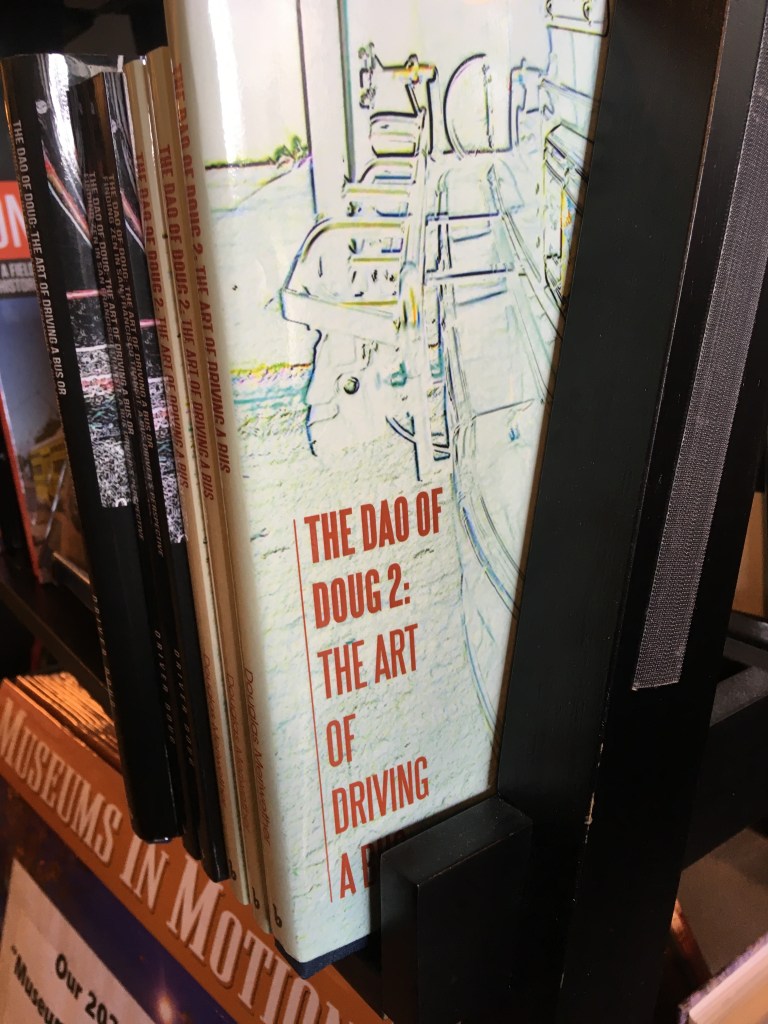
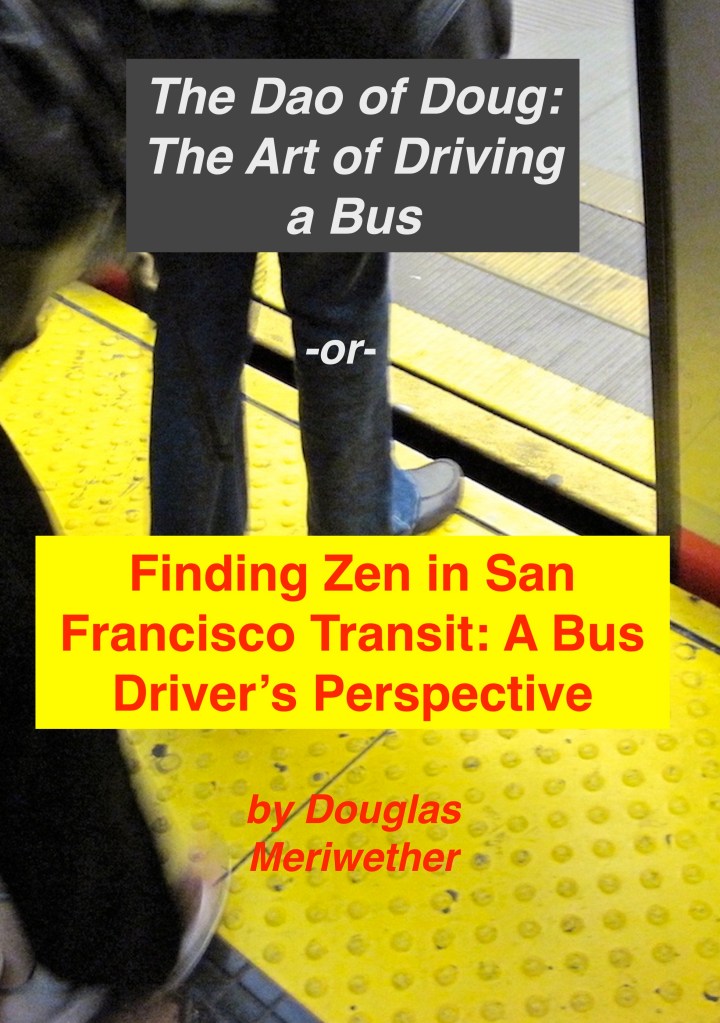


 The Dao of Doug: A Bus Driver's Perspective