Tree Trimming

Of all the calls I make to TMC, (Transit Metro Control), none is more gratifying than seeing the response to a tree trimming request. Homeowners are required to trim the trees in front of their home or business, but this has created some disparity in when limbs and leaves get cut away from our overhead wires. The decision to make property owners responsible for tree trimming has created a dead beat culture that makes for a disparity of time of when a tree gets its branches cut away from our traveling wires. Fortunately, our overhead crew responds quickly, and when they cut down limbs, any complaints from the landlord or tenants about the manner of tree cutting, falls on deaf ears when ‘life and limb’ is made under a public safety action. Fortunately our crew does a good pruning job so as to not distort the tree’s canopy. Even so, trees are forced to grow in a way that is somewhat unnatural as they cannot overhang our wires.

If a building on a corner has doors that open onto two different streets, and only one address is used for the mail, the owner can discount the tree by the door that is not officially recognized as a mail stop and say that the address does not exist, and hence not their responsibility to pay for tree trimming by the unused entrance.  

The delay in maintenance we renters face in our older rent controlled buildings is astonishing. This is matched only by our denial or hesitancy to report or call in a problem to the owner via a building manager. Hence, most repairs come in the nature of an emergency. This can be disruptive, especially regarding water leaks and electrical hazard, and elevator repair. So much of our maintenance culture has shifted to an emergency case only.

The only thing more shocking is the cost of a rent increase in a vacant unit.  Some say that doing away with rent control would bring down rents overall, but most of us don’t believe it in a second. As long as a shortage of housing exists, rent control at least keeps some of us in a stable or more realistic budget to survive in San Francisco. If an exodus of population occurs, such as what happened in 1999, in what we call the dot com bomb, large leaseholders just keep units vacant so as to keep rents up, to wait out the cycle until the next boom. This city has a history of boom and bust, and the siphoning swindle of taking cash from unsuspecting newcomers or visitors. So too goes the escape from responsibility with tree trimming. 

Transit Metro Control no longer asks us for an address for a tree trim request, as the mandatory owner responsibility law for tree trimming can create more problems in a lack of action necessary for safety. When my poles come down from a tree, I do get results very quickly now that the law seems to be off the books, at least unofficially. This is how most city departments work. We can only guess what the current modus operandi is, with or without a law on or off the books! On and off changes baffle even the best of us with what the current Standard Operating Procedure is in play.

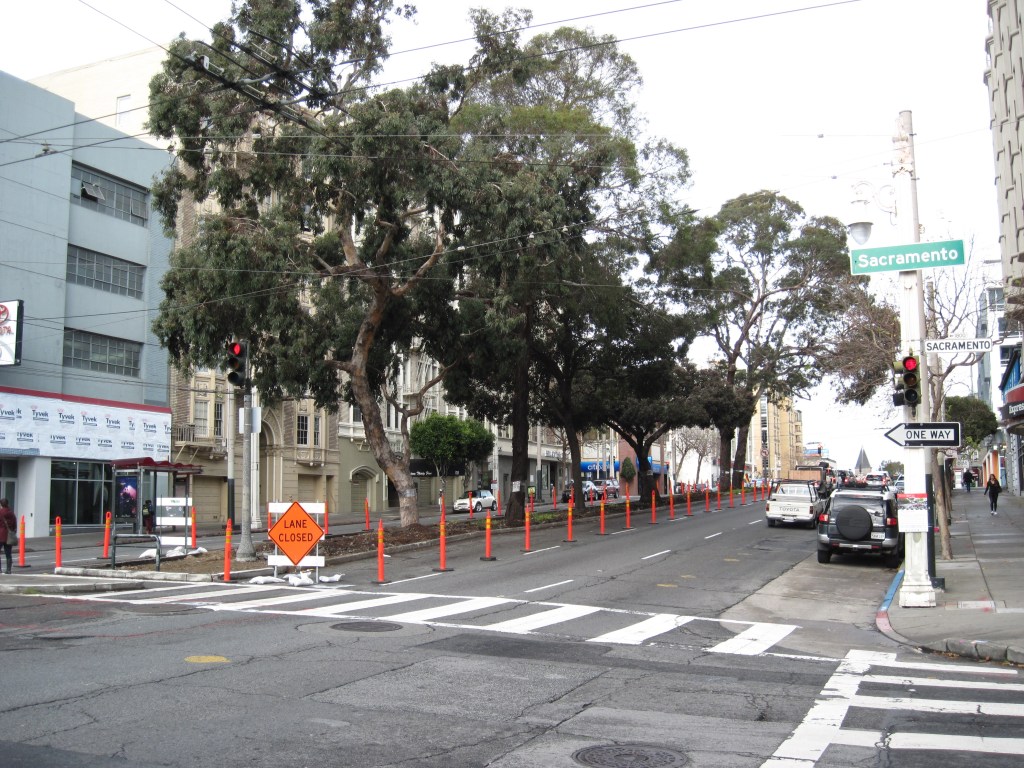
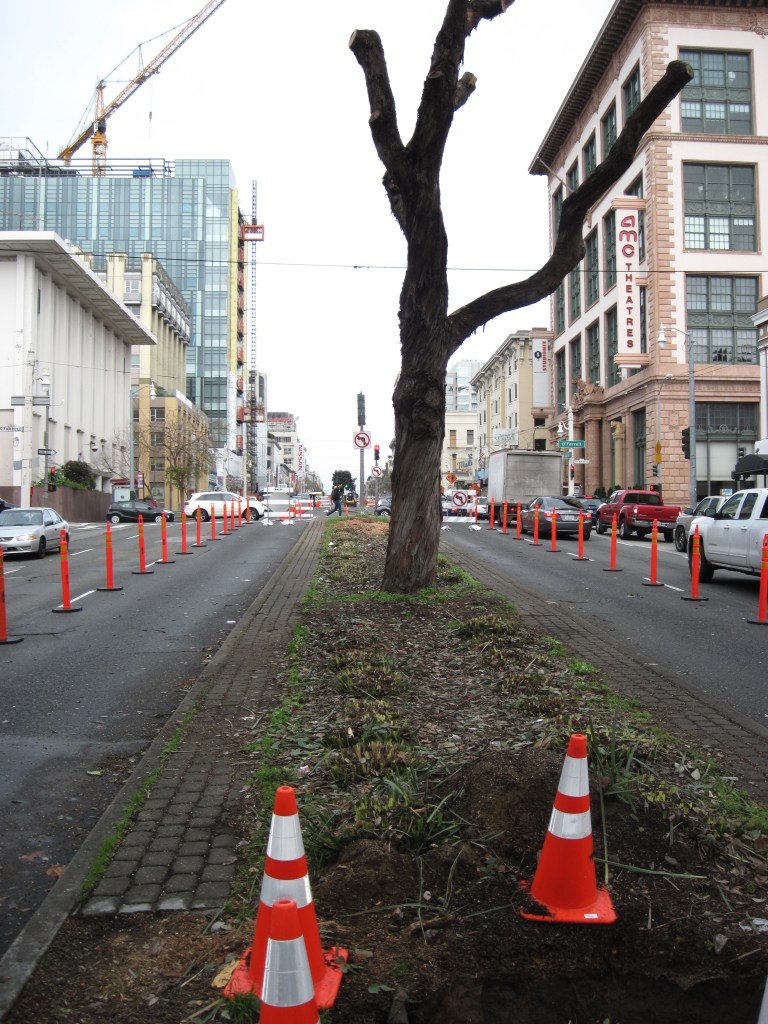
The one good thing about major street construction, when pipes for a sewer or water line upgrade occurs, are that trolleys are moved temporarily to a curb lane and all the overhanging branches get cut down.  I guess this is because eminent domain and public safety are much more obvious to point, hence the fear of litigation remains close to zero. A huge overhanging limb on Hayes was finally cut down because pipeline installation is on the way. Other smaller tree limbs have been cut so we can travel in the curb lane without threat from tree limbs. 

Indeed, as any bobtail delivery or pickup driver can attest, trees on the curb get damaged or cause damage when attempting to park properly by the curb. The fear of tree and vehicle damage make for a double park situation that cuts off free travel in a lane. Tree trimming helps all large vehicle drivers great and small; including trolleybuses, because our poles fall off of the wires when the tap the branches, especially after a heavy rain when the limbs droop lower, laden with water.

A branch from a gum tree inadvertently fell in front of my trolleybus by the corner Walgreens at O’Farrell and Divisadero. Luckily, no one was hurt, and I saw it in time to stop nearside at O’Farrell and call it in. Just a few moments later, a cyclist was hit up the street in the other direction so the line was blocked. Because of this delay with the tree branch, I was put out of harms’ way from the distracted cyclist that got knocked off his bike by another bus. I felt a wonderful feeling of Providence as the tree protected me from harm, from another accident. My gratitude for the shade they provide is immense, and I felt as though this love came back to me by this gum tree.

The Fire Department came in ten minutes to direct traffic, and our Overhead Crew arrived in fifteen minutes. I love it when passengers and bystanders marvel at how fast our city responds to an emergency. In less than half an hour, I was on my way, with all the branches cut down and cleared to the curb. 

A poem follows about our median trees making way for the BRT on Van Ness. I am not saying cutting them down was a bad thing, I am just thanking them for their existence on a hot summer day. I also thank the Friends of the Urban Forest for planting new ones, and can’t wait to pitch in when I have more time when I retire. Hah.

Being in the Zen in transit means the overhead crew has trimmed branches, or we get an immediate response when we make a call after de-wiring!     

Tree Trimming

Thanks for your service,

In the middle:

Noticed very little,

By the by,

Many in the Cars,

The Trucks, the Buses,

Have passed you on the way:

To bars

And you stood quietly,

Giving us fresh air,

As we didn’t seem to care,,

Now that you are bare,

More aware,

Of your trunks, and your twisted

Arms,

Your swaying branches and course,

Oh

—-A lone man takes a photo,

And gives a hug.

It’s Driver Doug!

And he won’t forget that hot

July in stopped traffic,

Where he did stop–

Under your shadow’s shade.

A Glade! A Glad,

Gladiator,

Preventing another radiator,

Overflow.

Go. Go. Go.

Slow.

And wave goodbye.

https://www.amazon.com/Dao-Doug-Trolleybus-Happy-Destiny-ebook/dp/B0BNN6PZSG

A Rose by any Name

One of the subtle aspects of joy about being a transit operator are the many people we see on a regular basis.  We may never talk to them or get to know their name.  They inadvertently become a part of my friends and acquaintance list, even though I have no written list, or what would qualify you to get on it.  After about three ‘visits’ or if I catch you twice in one day as I pass by your routine more than once, you may be unconsciously put on the list. 

At the 33 line terminal on weekends, I would see a nice lady tending to roses behind a narrow fenced “yard” between a house and the sidewalk along our terminal. The rose bushes were mature as they had a thick trunks and looked like they had been pruned many times over the years. She wore a scarf and gloves as she tended to her rose garden. My thoughts turned to my grandma and her sister and the gardening techniques my mom taught me as I paused during my day at this bus terminal. Gardening was one joyful gift my mom taught me as we worked together in a rare moment.

Then, working one weekend assigned to the 33, which I hadn’t signed on to for several years, I noticed weeds and grasses had grown up taller than the rose bushes, and it looked like the yard had not been groomed in this growing season. I was overcome with sadness for my grandma passing, and was sure the unkempt garden was a sign that she too, had passed.*   *editors note: she was evicted, and is still alive at this reading.

A few weeks later, when I did the 33 on OT for a Sunday, the garden was completely gone: no weeds, but no roses either. I wistfully departed, wondering if anyone knew the story of what happened to the garden. There was a big raccoon that would stare back at me from the fence line when the garden was in full swing.  I would pass by after dark, in the wee hours before pull-in, but he wouldn’t talk to me, and I never saw him or her again.

Losing the Zen garden of roses was a sad day on the 33 Ashbury. https://www.amazon.com/Dao-Doug-Trolleybus-Happy-Destiny-ebook/dp/B0BNN6PZSG

Rider Alert

Nothing is more disconcerting than seeing people waiting for a streetcar that isn’t coming. Especially in the afternoon when the fog is rolling in and visitors are caught in shorts and without jackets. If you plan to visit San Francisco between the Fourth of July and Labor Day, prepare for early spring/winter conditions. Even though century mark temps are only a few miles away from San Fran’s city limits, maritime conditions prevail in the city. Mark Twains phrase, “The coldest winter I ever spent was the summer I spent in San Francisco.” applies to July and August in the city. If you are dying of the heat back east and in our Central Valley,  then do come and enjoy our natural air-conditioning!  I am familiar with the challenge of packing in hot weather back home, going to ‘sunny’ California, but not here between the ocean and the bay.

When I do the 21 Hayes, I travel down Market Street and see all the tourists waiting for the streetcar to take them to Fisherman’s Wharf. They pack in to the cars like sardines and creep towards the Ferry Plaza. Little do they know, they can take any bus or trolley down the street to Kearny and take an 8 to Chinatown, Coit Tower, and then Pier 39. 

Any disruption on the rails can block the track and cause a large queue of intending passengers on the islands on Market Street, particularly at Fifth, Fourth, and Main.  At these times it pays to take a 6, 21, or 31 to Ferry Plaza and transfer to the ‘E’ Embarcadero streetcar. An express 8X bus crossing Market at Third to Kearny is a great crosstown ‘shuttle’ to pier 39 and helps to clear the islands and get you moving to have fun.

The SFMTA posts “Rider Alert” signs in red and white, or orange, to let you know when stops and streets are closed to traffic. It’s important to notice these a day or two before an event. Indeed, many who find a never again attitude about transit is because of a lack of communication about rider alerts. This is where an Amber Alert type message can and should be adapted to our smart phones and with GPS technology developed by Uber and driverless car coding. 

Rather than stymie new creative GPS tech, Muni should work with Uber to track not only their own rideshare cars, but with buses. This would open up bus stops to ride share pickups when no buses are arriving or departing. Minutes go by when it is safe to use a bus zone, and this priceless curbside real estate can be easily shared with GPS tech. So too, could the large tour bus shuttles, also be included with this zone sharing. The key here is that transit is being administered as a unified body of vehicles, not separate entities fighting and blocking each other.

As a governmental body, our transit department just had another resignation, and now brings the vacant manager positions to eight. Coordination is lost. Creative new ideas are vacant because self-preservation mode is on, and no bigger picture can be established, much less horizon goals of integration as a whole.

Eventually, Rider Alerts could be all done electronically from an application rather than to have to manually park a vehicle and go out and attach a laminated alert sign to a bus shelter. The labor to then go ahead and remove all the signs would be a thing of the past: Remember, with a sense of community, anyone lacking a smart phone could be instructed by those nearby who do have a transit app on their phones. I ask all the time when I am at a shelter with others who are on their phones.

When Rider Alerts, Next Bus arriving times, and trip template suggestions all match to real time GPS and bus timetables.  Interactive GPS system can suggest changes to avoid congestion and blocking at transit stops. This is really an exciting time to be in a manager position to integrate stoplights, trip tracking, and headway adjustments between Uber, driverless tech, and transit schedules. Transit Metro Control (TMC) needs not be in the dark about conditions and buses. It can see what Uber customers see, inclusive of buses, including the Silicon Valley shuttles.

Being in the Zen means asking others about Rider Alerts and Next Bus arriving times when I am without the phone or application to be in the know. The same goes for tourists on the islands waiting to go to the wharf!

https://www.amazon.com/Trolleybus-Happy-Destiny-Dao-Doug/dp/1723329134

Alpha Dog

People watching is the greatest job benefit of being a transit operator in the Baghdad-by- the-bay. Friends and family always ask about the great benefits a that civil service worker must have in being a government employee. I usually mention the post office as having the best defined contribution plan or pension. But in the day-to-day flow of ants moving to and from the anthill that are the skyscrapers built on the bones of boats in the bay downtown, it isn’t a column of numbers in the year-to-date tab on a paycheck that is a job perk in being a bus driver over and in the arteries flowing from the heart of San Francisco that make for daily job benefits behind the wheel: The benefit is not being stuck inside an office. 

It is feeling as though you are on the outside. Yet when the fog is freezing the bones, the wind is whipping through your layers, the bus is like a shelter from the elements. To comfort those at the mercy of the weather, it becomes important to stop close to the alpha dog in the queue on the sidewalk, so all can enter the bus as soon possible, without blockage at the gate.

Visitors are easy to spot as the alpha dog always holds all the transit passports in their hand for all of the group. They usually follow at the end of the queue. When a large family passes-by the fare box without paying, the alpha comes up the steps at the end with the fares. Sometimes, a large group passes, and there is no alpha with no fare! To keep my ambassadorial role as a representative of the city, I don’t say anything. When I do, they usually have their fare, buried in the back of their backpacks. This is another example of how we fail the city. No one assumes responsibility to inform them on how to ride, where to stand, or how to validate their passes.

A fare only becomes valid once the month and the day or days are scratched off on the passport sheet which is not unlike a lottery scratcher ticket. Fortunately, the 21 Hayes is a great bus line which permits the time to teach visitors. Other arterial lines are not such. Rear door boarding is allowed and little time for conversation is allowed between the rider and the driver. Crosstown buses are best for enlightenment and understanding.

Many times the person asking the questions is in front, and the ticket holder is at the rear. I can usually tell who they are. If they are asking a question I don’t understand,  I ask them where they are going. If they can’t answer this, I then switch over to intuitive mode and say yes and ask them to step up. When this fails, I beckon them with my  hand.

When this fails, it’s because I have put too much expectation and hesitation in my voice, and I have to let it go. A simple nod is all I need. Then, if it turns out they are going the wrong way, there is usually a better transfer point down the line that will get them on the right bus with less confusion. I need to remember when I was new to the city and I did not know inbound from outbound because tall hills or the fog  make it impossible to know which way is downtown or east versus west.

Talking to just one person, the alpha dog as Zen master, is best to keep the herd in line!

https://www.thriftbooks.com/w/the-dao-of-doug-3-the-trolleybus-of-happy-destiny/38040606/all-editions/

Welcome to my collection of Stories: CAR CLEANERS

I am sure these coworkers have stories to tell!  I can only imagine what sorts of things they have had to pick up, wipe up, or mop up in their day.  If there be any sequel to this missive, I am sure the experience of a graffiti cleaner, a floor sweeper, or those that pick up the trash have some interesting tales.  

Dipping dots and chicken bones are not high on my list of favorites.  Neither are the empty cups of mixed iced coffee or smoothies.  Open containers of soda or beer are the biggest bummer, especially when not completely empty.  They can fall from the small platform next to the rear seats and get kicked around on the floor, sending a trail of sticky fluid halfway up the aisle.  We are supposed to do a walk-through to the back of the coach at every terminal. This is important to see if anyone has left anything by their seat.  

I once found a paperback with 500 dollars in an envelope as a bookmark at 14th Avenue and Quintara on the number 6 Line.   I put the book up on the dash before I left the outbound terminal.  Sure enough, when I started back down the hill to 9th and Judah, two young men rushed into the street in front of the bus and  started screaming and waving for me to stop.  This was on a dark moonless night.  I opened the door and held the book up in hand.  

“Envelope?  What envelope?”  I couldn’t resist.  “The money is still there.”  They were relieved to say the least.  It was rent money.  Paying rent by cash in San Francisco is common on grandfather long term leases, but can add to drama and problems when  the money disappears!  

The other big ticket item was a laptop computer.  Fortunately, there was a name and phone number in the case and I was able to call the owner immediately.  They were so happy to get that one back.  With cell phones, too.  I can usually find a recently called number that is a friend of the owner and let them know I have it.  In all these cases, I call Central Control as soon as I know I have something, such that when the lost and found passenger calls Muni, Central lets them know when my bus will pass back in their direction.  They are so happy to see me coming.  

This is probably the nicest feedback and recognition I receive at this job.  It can come so quick and simple, and all I have to do is make a sweep of the coach at the end of the line.  Not only can this result in the most rewarding gratitude from a passenger, but can prevent a nasty, sticky mosaic of soda or beer in the aisle from the back seat to the front seats!   Ice cream on hot day really creates a sticky hazard on the floor.  The cone or stick can become stuck to the floor like crazy glue.  Once a little girl dropped her ice cream ball atop her cone right on to the lap of a nicely dressed woman going to a job interview.  Words to the wise:  when going to an interview, take a cab!  Or at least bring some detergent wipes, just in case!  

And then there is the full cup of joe without a lid.  One person tripped up the steps and doused me and my shirt with coffee.   Oh well, at least the color matches the uniform!  We are allowed to go out of service for up to two hours to get a new shirt, but I kept on going.  Here was the opportunity to state why bringing drinks on the bus was not a good idea, and it stuck!

Newly hired car cleaners have been present on the track and in my coach before I pull out in the morning.  I see them applying the finishing touches on the windows and cockpit.  The floor is freshly mopped.  The bus is spotless.   

I pick up my first passenger just outside the gate. She quickly noted the wet floors as a potential hazard.  I grinned.  Enjoy it while it lasts! You’re on a clean bus!

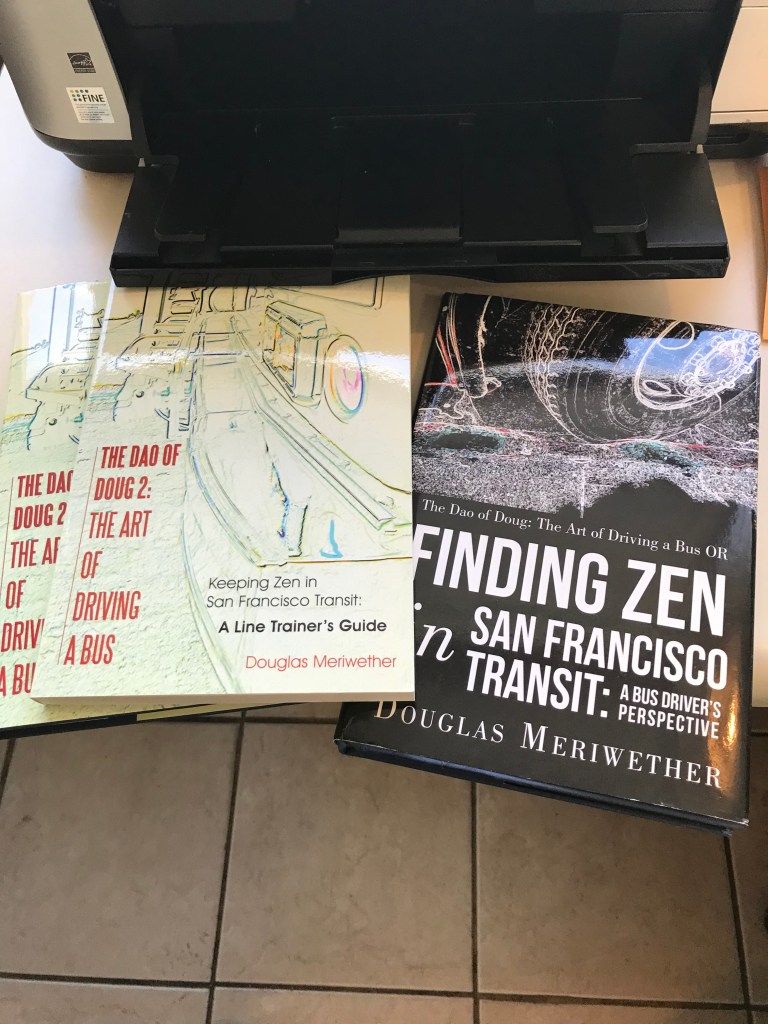
The Dao of Doug 2: Keeping Zen in San Francisco: A Line Trainer’s Guide Glossary 2

 kneeler: pneumatic pistons installed at the front door of a coach that can lower the steps for those needing assistance in placing a load or themselves on to the first step

   lift:  another device located below the front steps of a bus that extends from the bus and on to the sidewalk to allow for a rolled object such as a wheel chair, grocery cart, or stroller to be loaded up to the aisle elevation without needing to go up the steps

   avenues:  numbered streets located out by Ocean Beach in the Sunset and Richmond neighborhoods of San Francisco

   streets:  numbered roads close-in to the city in the Financial District, the Mission, and area South of Market, or SOMA

   islands:  a set of land tips in the most remote location of the world, in the center of the Pacific Ocean, where a stressed out bus driver sometimes goes to in his mind, renamed since established in the Western world, by the Earl of Sandwich. Or:  those concrete medians on Market Street that have a bus stop that takes you south of Golden Gate park to the Inner and Outer Sunset, or take you to an inbound terminal short of the Ferry Plaza.

   curbs: referring to the stops on Market Street, downtown, that take you north of Golden Gate park, and can get you west much faster than the islands when on a weekend with a special event

   crunch zone:  a time and place to avoid on Muni, as items may get picked, or a fight or altercation may arise.  the chances of a bus breakdown are high.

   over there: a phrase to be avoided when addressing an operator. An answer of yes or no still results in no clarity about where to stand.

   flat tire:  a blemish or flattened tread in a city transit bus tire that can create a thumping noise at speeds over 15 mph

   hot lunch:   excreted body fluids on a seat or floor on a Muni bus

   running time:  the amount of time allowed spent on a treadmill at the gym on lunch break: or, that amount of time it takes to complete a trip on a run

   leaving time: used by operations’ central control to mark a time for a revenue or shop appointment for an in-service coach, usually by the inbound terminal.  This commonly refers to time on paddle that denotes time for a coach to start a trip, inbound or outbound

   splits: day shift that allows for a two hour break in the middle of the shift

   feng shui:  literal translation is “wind-water,”  that ancient practice of harmonizing with invisible energies

   straight through: a shift with no break, save for some recovery time written-in on the paddle, which may or may not be true in reality.

   owl: run that works from 9 p.m. to 6 a.m.

   open run:  no operator scheduled in front of you.  (see: ‘Ninth Level of Hell’, or ‘Packed, Stacked, and Racked,’ in first book, Finding Zen)

   timed transfer: a vanishing point, but still followed on the 22 Fillmore at Mission at night.  22’s will wait and see if a 14 is coming, so you can make the transfer.  the 38 and 90 seldom make this, as with the L and 90.  Get that run number!

   Lojong:  the mind training practice in Tibetan Buddhist tradition that treats disaster or adversity as a way to overcome trouble and pain by using the 59 Slogans.

   the wiggle:  a well marked bike route connecting the Panhandle with Market Street, avoiding any hills

   e p u : auxiliary or battery mode whereby a trolley is not connected to the wires

   l p o : late pull-out

   a p c : automatic passenger counter,  can be spotted by the red laser lights on either side of the steps, or above the door by the courtesy lights

   v t t : verified transit training, in which a professional class b operator within a city transit system is re-qualified on bi-annual basis, as is a distinction from tour bus endorsement which carries no v t t card

   range sheets: posted in the Gilley room at the barn where the line and run and bus pulls-out

   g s u : general sign-up whereby an operator can change report barn and may mean use of different equipment or mode

Driver Doug is a twenty-nine year resident of the City by the Bay, and has been a transit operator for the San Francisco Municipal Railway for almost 20 years. His current run is on the 21 Hayes trolleybus line from the Ferry Plaza to Golden Gate Park. His interests include photography and writing, and this latest book, The Trolleybus of Happy Destiny, is a composition including anecdotes and photo illustrations from his experience behind the wheel of a city transit bus.

The Dao of Doug: Finding Zen in San Francisco Transit: A Bus Driver’s Perspective (Dao 1)

Glossary 1

paddle: our timetable or schedule that we pick up in the receiver’s office that comes with our defect card and books of transfers. This entire bundle is called an outfit.

pre-op: usually done on a track in the bus barn and is a term for checking mirrors, lights, radio, horn, doors, wheelchair lift, kneeler, bike rack, collectors, poles, retrievers, operator chair and the set up of the fare box. Operators are given 15 minutes to ready a coach for revenue service.

pull-out: pre-opping a coach on a track at the bus barn to prepare the coach for revenue service. Denoted on a run schedule by an asterisk * These coaches cut-in on a line somewhere on the middle of a line.

pull-in: going home. Coaches are taken out of revenue service, somewhere in the middle of the line. Example: 14 Mission line coaches pull-in at 11th Street, usually outbound and on 25th Street inbound. Coaches on the 49 line pull-in at Market outbound, or 25th Street inbound. 49 line coaches may also pull-in on 11th Street, 14th Street or even 18th Street.

leader: the run and coach in front of you

follower: the run and coach behind you leader’s leader: the run and coach two buses ahead of you follower’s follower: the run and coach two headways behind you not-out: a run not scheduled to pull out, usually a four hour period on your run of schedule

pole-dropper: a coach whose bushings are stiff and locked in an unfavorable position, usually when a coach makes a right turn, so that the poles drop off the overhead wires.

slack brakes: a coach with an abrupt braking transition to the dynamic braking at 3 m.p.h. from the air brakes

hill holder: a toggle switch that holds the coach on a hill without the necessity of applying the service brake.

master: the on/off switch that also has a park charge setting for recharging the coach overnight service or courtesy lights: the lights that come on when the doors are open. The green light over the rear doors means it is safe to step down to activate the rear doors.

run sign: the three digit number in the lower left of the curbside windscreen, denoting what run number is assigned to the coach and operator at the time the coach is in or out of service.

road call: maintenance assistance from the shop to service a vehicle and bring it back in to revenue service.

sick on the run: going out of service in the middle of an operator’s scheduled run

daily detail: a posting of all runs not held by the usual operator

rdo: regular day off

ci: classified industrial: an operator out on leave due to illness or injury on the job

hol: operator’s day off due to legal holiday move up: given by street operations by street inspector or operations central control, and gives permission to leave early from terminal.

pre-empt: a tripper mechanism located in a small box in the wires, favoring a green for an oncoming coach.

far side: not a Gary Larson cartoon, but a bus zone after crossing an intersection

nearside: a bus zone located before an intersection.

bus bulb: a bus zone mid-block where the sidewalk is moved out from the curb lane.

flag stop: made without the bus coming to the curb, usually because another vehicle is in the zone, or a regular bus stop made by or between parked cars. Example: 17th and Kansas is a flag stop both inbound and outbound on the 22 Fillmore.

coach stop: any location where a yellow marker indicates the line number of where you can pick up a coach by signaling for a stop.

multiple line stop: a bus stop serviced by more than one line. Always a good idea to indicate to the operator before approach to the stop that you want to board the coach indicated on the head sign. Looking away is a sign you want another line coach.

head sign: the line and destination of an approaching coach located on the front, sides, and rear of the coach.

destination sign: next to the line sign indicating the coaches’ final stop. Always good to be mindful of short line pull-in coaches having a different destination as peak period ends, usually from 5:45 p.m. to 7:45 p.m.

line sign: the first sign on the head sign that shows you the line number of a coach. If blank, yellow, or red, usually means that coach is short line and pulling-in somewhere in the middle of the line. New coaches display, “Ask Driver.” 

transfer: issued after fare is paid, good for ninety minutes to board another coach to reach your destination. Note: all lines finish one trip in about 45 minutes, so the time given allows you to go to the end of the line and still have time to catch another coach to get to your destination.

headway: the time in minutes between coaches, and changes every four hours.

transfer point: a place where two or more lines cross or meet.

inbound: a bus headed downtown or to fisherman’s wharf. Jackson and Fillmore, Aquatic Park, Pier 39, and Fort Mason are considered inbound destinations.

outbound: a bus headed away from downtown, or from fisherman’s wharf. The Avenues, Dog patch, Potrero, and Third Street are considered outbound destinations.

peak period: that four hour headway between 6 a.m. and 10 a.m. in the morning, and 4 p.m. to 8 p.m. in the evening. Many coaches go out of service in the middle of the line before 8 p.m., which creates the illusion more buses are going in one direction than the other.

streetcar: any number of cars that run on rails and can be the new Breda Light Rail Vehicles, Milan Historic streetcar, or PCC

trolley: an electric bus with rubber tires that has evolved from the box-like vehicle that used to run on rails.

articulated trolley: commonly referred to as a double bus, these electric buses are sixty feet in length and have a joint between the front and rear section.

getting the swerve on: shaving every second of every minute to move up after being delayed, such as by a slow leader.

Muni: short for San Francisco Municipal Railway

Zen zone: that joyful and meditative space on the bus when all is calm.

Suggested Categories/Genres

for the above series of my books

Behind the Yellow Line

“Please move back. I need you to step back behind the yellow line while the coach is in motion.” I state, when the coach is full: Or, if someone does not have their fare ready and they are looking in their pockets or hand bag for change, I say, “I can’t see my mirrors.” The fare box is in a place such that we cannot see our curbside mirrors when someone is standing by the fare box. 

I understand why you guys do this. You’re trying to lock your body in to the yellow hand rails so you can keep stable if the bus takes off from the curb. You are trying to pay and not hold up the bus, so I can go. Unfortunately, it is not a good idea to pull away from the curb without checking to see if there are runners coming up from the back, or if someone is smoking a cigarette or talking on a cell phone too close to the curb, and looking away from the bus. We have several blind spots from our seat, and this is one of them. Our rule is to not move until all fares are paid.

The good news is, some lines have enough time to follow this rule throughout the day.  The 2 CIement has time all day, as does the 21 Hayes. The 31 Balboa and 41 Union are usually OK, as is the 45 Union, but some lines such as the 3 Jackson and 24 Divisadero only have the time to wait for someone to move back and sit in the morning.

The 1 California does not, even in the wee hours of the morning, or late at night. This glaring inequity surfaces as running hot. We are told over and over by managers and from the training department, operators are running ahead of schedule on the 1 California. For the first time since I began, I heard this innocent question asked at a safety meeting, “Why are we running hot?” No one answered. 

I know why. It is because we don’t have the time to run on schedule and take recovery at the inbound, peak period terminal. If we wait too long to leave at Clay and Drumm on the 1, the standing load we will have in store for us begins at our first stop outbound at Davis and Sacramento. 

Because the other terminal inbound at Howard and Main was removed, all persons great and small must walk from Embarcadero BART and Market Street to Embarcadero Building 3 to pickup the 1, so there is no load share to split outbound. The yellow line comes into play as we climb to Nob Hill past Chinatown. The operator of the lead coach with extra headway must skillfully negotiate drop-offs and pass-ups to split the load with his or her follower so the yellow line remains clear.

I lost my conscious contact with experience in projecting my confident vibe while working overtime last Saturday, on the 1 line, and I lost control over keeping the yellow line clear at Grant Street. I was overwhelmed by the number of intending passengers, and did not pass up Kearny as I had no coach directly behind me. I forgot to wait and see if my follower would turn the corner behind me at Davis. Big mistake. 

Weekends have fewer coaches in service, and this makes pass-ups difficult. Keeping the front door closed is the only way to keep the front clear. If someone wants to get off, I need to find that out before I cross to the far side. I can kneel the bus and let them out nearside, so I don’t have to open the front door at the bus stop. This is scorned by those who direct us to follow the rules, but they are not facing the yellow line dilemma. They are sitting behind a desk and not a wheel. One can hope for a “caution and re-instruct” letter, and not time off. 

I can also wait to make sure everyone is sitting down before I roll. The new buses have a new twist because the stairs are located in the aisle behind the second or third doors, and it takes a few moments for passengers to make their way to the back seats. The timing is such that, as they reach the stairs, I am ready to pull away, and this can throw off their balance, especially because they are putting their wallet away, or taking off a bag to get ready to sit. I love the 21 Hayes because I have the time to wait.

Not all lines afford this luxury. The 1 California does not. We ‘walk the baby’ and slowly start to move as the passenger adjusts to find a seat; or in most cases, when the bus is full, to stand and find a hand hold. It is already obvious to us who the newbies are because they are not ready at the fare box. We are aware of the chronics who never have a clipper card, and always pay cash. 

When empty, near the terminal, the other problem is musical chairs”  in which a person cannot decide which seat to take. Use of the rear interior mirror is essential in keeping out of the Superintendent’s Office. Our regular riders are smooth and smart on how to pass by the yellow line and sit. On “weekends, when most new operators work—out-of-towners—and others new to riding—make up a higher percentage of riders, and we must be on the lookout for these wild cards, and stack the deck with a good hand, so we don’t loose the trick.

You can’t teach an old dog a new trick, but you can teach a new dog an old trick. I don’t believe Muni wants new operators to learn the old tricks this old dog has, but I have continually found I have lost or forgotten old tricks, and I am amazed at relearning the rules I never took in to account in the years that passed by.  Moving back has never been a problem for me on my coach, but moving forward has. Our new interior convex mirrors are great for a complete view of the rear. All hail the new Flyer trolleys!

Afghanistan Banana Stand

The US and the UK now have lagging world currencies with real interest rates below inflation – and have money that has lost more value against gold than any other BRICS nation.

all rights belong to their respective owners maneco60 on his YouTube channel, and graphs displayed by fxtop

Mirror, mirror, on the wall, who [has] the fairest [currency] of them all?

c1937 Disney Pictures, from Grimm Faierie tales, Snow White and the Seven Dwarfs

Perhaps the Seven Dwarfs are the G-7 nations of the west? In the above YouTube video by Marios–comes the stunning revelation that Mexico and Brazil did the right thing by raising interest rates in mid-2021 when inflation started moving up–and that now both Mexican nationals and Brazilians–have savings rates well above today’s inflation rates because they don’t face the steep wall of rising interest rates.

Rates like those in the US, coming due on commercial real estate resets and the 1031 dance real estate holders can use to reduce their taxes on depreciation by simply buying another building to offset capital gains. Unlike the liquid LA market, Florida has fewer big time players to smooth out real estate market cap rates, and those residents are really being shocked by inflation’s effects on real estate. Recent bank failures are also a result of the mismatch of Mark-to-Market bond yields of 2021 versus the percent of short term debt bonds now at much higher rates.

Stand by for the reverse repo debt swap facility to blow up above the current overnight volume of 2.5 tn. Yes, you heard correctly, Two-point-Five-Trillion USD.