The Weird Curve

Duboce is not exactly in line with Division, which is not exactly perpendicular to Divisadero, which zigs to become Castro right where Duboce crosses. 

Is Mission one block away from Market? Of course it is, when we don’t count Minna or Stevenson. 

Wait, you mean Valencia, don’t you? Valencia is 15 blocks long and ends at Market on one end at Mission on the other. How could you say Market and Mission are only one block away from each other when Valencia stretches for over a mile between the two? 

Perhaps we should say San Jose and Mission are together. San Jose goes from being the major outbound arterial to El Camino in Daly City, yet ends without fanfare near Fair Oaks as a dinky residential street at the outskirts of the Inner Mission.

How about the streets named after the planets? They should be together in one neighborhood, right?  Neptune is one block from Venus with Mercury and asteroid Ceres on either side. Halfway across the city off of 17th we find Mars across from Saturn, both below Uranus Terrace! Oh wait, maybe I do understand this a little better! Perhaps it would be better to keep the gas giants separate from Venus and Mars!

Beach must be by the beach, and Bay by the Bay, but wouldn’t we rather say Embarcadero travels the piers by the bay, and that The Great Highway is the king of La Playa? 

And the question asked, “Do you go to Twenty-Fifth?” is a loaded with misdirection if asked on Market outbound. Twenty-Fifth Street in the Mission by SF General Hospital is not even close to 25th Avenue that can take you to Land’s End Beach! Even a simple, “I need Tenth.” can have you end up in the Richmond district versus SOMA (South of Market.) 

Every paragraph and sentence up to this point has omitted the word street or avenue, but not here. You must use street or avenue when mentioning a numbered byway. Streets are south of downtown and Market, and avenues are out by the Sunset or the Richmond. Adding to this confusion is the city named Richmond, which also gets interesting in making sure the person is asking for, the Richmond, or Richmond.

Do you go to Union? Did you mean Union Square or Union Street? 

The 31 Balboa must go to Balboa Park BART, right?  Nope. The Balboa bus will take you to the denizens of the deep in the Tenderloin, and not out by Geneva or Ocean by the connection to Daly City  at the Balboa Park BART station. You’d actually have to get off at Highway 1 to take a 28 Golden Gate outbound to get to BART. But don’t get on in the wrong direction, because although this bus ends inbound on the 49 line which does go to Balboa BART, you would have added over an hour and a half, maybe two hours, to your journey!

The bottom line is the answer to your question can be yes, but it is not the quickest way. This brings us to the next qualifier about questioning a transfer. 

“What’s the quickest   way to get to . . .?” 

Being a native New Yorker, I can’t help but be sarcastic in giving the correct answer: “Take a cab. Ride a bike. Text Uber.” But of course, they mean what is the fastest way using Muni. This can get interesting as our city population heads toward one million.* 

We have more bus stops per mile than perhaps any other US city, and this slows us down to below eight m.p.h. What looks like a few minutes on a bus map in the shelter can drag on to an hour when stopping at every light on every corner, or stuck in traffic with unrestricted permitting of ride share vehicles.**

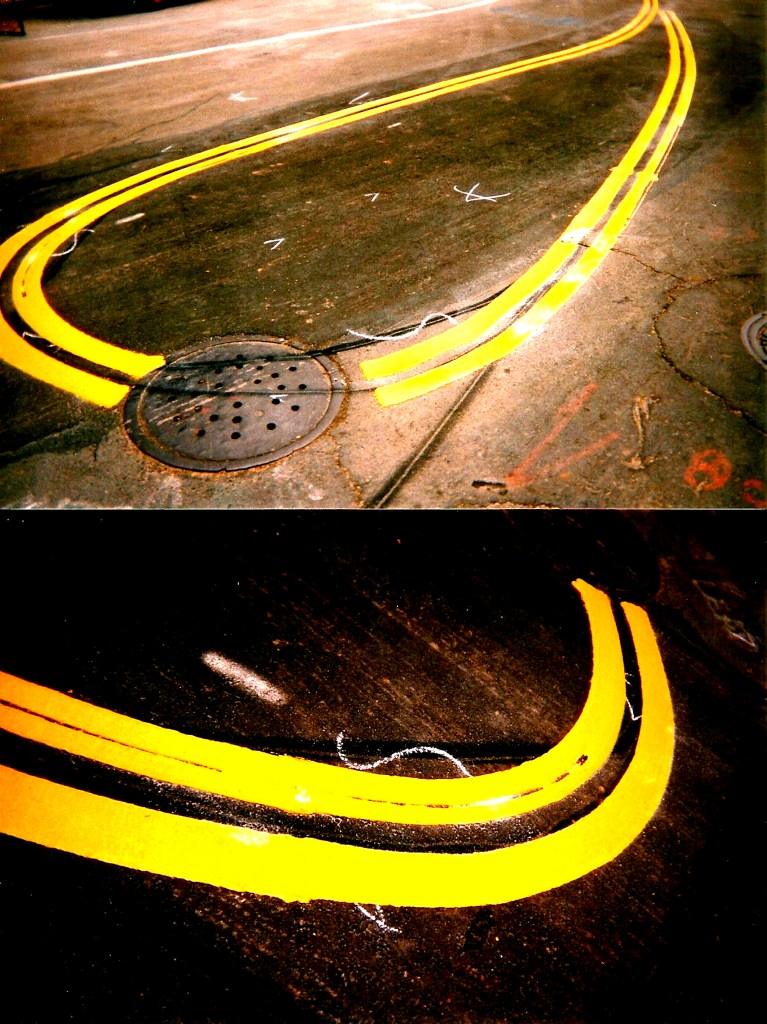
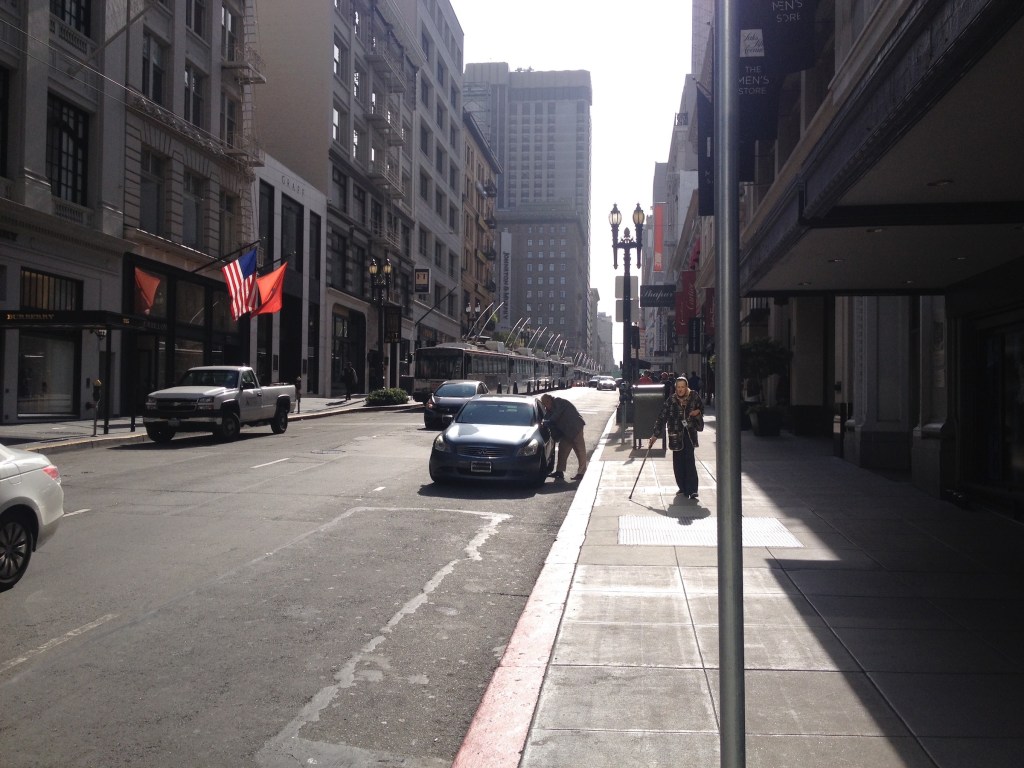
The Weird Curve can be found at any valley break or crest of hill. When Union Street heads up Russian Hill at Larkin, if you look at the curb distance, you see that Union does indeed jog a little in alignment as it plunges down to Polk and Van Ness. Another fascinating detail in league with the Weird Curve is the width of Market Street. Market does not have a uniform width. The building set backs are not the same either. I dare you to notice where the buildings move back to a wider stance when heading outbound.

Also interesting to note are residential street widths around town. As a street leaves the flats or a valley, and heads up a hill, the width narrows. 

Take a look at the buildings along Market Street. They aren’t the same distance apart as you move inbound. They get closer together as you move towards the Ferry Plaza.

Indeed, it takes at least five years of living here and taking transit to get to know how the Weird Curve affects travel directions!

*in 2018 during the writing of the first edition, this looked true. The city was well on its way to one million inhabitants. After the Covid diaspora, however,  San Francisco has lost over 100,000 residents. But no worries. Long term residents have seen this bust and boom cycle over and over. It’s the nature of the history of city as far back as the gold rush.

**after a dismal average speed in 2019, San Francisco has completed the central subway and the Van Ness Busway, both of which separate mass transit from vehicular surface traffic. These infrastructure improvements, complete with a new fleet of equipment, should lead to much better travel time statistics. More skip-stop rapid line runs have been added. Hopefully, recovery time and headways will revert to earlier schedule timetables, allowing operators more leeway to complete their trips, and increase safety and retention.

https://www.abebooks.com/servlet/SearchResults?sts=t&cm_sp=SearchF-_-home-_-Results&an=Douglas+Meriwether&tn=The+Dao+of+Doug&kn=Bus&isbn=

The Complaint Department

Is closed. Or so I was told every time I entered the tower at Potrero by the lead shop man whenever I had to pull-in. Perhaps this message stemmed from the incident with the dirty filter I had on my bus when I pulled in one night.

The clasp holding the grille that protects the filter inside dropped to the floor, and I gasped at seeing filthy dust bunnies on both sides of the fiberglass tray.  Babies were crying and seniors were coughing all day long on my bus. I kept my cockpit window open and was blessed by the Pacific breeze which can remain continuous throughout the day, so I didn’t notice how dirty the air was streaming into the coach. This was my first realization why operators don’t turn on the heat in the coach. On my crosstown ride home on the 22 Fillmore, I finally got the lesson from an operator about the do’s and dont’s of when to use the fan on a bus.

Do turn on the blower to high before pulling out to warm up the cold metal terrarium inside before sitting down inside the cockpit seat to set the controls. Sure enough, after the first five minutes, the blower motor warms up and quiets down. All the collected dust and carbon settled in the tubes gets pushed out from the first burst of air, and air quality improves. Once warm, the blowers can be turned off before picking up at the first bus stop. Don’t leave the fan on for extended time during a trip.

Do use terminal breaks as a good time to reuse the fans to reheat the coach, again while standing outside the coach or using the bathroom. I also learned the valuable lesson about the other drawback to a warm coach: sleepers. So many of us are deficient in sleep hours that it is usually a matter of fifteen minutes of warm interior air that  we doze off into la-la land. Making a coach a hospitable interior climate is not helpful when pulling in on a twilight run! Our twilight trips last up to an hour, so it is key to spot potential sleepers when they board, especially during the first few minutes of departing the terminal.  

Do keep mental track of who is boarding, especially when the aisle becomes crowded and the rear interior view is blocked from seeing who is laying down on the back seats. Don’t allow persons with blankets to board rear if you cannot see where they ‘sit.’ Do pop the brake and stop a sleeper in their tracks when they first board, by asking where they are going. If they cannot answer, politely, and in keeping their dignity intact, state that Muni is not a shelter, and my job is to get you where you need to go. This usually helps in getting an answer. If they are just shining me on, I tell them I am pulling-in. I don’t want you to get stuck far away from where you need to be. If they do answer, I can wake them up at their requested stop. If they are really dead in the water, I have to wake them up a few blocks early.

This may seem like a call above and beyond duty, but the only way to get them off is by going to their seat and letting them know we are at their stop. This saves a call for an inspector, the police, or the fire department later on when I desire to go home. We cannot pull-in to the yard with a sleeper on board.

I do provide wake up service. It saves down time so my follower doesn’t lose me as a leader when I am waiting for the inspector or police to rouse a deep sleeper. On late nights, it is sometimes easier to let sleepers go for a trip or two to catch up on sleep, but there are limits.

So back to my pull-in at the tower and my tirade upon pull-in. I held up the fiberglass baffles and shook the nasty dust on the floor. “This is unacceptable! Seniors are coughing and babies are crying!” Silence. My mind conveniently goes blank on what I said next, but I was full of rage. The tower was full of other shop workers, the yard starter, and other operators waiting on equipment. 

My compassion for safety and doing my job backfires at times in inappropriate ways if I do not express myself at the right time. This time I nailed it. I finally showed an inadvertent omission on an item not considered “safety significant.” I got angry at the right time and never looked back. And there was nothing anyone could say about it from the shop because I was right. And I bore witness in front of all my peers. This was one of those classic moments. 

My “out to get me” conspiracy theory thinking has not served me, but I never knew it because I never stopped to see the effect I was having on others when I would pass anger on to someone else at another time and place. Only by keeping Zen with prayer and meditation do I have a shot at an easier, friendlier way. And so the transference of frustration at hearing, “The complaint department is closed,” thereafter, by the lead shop man at the Potrero tower, to a smile that it is not all about me. 

I now feel the relief of this realization as I sit here and type this in on my netbook. This is why I write. This is why writer’s write. If I were a normal non-writer, I may have never needed to do an personal moral inventory. A secret of “Why?” emerges. It helps get out the crazy. In this case, the nasty dust bunnies trapped in the filter of my brain and behavior! 

Now when I hear the complaint department is closed, I can turn in my defect card quietly, and keep a copy for myself. Keeping a day timers daily log diary helps, too. 

I just had my jacket snatched down at Townsend on the 45!  I left it on the operator’s seat back and stepped off to talk to my leader. I got my uniform jacket back, but my daily diary book was taken. So much for the record from January to June!  Hmm. I wonder if the Muniverse is trying to tell me something: secure the coach when leaving, if only for a moment. Now I have to tie my bag to the back seat. I hate having to worry about security when I am just trying to take a break. This job keeps me on my toes. As soon as I slack off in one area, such as security or defects, the “complaint department” responds in kind! The killer allied incident was when I got my first air-conditioned trolleybus after eighteen years of service without air, and the first passenger I picked up asked if I would turn off the air!

When I am rested and mindful, I am in the Zen to do the right action, and keep the complaints at bay. At bay with the barking sea walruses and seals.

Tagging the Coach

I came back from the bathroom at City College, and saw a young man running away from the front of my bus. He still had an aerosol paint can in his hand as he ran. I knew I had less than 15 seconds to capture the image. I ran to the front door, pried it open and hit the drive cam button. The camera captures up to 15 seconds, with hopefully about 8 seconds prior to button push. I nailed him. On the front windscreen, this idiot tagged both windshields and covered then with paint. I would be unable to move the coach because my view was blocked by graffiti.

I found a soda can at the curb that still contained a swallow or two, and immediately held the open top to the paint on the windows. Like a deicing blade on a cold winter morning, I let the cola drip out of the pop top and used the lip of the can as a scraper. Because the paint had not dried, the carbonated water was great in cleaning off the mess. Score another victory for staying in service without a call to the car cleaners!

The next week, I pulled in to the Phelan Loop at City College and I saw a paddy wagon and several cops standing around with radio sets talking to a youth. I heard them say the fine was $10,000 dollars as they put handcuffs on him. The young man freaked out with a scream or a moan of “No!” as he dropped to his knees.

I didn’t feel victorious or elated. I felt sad. Could there be another way to instill in this young man the consequences of his thoughtless action? The thought of Ripley in Aliens came to mind when the alien egg opened in the nest one last time to find another victim to grab onto and incubate. 

That’s the last straw. You went over the line. It’s one thing to put some initials on the tail end of a bus as we pull away from 18th and Mission, but it’s a whole different ball game to completely block an operator’s view on the front window. 

My motive to capture his image on screen was consistent with the “broken window” theory used by the police in New York City. By clearing graffiti in its tracks by (fixing a broken window stat) and stopping the blight immediately as it occurs, the message, this situation is unacceptable, prevents future abuse.  

I do look at graffiti as an art form and admire the many alleyway walls that contain such aerosol art. Watching the creation process is interesting and informative.  California may hold the record in number of wall tags and wall art; but on the windscreen of a bus?  I don’t think so.

We have event marker buttons to record what happens on the side of the bus, where most tags occur. We now have 9 active cameras covering all interior and exterior sides of the bus. Usually, as I pull away from the zone, I see a tagger hurrying to scribble before the bus moves away. They wear a black hoodie pulled over their head to make facial features hard to detect. I never know if the image ever gets to an authority able to catch the tagger, unless I get a radio call to pull over and wait for a police car to identify the person in the back seat. I usually continue on my way without any confirmation that resources are to be used to catch the taggers. 

The passive approach seems to work best. By marking the time and place, resources can be ready the next week and see if the pattern repeats.  More often than not, it does. It is these patterns, these beats within the energy flow of the city that fascinate me and keep my mind active and interested in what is coming next. 

When taggers come to the front to talk to me after their buddies go to jail, I know justice has been served. Very few incidents occur once the word is out. Sometimes there is retaliation inside the bus before an exit. They come in huge packs so the police cannot discern who sprayed what as they all wear the same black uniform. When they are all waiting at one bus stop to board, I pass by. This means passing up a stop, and sometimes a passenger has to walk back a few blocks, but I try to explain why I didn’t stop. They understand. It’s fewer buses out of service.

Bikes Pass on the Left

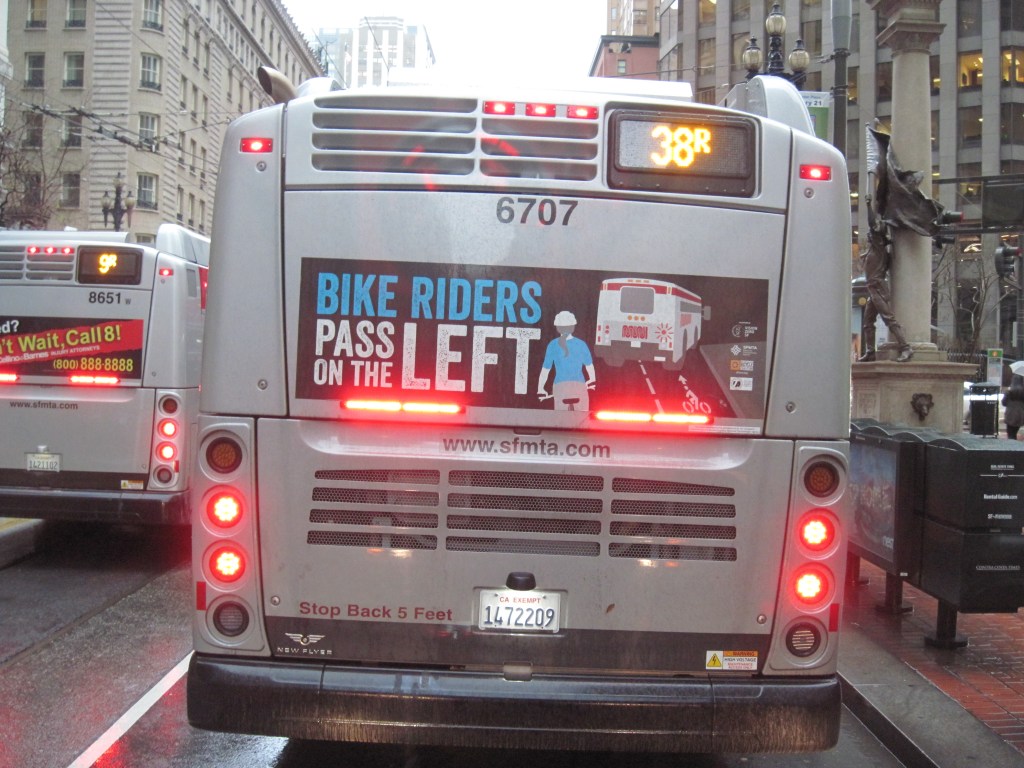
One great billboard on the back of some buses is the illustration showing a bus turned-in at a bus stop with a cyclist behind the bus moving to the left to pass the bus. What a great illustration for a cyclist to see traveling behind a stopped city bus! This message has helped countless times avoiding sideswipe right from a bike getting caught behind or at our rear door as passengers alight.  One of the keys to effective change is to have the message right where it needs to be, and this safety ad is in first place!

Unfortunately, much more needs be done to clarify the do’s and dont’s of riding a bike in San Francisco.

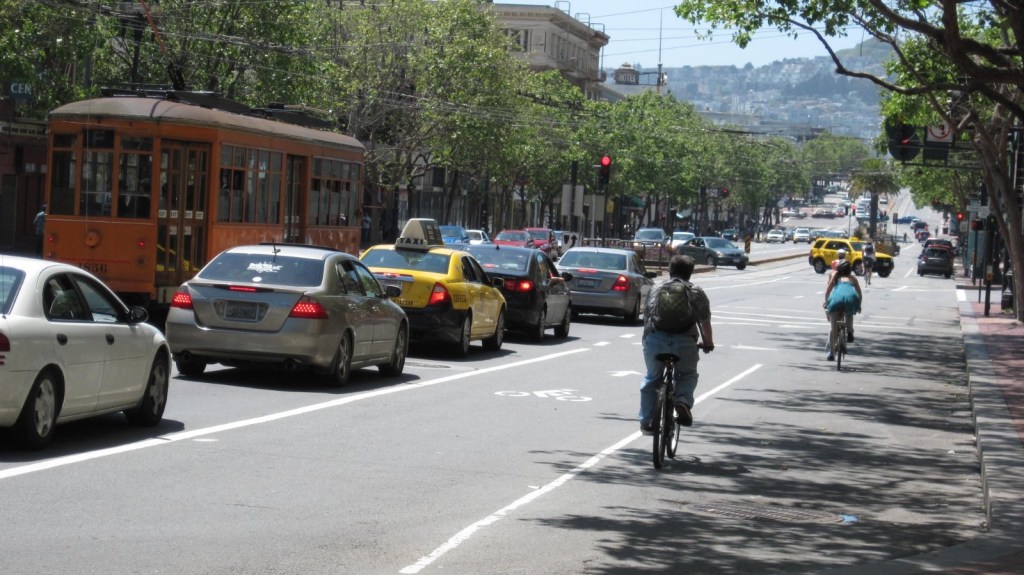
First off, dear bike riders, take the parallel street! Usually there is a nice residential, less commercial street just off of a transit artery that is immensely safer for less conflict collision. Scott Street or Baker off Divisadero for starters. Page Street instead of Oak or Haight. Valencia instead of Mission. Howard Street with marked bike lane  sharrows instead of scary Mission Street. Polk instead of Van Ness.  The list goes on. It just is not safe to be on Van Ness or Divisadero during peak period, or what most call rush hour.

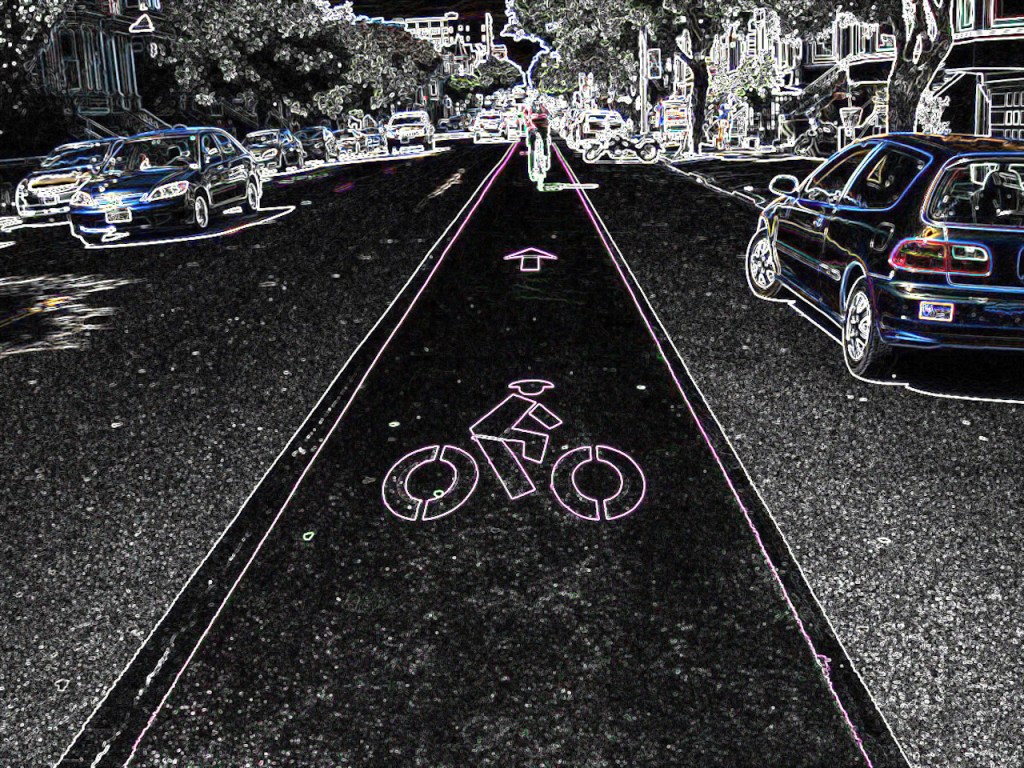
Sharrows are the arrow-like bike icons indicating a shared lane with vehicular traffic. They are stenciled in the center of the lane so cars are not in a reduced width lane because of a separate lane for bikes. All these extra paint marks on the street do make for a confusing first time if you are in a car visiting San Francisco.  What with transit islands and taxi and bus lanes, the driving space for regular traffic becomes constricted. This philosophy is extended to discourage automobile use, but with the advent of rideshare vehicles in large numbers, the squeeze play can become not unlike a video game.  But unlike on a screen, injury and collision are real.

Second tip: Walk the bike. When the space between parked cars and the first traffic lane is not consistently wide enough, walking the bike on the sidewalk is safest. The point is that this bike walk need not be a distance longer than two blocks. Sometimes sidewalks are wide and empty. Taking a driveway becomes the safe in and out. Timing with the car clusters based on the traffic lights also helps smooth the flow in making good time on a bike.  If you know you’re going to get a red ahead, why not enjoy the eye candy along the way?

Third tip: Knowing the lights. Blazing ahead through a red looks really bad. When I see this happen, I follow behind to see if this violation pays dividends. Does running the light make for a faster trip down the line? In most cases, the answer is no. Violating a red light does not make for a faster trip, due to the following red at the next intersection. I would lose my cool and scold the cyclist stopped at the next light. They also block autos from being able to make a right on red as they prance on their cranks or violate the cross walk by being way too close to the traffic lane of the crossing street. 

I stopped trying to control them by chiding them at the next light. It wasn’t worth the cost to my serenity. I let one girl have it at Van Ness and Golden Gate, and I saw the next day that she took another route. Instead of changing her behavior on one path, she diverted to another. It was the safer route: less high speed traffic on a two-way street.

 Our stoplights are not timed. The reason for this is to slow traffic and break the pattern of speeding towards the end of the cycle when all the lights go red. Zipping through on a stale red can pay dividends, and most motorists and cyclists get this. The hard part is then to slow down and submit to the next red if it is not timed. An off-duty C.H.P. officer riding my bus one night told me why there are so many reds on Van Ness. During the dot-com boom, new residents were staying up late drinking and then driving home. The lights were changed to prevent injury accidents.

more cyclists than Muni

Fourth tip: Ride with the pack. This can be dangerous if some in the pack want to pass. Usually, riding just behind the pack is best. Let them blaze the trail for alley car pullouts and car doors. I come behind well lit and at a tracking speed. If they want to rush ahead without lights at dusk, more power to them. At least I will be seen.

Fifth tip: Be seen.  Now some guys take this to the extreme. Some of these new head lamps look like they could be used to mine gold. The intensity of the beam looks like a close encounter of the fifth kind!  But that apparently is not enough. Adding the flash makes for an eye blinding experience, and does not seem to be a way to befriend or influence a motorist to be kindly and yielding. Be wary of pushback.

I did have a newly charged light on flash, and was using the sidewalk for a block on a narrow residential street where the cars fly by in a single lane situation. The pedestrian screamed at me as I approached and severely chided me as I dismounted. I did thank him for letting me know the light was bothersome. I now point it downward to the street right in front of me. I also use the dimmer function if I am on a sidewalk. I also slow or dismount if a pup is on a leash or young ones are playing.

I have since noticed that a light on a bike’s handlebar is even with the rearview mirrors of a car. I use this to my advantage when coming up from behind a car at a stop sign in inclement weather or when its really dark outside.  Being mindful of other cars and other bicyclists has helped me keep my Zen on the streets and in transit!

Bus Bunching

When a delay occurs on the line, and buses get bunched together, it is important to understand that how the bigger queues of people waiting at a stop can influence whether this delay get worse or better. Wise are the riders on the Geary, Mission, and California lines who know on a regular basis, that being first does not mean being best. Or most comfortable. These regular riders know to look to see how crowded a bus is inside before boarding, and also look down the street to see if another coach is coming less than two blocks away.  This one act of looking in and behind a bus saves falls on board, fights on board, and squeeze play delay in the aisle and in looking for seats. The lead bus falls farther behind, as do those behind it.

The biggest help in keeping buses evenly spaced is receiving a switch from TMC central control. By turning back the second bus at a short line terminal, and asking the  leader  to complete a full trip, normal headway can be established quickly. The key is to allow bus number three to leave on time from the next terminal and give the leading coach a break. But the orders for even headway appears to be a forgotten art. 

Roving street inspectors are to put the line back on time after a delay, but this can sometimes take two hours to correct. If you look at each trip being an hour, and a delay occurs in the middle of the line, it is reasonable to expect that the line should be back on time in 30 minutes.  

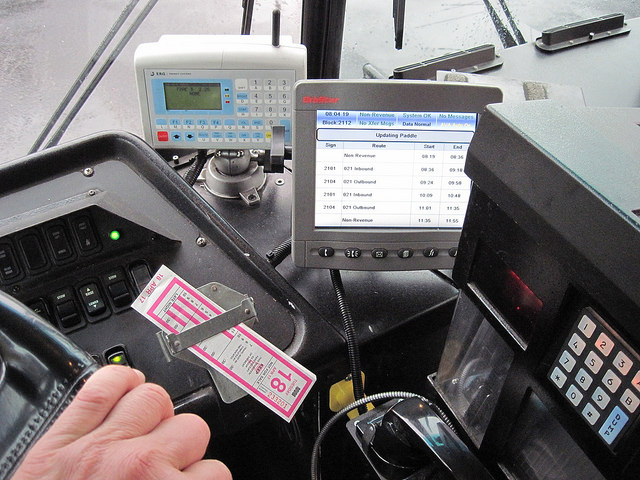
Radio procedures are now being updated with the new software tied to our new radios being installed in our new equipment. We now have the ability to request a headway adjustment and ask for a reroute simply by our touchscreen. 

I am a firm believer that technology holds  many keys in helping smooth operations.  Without these simple communication procedures, the delays of buses did lead to an abysmal on time rating of 60 percent. Knowing when and how to ask for this crucial information can pay dividends.

I recently reported damage to the overhead using the new radio system. I entered in the message of mechanical electrical on the radio touch screen as a marker to my emergency call request. I got called back immediately and described the problem. The best part was that operations sent me back a message saying ‘thank you.’ I felt satisfaction in being heard and recognized. This is a huge step in the right direction in communication between operations and the operator on the street.

Bus bunching occurs and continues if no open communication exists and leads to anger and delay between staff and the riding public. Losing Zen is  easy to sort if no solution appears on the radio.

https://fineartamerica.com/featured/2010-muni-fast-passes-douglas-griggs.html?product=tote-bag

Retarder Control

One aspect of driving a large vehicle is the larger number of lights and controls on the dash. In a tour bus there is sometimes a retarder control joystick that assists braking.   On a city transit bus, the retarder control is built into the service brake. We transit operators can see a retarder light illuminate on the dash after the service brake light goes on. There is usually a delay in braking when the retarder engages. Retarder control is extremely helpful for our long term physical stress on our legs and knees, which can also end up being read by our body as an emotional stress. 

Unfortunately, humans, unlike animals, cannot turn off stress as soon as a fight or flight situation ends. But I do appreciate the fact that our continuous stopping and starting at every corner keeps us city transit operators alert and on our toes, literally. The long uninterrupted freeway driving of a tour bus driver is not necessarily any easier when the miles turn into hours on the long slow graceful grade of an interstate highway.

Before being a transit operator I had the fun of driving the tour bus on the freeways. I say fun cautiously. Bay area highways are no longer that much fun. Traffic slowdowns and backups no longer give the feeling of freedom of being on the open road. As most drivers in the city come to realize, city streets, even with stop lights, become less stressful than highway driving that comes to a standstill. At least, the hope goes, the arterial keeps moving.

This accordion logic to traffic comes into play with how smooth a braking system we have on our coach. The great news is that within two years, all city transit buses will have the newest braking systems called regenerative braking. These brakes are not unlike the retarder controls on the highway tour buses I drove before taking a job in city transit. 

As a young man I thought nothing of any possible stress a bus driver would have. Seemed easy enough to just be sitting in a padded seat and not having to lift anything. But the idea and action of repetitive stress that was lost upon my youth has started to catch up to me as I approach my sixties and my twenty-year mark behind the wheel. 

Anytime new equipment is added to the fleet, I sigh a breath of relief.  I am so grateful my last years behind the wheel will be with brand-new equipment and smooth braking systems!

https://fineartamerica.com/featured/muni-bacarri-worm-livery-douglas-griggs.html

Use a Black Pen

Describe something you learned in high school.

I learned not to use a different colored pencil when filling out an alcohol drug survey in math class. Ms. All-rabid started failing me on quizzes when she realized what I had done wrong by drinking beer and smoking pot and cigarettes several times a week-according to my honest answers in the survey.

Instead of getting the help I needed in the counseling department, I got burned in applying to engineering school because of the one semester of an average grade. Susan Wokeman showed me her quiz with the same mistake I made, but she didn’t get dinged and got an A.

Kitty Corner

“Is this the way to Powell Station?” intenders ask as I open the door.  I tell them they need to take the bus in the other direction. This question gets asked often at Steiner and Hayes across from the Painted Ladies at Alamo Square. They have arrived at the park from the crosstown 22 Fillmore or 24 Divisadero, and are not familiar with where to stand. “Just wait over there,”  I jest, knowing from experience that it won’t help. 

Pointing to the rear of the coach and telling them to cross to the other side to go inbound, results in a polite smiles of thanks, but when I pull away, seven of ten times, they walk in the wrong direction, or stand transfixed, looking to ask again. 

Most United States born and raised folks get it when I say, “Kitty-corner.” Not so with visitors unfamiliar with our common US phrases. The blank stare I receive means I did not get through. Back to geometry class: “The opposite adjacent angles, are not only congruent, by going the other way, but on the oblique corner .”  If this doesn’t compute, then I need to be willing to pop the brake, step down on the sidewalk, and point like a hound dog’s tail right next to them, so there is no doubt. It may not be the patience in stalled traffic that is the hardest trait to master as an operator, but being gentle in answering repetitive questions throughout the day, world without end! Getting my ass out of the seat solves so many problems so fast, I would do well to get the concrete out of my britches, for when I do, my legs give thanks, and I am energized to be in service mode.

This would never happen on Market Street or at Kearny because of a desire to get out of the zone as soon as possible. More runners are coming from the underground and any delay at the door means rear doors that won’t close, pickpockets can flourish, and other trolleys will back up from behind on Third Street.  We gotta go.

Not true on the 21 Hayes, mostly. God bless the Muni lines that still give us time to chat and not shut the door and rush away. At Union Square, however, a large visitor group can throw off the beats to pull away from the curb, and I have to keep it short and simple. Our perceived rudeness is not a personal affront.  It is because of the beats of the traffic, and holding back other trolleys or streetcars behind us in the queue. Cyclists are moving in a pack from the last light at a speed too fast for lane change judgment by motorists. The rails, when wet, can become deadly. The front wheel of a bike fits nicely into the groove and all bike momentum in the front stops.

The simplest way to convey kitty corner then, is to say, “You must cross both streets behind me and wait on the other side of this street.  Choosing Zen to Happy Destiny means I can remain gentle knowing my work is never done. And shall be done again. And again. World without end. Amen.

1976 Flyer turning on to Market Street 2016

Summertime in the City

The inability to see or read the head sign of a bus, or to know where to stand based upon stalled traffic or double parked vehicles notwithstanding, one detail that usually does not escape notice in our fair city is when our air temperature is not fair. The afternoon fog moves in, the temperature drops and those who do not live here become obvious to even the denizens of sidewalk cracks, the suits leaving a tower of high finance, and unfortunately, the thieves and pickpockets looking for quick takes. 

As I drive my bus past the humanity walking by, I point out to visitors on board my bus how we spot tourists instantly. They are curious as to how I know they are not residents of our city when I pick them up. True, the ability to read others becomes fine tuned within our senses as the years add up behind the wheel, but it can also be much simpler.  We key in on what you are wearing.

If an entire family is wearing brand-new hoodies and sweat tops with Alcatraz images, it is obvious the ferry ride over to the famous prison island caught them unawares of how cold our sea breeze hits the skin. Especially true when traveling the rails of a boat over the bay or waiting for a bus on a hill.  

The current gold rush becomes apparent. The gold is not in the hills at Sutter’s Mill. The gold is found by selling hoodies and sweat shirts to tourists at Fisherman’s Wharf; or out of a blanket atop Twin Peaks.  It can even be mined from a handbag held side saddle with a wide-open top or side pocket.

Not limited to the wharf, other places, such as tour bus vista stops, also become a bazaar for clothing sales. In order to bypass permits, vendors have all the shirts and gear lying on large blankets and sheets. If the spotter sees police cars coming up the hill on the road below, they quickly wrap the garments in the blanket and throw them over the rail. The clothing becomes invisible to the police in the patrol car when it passes by the vista point area. 

Most crime occurs because the police never exit their vehicle.  Beat patrols are always requested, but hard to fill. I argue with others that it is not more cops we need, but pavement pounders on the beat. We are not a car culture city. Our streets have not changed when it comes to foot traffic.  In fact, more people are walking than ever before. This is one reason we become slender after living here for a few years.

July is the number one month for visitors: Central Valley residents are beating the heat, Europeans are using their generous vacation time, and the occasional and occasional Midwestern family is visiting a young family member just moved into the city. It’s fun to watch a new city resident train their family on how to pay the fare and ride the bus. I really have to watch my self to make sure I don’t go overboard on being a driver guide instead of a city transit operator, but it makes for a fun ride.

Great places for selfies and shots with friends are the Hearts of San Francisco on the corners of Union Square. Alamo Square by the Painted Ladies has landscaping of new trees and freshly sodded green grass. New plumbing for sprinklers and a bathroom have also been upgraded. The Victorian beauties abound around the 4 block square, and look great as a backdrop for a picture. 

I like to point out the four different styles of the turn-of-the-century architecture, and to see where a house lost a complete story in the ’06 earthquake, and if the rounded windows in the cupola were replaced by conventional flat windows. Lots where a newer house stands, point to a fire, where an old house didn’t survive with its’ neighbors. Our city history is chock full of these old hotspots. Not so with the afternoon temperatures in July!

If you want to cool off on a vacation in July, San Francisco is the place to be! 

https://www.amazon.com/Dao-Doug-Trolleybus-Happy-Destiny-ebook/dp/B0BNN6PZSG

Great Expectations

I pick up a runner crossing from the far-side corner after I turn the corner and wait for him to come to the rear door as I toggle the rear door open.  A little boy with tears in his eyes giving the constant low moaning wail of not getting something he wants, lights up and goes quiet when I hand him a transfer for being a big boy. A late boarder slips in a dollar and takes a transfer from the top of the fare box and moves back down the aisle without showing the discount card.  

Sounds like a commendation on the way for being an expert operator, right?  Fat chance.  In fact, these actions may work against me in the long run, especially with my coworkers.  The common thread in these three examples, and many such others is this: I am creating great expectations.  The most cunning baffling and powerful demon facing a transit operator within this City by the Bay are unrealistic expectations from the service provided by the SFMTA.

Allowing large tour buses to use our bus zone for pickup for a dollar a day is an unrealistic expectation from our elected leaders about the value and worth of this curb space real estate, and keeping the city bus running on time. Not reading the head-sign of our coach, and asking questions after boarding and passing the yellow line, create distractions and delays. This need not be if the questions were asked at the bus stop while waiting. Separating yourself from those waiting for ride shares and shuttles, and those who have not bathed for several weeks also helps in getting our front door by your side.

Texting on a phone or wearing earbuds cuts off this important connection between riders.  All of this has a theme: a lack of willingness, coupled with great expectations, leads to failure of service. The failure to make a ride on the bus.

Here are some tips: if you can’t make it to the bus stop by judging the coach speed, don’t run away from where you are. Moving targets are hard to hit! Move to the corner where there is a stop sign. We don’t want to make an extra stop, and if you are by a crosswalk, stay there.  Step down, when safe, and raise your arm to hail us. The biggest mistake is that late runners run toward the coach, shortening reaction time to make a stop. If anything, walk in the same direction of travel as the bus, extending stopping time, and then raise your hand and stand still. Step down where we can see you, and create a fixed point.

You don’t have to run across to a far side stop, just wait at the near side corner, and smile. Most stoplights are short in cycle, and we’ll probably get a red by the time we get there. When you are in the Zen and remain calm and project dignity, you will appear attractive. We don’t want to pickup distracted and annoyed energy. Pounding on the door does not increase your chances if you want to get on the bus.