Morning Rush

We all know we try to cut it as close as we can and get away without wasting any time. This image of efficiency is to take the bus without any waiting time. But just like a Mad magazine comic strip, if we are all making the same determinations at the same time, we invariably create our own hell.

What I came to believe from the run from hell, was to note at what time was the point of no return for folks not able to make it the elevator to work before the clock strikes nine. And I found, down to the minute, that someone walking out their door at 8:22 a.m. in the avenues of 22nd and 23rd, could not make it to work in time downtown. The last express just passed by at 8:21 a.m., and my coach would fill to the brim before I even got to Park Presidio, which is around 14th Avenue. If someone walked out their door by 8:15 a.m. they stood a chance to make it to work on time, but they were still risking it.

Indeed, the window of vulnerable time was actually about six minutes, which coincidentally was the headway between coaches, and that this time window seemed, at first, to be a plausible time to allow for getting downtown. It seems reasonable to make it downtown in 42 minutes from 22nd Avenue.

But not when the Muni system is challenged to peak capacity, when many are traveling in the same direction at the same time, to get to a destination within a few blocks of each other. The many new tall buildings downtown have made a mess of trying to catch a bus after 8:20 a.m. from the Avenues or from beyond Masonic Avenue. Pass- ups become frequent during this time frame as there is simply just not enough capacity to bring that large of a swarm of people at once to work by 9 a.m. on the dot.

And so I started looking at the passenger loads of buses that were to arrive downtown by 9 a.m. And sure enough, the passenger load was very telling. A bus arriving downtown at 9:15 a.m. or 9:22 a.m. was much emptier than one scheduled to arrive on or before 9 a.m.

But crosstown routes were another matter. Crosstown coaches were less influenced by the peak period flux, but their drop offs at transfer points were critical for inbound downtown coaches.

My leader, god bless him, was able to “escape” past the transfer points before those coaches dropped off their passengers trying to transfer to get downtown. And this “transfer cost” had a lot to do whether people could make it to work on time, or whether they stood waiting for a downtown bound coach already too crowded to take on any new transfer passengers. But I also came to believe it might be impossible for scheduling to try to take all this in account and place extra buses during this witching hour.

The bottom line I came to realize is if individuals found they could not make the trip in a timely fashion, they would have to move-up at least ten or twenty minutes to avoid the bind. The supposed injustice of this model is that at some point after 8 a.m., the time it would take to get where you needed to go, was much longer than someone leaving the house at, say, 7:30 a.m. And so, if there was some magic wand I could wave to business leaders to make the perception of transit doing its job and running on time, it would be to stagger work start times in 15 minute increments, so that no one large group of people would be required to clock in at one specific time.

The patterns of going home do seem to support this idea. I noticed although the start time for people going to work was relatively cut and dried, the time people leave work is spread out over a longer time frame, as people may do other tasks before they get on the bus, such as staying at work a little bit longer. Also, because there was no deadline to get home in the afternoon as there was to get to work in the morning, this more relaxed attitude helped make a better environment for the bus driver in the p.m. rush. Usually.

And my tip to those up and comers working downtown, or to those looking to ask for a raise: show up early and get more work done when the office is quiet. Relax towards the afternoon when everyone is just playing card games or surfing the web at their desks. You may find your ride on the bus is much more pleasant when not on the ball and chain schedule of those arriving downtown by nine a.m. I’ll bet your productivity would skyrocket if you came in two hours early to get stuff done without constant distraction. Not every day, mind you, but you might be surprised at how much faster you go to sleep and how much easier your commute in the morning and afternoon might be if you stagger your self earlier.

In San Francisco we do have sort of a split workforce. Many traders in the market, or manning the screens for trades are set on East Coast time and so they arrive early to work, and get off around 3 p.m. These guys do seem a lot happier than the ball and chain nine to fivers. And when they get on the bus in the morning, sometimes with tie in hand, you can’t always tell if they have had their coffee. But for those after 8 a.m., I would suggest that you get your coffee near your office if your breakfast routine is dragging you down before you go out the door. In any event, if your morning commute is not working, try something different. I have seen the creatures of habit who are just miserable. Those who are more adaptable seem to have a better go of it. And taking a Zen approach brings dividends.

Where to Stand

Most of the time intending passengers are not standing where I want to place the front doors. Folks don’t seem to understand what it takes for a forty-foot or sixty-foot vehicle to come to the curb, and then have enough room to pull away leaving a four foot clearance from any object or vehicle parked nearby at the head of the zone.

If pressed for time, I can always do a flag stop. A flag stop is when I keep the bus parallel in the traffic lane and drop the kneeler to have folks step off of the curb and come to the door. Only problem is, if there are those waiting who have mobility problems, not coming to the curb is also a problem. Using the “body english” of the coach, I can control how long I spend in the zone, and where folks must migrate to get to the door.

If I am early, I can make people walk a distance on the sidewalk to come to my door, which may not be where the majority are standing. If I am late, I can flag the stop, and pull away faster because I have clear visibility to the rear in my mirrors because my bus is straight, and I can see far back to see approaching cars. Problem is, when I am late, I am usually heavy, and have standing room only. This is when flagging a stop and not coming to the curb may be a problem because usually seniors are present, and the kneeler may groan in trying to rise after I pick up because the aisle is full, and the bus is heavy. Use of the kneeler can damage the suspension and cause a fall on board.

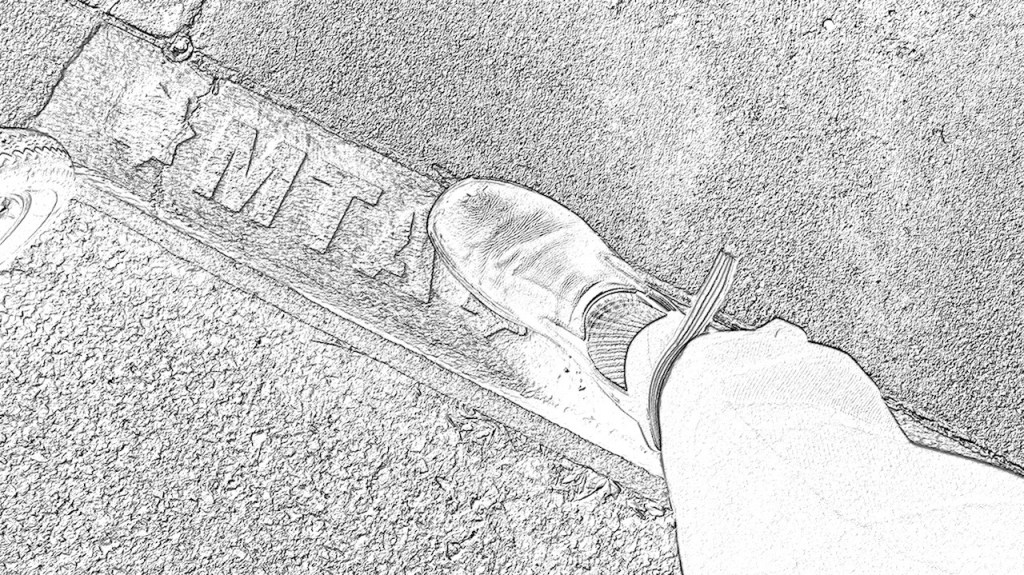
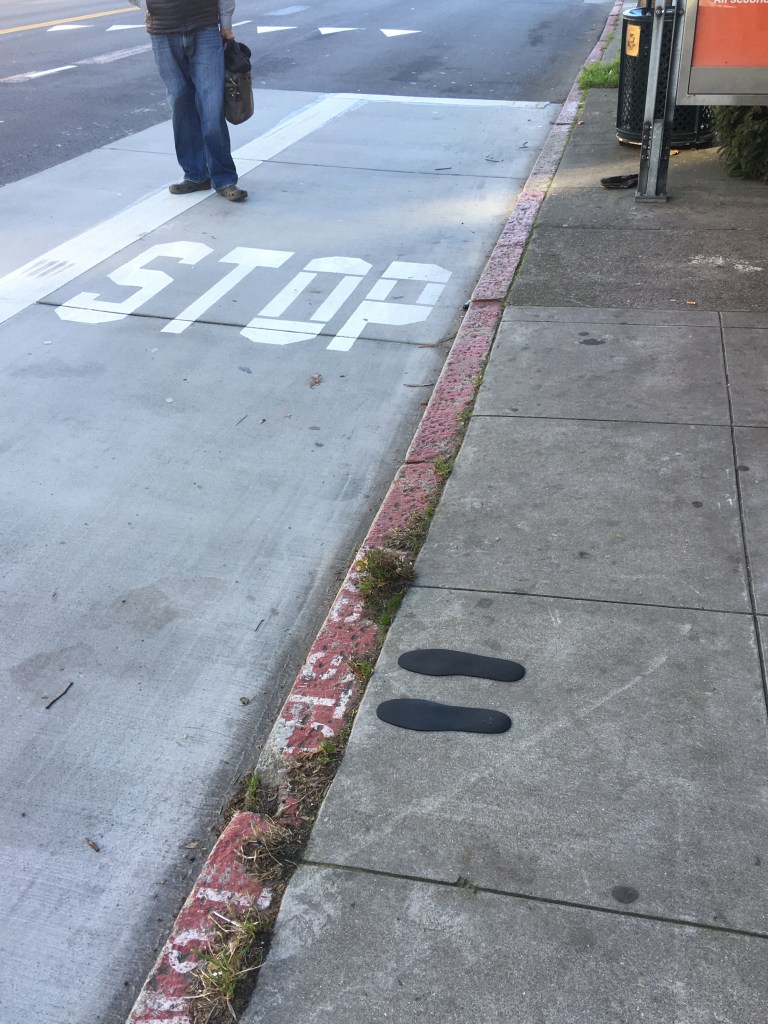
So a rule of thumb that some operators may not have experience to pick up on, and what most passengers seem to be amiss about, is the painted stencil on the red curb, usually between the two MTA stars, that says “bus stop.”

These stencils I have found, are accurately placed as the best place to put the front door. The stencils are roughly the distance between the two sets of doors. I don’t understand the coincidence of this, and why it works so well, but this is generally the case. I have had issues with where the various stencils are placed to mark our breakers and switches on the street, but the bus stop markers are highly accurate. So if you want to “be the man,” or the “woman” who gets to be the first on the bus, here is what you can do to increase the odds that the bus stops where you are.

When the bus is one block away, and say, gets a green light at the corner before the stop, slowly wave your arm from beside your leg to a point halfway up or perpendicular to your stance, back and forth, when the bus starts to move a block away. If you are standing mid-way from the top of the zone to the first stencil on the red curb, and there are no double parked cars at the head of the zone, or encroached upon the zone rectangle in the street, you are a “winner.”

The bus will stop right where you are standing and you can be the first to board, especially if you have your pass or card visible in your hand when the bus approaches. Kudos and good karma, you’ve got the Zen in San Francisco transit!

Stopping and Starting

One of the most challenging aspects which takes its toll on the body is trying to maintain a smooth start and stop, particularly on a hill. All coaches are not equal. In order to maintain an even stop on a hill, some coaches require 40 to 60 percent more force on the pedal, and then, at 3 m.p.h., where the dynamic brake kicks-in, an abrupt off pedal feather to prevent a lurch.

Slack brakes are what cause the abrupt lurch after the air brake disengages right before the full stop. On a heavy day, with many hills, this can cause the calf or hamstring muscles to “complain.” In order to keep hearing “thank you” when passengers alight, much torque force and muscle tension must be applied on a regular, staccato, repetitive manner. Sometimes we use the hill holder toggle to hold the bus instead of the service brake. This is a no-no.

As a passenger, especially if reading or texting, be mindful not to use the canvas hand-holds. This places you in an unstable mode. These loops are for sitting down or getting up only. If we start on a hill without first letting off of the service brake, you can feel the jerk. It is easy typing this information on a black and white manuscript to state that using the hill holder is not advised to release the brakes on a hill, but after hours and hours of double headway, fatigue sets-in. Our jerk is not necessarily from laziness, but of preservation of our quads and hamstrings.

If the time behind the seat is for more than four hours without a break, and you are missing a leader, this makes it difficult to walk up the stairs after work! Keeping my body from falling apart as I add on the mileage over the years of driving a bus is definitely a challenge to be able to stay at work and be in the Zen zone!

Dust Cover Jacket


“Do you have a car? Yes, I do, and your sitting in it! Today’s car number is 5481. I get
a new car everyday, and I can hold up to 50 people at once! I get to take you where
you want to go and get paid to do it. I don’t have to worry about parking and I can call
on my phone here to get help from crews of people set up to help me keep going. I
don’t have to pay for gas because this car uses free power from O’Shaunessy Dam at
the Hetch-Hetchy reservoir. Parking is free, and I have a camera to send a bill to
someone blocking my parking space. If there is any trouble, I can call for help from my
phone, and it can be here in three minutes. The police are my friends and co-workers
and also here to help.
I sold my truck when I moved here to pay for the deposit on my apartment, and I haven’t
had to pay for tires, batteries, gas, parking, or insurance since I got rid of it. My
employer is my insurance company. The money is coming in, not going out. I enjoy
driving very much and am glad that I am not polluting the air by driving you to where you
need to go. It’s kind of like the ultimate in ride share, without any carbon emission!
Thanks for riding in my car today!

Not My First Rodeo

Dents and dings notwithstanding, one can tell how much time one has behind the wheel
by looking no further than the defect card after making relief. Senior operators can roll
with whatever they have been given. Others, take “safety significant” to levels seen
only at the National Security Agency. The biggest variable to accepting equipment,
headway, and, as training calls; weather, traffic, and operator; is the personality and
style of who is behind the wheel. We have terms for the style of movement an operator
has during his or her run. I have a reputation as a runner. With Mars in Aries and my
second house rising in Leo, I have a charismatic demeanor that may come across as
non-diplomatic, though I love to show my sunny side. This, however, can get lost in my
strong desire to go: Mars in Aries, born in New York, “We gotta go!!”

Anyway, I see how what may be a good schedule during one sign-up can be come a
set-up for failure in another, depending upon the headway between transfer coaches,
leaving time of a leader, and how fast one can push stale greens. I have learned to eat
fresh greens, and this pause at a stoplight has turned my style in to that of being a good
guy. By stopping well behind the crosswalk or stop line, and looking at the “show” on
the street, all is calm, all is well. Turk, Eddy, Post, Harrison, and Kansas are streets,
just to name a few, whereby I do a self-check-in to see if I am pushing ahead or laying
back.

The space cushion we are seen observing by driving down the hash mark of a two lane
street, is actually a safety method which pays dividends at crosswalks and busy corners
with bikes and pedestrians. By stopping back from the stop line, all problems with
conflict at intersections has reduced dramatically. Problems now equal zero. The
recent paint request to install a chain of triangles behind the stop line, has been a great

help for motorists to observe our passive example of keeping a space cushion in those
crosswalk areas where pedestrians don’t stay between the lines. You can see these
triangles at Francisco and Columbus by the Wharf, and near UPS at 16th and Utah.
Use of the horn has gone to zero, as have car horns directed at me. Operators with a
reputation of dragging the line and that use the horn are, quite frankly, an
embarrassment to me, and I have had to leave the bus, if I am a passenger in transit,
on their coach. Indeed, diplomacy with co-workers is perhaps, at the end of the day, the
biggest challenge to face with time behind the wheel. Did my hand signal to move up to
the top of the zone at the terminal actually show an angry hostile flip-off with fingertips
down, in a condescending brush-off motion, or was it an Alleluia, praise God, hands up,
palms facing, show of Grace! I am reminded of how often it is not what is said, but the
“tone” with which it is “said.”

The Fare Box

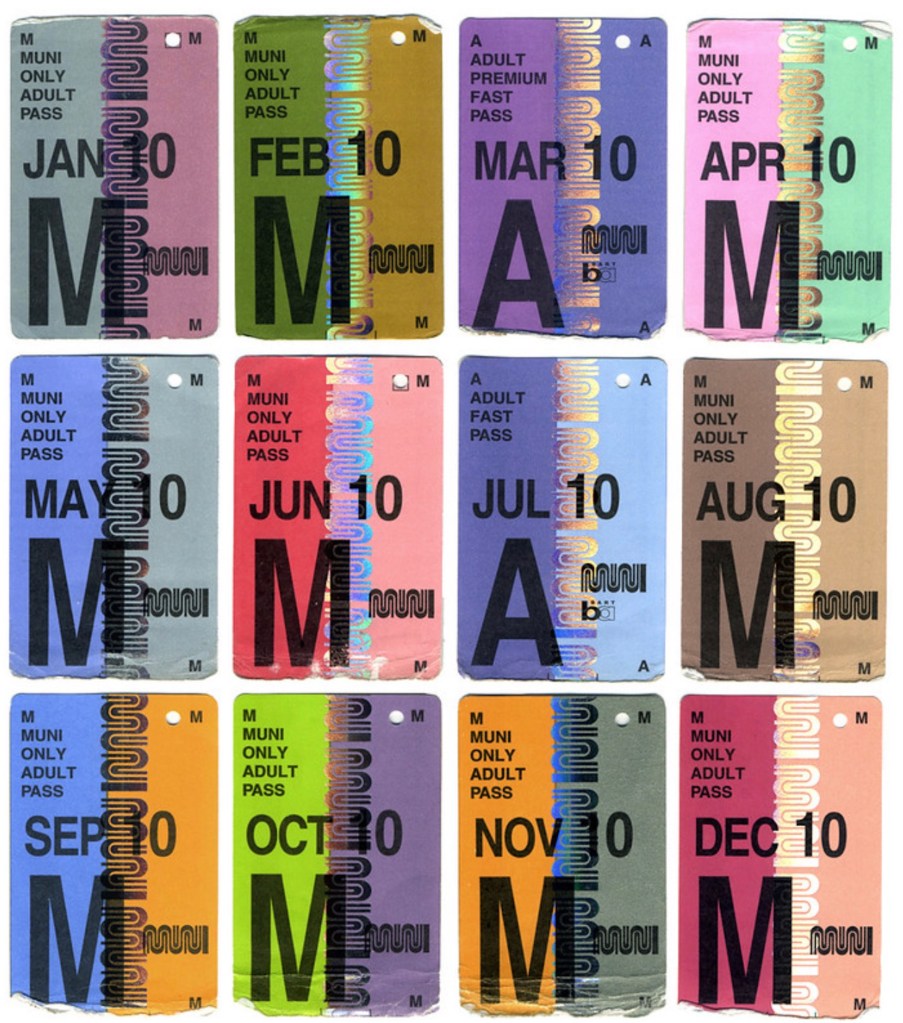
Sadly, this favored chapter in book 1 has become a nostalgic memory. Renew your fast pass today!

Surveys of time use show much time is spent in the bus zone loading passengers. Although this would seem to be a revenue loser as those who board in the rear would be evading the fare, my experience has been most riders are honest and pay their fare share by coming to the front door to get a receipt or transfer. Those who enter in the back because of wheelchair boarding or kneeler requests, do come to the front from the aisle to get a transfer, and pay their fare. By believing most people are honest and abide by the unofficial honor system of paying for their ride, I have reduced almost all problems and delays at the front door and fare box.

This surrender on my part has made my job a lot easier, and I always try to be of service if someone is a little short, but needs a ride. This took me several years of discovery, as I am somewhat of a perfectionist. My Mars in Aries has reared its ugly head with some fare disputes that got me in to trouble. And the idea the riders also can train operators by their feedback, even if it is unpleasant. Being rude or appearing nasty is a fast behavior modify if ever there was one. How riders react to my statement of what the fare is, over time, gives me an idea of how I am to handle myself, or set the tone of requesting the fare, without getting in to an argument.

The obvious dilemma one first realizes as a transit operator, is how oblivious passengers are in expecting us to see their fare in the first place. If I had one wish to click my heels to make come true, it would be for boarders to see how impossible it is for us to check their fare. If it were a problem with less than 10 percent of people riding, then it would seem like I am being picky or controlling, but over half of the people boarding do not show their fare in what I would call a thoughtful or honest way. Granted, as two columns of people board at major transfer points, they pass by quickly if I am lucky, but the way in which I am to look at their fast pass or transfer is ridiculous by any standard. By injecting humor in to the situation by stating there are two lines, fast track and exact change, and motioning to imaginary two lines at the front door helps interrupt the pattern of blocking that occurs from tagging in on the one side, and the fare box on the other.

So there should be no surprise why the majority of operators appear to not be looking at the fare when it is presented. Almost no one appears to be concerned we have a chance to actually look at their hand: I’d say less than one in ten boarders actually shows me the fare in a reasonable way. I’ve learned if I turn in my seat to face the door, and appear genuinely interested in looking at what’s in your hand, then odds do increase for proper fare presentation.

What the majority don’t seem to understand is that front door boarding is no reason for a reduction in fare evasion. People showing fare properly at the front door are such a small fraction of the total, that to us as operators, it makes no difference what door people enter. Hopefully with the newer cameras, if anyone is actually viewing images, they would see it virtually impossible to see most fares, even at the front door.

This brings us to the various styles of impossibility of “fare evasion” by those coming to the front door. Once again, what I have just said is contrary to the start of this Chapter when I said most people are honest, and abide by the unofficial honor system. There seems to be a paradox. And indeed there is. While I said most people are honest in paying the fare, I also said they are clueless about how useless their presentation is, for us to see. And bereft of knowing what they are showing, after countless times being berated by them for questioning their fare, taking my request personally such as an attack on their character, I have learned how to ask for the fare without too much backwash. So here are some of the major “food groups” of fare evasion. Remember, I am not saying these passengers don’t actually have a valid fare. What I am saying, is for the purpose of checking the fare, these maneuvers constitute fare evasion because we cannot determine if the fare has been paid.

The Wand

Like Merlin the magician, or something out of a Harry Potter movie, these people move their arm in such a wide swath it is a miracle anyone can see what the hell it is they are holding. We have many types of pass ID acceptable for fare, but it doesn’t matter, because we can’t see what the hell it is people are showing us anyway. This does not mean we should not make an effort to look at people’s hands when they board, and it definitely does not mean we should just rationalize in to not checking at all.

A hardworking driver was asked by a man why he wasn’t asking for the fare for those who boarded in the rear, and he replied that they do it all the time. He got written up for a passenger service request (PSR) because this is against the rule that we ask for the fare by stating what the adult fare is. He could have asked to see the fare of those boarding in the rear or by making the announcement to please come to the front if you need to pay your fare, but he didn’t.

These small nuances can come at any time at any place, and we have to be ready to do the right thing. If we get distracted by another question, or are in our mind about something else, these small rituals throw us off and we get mail. We get a letter for a review about our behavior when we can’t see why this is so.

If we talk to other drivers about this at the relief point or in the receivers office, we usually get the right answer. I would rarely ask for help or feedback when I was new, and this added years of distress that did not really need to be there. So when the wand goes by, we need to always be ready to do the correct action. Ask for the fare, even if the person whipping by us never stops. Most times, the wrong person usually stops to question us. “No, I wasn’t asking you. The fare is two dollars twenty five cents.” And that’s usually the end of it. Just as in calling out transfers and destinations, it matters not the right person hears us. Just that we were following the rule.

Our most honorable Mayor, Mr. Gavin Newsom, when riding on a cable car, made the observation that the conductor was not checking fares. What he may not have known, is we become accustomed to our regulars. We know who has their fast pass, and after the fourth of the month, it is not necessary to see the fast pass every day. Just because it is not apparent that we are checking every fare, does not mean we do or do not know who is paying.

The Jack-knife

In all fairness, there are those seniors, and those with mobility problems that may make coming up the stairs a balancing act. I have to be mindful of being of service, especially towards those with mobility problems that may not be visible, however, can we at least make an attempt, once in a blue moon, to at least show the operator that we have a current valid monthly pass? If the month is new, and we are a regular, isn’t it reasonable to show the operator at the beginning of the month that we have our new pass?

The jack-knife is accomplished like the wand except for an excessive up and down motion with the arm holding the pass. Made to look like the arm is a counterweight to the balancing act of climbing, there is no chance in hell our eyes can focus on a pass that is moving up and down at or near the speed of light. Just because you are holding the pass does not mean we have the ability to see it.

When I explain that this is the fourth of the month, and many old passes have expired, this usually helps. If a regular rider becomes offended that I am asking to see their fare, I respond by saying, “Yes, I know you are a regular pass holder, but I haven’t seen you with the new pass yet.” If the fourth day of the new month is after a holiday, I give grace for this. “Are you going to get your new one today?” Then things get better. “You need this transfer until you purchase your new pass, I don’t want you to get in trouble.” This heals all wounds, and prevents me from being perceived as a heel. The great reward at first impressions was when days turned in to weeks turned in to months, without anyone taking my fare checking personally. This took me over five years to be able to say this truthfully.

Toll Booth

Having been a Jersey boy, I pride myself on being quick to pay toll. If you have ever been headed to points south from NYC on the Garden State Parkway on a summer weekend, and you have successfully crossed the Raritan River Bridge crossing and toll booth, you know how paying the toll in the bucket in a timely fashion can contribute to delays of those behind you. Before the days of automatic billing, knowing how to do the toll booth was an art.

The one thing about Californian’s laid backness which some times drives my east coast roots up the wall, is the sense of cluelessness about how action or in this case inaction has a cannonball affect on others. I have never met a native New Yorker who was completely clueless at the fare box.

Granted, I may be able to teach them about the waterfall method as an enhancement of toll booth, but some Californians who have grown complacent and accustomed to not showing their fare, are the biggest offenders with the toll booth method of fare payment. Should they be asked to show their fare by the fare inspector, they become grudging payers. They may be seasoned riders, but it fast becomes obvious at the box they are unfamiliar with actually paying a cash fare.

This is where I have to get over myself. I need to remember everyone is doing the best they can, given what they know and what they have.

And my judgment of others as a silent arrogance remains with me today. Try as I might to maintain humility, I quickly fall back in to self centered superiority, thinking that I am the boss, and that I am in charge. And I find I lose my balance, and fall back in to a familiar pattern of not liking you if you don’t behave like I think you should.

The toll booth method involves dropping the coins over the slot in a dropping fashion, using the thumb or pointer finger as the feeder for the coin drop. Most people take the slow drip method instead of the fast pour because they are counting out their fare as they pay. This method is a bummer on morning peak inbounds if people haven’t counted out their change in advance. This really slows us down and is the best reason to eliminate the fare altogether.

Dump Truck

These folks have learned a single coin drop by drop is too slow, so they count their change ahead of time. This is a great first step to making the step-up flow. But dropping the whole wad at once plugs up the coin slot. And those who have perfected this style usually also know how to fish with their fingers to stir the pile and let the coins trickle past the slot. But I need to be willing to show them how to clear the slot. And if they aren’t willing to wait to see this, I need to surrender and clear the pile anyway.

What I resist persists. And so I need the humility to wait another day to find the right time to see if they will learn. After all, their rush to move back is my desire. I have to see my part in creating the dump truck. This patience to resist change upon them is something I have to constantly guard against in picking up folks who are slow to the door placement. And if I don’t allow them the grace to do their thing, trouble soon follows.

So I review my day and make sure I don’t resist what I fear is to be a constant unchanging dilemma upon my daily trips. And with tourists or first timers. If I am short and without patience, the sooner I can catch myself the better. And God, or the transit gods, do give me grace in making a mistake once or twice. But if I go unchecked, and don’t do a daily review, an incident will invariably occur whereby my being wrong comes back to bite. So, I need to be clear when a coin dropper has counted their fare, this as a first step in the right direction on my part.

And I do get rewarded when I see the dump truck method working: Especially with dimes. Dimes are the worst for jamming. If I create a patient and loving attitude when a jam occurs, the situation rarely repeats itself. The more I resist, the more frequent the jam. And the problem won’t go away until I surrender.

Tissue Deluxe

I was always seeing granny holding her fare in a wrap of tissue. And the tissue would breakup and fall in to the coin slot and lead to a coin bypass. Or there was some hair that fell into the coin slot along with the coins. Hopefully, I could dump the whole lot with my dump button and make the problem go away. But over time, if not caught right away, the fare box would stop counting coins, and the coins would build in the neck and cause a constant distraction.

It wasn’t until I asked why seniors would wrap their coins that I got the answer. Their hands were dry with age, and the coins would stick to their palm and not go in. They had learned to put the coins in a wrap so that they would not stick to their skin, and go in. They were only trying to be ready and be fast, but I didn’t see it this way. So whenever I see something happening over and over which is not to my liking, if I stop to ask, I get my answer and the distraction goes away. Finding the right time and place to get the answer doesn’t occur when I think it should. Only after I take a prayerful pause to be ready to accept I may not have the answer, does the answer soon come. And the sooner the answer comes, the closer to being mentally fit am I.

 This gets me excited about my job again. If I take the role of a detective, and try to unravel a mystery, I am back in the right mindset to discover the answer. And the answer is not one of arrogance or hostility to make my life as a driver miserable, but because they are only trying to do the right thing after having problems paying the fare the regular way with their palm and fingers. Most operators are not so controlling as I am, so they haven’t had to worry about how someone pays the fare. But for me it was a big deal. I am not a good person if I ignore what I thought to be the most important deal for keeping my employer in the black by collecting as much fare as possible.

In reality, this tightrope this tightrope actually was reducing my job security and my paycheck as I was being perceived as a dick, or a mean driver. So the comment, all conflict arises from misplaced desire, really hit home here. I am not the gestapo or the police. I am not an inspector. I am simply required to state what the fare is and let it go. Passengers actions or reactions are not my responsibility. And once I got over this, my job at the fare box got easier.

Dollar Curl

I have always had a recurrent idea in a dream state regarding a life purpose here. And it revolves around a seemingly impossible task such as in Horton Hears a Who, whereby the elephant has to go through a field of flowers to find the one flower with the one speck containing Who-ville. The enemy drops the one single flower into a huge field of flowers off of a cliff. Amazingly, our hero begins the daunting task without a single hesitation.

In my design, it is like cleaning up a huge trashed-out area like a stadium after a game, or trying to change a mass behavior, engrained on such a large scale, so no one person would ever agree to start picking the first flower, the first piece of trash, the one request from another person because the immensity of the task at hand is huge. But that my goal or purpose in life, is to begin the impossible task, and to be successful in the task with someone coming by later to remark, “You’re done already? I can’t believe it!”

I have had some success in this area. Except for the dollar curl. Transit operation does seem to offer the ultimate challenge: To change a behavior that is creating some delay or headache, and to make it largely disappear. I would hope to borrow Dante’s wisdom: from the little spark may burst a mighty flame. Not the spark of a fare dispute creating brush fire of anger, but like that of a candle in a cathedral, spreading light to an entire congregation: Such that the problem is basically removed forever. Everyone understands how to put a worn bill in the meter. And having the knowledge I was there at the beginning. That one person can actually make a difference. That it isn’t about the impossibility of ever finishing, but about be willing to try. And see what happens. And so I trudge with the dollar curl.

Not all fare boxes are created equal. I found out from a co-worker in the revenue department that the slots on some of the bill meters are narrower. I would always take the effort to make a revenue appointment for my coach and see what I could learn. It seems few operators would ever consider calling central control to get a fare box fixed while in revenue service, but I did so anyway.

I learned something about what causes the fare box to fail: hair in the coin slot, tobacco and cotton and cotton from pockets that were mixed with the coins; and just the regular dust on dollars. But I also learned about what to look for that would set the ball in motion to begin to clog the fare box. And my problems of fare box failure went down.

I would get owl coaches assigned to me in the morning from another run, I would go through a period of days where I would get several coaches in a row that had bad fare boxes. But if I kept calling to get revenue to meet me at Ferry Plaza, or Cal train, or Howard and New Montgomery, I learned where the good times and places were to ask to meet. I never would have figured this out if I never called. And around 9 a.m. in an off peak direction, by the inbound terminal, where other coaches collected, was a good time and place.

So my journey about cause began. Then on to offer help when and where the problem started. When someone put a dollar or coin in to the box. If a dollar has a bent up corner, or if the edge is creased, the dollar will not go in on fare boxes with a narrow slot. So if I had a box like this, I knew it would be a problem. This would be a problem on about one in three coaches. And it became easier to look at their bill before they put it in the slot, rather than to watch them struggle and hold up the boarding cue. Saying to them to flip it over didn’t work because they would try the other side of the bill rather than a simple flip, and the other side had a crease up in the same direction. Using my hand as an example doesn’t work because they are focusing not on my hand but on the slot. Telling them to crease the bill in the middle lengthwise results in them folding it in half which acts as a dam in the machine, and increases chances for a jam. Stating that a bent up crease doesn’t work because they are in a hurry to get by as we have trained them to do, so showing them how to put it in is the fastest and best. Most don’t care, or seem interested in knowing this, but over time, I noticed fewer and fewer people having problems.

I started seeing more people with worn bills having them pre-folded to put in to the machine. I also learned from them that two bills together work, and that other operators had told them about how to crease the bill before putting it in the slot. So by using my hand in a curl, pointing my fingers down, stating that the dollar moves into the machine going down through the roller, I saw the light go off in their head, and declared it another victory of the day. Because even though I may never see that person again, I could take comfort knowing that on some other bus somewhere else, a driver was able to make the light, or close the door just a little sooner, because that one extra person was ready at the fare box.

The Question

These are the pros. They don’t have the fare, and usually don’t intend to pay, but by framing the greet by asking a question about where I go, they get me to tell them the correct answer, and they thank me passing without showing a fare. They have made me look good. Doing service. They get to pass by without a delay. And there isn’t any humiliating or hostile story about asking or needing a ride. And I have since gotten less offended at the those who do the drive by. That is, those who don’t look, talk, or indicate that they have a fare, but use the others paying their fare as a smoke screen to passing by without fare. But after realizing I am here to be of service in providing a ride, I became less angry at the drive by folks, because, in the end, they were saving me time in the zone. Do you need a transfer? is the best one liner to get their attention and see if they have some money to put in the box. Some times they only have a penny to put in. I’ll take it. Hey, it’s one penny more than Muni would have got. And the sense of self esteem that seems to manifest from this does seem to make for a friendlier coach and a friendlier ride. Better than those who ask the question are those who say. . .

“I Have It.”

Not All Stops are Equal

Proper place to stand at a bus stop.

When buses are missing, the time between buses doubles so waiting time increases. It can become very unclear to those standing at or near multiple line bus stops why the bus passes by. The bus is full because double headway means double passenger load.

One phrase used frequently by bus drivers are the phrases, “my time” and “your people.” Such as, “He left on my time,” or “I am picking up her people.” The tone, is in proportion to the tension felt by those waiting. Use of a Jerry Springer Show dialect, with a sliding bobble head neck drives home the point of coming to work to do work, or to just stay home.

All the frantic yelling and screaming is moot if you are no longer in the scanning range of the operator or outside the zone. The scanning range of an operator is one to two blocks ahead of the direction of travel. Once the front door passes by where you stand, lucky is the day the bus stops. And I do appreciate your thanks when I do stop. But stopping is the exception to the rule when I am late and I am full.

If no one rings to get off, and the bus is full, the bus doesn’t stop. It becomes important to see how full a bus is as it approaches. Looking away on a cell phone, or talking to someone else and facing away from the direction of travel, all compound the chance of a bus not stopping if no request to stop is made on board on a crowded bus. These are the unwritten rules of not wanting a bus: If you are not facing the operator as the bus is a half a block away, and you are alone, and you are on Van Ness or Mission, we usually will not stop. In San Francisco there are so many passing by, or standing, or sleeping (or whatever) in the shelter, we have learned to look at your hands to see if you are holding the fare. This is called looking for those who are ready.

So baby stops, not at a light, or far side from the cross street, are not equal to major transfer points nearside at a stoplight. Increasing your odds for pickup become relevant if no bus is seen coming, or you see the taillights of a bus just having gone by.

A red light can save you when headway is long, or a bus is full. A good question to ask yourself while waiting, is, what are the chances of someone wanting to get off at this stop where I am waiting? It also pays to be aware of when the next bus is due. Do you have a clock in the shelter where you are waiting? If not, is there another bus stop a block or two away that does have next bus? If you are waiting at a minor stop with no clock, and no way to see a bus coming, should you move to a better line-of-sight stop by a stop light or transfer point, so as to increase the chances of a stop? The answer is Yes!

Odd numbered street stops have been removed in the Inner Mission to reduce dwell time and running time for the 14 line and this makes it important to know where to stand and have your pass ready to tag-in with your phone or card. As soon as you leave the store with your wallet out, get ready to have your phone or fare ready to go. This compliments our ‘red carpet’ treatment on the pavement: transit gets priority over car traffic. The newly painted red lane reduces congestion from the influx of the 5,000 ride share cars coming in to the city from the East Bay.

If, however, that other stop has a large number of people waiting, sometimes it pays to backtrack to a stop with less people waiting so you can get a better spot inside the bus before it gets too full. Giving up a major stop is good if you can tell on your smartphone or the shelter next bus time clock, that another bus is only one or two minutes behind the first coach. Usually this first bus is packed, and the next one is okay. So sometimes getting on the first bus is bad.

The chances of a fight breaking out, “Quit Pushing!” “Get off my Leg!” and such always occurs on the first, more crowded bus. The chances of this bus going out of service are also greater.

Think about it. When you see a mob of people getting off of a bus that stops working, it is a mob of people. Very rarely is it an un- crowded bus. This crowded bus is usually late and arrives after a long wait for buses. Try to avoid getting caught by noticing how many people are waiting when you first arrive on foot to the bus stop. Sometimes if you get on a local neighborhood bus or another line with less people, you can transfer later down the line and be on time.

So what am I saying? I am saying if you are smoking a cigarette, talking on your cell phone, looking away from the street, all alone or sitting down, and look like you haven’t seen the inside of a gym in years, forget about it! All the shouting and cursing in the world isn’t going to make the bus stop, unless you can beat it to the next red light and get the cap number of the bus driver! Good Luck, and see you next time!

Yard Starter

When we start our day, we pass by the receiver, sign in for our coach, and then see the yard-starter if we have no coach assigned to us. The receiver has our bundle, called a paddle, which includes our run’s timetable with scheduled checkpoints, books of transfers, defect card, and any bulletins we need be aware of such as permanent or temporary bus stop changes, construction alerts, lane or street detours, or battery power re-routes.

These are important jobs at Muni. The job duties require personality management, if such a thing is possible. The receiver and yard- starter must juggle several balls without dropping them, and can get pressure from any one of a number of sources: the operator, the shop, dispatch, or central control, just to name a few. And all of this bombardment comes with getting a bus in to revenue service, on time and without incident. As a driver, I have the benefit of being captain of the ship, so to speak, and rarely have contact with my coworkers while in the cockpit, moving down the street. The only time we get to see each other is when we get a coach in the morning, or when we pull-in.

Sometimes we need to go to another barn on the weekend and operate a motorcoach as a shuttle around a special event such as a street fair, parade, or demonstration. San Francisco must be number one in street events and reroutes. If there is anything that belies The city that knows how, it is transit flexibility to make changes to a line that will engage extra crowds and capacity. We plan our day based upon where we start and finish, and how long it will take to get home from a relief point. It makes for never a dull moment and its why I love being a bus driver in San Francisco.

Construction re-routes and detours are currently high on the list for choice of equipment. With sewer and water line reconstruction we may need diesel buses because the wires are turned off, or we have to maneuver in to opposite lanes where our poles won’t reach. The 49 line has been moved to a motor-coach division due to major construction on Van Ness Avenue. This dig will continue for several years and reduce traffic to a single lane in each direction.

The receiver has our paddles laid out on a table in what is called the receiver’s area, and if our paddle is missing, it means we have to see the dispatcher for mail about a status upgrade in our training or medical card. If we need a day off or a change in an upcoming schedule, we also see the dispatcher to fill out one of several forms to modify our detail. The dispatcher’s office is generally not the place to be a victim or crybaby. Get in, get out, and wait for the words, “I’ll pay you for time.” or “You’re on the sick book.” or “You got your one day vacation.” Yes. And be gone.

If my paddle is missing in the receiver’s office, it is because I have mail. These love letters contain a nice laundry list of rules violations that we must atone for in a conference or hearing to be assigned a penalty such as unpaid time off. With this comes the decision to open the letter when signing for it, or to wait until after the day is over. I prefer to open my mail after my day is over. I appreciate the mercy of central control calling me to see the dispatcher near the end of my day and not the first thing! Sometimes I conveniently forget that they called and I have mail waiting. The tone of voice of the receiver in the morning, or of central control over the air can sometimes be telling, or it can be confounding. When I don’t have a clue about what it could be, I can’t stand the suspense. I have to open the letter some time later in the day. Ouch. Whoops. Really?

The receivers’ area, on the other hand, is where the latest really bad joke can be told, or retold, or modified, or extended, or made in to a complete lie. The art, of course, being in how realistic the story can seem, and how far you can string them along until it falls apart. Reading mail about a passenger complaint or other such violation can be a good release. The thing is, with Muni, the truth is actually far more interesting than anything anyone could ever make up! If you can’t get ‘em rolling in the receiver’s area, then good luck in rolling down Mission for the next nine or ten hours! Don’t worry, something worthy of next day’s receiver’s room banter will probably come up!

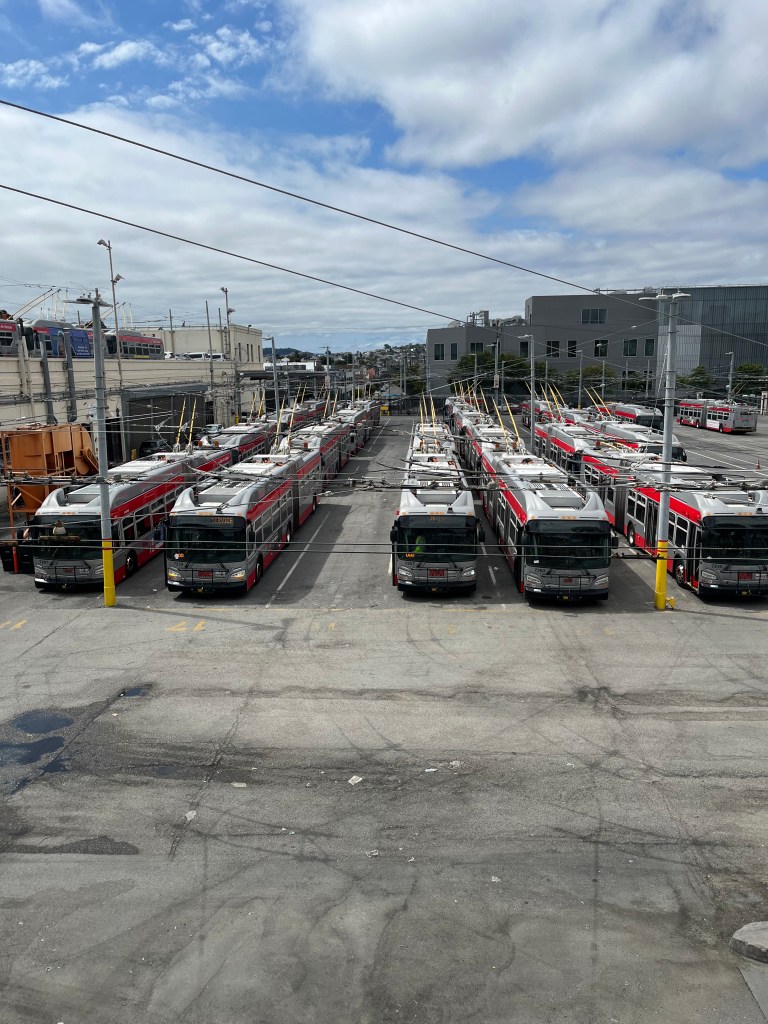
If on the extra board, runs are assigned daily, and can be checked after 2:30 p.m. in the room where the schedule detail is posted. Comparing cap number seniority to assigned runs can also add to drama. We then sign on our run on the operator’s sign-in sheet, and look for the coach assigned to our run on the track assignment, and note the number down on our paddle. Sometimes, the words, See the yard-starter are on the sign-in sheet, and we have to go down to the tower to find out what coach number we are to be assigned. Rather than going out in the yard with the sinking feeling of re- enacting a scene from Maze Runner, getting a new coach is a piece of cake. All the older trolleys were finally removed from the yard in preparation for the New Flyer trolleys, which are undergoing testing to be augmented on the 30 Stockton and 5 Fulton lines.

In the tower, we state our run and line and ask for a coach. Sometimes we get to go on a walk with the yard-starter and find a coach. This is often necessary at Potrero, as coaches are coming and going continuously. I have had the unique coming or going vibe as I would pull-in at 2:44 a.m. from the 14 Mission, and I see the yard-starter and receiver starting their day getting ready for the next shift of early day run operators. Are you coming or going? is perhaps the number one question I get asked.

I have not needed to purchase much in the way of civilian clothing, as I wear my uniform as a part of my body, up to 15 hours a day! Just like our trolleys, we are “in service” most of our waking life! Go up to any Muni operator and ask them the last time they bought any regular clothes. Or ask them the last time they wore something other than the uniform! You’ll probably get a laugh. And if you don’t, please s-l-o-w-l-y move away and carry on! Do not ask any more questions!

Such as in pulling-in from Daly City at 2:21 in the morning. If you see an operator engaged with another passenger, such as assisting a drunk sleeper on the back steps, wait to ask about where to stand to catch the next bus. Even if the owl coach has been parked in the terminal for several minutes, allow the operator of the next bus to clear the coach first.

Also important to remember is the rule that I must walk to the back of the coach to check all seats before I pull in to see next morning’s yard-starter. If a youth has fallen asleep in the seats near the back, or by the articulated joint in the double-long coach, I cannot see them from my interior rear view mirror.

I was blessed to have an inspector checking pull-ins from Bryant and 16th to call for assistance to have a youth removed who would not wake up or stir from his slumped over position. It can take up to an hour to have the police and then the fire department remove an intoxicated person on a stretcher in an ambulance off to San Francisco General Hospital. It is a no-no to pull-in and leave a surprise for the car cleaner!

So seeing a yard-starter when I pull-out, and then in the wee hours of the morning when I pull-in, makes this well rounded Muni operator a guidepost to the start of my day, and sometimes the last good-bye as I go home. When I see a yard-starter willing to drop and rack poles in the yard and help coaches pull out on time, I know I am in for a good sign-up!

Another tally for finding the Zen and keeping my job if I can see them in the yard and walk off without going upstairs to fill out an incident report!

Trashing San Francisco

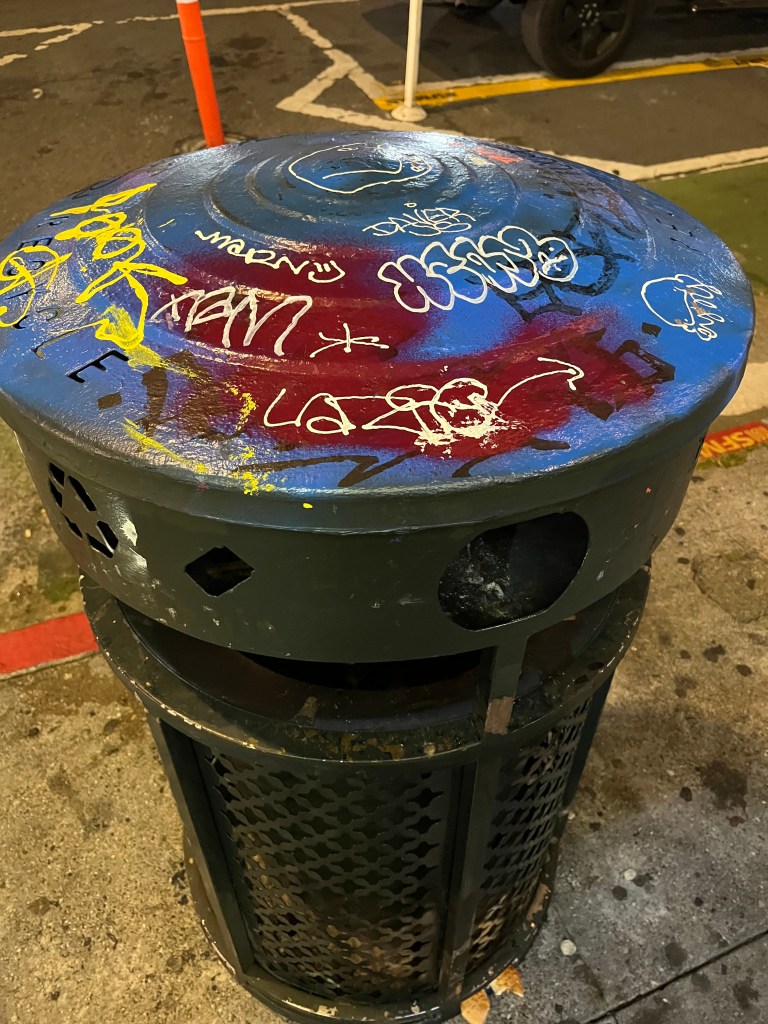
Valencia St. trash can graffiti

There are many YouTube videos about the closing of Nordstrom downtown in the SF Shopping Centre–adding to the long list of Walgreens’ drugstore closures–and the New Whole Foods at Hyde and Eighth and Market. Also in the Google algorithm are stories about crime, trash, needles, and homelessness–especially the interviews on California Insider with  Siyamak Khorrami from the Epoch Times of Southern Cal. A recent post by Siyamak with Angela Alioto confirmed my worst suspicions about Mayor Ed Lee:

This video explains the cause of my sinking feeling in the spring of 2014–during the IPO of Facebook.

I feel like a turncoat by leaving San Francisco during the epidemic and moving to Honolulu, and I am obsessed by returning to San Fran. Is it to prove the naysayers wrong about this city? Is my heart being torn by moving away instead of fighting the fight? Am I the lucky one? It doesn’t actually seem that way–most of time–or some of the time?

What becomes glaringly clear by those who post that they are glad to leave the butthole of ess eff. (My spell check wants to recreate ess eff with the words less off or mess off!) No where (Knowhere) are there any residents who still live in San Francisco describing how they feel, or why they still live in San Fran.

Apparently, we are liberal retards that are getting just what we deserve by the way we are voting. That God is punishing the ‘New Deal’ Sodom and Gomorrah for being a city full of sinners. [Sodom and Gomorrah were two legendary biblical cities destroyed by God for their wickedness. Their story parallels the Genesis flood narrative in its theme of God’s anger provoked by man’s sin.] –That we are sick and twisted by obedience to our Mayor for the lock down during the pandemic. But no one of the critics ever questions why we did what we did, or what our thinking is then, and now.

San Franciscans have recent memory of a pandemic, whereby the government stood by and did nothing. This would have been an apparent Godsend if this was the attitude taken by the government with Covid-19. We SF residents remember all those who died during the Aids epidemic, and found it easy to OBEY the rules being set by our Mayor and the CDC. Sarcastically, when they called me for an interview, I reminded them that they could just as easily been called the Center for Disease Observation. But the point is, Franciscans remembered our recent epidemic and knew what to do. We found the cases of Covid being reported after large in-person Republican fund raisers –where attendees wore no masks–and couldn’t fathom this thinking–and shrugged. Our compassion always lies in the less fortunate.

As for the homeless problem, in the above interview–Angela explains then Mayor Gavin Newsom’s plan to keep people off the streets. Unfortunately, Ed Lee shut down the 18 properties created to provide the ongoing services needed to prevent a return to the streets in 2014, just two years after the plan was completed in 2012.

Which brings up my main defensive point about the conditions on the “Streets of San Francisco.”

We San Franciscans were–and are–able to handle the homeless problem up to a point, but if states and municipalities are going to keep sending their addicts and alcoholics to San Francisco, because it has a tolerant attitude and a large treatment budget–there is only so much influx any city–can handle. As a bus driver I saw this unfolding during my 21 year career, and I figured out how to do my job by keeping my job.

I thought this was worth writing about.

One person in a large Saturday recovery group was insistent that I not be able to submit my meditations to a recovery handbook under production, and that I was in violation of several spiritual principles. He took great pride in cutting my writings from the submission list.

Learning how not be in a reaction mode, I took to the creation mode. Putting a “See” in front of a ‘reaction,’ I turned from a negative Reactive shock into a Creative one. Reactions with a C become Creations! I wrote a book in meditation essay form about how I used mediation to stay at a good job in a whacky city!

Hence my piece da resistance:

Lost and Found on a Cable Car

After riding the Cable Car to Fisherman’s Wharf, I decided to look at my watch and see what time it was. My watch was no longer on my wrist. I recalled taking off my jacket when I got on the Hyde Street Cable Car at the Powell turntable. The cuff of the jacket tugged on my wristband and I had shrugged my arm to free the jacket off my body. My watch must have fallen and dropped to the ground or the floor of the car!

I was already walking past Ghirardelli Square and headed up from Aquatic Park when I found the stop for the 47. I hopped on the motor coach back to Market Street with a dim hope of getting back to Powell Station, much less finding a lost and found booth, if it even existed.

When I got back to the turntable, a Cable Car was being rotated on the turntable. After the table was secured, I went up to the grip man and asked if he had seen a Swiss Army watch. He smiled. It was the same operator I rode with–exactly two hours earlier–to the Wharf. He held up my watch.

My dad got me this watch for my birthday on a cruise to St. Maarten’s. No, he didn’t put it up is ass to get past enemy lines, but the miracle of getting it back was just as unique.

Somewhere, somehow, some when, something was looking after me and keeping me on the path to become a Muni Transit Operator. The circumstances of coincidence in getting a double stamped notice-to-report for class one day late–but within the two week time frame of the later date–November 17, 1998 was just but another God shot on my way to my twenty-one year career being of service as a bus driver.

Find out how I got my job by clicking below.