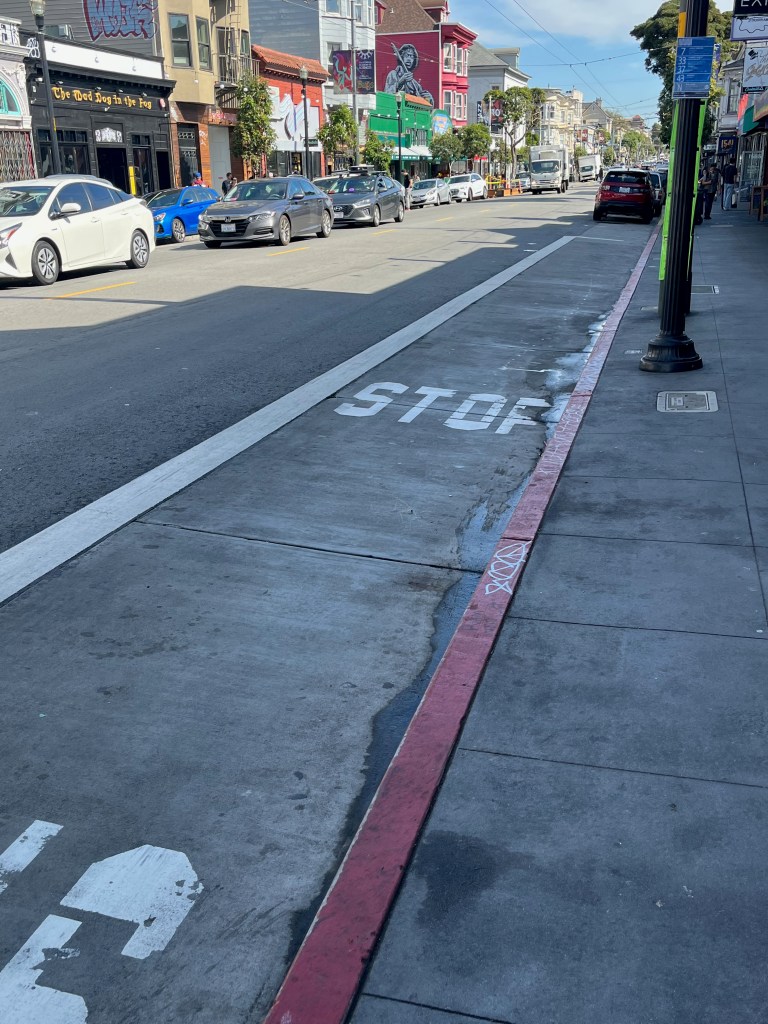
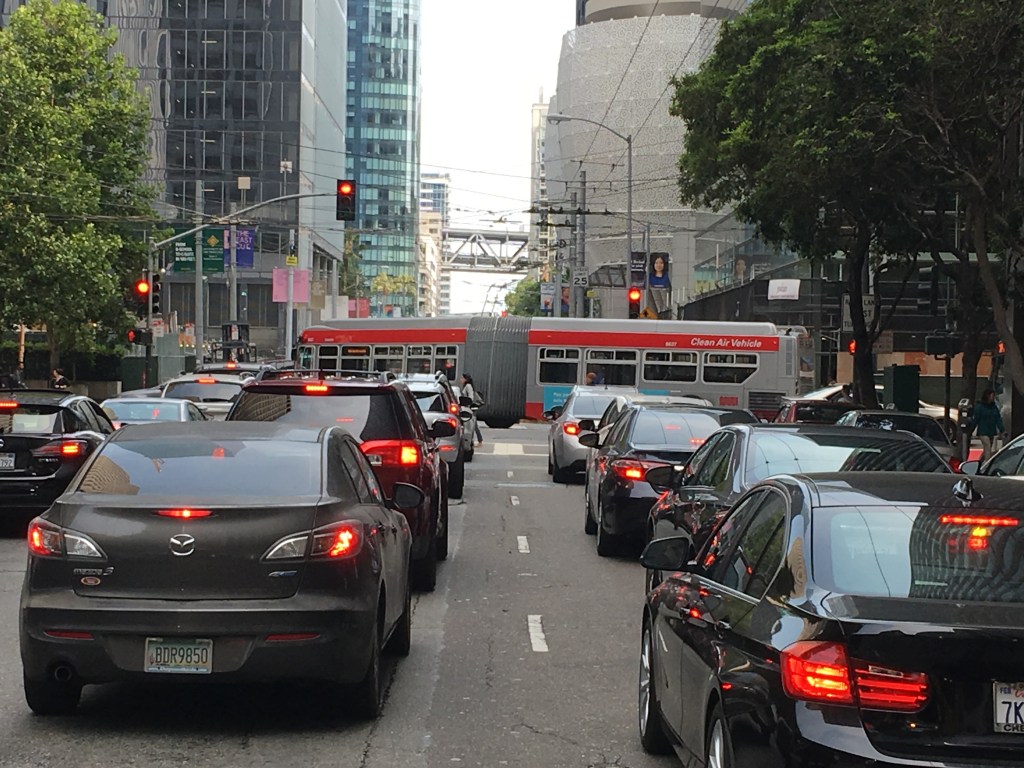
In the ebb and flow of traffic, the space cushion between vehicles goes up and down. As traffic turns from medium to heavy, the matter of inches can come in to play as to whether traffic comes to a standstill or not. When a limo or ride share is picking up or the motorist leaves the vehicle unattended for just the few seconds it takes to get to an ATM or get a coffee, the attitude of the car and it’s distance from the curb can determine if the lane is shut down and blocked. This then creates an abrupt left merge situation to lane two, and brings both lanes to gridlock. This setup for a backup is completely avoidable if the first parked vehicle would stay within 6 to 8 inches of the curb.
The pecking order of when and how delivery trucks set up to offload, also affects lane closure and gridlock. The first arriving number one truck may park in perfect order, but a second truck parks too close on the opposing traffic lane and makes for intense squeeze play that need not be if a longer gap is left open. Intending through vehicles build a backup line which prevents the oncoming lane from clearing truck one, thus preventing two way traffic from clearing. This occurs in a commercial zone where lots of cafes and shops line the street. Upper Haight in the Haight Ashbury and 18th Street between Delores and Guerrero are classic jam spots for the 33 Ashbury.
Once a delivery driver becomes familiar with his or her drop-off route, adjustments are made to the delivery schedule whereby no two vehicles create a rolling delay because they wait for the other delivery to clear, and go around the block to alter their drop off time. Experienced UPS and FedX drivers are good at this. Mainly because they have another address close by and can adjust. Trash trucks can also go around the block and work on other houses or businesses if other trucks block their trash can pickup. This usually works for smaller bakery trucks and bobtails. But fifty-three foot out-of-town tractor trailers from distribution hubs in the Central Valley can cause longer line delays.
The one line delay that can block both lanes in either direction is a loading dock zone. Fifty-three foot tractor trailer rigs attempt to back in to a dock perpendicular to a not-so-wide San Francisco street. These trailers take finesse and skill from the class A truck operator to make a pass in three moves maximum, else the blocked pedestrian, cycle, and vehicle traffic begin unsafe maneuvers. Office Max on Arguello near Geary, Big Lots on Mission near 30th, and the Whole Foods on 17th at Kansas are to name just a few. This just adds more delay to those patiently waiting in their lane. I have to pop the brake and relax and pretend I am watching a truck driver training video on how to back in to a loading dock.
Sixty-foot trolleys are being added to the 5 Fulton line* and it will be interesting to see how this works on Central Avenue by the Fulton Market grocery store. *editor’s note (2005-2006) A loading dock was placed on a small residential street with a trolley turn located on both corners, either side of complex which takes up the whole block. Full-length tractor trailers attempt to back in the dock whereby a space in parked cars is needed to access the dock by placing the tractor on the opposing curb to make the back-in.
The solution to this is to paint a red curb clear on either side of two residential driveways across from the dock. This means taking away parking space. Here’s the rub. Taking away parking requires a procedure that takes a long time. I cannot fathom why transit needs do not gain priority over the car. Especially in a city like San Francisco. A truck making delivery to a grocery store can block commuters on the bus for up to six minutes because they can’t back in to the dock because of a parked car across the street. Our event marker button on camera may help by taking a screenshot of the offending vehicle.
At the 45 terminal at Greenwich and Lyon, the red zone curb clear needed for the buses to wait their time to go downtown is not placed correctly on the block. Room for two more buses would solve the problem of coaches blocking driveways on the approach to the terminal. There are no houses on the terminal side, yet permission to move the red zone takes years to change. I hope the value of transit can be seen by all as we move in to the next generation of travel. I can’t understand why the planning department cannot use the eminent domain and public good to make the necessary changes for transit.
The battle cry goes up along Chestnut Avenue when bus zones need to be extended for longer trolleys. Everyone loves the fact that new larger equipment is to be added for service, but no one wants to sacrifice the three parking spaces necessary to increase the curb red zone. These delays add confusion to our General Sign Up and cause some operators to have to pull out from an alien division or extend a pull-out route from farther away from where our barn is or where we end our day.
The finale of long trailers in San Francisco occurs when a tractor trailer driver from out of town decides to go up 17th Street from Market to access Cole Valley, or takes Leavenworth from the Tenderloin to access 101 North over the Golden Gate Bridge. The loading stanchions for hooking and unhooking below the trailer scrap on the dramatic elevation change before or after crossing a steep grade. The trucks stall going uphill, or get wedged going downhill.
This recently happened when a truck got stuck crossing Union to go down Russian Hill. The only way to break free is to drag the tractor down the hill. The noise of the trailer’s hitching posts dragging on the street definitely awakens anyone in a three block radius! No alarm clock needed on this commute! Tour buses are also big offenders on Russian Hill. During Super Bowl 50, a beer truck got stuck on Jones and California by Grace Cathedral. Obviously this was a new driver on call for the extra work for the large visitor population we had hosting the Super Bowl. Tractor trailers at least have flexibility at the hitch joint. Buses are one solid mass and damage to the frame may result. I’d hate to be in their dispatcher’s office when this call comes in!
Also telling are when a new fleet of delivery trucks make to the streets. New employees are easy to spot by where and when they park. They must adapt their parking so as to not create a car jam so that cars waiting in the queue at a red barricade oncoming traffic stuck behind the newcomer. Passengers intending to board at a bus stop would also do well to adjust where they stand based on double parked vehicles nearby or next to the stop zone. While you may be standing where the bus usually stops, if other cars stand or stop in the zone or double park at the top of the key in front of the zone, this alters where we bus drivers’ can put our nose to the curb. Usually we make a flag stop: we don’t try to come to the curb and keep our coach parallel to the curb one lane away.
The simplest rule to keep the Zen is to leave a broad birth for smaller vehicles unable to see ahead, a space to move in front of my coach when they impatiently pass. I try to move to the right as much as possible so they can see the obstacle ahead, but many times this is unsafe for door openers and bicyclists. Even when passing a double parked truck, with my high beams flashing, oncoming motorists appear oblivious to my move and block me from returning to my lane. I remember I am the paid professional on the clock and a no worries attitude heals the block the fastest! I can find my Zen at any loading dock or any hill!
Surveys of time use show much time is spent in the bus zone loading passengers. Although this would seem to be a revenue loser as those who board in the rear would be evading the fare, my experience has been most riders are honest and pay their fare share by coming to the front door to get a receipt or transfer. Those who enter in the back because of wheelchair boarding or kneeler requests, do come to the front from the aisle to get a transfer, and pay their fare. By believing most people are honest and abide the unofficial honor system of paying for their ride, I have reduced almost all problems and delays at the front door and fare box.
This surrender on my part has made my job a lot easier, and I always try to be of service if someone is a little short, but needs a ride. This took me several years of discovery, as I am somewhat of a perfectionist. My Mars in Aries has reared its ugly head with some fare disputes that got me in to trouble. And the idea the riders also can train operators by their feedback, even if it is unpleasant. Being rude or appearing nasty is a fast behavior modify if ever there was one. How riders react to my statement of what the fare is, over time, gives me an idea of how I am to handle myself, or set the tone of requesting the fare, without getting in to an argument.
The first and most obvious dilemma one first realizes as a transit operator, is how oblivious passengers are in expecting us to see their fare in the first place. If I had one magic wand or wish that I could click my heels to make come true, it would be for boarders to see how impossible it is for us to check their fare. If it were a problem with less than 10 percent of people riding, then it would seem like I am being picky or controlling, but over half of the people boarding do not show their fare in what I would call a thoughtful or honest way. Granted, as two columns of people board at major transfer points, they pass by quickly if I am lucky, but the way in which I am to look at their fast pass or transfer is ridiculous by any standard. By injecting humor in to the situation by stating there are two lines, fast track and exact change, and motioning to imaginary two lines at the front door helps interrupt the pattern of blocking that occurs from tagging in on the one side, and the fare box on the other.
So there should be no surprise why the majority of operators appear to not be looking at the fare when it is presented. Almost no one appears to be concerned we have a chance to actually look at their hand. I’d say less than one in ten boarders actually shows me the fare in a reasonable way. I’ve learned if I turn in my seat to face the door, and appear genuinely interested in looking at what’s in your hand, then odds do increase for proper fare presentation. But what the majority don’t seem to understand is that front door boarding is no reason for a reduction in fare evasion. People showing fare properly at the front door are such a small fraction of the total, that to us as operators, it makes no difference what door people enter. Hopefully with the newer cameras, if anyone is actually viewing images, they would see it virtually impossible to see most fares, even at the front door.
And so, this brings us to the various styles of impossibility of “fare evasion” by those coming to the front door. Once again, what I have just said is contrary to the start of this Chapter when I said most people are honest, and abide by the unofficial honor system. There seems to be a paradox. And indeed there is. While I said most people are honest in paying the fare, I also said they are clueless about how useless their presentation is, for us to see. And bereft of knowing what they are showing, after countless times being berated by them for questioning their fare, taking my request personally such as an attack on their character, I have learned how to ask for the fare without too much backwash. So here are some of the major “food groups” of fare evasion. Remember, I am not saying that these passengers don’t actually have a valid fare. What I am saying, is for the purpose of checking the fare, these maneuvers constitute fair evasion because we cannot determine if the fare has been paid.
The Wand.
Like Merlin the magician, or something out of a Harry Potter movie, these people move their arm in such a wide swath it is a miracle anyone can see what the hell it is they are holding. We have many types of pass id acceptable for fare, but it doesn’t matter, because we can’t see what the hell it is people are showing us anyway. This does not mean we should not make an effort to look at people’s hands when they board, and it definitely does not mean we should just rationalize in to not checking at all.
A hard working driver was asked by a man why he wasn’t asking for the fare for those that boarded in the rear, and he replied that they do it all the time. He got written up for a passenger service request (PSR). because this is against the rule that we ask for the fare by stating what the adult fare is. He could have asked to see the fare of those boarding in the rear or by making the announcement to please come to the front if you need to pay your fare, but he didn’t.
These small nuances can come at any time at any place, and we have to be ready to do the right thing. If we get distracted by another question, or are in our mind about something else, these small rituals throw us off and we get mail. We get a letter for a review about our behavior when we can’t see why this is so.
If we talk to other drivers about this at the relief point or in the receivers office, we usually get the right answer. I would rarely ask for help or feedback when I was new, and this added years of distress that did not really need to be there. So when the wand goes by, we need to always be ready to do the correct action. Ask for the fare, even if the person whipping by us never stops. Most times, the wrong person usually stops to question us. “No, I wasn’t asking you. The fare is two dollars.” And that’s usually the end of it. Just as in calling out transfers and destinations, it matters not that the right person hears us. Just that we were following the rule.
Our most honorable Mayor, Mr. Gavin Newsom, when riding on a cable car, made the observation that the conductor was not checking fares. What he may not have known, is we become accustomed to our regulars. We know who has their fast pass, and after the fourth of the month, it is not necessary to see the fast pass every day. Just because it is not apparent that we are checking every fare, does not mean we do or do not know who is paying.
The Jack-knife.
In all fairness, there are those seniors, and those with mobility problems that may make coming up the stairs a balancing act. I have to be mindful of being of service, especially towards those with mobility problems that may not be visible, however, can we at least make an attempt, once in a blue moon, to at least show the operator that we have a current valid monthly pass? If the month is new, and we are a regular, isn’t it reasonable to show the operator at the beginning of the month that we have our new pass? The jack-knife is accomplished like the wand except for an excessive up and down motion with the arm holding the pass. Made to look like the arm is a counterweight to the balancing act of climbing, there is no chance in hell our eyes can focus on a pass that is moving up and down at or near the speed of light. Just because you are holding the pass does not mean we have the ability to see it. When I explain that this is the fourth of the month, and many old passes have expired, this usually helps. If a regular rider becomes offended that I am asking to see their fare, I respond by saying, “Yes, I know you are a regular pass holder, but I haven’t seen you with the new pass yet.” If the fourth day of the new month is after a holiday, I give grace for this. “Are you going to get your new one today?” Then things get better. “You need this transfer until you purchase your new pass, I don’t want you to get in trouble.” This heals all wounds, and prevents me from being perceived as a heal. The great reward at first impressions was when days turned in to weeks turned in to months, without anyone taking my fare checking personally. This took me over five years to be able to say this truthfully.
Toll Booth.
Having been a Jersey boy, I pride myself on being quick to pay toll. If you have ever been headed to points south from NYC on the Garden State Parkway on a summer weekend, and you have successfully crossed the Raritan River Bridge crossing and toll booth, you know how paying the toll in the bucket in a timely fashion can contribute to delays of those behind you. Before the days of automatic billing, knowing how to do the toll booth was an art. The one thing about Californian’s laid backness which some times drives my east coast roots up the wall, is the sense of cluelessness about how action or in this case inaction has a cannonball affect on others. I have never met a native New Yorker who was completely clueless at the fare box. Granted, I may be able to teach them about the waterfall method as an enhancement of toll booth, but some Californians who have grown complacent and accustomed to not showing their fare, are the biggest offenders with the toll booth method of fare payment. Should they be asked to show their fare by the fare inspector, they become grudging payers. They may be seasoned riders, but it fast becomes obvious at the box that they are unfamiliar with actually paying a cash fare.
This is where I have to get over myself. I need to remember everyone is doing the best that they can, given what they know and what they have. And my judgment of others as a silent arrogance remains with me today. Try as I might to maintain humility, I quickly fall back in to self centered superiority, thinking that I am the boss, and that I am in charge. And I find I lose my balance, and fall back in to a familiar pattern of not liking you if you don’t behave like I think you should.
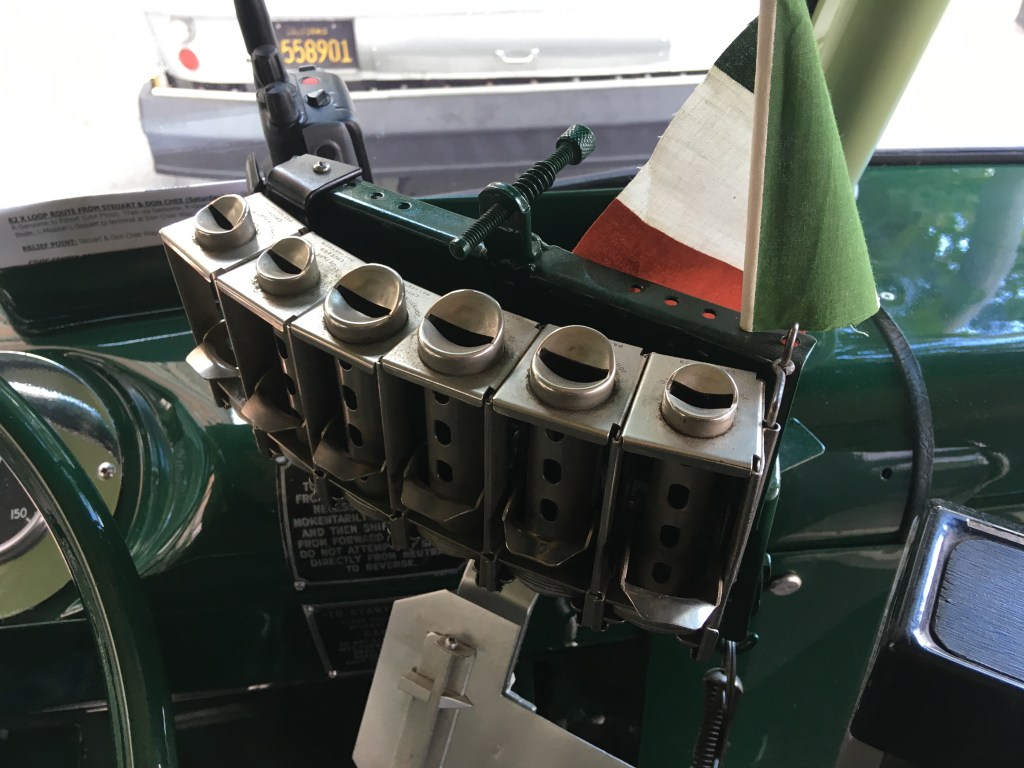
The toll booth method involves dropping the coins over the slot in a dropping fashion, using the thumb or pointer finger as the feeder for the coin drop. Most people take the slow drip method instead of the fast pour because they are counting out their fare as they pay. This method is a bummer on morning peak inbounds if people haven’t counted out their change in advance. This really slows us down and is the best reason to eliminate the fare altogether.
Dump truck.
These folks have learned that a single coin drop by drop is too slow, so they count their change ahead of time. This is a great first step to making the step-up flow. But dropping the whole wad at once plugs up the coin slot. And those who have perfected this style usually also know how to fish with their fingers to stir the pile and let the coins trickle past the slot. But I need to be willing to show them how to clear the slot. And if they aren’t willing to wait to see this, I need to surrender and clear the pile anyway.
What I resist, persists. And so I need the humility to wait another day to find the right time to see if they will learn. After all, their rush to move back is my desire. I have to see my part in creating the dump truck. This patience to resist change upon them is something I have to constantly guard against in picking up folks who are slow to the door placement. And if I don’t allow them the grace to do their thing, trouble soon follows.
So I review my day and make sure I don’t resist what I fear is to be a constant unchanging dilemma upon my daily trips. And with tourists or first timers. If I am short and without patience, the sooner I can catch myself the better. And God, or the transit gods, do give me grace in making a mistake once or twice. But if I go unchecked, and don’t do a daily review, an incident will invariably occur whereby my being wrong comes back to bite. So, I need to be clear when a coin dropper has counted their fare, that this as a first step in the right direction on my part. And I do get rewarded when I see the dump truck method working. Especially with dimes. Dimes are the worst for jamming. If I create a patient and loving attitude when a jam occurs, the situation rarely repeats itself. The more I resist, the more frequent the jam. And the problem won’t go away until I surrender.
Tissue Deluxe.
I was always seeing granny holding her fare in a wrap of tissue. And the tissue would breakup and fall in to the coin slot and lead to a coin bypass. Or there was some hair that fell into the coin slot along with the coins. Hopefully, I could dump the whole lot with my dump button and make the problem go away. But over time, if not caught right away, the fare box would stop counting coins, and the coins would build in the neck and cause a constant distraction. But it wasn’t until I asked why seniors would wrap their coins that I got the answer. Their hands were dry with age, and the coins would stick to their palm and not go in. They had learned to put the coins in a wrap so that they would not stick to their skin, and go in. They were only trying to be ready and be fast, but I didn’t see it this way. So whenever I see something happening over and over which is not to my liking, if I stop to ask, I get my answer and the distraction goes away. Finding the right time and place to get the answer doesn’t occur when I think it should. Only after I take a prayerful pause to be ready to accept that I may not have the answer, does the answer soon come. And the sooner the answer comes, the closer to being mentally fit am I.
This gets me excited about my job again. If I take the role of a detective, and try to unravel a mystery, I am back in the right mind set to discover the answer. And the answer is not one of arrogance or hostility to make my life as a driver miserable, but because they are only trying to do the right thing after having problems paying the fare the regular way with their palm and fingers. Most operators are not so controlling as I am, so they haven’t had to worry about how someone pays the fare. But for me it was a big deal. I am not a good person if I ignore what I thought to be the most important deal for keeping my employer in the black by collecting as much fare as possible. In reality, this tightrope actually was reducing my job security and my paycheck as I was being perceived as a dick, or a mean driver. So the comment, all conflict arises from misplaced desire, really hit home here. I am not the gestapo or the police. I am not an inspector. I am simply required to state what the fare is and let it go. Passengers actions or reactions are not my responsibility. And once I got over this, my job at the fare box got easier.
Dollar Curl.
I have always had a recurrent idea in a dream state regarding a life purpose here. And it revolves around a seemingly impossible task such as in Horton Hears a Who, whereby the elephant has to go through a field of flowers to find the one flower with the one speck containing Who-ville. The enemy drops the one single flower into a huge field of flowers off of a cliff. Amazingly, our hero begins the daunting task without a single hesitation.
In my design, it is like cleaning up a huge trashed-out area like a stadium after a game, or trying to change a mass behavior, that is engrained on a large scale, so that no one person would ever be able to agree to start with picking that first flower, that first piece of trash, or that one request for another person to even consider helping, is ridiculous, because of the immensity of the scale of the task at hand. But that my goal or purpose in life, is to begin the impossible task, and to be successful in the task with someone coming by later to remark, “You’re done already? I can’t believe it!”
I have had some success in this area. Except for the dollar curl. Transit operation does seem to offer the ultimate challenge. To change a behavior that is creating some delay or headache, and to make it largely disappear. My hope is that like one candle being able to light an entire cathedral (or one match to trigger an immense wildfire) I hope that I can actually start one task or action which eventually leads to a permanent change whereby that first once thought impossible task, is basically removed forever. And having the knowledge I was there at the beginning. That one person can actually make a difference. That it isn’t about the impossibility of ever finishing, but about be willing to try. And see what happens. And so I trudge with the dollar curl.
Not all fare boxes are created equal. I found out from a coworker in the revenue department that the slots on some of the bill meters are narrower. I would always take the effort to make a revenue appointment for my coach and see what I could learn. It seems few operators would ever consider calling central control to get a fare box fixed while in revenue service, but I did so anyway. And I learned something about what causes the fare box to fail. Hair in the coin slot. Tobacco and cotton from pockets that were mixed with the coins. And just the regular dust on dollars. But I also learned about what to look for that would set the ball in motion to begin to clog the fare box. And my problems of fare box failure went down.
I would get owl coaches assigned to me in the morning from another run, I would go through a period of days where I would get several coaches in a row that had bad fare boxes. But if I kept calling to get revenue to meet me at Ferry Plaza, or Cal train, or Howard and New Montgomery, I learned where the good times and places were to ask to meet. I never would have figured this out if I never called. And around 9 a.m. in an off peak direction, by the inbound terminal, where other coaches collected, was a good time and place.
So my journey about cause began. Then on to offer help when and where the problem started. When someone put a dollar or coin in to the box. If a dollar has a bent up corner, or if the edge is creased, the dollar will not go in on fare boxes with a narrow slot. So if I had a box like this, I knew it would be a problem. This would be a problem on about one in three coaches. And it became easier to look at their bill before they put it in the slot, rather than to watch them struggle and hold up the boarding cue. Saying to them to flip it over didn’t work because they would try the other side of the bill rather than a simple flip, and the other side had a crease up in the same direction. Using my hand as an example doesn’t work because they are focusing not on my hand but on the slot. Telling them to crease the bill in the middle lengthwise results in them folding it in half which acts as a dam in the machine, and increases chances for a jam. Stating that a bent up crease doesn’t work because they are in a hurry to get by as we have trained them to do, so showing them how to put it in is the fastest and best. Most don’t care, or seem interested in knowing this, but over time, I noticed fewer and fewer people having problems.
I started seeing more people with worn bills having them pre-folded to put in to the machine. I also learned from them that two bills together work, and that other operators had told them about how to crease the bill before putting it in the slot. So by using my hand in a curl, pointing my fingers down, stating that the dollar moves into the machine going down through the roller, I saw the light go off in their head, and declared it another victory of the day. Because even though I may never see that person again, I could take comfort knowing that on some other bus somewhere else, a driver was able to make the light, or close the door just a little sooner, because that one extra person was ready at the fare box.
The Question.
These are the pros. The don’t have the fare, and usually don’t intend to pay, but by framing the greet by asking a question about where I go, they get me to tell them the correct answer, and they thank me passing without showing a fare. They have made me look good. Doing service. They get to pass by without a delay. And there isn’t any humiliating or hostile story about asking or needing a ride. And I have since gotten less offended at the those who do the drive by. That is, those who don’t look, talk, or indicate that they have a fare, but use the others paying their fare as a smoke screen to passing by without fare. But after realizing that I am here to be of service in providing a ride, I became less angry at the drive by folks, because, in the end, they were saving me time in the zone. Do you need a transfer? is the best one liner to get their attention and see if they have some money to put in the box. Some times they only have a penny to put in. I’ll take it. Hey, it’s one penny more than Muni would have got. And the sense of self esteem that seems to manifest from this does seem to make for a friendlier coach and a friendlier ride. Better than those that ask the question are those that say. . .
Or so went the announcement we could cue up with our DVAS (Digital Voice Activated System.) But under new management, with the service cuts to our riders, this manually activated announcement was removed. Does this mean thanks are no longer needed? Ha ha. Just kidding. Sometimes I do get in trouble for ad-libbing on the PA or mic. Very few coaches have a clean and clear PA’s, and when I have a good one, it helps when the coach is crowded. When I have been a passenger on a crowded coach, and standing in the aisle, it’s very hard to see where the coach is, especially at night. I have learned from riding Muni, that calling out the stops helps people get ready to get to the door.
Timing is everything, as they say. If there is construction ahead, or a bus zone is blocked by a big truck, it is nice to open the doors nearside and let them know they can get off here. And make sure it is safe; no bikes or skaters are coming up from the rear. The mic really comes in handy when I am pulling in or going out of service. I sometimes don’t have to repeat myself when everyone is in the know. I have also found that if I am willing to pop the brake and step out of the cockpit and face “the audience,” I get a much more positive response in clearing the coach. I always have to mindful of my tone of voice. If I end the sentence on an upbeat note, and not an annoyed or aggravated tone, this does wonders. I am always amazed at how quickly I forget the impression I am making by how I sound. My overhead voice can go south real quick if I am impatient or feel entitled about why I think they should know my bus is going out of service. But a smile and a transfer at the box is usually all it takes.
Adding some messages under the safety cue might help, such as in the rain: “Thanks for shaking the water off your umbrella before boarding!” Some of these newer umbrellas are huge and carry lots of water! The extra water on board makes for a slippery step, and creates a jungle-like humidity in the bus which fogs up the windows. The key to keeping the windows clear, especially the front windscreen, is to hold the doors open as long as possible. This lets in the fresh air and prevents the humidity from going up too high.
When I am standing at a long red light, I keep the rear doors open, and this keeps the fresh air circulating. No one likes a puddle on their seat, so all of the side windows are closed. Also the ceiling vents have been known to create a puddle on the floor if they were left open the night before, or while in service. I always try to secure the hatches and windows if I am pulling out in the rain. Holding the doors open as long as possible keeps the air fresh and keeps my mirrors clear from fogging up. There is nothing worse than closed windows and high humidity from all the umbrellas and jackets that are wet. Keeping visibility at a max is mastered when the rear doors are held open and the baby heat settings are set for both the coach climate and the driver climate. I recently did a coach trade in the monsoon season, and had fog everywhere. But by holding open the doors, and adjusting the heat down, after just a few stops, the windows cleared.
Holding the doors open and keeping the heat to the low settings, was a gift from an old timer who had clear windows. I was at the terminal and noticed his windows were clear. His rear doors were open even though it was raining and we were at the end of the line. He came to my door and I complained I couldn’t see my mirrors. “Does your bus have a better defroster?” I asked. And it was then when he explained on how he kept his windows clear: baby heat in front and back, and leave the doors open at the terminal and long red lights. I have never had to get out some newspaper and wipe the windows since. Nice. We now return you to your Zen zone, already in progress!
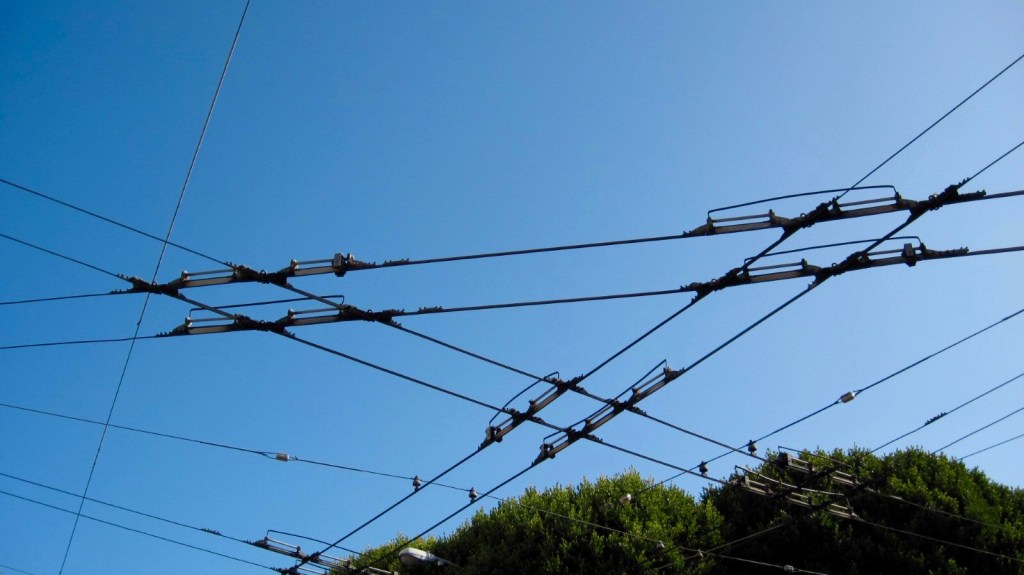
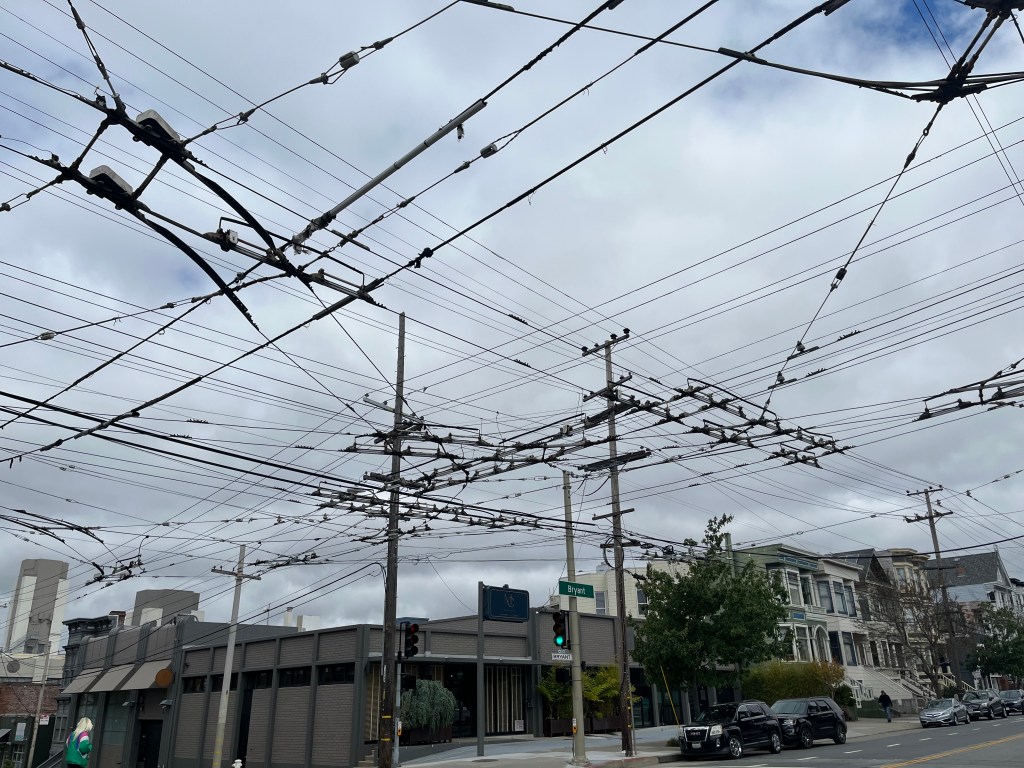
The overhead McAllister and Fillmore Streets. See the three nice crossovers on the blue field sky, and the other two crossovers for Fillmore Street crossing McAllister. Note Fillmore gets the dead area, and McAllister has power thru the intersection.
One of the differences our corridor streets have that most cities have lost, are the sets of wires over the center of the lanes. Only nine US cities still have overhead from the 50’s. Newer trams recently built may be increasing this number. In SF, we have numerous utility poles alongside the sidewalk that have support wires holding the power. These traveling wires are for our trolleys to be powered by electricity from our hydroelectric grid. Our O’Shaunessy Dam is one valley north of the Yosemite Valley, and provides not only drinking water, but power for our trolleys.
I love the fact that our city uses this carbon free source of power for our extensive trolley lines. We have more miles of trolley wire than any other city in the world. I am proud to work for a railway that has so many different modes of equipment, and that I can call myself a bus driver, but not use any fossil fuels when picking up passengers. I feel as an active agent helping our Earth stay as clean as possible.
Note the selectric switch on the upper left with the two staggered boxes–followed by a crossover. See the jump-over wire on the left wire fastened by two fiberglass insulators such to prevent a short on the crossing wires on Seventeenth Street. Coming off on a diagonal on the upper right is a support wire which has a breakaway midway from the overhead to the utility pole off camera. This rips away from the wires so the trolleybus poles don’t take down the whole intersection of wires.
Our overhead requires routine maintenance, and it is common to see our big yellow trucks working on the wires over the street. Now, all of our trolleys are equipped with battery power or APU, auxiliary power unit, or EPU, emergency power unit, to go around a crew working on the wires overhead. There are sets of trays of batteries that power this mode. This is another technology change that makes life much easier than in the day when we had to roll around an obstacle or get pushed by another trolley. Gone are the days when passengers would be asked to step outside and help push the bus through an intersection or dead area at a breaker crossing. Before bicycle racks were mounted on the front bumper, we could push a dead-in-the-water trolley from behind with another trolley.
I try to learn about the parts and pieces of the overhead whenever I see the crew taking a break, or just having finished doing a repair. I like to know their terms for things, so if I have to call in a repair, I can at least give Central Control an idea about what I am talking about.
The biggest reason nothing gets done is that the wrong switch or converge is being described on the radio. It is difficult to call in a specific problem in detail when of a driving mind: being in an alert, problem solving state of mind. This is a different part of the brain than that which answers a question about how many number of stops away until a destination, or a part location in a complex intersection of lots of special work. Without knowing the standard name for a part, any report for damage is left open for misunderstanding about where the maintenance is needed. Try as I might, I haven’t been able to convince those outside of training to add this to our syllabus. Line trainers become the key.
Crossovers
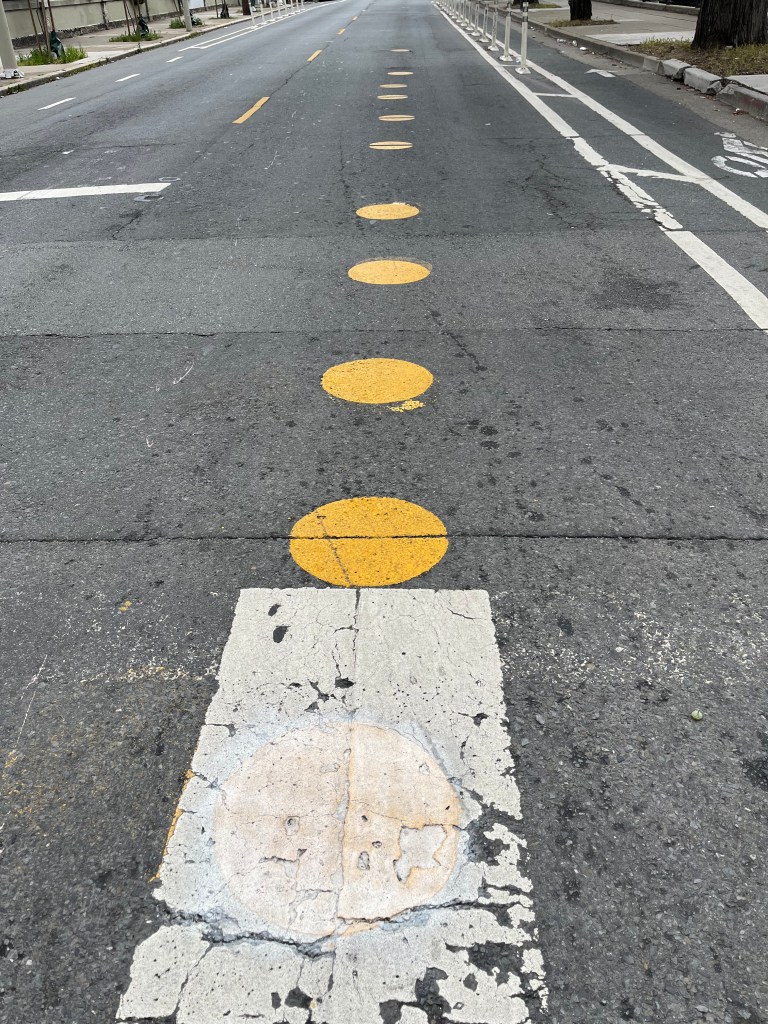
If you ever look up in the middle of an intersection where two trolley lines meet, you will see crossovers. Below these are the fiberglass slots along the traveling wires and jump-over wire bridging the gap, so to speak, over the dead area where the wires cross. This insulates the positive and negative wires from touching one another. We must power off our coach as we coast through this dead area. That is what those yellow dots are that are marked on the street. They mark the dead area where depressing the power pedal has no effect on forward traction. So, if you see dots in the middle of the cross walk, it means we have no power at this point.
Should not the breakers be placed in such a way that there are no dead areas at critical pedestrian and car crossings? Thank you! Now you are beginning to see things from a trolley man’s point of view. The dead area placement is affected by where the power poles are positioned, which has much to do with trees, buildings, and numerous other obstacles. Take time to study an intersection and notice what decisions went in to why things are where they are. Eventually you could graduate to an intersection like Church and Duboce! Or S. Van Ness and Mission! It isn’t as simple as it first might seem. Especially if streets come together at odd angles due to SF’s topography.
Surge Suppressors
On the leading edge of all crossovers is a thing that looks like an Oreo cookie, perpendicular to the wires. This suppresses a spark from a depressed power pedal, should an operator have power on when crossing a breaker. If you have ever been on an electric bus that shudders suddenly, this is because the operator has the power pedal depressed over a breaker. This occurs when trying to move in stopped traffic, especially on an up-hill near a stoplight.
If the dot on the street isn’t measured correctly, or worn away, or unmarked, a jolt can be felt. The surge suppressor reduces this jolt. It is a pair of insulated disks that try to suppress the flash from power attempting to short between the crossing wires. Sometimes these become detached from the wires due to frequent jolts, and this causes trolleys to de-wire near intersections and turns. It took me six months to get the surge suppressor fixed at the Townsend CalTrain crossover for the 45 Union. The glaze in the gaze of an inspector trying to guess what I had described over the radio told me nothing was going to get done. No one in street ops or as a trolley operator knew what a surge suppressor was. This compartmentalization between departments (it’s not my job) in the city is a hassle any small business person understands in trying to get a permit, or pay a fee with the city. Can’t we all get along?
The yellow dots commonly called “pancakes,” denote where an operator has to power off on the power pedal
Breakers
Of all crossovers and switches, where opposing poles of electricity cross, is the universal term, breaker. This is all we are required to know as an operator of electric buses. A previous manager of the Overhead Division was asked to create a class plan to instruct new operators on the various parts of the overhead, but he retired before this was put in to play. I try to get the names of the various parts of the overhead when I see the crew on break by a repair area, but this is not easy to do.
Different guys on different crews may call a part by a different name. If I am moving through an area on a bus, or if at a terminal and the crew is busy, it isn’t all that common to get answers to questions about crossover parts and switches. Their general response, “Did you call it in?” Rats. Okay, next time I have a problem in an area, I’ll call it in. But not knowing the name of the part I see in need of repair, makes it a challenge to use this part of my brain while driving. And hence, most operators don’t make the call.
Nothing happens until more than two operators call in a de-wirement problem. So I have to get my leader and follower to also make the call. This is not as easy as it sounds because we no longer see each other at the terminals because recovery time has been cut. Being on a racetrack means that if I want to communicate with my leader or follower, I have to be familiar with where our paths cross. I then have to get their attention, and make sure they can hear me.
One of the first questions asked about inter-bus communication is the necessity to go through the OCC. We can’t contact another bus directly. The best we can do is get the cell phone number of our relief, and make a call at a terminal before relief time to let them know of a delay. Calling Central is the simplest and best way to make contact, and should be the primary method of inter-bus contact. I have seen that “making deals” with another broke-down operator is usually too self-serving and not in the public’s interest. Many times a coaches’ overload in going over a breaker occurs after the bus is hot and been in service for several hours. A bus’ performance changes as the day progresses, and power surges in the breakers have a lot to do with where a bus breaks down.
Dog-bone
In the middle of a converge or diverge are a set of opposing toggles that guide the collectors through a switch to make a smooth transition from one set of wires to another. Their pattern resembles the classic cartoon dog-bone: Two wide flanges at either end with a narrow middle. If they stick, due to changing weather conditions, such as morning dew and fog, I ask for ‘special sauce’ to be applied to reduce sticking.
Sometimes the toggles refuse to change or only go halfway. This causes de-wirements at switches. The problem is the toggles may only act-up intermittently. This can cause a resource drain if an inspector is required to monitor a switch until a de-wirement is observed. As more coaches go through the area and it warms up, a switch may be okay. Or how a previous coach hit the dog-bone can make a difference. Sometimes the de-wirement only occurs after one coach makes a right turn preceding a straight-on coach. Or if a coach has worn shoes, bent collector, or a twisted pole.
If my leader caused the problem the way he or she went through, my follower may have no problem. This creates an awful cat-and- mouse waste of time. Inevitably, the switch needs to be fixed. I say sooner than later, but it isn’t up to me. Only inspectors can make the call. I have learned that even if nothing gets observed or fixed right away, I can relax knowing I did the right thing. Leaving up to ‘God’s time’ is a big resentment I needed to get over as a bus driver. In the mean time, 3 to 5 mph when crossing through special work!
Pan
Above most inductive switches is a sheet metal piece referred to as a pan. This shields the transmitter ball located at the end of the right pole from sending its signal to other switches in the area. When new switches are installed, they were without a pan of metal over them to shield the signal. I went through a two year battle to get pans installed over the inductive ring which is wired to turn the toggles in the switch. Especially at North Point and Van Ness. After countless de-wirements, pans were installed. It is this poverty consciousness that pervades most government agencies, transportation notwithstanding. Waiting for failure is the watchword for trolley repair and overhead repair and it is another battle in my head that I have to let go if I am to stay safe. People ask me why I am writing this book, and this could be my number one reason. I can’t change the system, but I can change myself. And this changes the impression I am creating when behind the wheel of that large automobile. How did I get here? Sounds like Talking Heads, no? The new doughnuts are white and are not necessarily installed with a pan on top. Only after months or years of calls do they get a pan that shields the signal from another trolley. Cue Bob Dylan’s “Blowin in the Wind,” as to when the switch will be installed properly.
Truth be told, some switches activate for no apparent reason. No matter how meticulous a pan is installed to shield a nearby trolley coach from inadvertent trigger, switches activate on their own. I have looked at my switch control dial in the normal position, only to see that the semaphore has changed, or I hear the click of the switch changing, even before I am over the doughnut. As a Line Trainer, this is a mandatory lesson about what makes a trolley operator different from a motor coach operator: we must listen to what the overhead is telling us: especially when we need to turn on a switch.
Fortunately, I am always aware of what position the switch is in before I cross the intersection. I have not brought down any overhead due to a falsely triggered switch. As a line trainer, I tell my student where these ghosts are in the system. A study of the natural Earth energy lines does make for a compelling reason as to why these electrical mysteries keep happening.
Doughnut
Underneath the pan is the doughnut. This is the electromagnetic loop that sends the turn signal message from our foot pedal button on the floor to the switch. In certain areas, such as Main and Mission, Mission and 30th, and Market and Eighth, a following trolley must not activate a turn signal until the lead coach has passed the frog of the switch. By reactivating the toggles before the lead coach passes, this causes the lead coach to switch incorrectly.
I am good at spotting this, and because my follower is in a rush, he has to then reset his poles because now the switch is set in the wrong direction because he passed the doughnut, and the lead coach took the switch. The distance between the doughnut and switch is too far away and more than one trolley can pause between the transmitter and the diverge. Anyway, I haven’t heard of anyone getting in trouble for this, but I think that they should. Call me Mister Overhead. If following the one block spacing rule, these de-wirements would not occur.
The newer trolleys have a smaller footprint on the wires. The brasserie is smaller and the carbons are thinner. The poles are two feet longer. Less metal is used, and parts are more flexible. To be fair, these improvements have helped tremendously. New switches seem to have less problems, and all trolleys can get around a repair area using battery power. These changes have made for a nicer day behind the wheel.
Selectric Switch
If you look up near an intersection of two trolley lines, you may see two staggered parallel gray boxes before the converge of two sets of wires. These are selectric switches. They are triggered by the angle of the dangle. When a coach begins a turn, the poles begin to skew on track and are no longer parallel on the wires. The angle of the bus, with the poles askew, triggers the switch because the gray boxes are hit simultaneously by the angled poles. If you stand by such a corner, you can hear the click as a trolley makes a turn on to another line. Being in a Zen state means being able to hear the click!
One of the nicest tricks to leaving the zone safely at a nearside bus stop is what my line trainer called the noodle. If done correctly, it reduces squeeze play merging, and the set up for this maneuver helps prevent sideswipes caused by lack of visibility from the rear as a car approaches, particularly if a car is turning right to pass the coach.
I had trouble in spelling maneuver, so I looked it up in my dictionary. My Webster’s Ninth New Collegiate Dictionary has several definitions (below) that fit this move. I have found it nice to have a dictionary handy when I write, because it clarifies what meaning I am trying to convey, and I take interest in all the other words I come across in trying to search for the correct spelling. I recall when I was in grade school, one of the best exercises I enjoyed the most was to use a dictionary in order for correct spelling. The teacher suggested, and I have never forgotten this, was to just open a dictionary and browse around. I encourage any students reading this manual to spend time poring over a dictionary. This is such a helpful creative endeavor that helps us clarify how to communicate and increase our vocabulary.
Our perceived fitness to communicate aids in directness and should not be an intimidator. Finding the simpler word is best for reaching the most, but I am amazed at how few people really know the definitions of the words they use, and how much learning is skipped when definitions are misapplied or not understood. This becomes apparent when listening to someone reading aloud. I was shocked to see how many people stunt their learning by glossing over mispronounced words they don’t have a clear meaning of what they are reading.
So, the definitions of maneuver, which apply to this technique are as follows. “1.b: To make a series of changes in direction and position for a specific purpose. 2. To manage into or out of a position or condition: manipulate a: to guide with adroitness and design b: to bring about or secure as a result of skillful management. – maneuverability; maneuverable, maneuverer.”
The Stop on Haight and Clayton Inbound for the 7, Outbound for the 33, was moved to far side! No more noodle! Whoop Yeah!
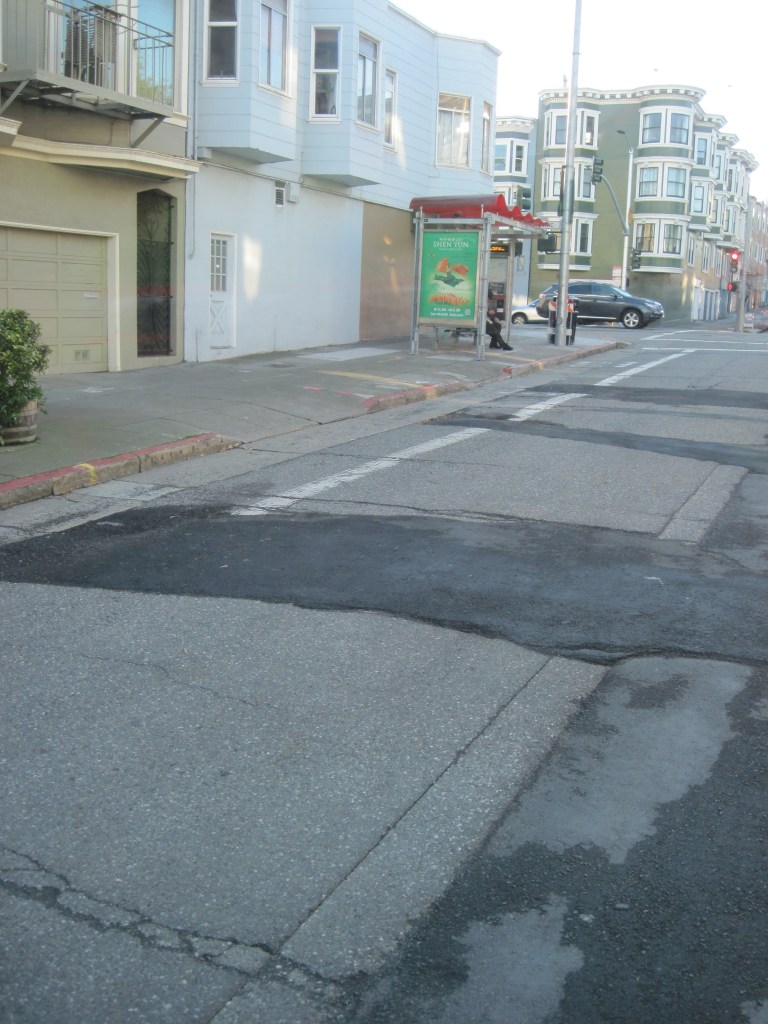
The set up for the noodle is important. When coming to a stop nearside, the bus is as close to a straight line parallel to the traffic lane as possible, so that visibility in the driver side rear mirror is maximized. This is in the rule book, so that the front door is close to the curb, within six inches, and the rear door or doors, are also within one foot of the curb. Many times this is very hard to do due to lack of room created by double parked vehicles, or cars standing in the zone. But the good thing about nearside stops, is they are usually clear. If any car is at the nearside corner, odds are they can easily move away. The car is almost always attended, and when they see the bus coming up behind them, they move. So when the nearside zone is clear, pulling the bus up parallel to the curb, helps those passengers departing, and gives maximum rear visibility
After boarding and alighting, and when the light turns green, or at a stop sign, the problem always becomes being let-in to traffic to proceed through the intersection. Keeping good car karma helps, by always allowing a turning oncoming car, or a car trying to pull out in to traffic, the space to move, and not to block them. Even in construction squeeze play, I have found that best man wins, or me first, usually adds more delay than spacing which allows for a smoother merge.
When beginning to move from the zone, the noodle involves, not using the turn signal and abruptly turning left into the traffic lane, but rather to slowly move forward, straight ahead, in the curb lane. So, if an accident report should ever result, I would not have to check the box turning left, or using the left turn signal. Any operator soon finds activation of the turn signal when merging left, almost always has the unintended consequence of vehicles speeding up to pass left, and to block the merge. The thought of getting ahead of a billboarding vehicle outweighs the smoothness created in allowing us to move ahead without stopping.
Billboarding is a professional driver’s term describing a blocked view. So by moving straight ahead, all cars can see that the bus is moving and clearing the zone and intersection. This also signals that the bus is finished with boarding, and no more delays will result in more people running to the door and stopping again.
If a car wants to race, that vehicle can easily pass the bus on the left as there is no conflict in the traffic lane. And this also helps, because now the bus is clearly, in the lead, in crossing the intersection for any secondary car, and the size of the bus usually stops any additional threats on the left. Because we are still parallel to traffic, we can see in our mirror any threat coming up from the rear. And as we get close to the far side crosswalk, we then move to the left, free and clear of any threat.
When I began to call the shots at when I could pull away, with clear visibility to my rear, and no threat on the intersection far side, I knew I had found the Zen of the noodle.
Our New Flyer Trolleys will have an important modification over the first order of motor coaches. The left side of our exterior mirrors will be below our line of sight, and not above. This elevation change means we can turn left and see where we are headed. We still have the stanchion between the front and side of the bus as a blindspot, but no longer have the billboarding effect of the mirror below an overhead arm support. This work order modification is a direct change from input from our union representative in the Joint Leadership Management Board. I am grateful for this modification; management listened to what the JLMB (Joint Leadership Management Board) had to say, and made the change.
Pedestrians must take ownership of their surroundings when stepping off the curb. There are those rare moments when our tracking left and a pedestrian’s movement in a crosswalk are at an exact relative speed such that your profile is blocked from our sightline between the front windshield and our side window. This has happened to me several times a year, and it is both a shock to me and the person crossing.
Stink eye and angry retaliation from the pedestrian soon follows, and it is imperative I try to let them know I could not see them, but usually they are so angry at my perceived lack of care, they don’t see their own responsibility of looking before they leap, so to speak.
Hayes inbound at Gough
The hardest angst to overcome is the angry pedestrian emotionally unavailable with phone and music in hand, refusing to communicate with me, the driver. No learning takes place, save for a passive aggressive complaint to await me in the dispatcher’s office about two weeks later. Our Vision Zero campaign is a blessing to behold, especially with the great design graphics on the back of our buses.
Unfortunately, like all good messages, a Las Vegas casino winking neon sign, a movie marquee, a Golden Gate Foghorn, is not enough for some folks. My hope is this chapter can save another chapter in an operator’s career, or in a pedestrian’s life. Pedestrians do have the highest right of way from all others: skaters, cyclists, and motorists, but this includes the law: do not start crossing if an intersection is blocked. If a bus has passed the second stop line of a nearside crosswalk, the intersection is blocked. If your visibility is blocked from the sight line of the oncoming lane such you cannot see an opposing vehicle approaching, the intersection is blocked. As a pedestrian, the rule of law is to look both ways before you start crossing.
As a transit operator, you dear readers, would be surprised to learn the percentage of pedestrians who do not look before they leap. It isn’t a small percentage like 5 or 10. It’s over half of all crossing pedestrians. Please spread the word of Vision Zero if you see someone take off without looking. My vision of Happy Destiny is for you to stay within your current body, and not be rushed to the ER.
All the legal maneuvers and fault finding after a fatality could all be avoided by taking personal responsibility when stepping off the curb. Family members and loved ones cannot do this for us in the moment of now. It is our responsibility.
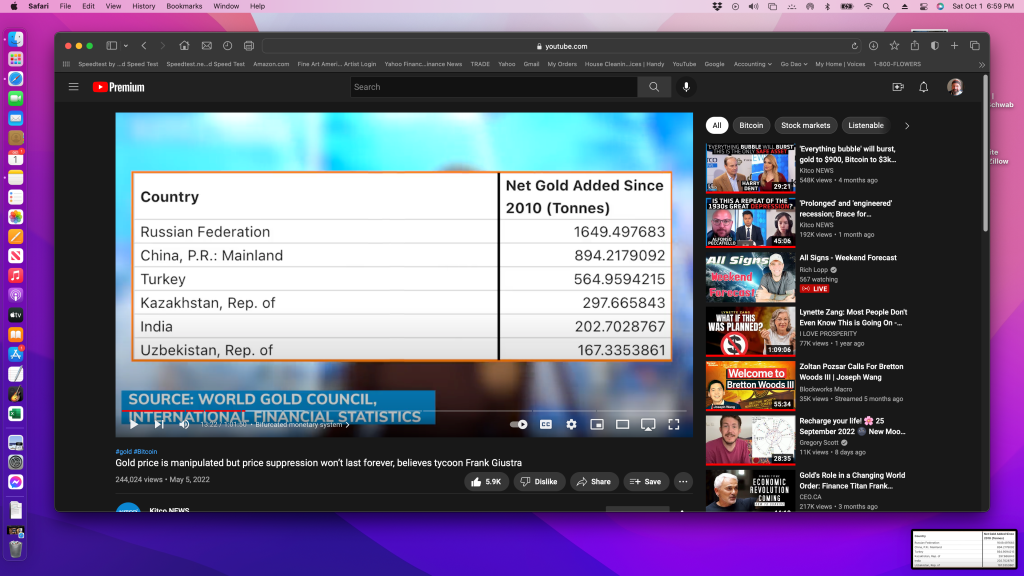
Quick—What’s the oldest profession?Nope—not Prostitution. It’s Mining! Sure, after the mine is established, the workers may need the second oldest profession, but we as a Realm, a World, a social-memory complex–have always trusted Gold. Does Russia trust China? Does Iran trust Saudi Arabia? Does Turkey trust Turkmenistan? Who knows–but I wouldn’t put up any gold to bet on it!
In the oldest cave in Europe, gold pieces of necklace and bracelets were found. Long before Cameco and Barricks and Goldfields–humans collected raw gold nuggets out of streams and wore them for the beauty. It never tarnishes, can’t be destroyed, and its “print” hasn’t changed in the last 4.5 billion years. It comes from the dust of stars. It’s created during supernovae.
Where do you think things are headed? Is gold a useless pet rock that has gone the way of the cabbage patch doll? Methinks not. And ‘not’ do those running the world’s central banks.
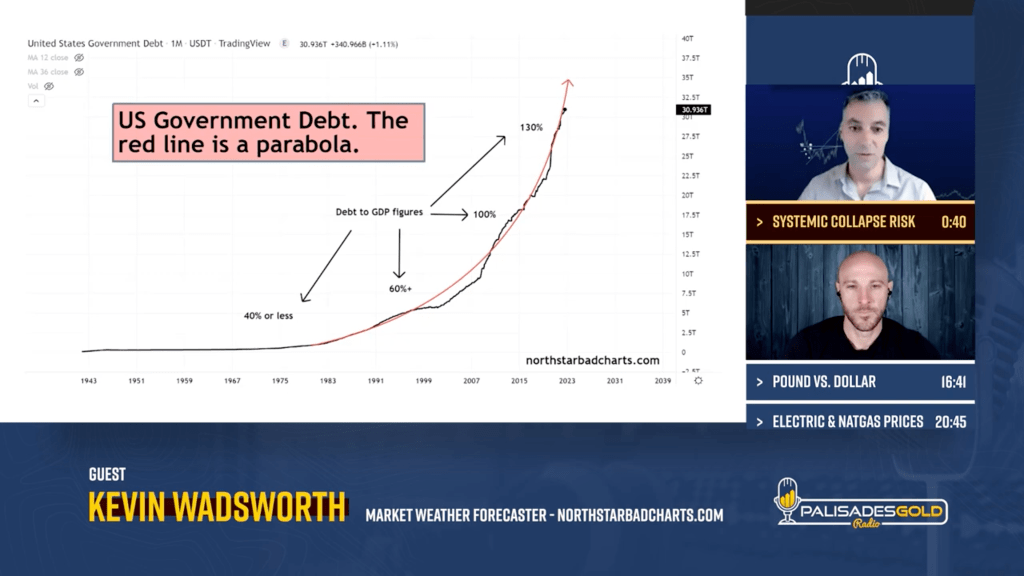
Unlike the 1970’s when the US debt to GDP was less than 40 percent, our national debt is now greater than the Defense Department budget! It costs us more to service the debt than to spend on war! And when fiat currency collapses, war is just the around the corner. Sound familiar? But as these things unfold–we just can’t afford it anymore. If we continue to print more money, we only get a wealth effect of less than fifty cents for every dollar created. Last time inflation was this bad, we would get over a dollar fifty for every dollar spent by the government.
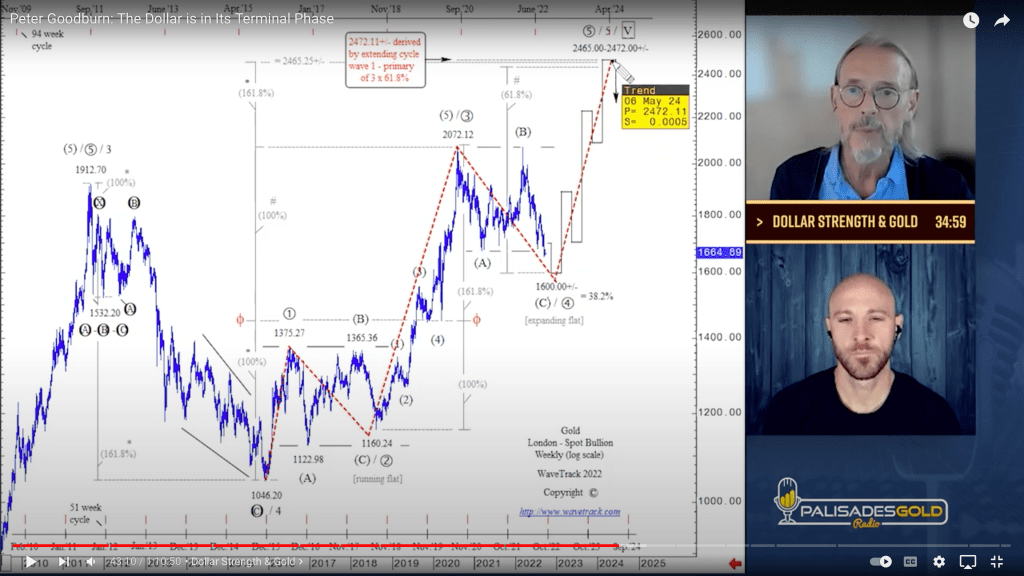
As soon as everyone realizes the Emperor is naked when the tide goes out, we see it isn’t that we can’t buy a house or pay the rent with the money we got because the cost of a house has shot to the moon–it’s because our currency is buying less. But what could we buy from a silver dollar? A gold coin? I could pay my rent with one gold coin–but that doesn’t sound very fair, does it? That’s because an ounce of gold would be worth $86,000 dollars if we valued it as it was before the Fed, and before we were taxed. I could use one 1 oz. gold coin to pay for my rent for about 36 to 48 months! Now that seems like living in a prosperous economy!
Does buying a split-level ranch rambler with four bedrooms sound reasonable at 5 point 4 million? Well, you could buy it with about 63 gold one ounce coins if the gold price was brought to it’s historically correct level. Doesn’t this seem innately correct for the value of a four bedroom?
God I hope I’m wrong.Gold, I hope I’m right. Anyways (I hate saying anyways, just like I hate saying orientate.) Anyway–when the shoe shine boy and the cabbie talk about buying xyz stock, it may be time to sell.
Which leaves us to this current missive. What does it mean when a bus driver talks about buying gold?
When I get into trouble, it becomes difficult to know what action to take, especially if I am in a rush. Paradoxically, it is when I am in a compromise, that my choice needs to be decisive and clear. If I am not in a good space, I am apt to be in “an accident.” This is no more clearer than when operating large machinery with lots of souls on board. A car tries to overtake on the left, or cuts in front from the right to make a right turn at a congested intersection. This one ideal, to watch the show, allows me to avoid the need to “back up.” Meditation on a regular basis about my “show” in life, has helped me immensely in knowing I am ready to make a choice. I now try to avoid blocking any vehicle in the zone by slowing, and see if the extra time cushion works. Nine times out of ten, it does.
Experience in driving a bus has given me intuition that can also arise if I take quiet time before my day opens, and when I get ready for bed at night. The patterns of my daily journey on the road become predictable, so when I see something out of place, I immediately adjust so as to keep a space cushion around the impending threat. When I was new, I would charge ahead of a taxi picking up or dropping off in the zone, but I have since realized by pacing myself to the pull-in to the curb, the taxi customer usually alights or departs, and the taxi has room to move away, thus giving me full access to the zone. I also find it easier to find a cab when I am going home from work!
Then there is the key for me to be sparing on the horn. And sure enough, I rarely need to use it now. And when I do, I try to keep it to a friendly toot and not a ship-to-ship foghorn! Blaring does nothing for keeping my serenity, and I usually get a blast back later in the day, as the equation always needs to remain balanced. I would get awful angry horns when my tail end blocked an intersection because I had rushed ahead in to the zone behind another coach. I became aware of the frequency of the angry horn directed at me, and I looked at my part leading up to the situation. I also recalled the last time I gave an angry blast at another vehicle, and the hostile energy seemed to be about the same in intensity and force.
Compulsive Honking Syndrome: The Cure
So I stopped using the horn and got light on the power pedal. And sure enough, the longer the time passed with me not using the horn, the fewer horns I got. And I started applying this invisible karmic ledger to other behaviors I found offensive to me on the road. When shocked about a car cutting me off, or a drive-by that seemed scary, I tried to recall when I made an action not anticipated by pedestrians or motorists, who may have given them the same feeling. And my compromising situations decreased dramatically. The suggestion to “sit back and watch the show,” started to be a working part of my mind, and I got it.
My iPod nanos. I can’t understand why Apple is going backwards. “I wish we could go backwards–really, really fast. Pedal to the metal, you know.”*
After an argument with Art3mis, Wade visits a scene in Halliday’s Journals where James Halliday argues with Ogden Morrow over the OASIS and Halliday’s hatred for making rules. The scene contains the clue to beating the race: Halliday states that he wishes they could go backwards for once really fast. James Halliday’s clue was this: * “Why can’t we go backwards, for once? Backwards, really fast. Fast as we can. (laughs) Really put the pedal to the metal, you know?”
Ready Player One, Warner Bros. Directed by Stephen Spielberg
Screenplay by Zak Penn and Ernest Cline–from the book by Ernest Cline
James Halliday 2029, Halliday Journals, Hallway 3 Diorama, Office Party–creator of Gregarious Games, movies.stackexchange.com
The above iPod had a screen displaying the album cover and a simple control screen that was touch simple. The storage was huge.
Now I see joggers and gym bunnies wearing this huge arm band to contain the extra weight of their iPhone, just to listen to their music. True, wireless buds are easier to handle than the old fashion ones you see hear, but I’m not paying $175 dollars every time I need a new pair; just $19.99 at ABC or 24 Hour Fitness–and I don’t have to spend $799 for a new phone, just to keep my music mobile. Don’t get me started about iTunes. The cost of this portable music is zero dollars and zero cents–since 2009.
Raoul Pal and other YouTube celebrities point out that our tech improvements actually reduce inflation because of all the extra features we get in the newer models. I don’t buy this argument. (It’s too expensive, if you ask me)
I could text with unlimited data and get a new phone flip phone for about $69.99, not over $600. My point is we lose our freedom of options with bundles, and we have to pay a small fortune. This isn’t going in the direction of lower costs.
California had a law that Apple still had to service iPods three years after they stopped any given model. I did get the above iPod serviced the last week possible for a replacement. Government should force phone makers and carriers to always offer a less expensive option, and this gets to my innermost core: Listening to our music library in a hands free way, with a cost under one hundred dollars. Just sayin.
The above iPod is about to go bust. The controller ring is about to crack, and she sometimes can’t take a charge. But I love her so much. I will miss her when the control ring stops functioning. I also have a green waterproof one for swimming, but alas, she won’t take a charge, and I can’t advance or replay a tune if she has some juice.
Dear Apple, why don’t you make these again and start a huge retro campaign. Hint: Make a new MacBook Air with a 16 inch screen.* Knowing you will support iOs upgrades indefinitely unlike the MacBook Pro and iMac, should bring back the faith–and install iWork with it!
*Apple did indeed introduce the MacBook Air with a 15″ screen!
The most confounding problem with rule enforcement is at a flat terminal where inspectors can write us up for non-use of the wheel block. Usually, when we need a break after an intense trip, we don’t bother with the extra time to place a wheel block because we are short on time to go to the bathroom, but invariably, this leads to a reminder to use our wheel block.
Being tuned in to the latest roll-away is important, so we know inspectors have been asked to write us up for this violation: Muni will stay out of the news. It’s when someone else forgot to secure their coach, and an accident resulted, we must be alert to use our own block, so our ‘fan’ will remain clean! We all know what rolls downhill, and in this case, it’s the bus!
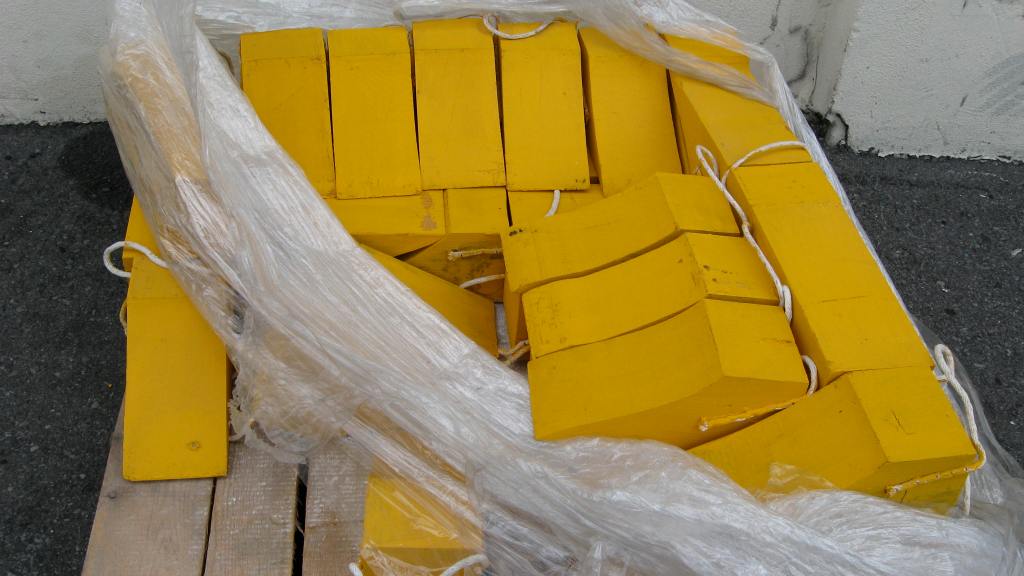
A well curbed wheel was always a way to prevent a write up, but now we are to use the wheel block anyway. New wheel guards on the curb side prevent us from using the block, so we must place it on the traffic lane side of the bus. I have since learned to leave a sliver of the yellow showing beyond the wheel tread, so I can see it from my exterior driver side mirror. If I am distracted by a question from a tourist at the Ferry Plaza, I am in for a shock as I rollover my wheel block when I take off.
Not placing the wheel block correctly can have dire consequences as the new wheel blocks are so strong and rigid that they don’t crack like the old wooden ones. Instead, they shoot out sideways like an arrow from a bow, if not placed squarely on the wheel. Thank God I learned this lesson when no one was passing. My block shot across the street by at least thirty feet!







 The Dao of Doug: A Bus Driver's Perspective