Surrender

The most challenging aspect of any operator of large equipment on the road is keeping aware of the “what if ” possibilities. “What if ” that bus in front of me, stopped in the zone, goes out of service? Did I leave enough space between my coach and the stopped coach to get around, if that bus breaks down or has a fight on board? A big no-no in the operation of a bus is to never back up. In life, of course, if we make a decision that appears to lead to an unforgiving situation, the challenge arises to decide to continue on ahead, or backtrack. The bigger the decision, the harder it is to surrender to the humility we need to go back. So too with larger vehicles, comes the fact that getting in to a jam is more difficult to escape once we become boxed-in.

And so the joy of driving a small zip car becomes clear in congested situations. The fluidity smaller cars have in traffic is almost a given. That being said, my most embarrassing moments come when my bus is stuck in an intersection or my tail is blocking the crosswalk after the signal has changed to green for the crosswalk and cross street. Usually, I scan the sidewalk ahead to see who is waiting, and based on previous stops on how the leading coach departs, I make the choice to pull in to the zone behind another coach with the probability that even if my tail blocks the corner by a bit, we can usually clear the zone space before the light changes.

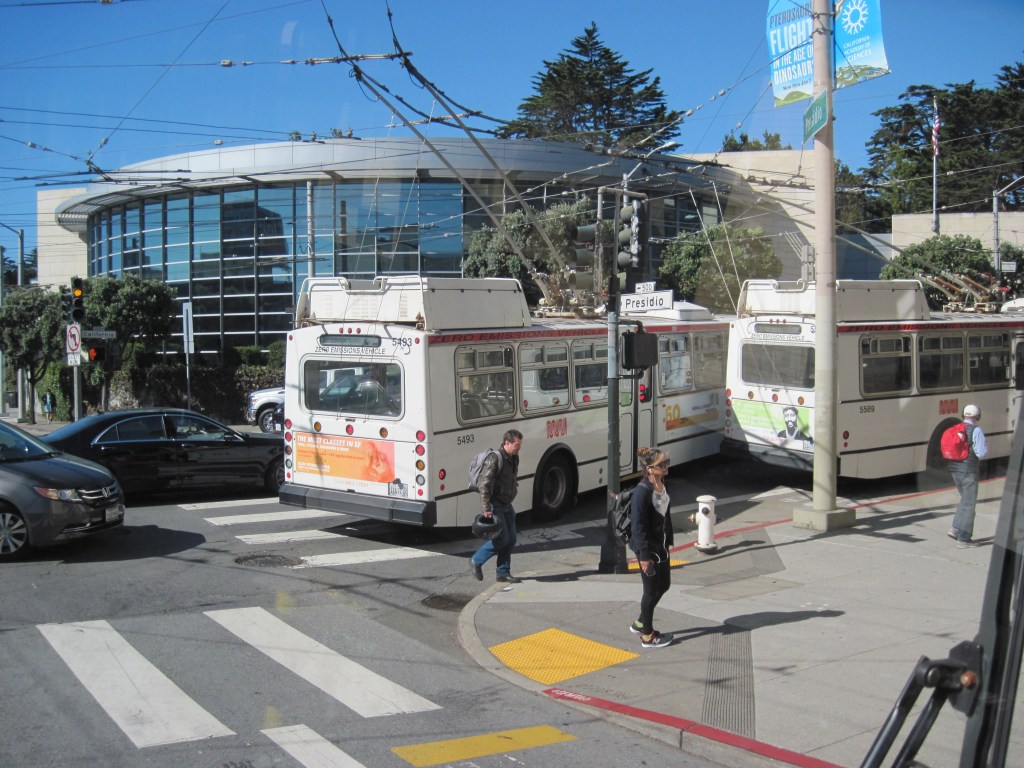
The contradiction of my error becomes glaring and in the form of the horn from cross traffic which cannot turn right behind me when I have stopped right behind the coach in front, and we aren’t moving and the light changes, and to my horror, I see pedestrians leaving the crosswalk to walk behind my tail in to the intersection space needed by a turning car to pass behind me from a turn. And this resulting rear sideswipe contact is one of the most common to buses.

In a way, pedestrians become friends in that their walk space puts an added cushion on my rear. But when pedestrians don’t cross, usually because a car is aggressively pulling forward to turn, is when the danger zone becomes active. Not knowing the mood or state of the cross traffic when the light does change, is a blind spot that can and often does, lead to trouble. Even when a car decides to cross over the center line to pass me while I am stopped at a green, any collision they get in to is not on me. I see no merit in creating more paperwork.

And so too with life, if things are moving fast and we feel light and free, we rarely stop to think about any negative consequences arising from having to know a ‘what if.’ But if we are doubtful about our next move, and we feel heavy and distressed, I have come to believe not to decide is to decide: not to move ahead even if the light is green. I have a problem with understanding this.

Not to decide is to decide. What the hell does this mean? It has always struck me as being like a cop-out. And this is where being behind the wheel of a bus has helped me in my life in other decisions where I could not guess the outcome. Which is to wait until the way is clear. My codependence about what others’ think in the immediate, i.e. the car behind me honking to push me through the green, has pushed me to move ahead behind the other coach. But as like attracts like, my move forward comes with even more anger with the honk from the car trying to turn behind me after the light changes.

This paradox took me a long time to be able to integrate in all areas of my life. That when running late and running heavy, the impulse to move up, or to push the envelope and try to cut down on waiting time, very rarely pays off. My coworkers and trainers would mention this time and time again as a precursor to an accident, and only when I have seen this over a long period of time, did I finally get the message. Usually when I am in the lead, and another coach moves in too close to me, do I realize how uncomfortable I feel. I immediately have to forgive myself because I have done the same thing myself. Rather than get angry at my follower, I can kill a stale green and cross on the amber nearside at the next stop to indicate I don’t want him or her to follow me far side.

When I was a rookie, and a senior operator was coming up close behind, the best thing I could do would be to pull my poles and get out of their way. They usually smiled and moved on up ahead. The most frustrating thing about all of this is when they tailgate, but they don’t want to move out in front. I have to muster all the courage and serenity I have to not let them affect my driving and decision making. I did learn early on, that seeing the rear end of the bus in front of me is not a happy day. And being a free range chicken is much easier than having a train of trolleys in front, or worse, in front and in back.

This becomes the most challenging aspect of not “winning” the race–when there are too many buses bunched together. The master of this principle will immediately adjust her speed and time in the zone by leaving the door open and pausing before moving forward, keeping the one block spacing rule in mind. And this rule is the clearest for me to see. The one block spacing rule is the best rule for avoiding an avoidable accident.

I tend to be too much an all or nothing guy, with little head space for a steady, easy course. Pacing myself in all my comings and goings has been a lifelong challenge I did not relate to this rule.

By doing several small steps in a series of activities, such as writing this chapter now, then going to the store for groceries, and then having a stretch and a snack, creates a world I would not uncover once I get in to the hour-by-hour zone of being stuck doing one thing. Same is true with obsessing about something in my mind. I did not see how the idea of surrender was actually what I was doing by pacing myself in doing a term paper, studying for a test, or working out in the gym. My sleepless cramming for a test, a torn rotator or tennis elbow, pigging-out at a breakfast bar, were all the endgame chargeable “accidents” resulting from a pattern of not surrendering. But I can say, if I find myself having to back away from a coach dead in the water, I can immediately choose to take a point of gratitude in seeing where I went wrong to not make the same mistake again.

I can eat a snack before a large meal. I can stretch before I hit the weights, I can use flash cards or reread my class notes later in the same day to burn the information in rather than do nothing and then try to cram. So surrender can actually means pacing myself based on what others are also doing. It keeps resentment at bay.

No better a traffic example is on I-5 between S.F. and L.A. Or in inner city medium traffic during off peak hours when everyone is cruising at about the same speed and distance. Stress is low and everyone is content with making the same time. I also had to learn this lesson about how the CHP also handles traffic. If everyone is doing 70, and there are no obstacles such as weather or construction, they tend to let “free-range traffic’ to continue uninterrupted at pace. Like an idiot, when I was new to California from the midwest, cruising with everyone at 75, I did panic when I saw an oncoming cruiser, and brake abruptly to slow to 60. All I did was call attention to myself, and he immediately began braking to look for a safe crossover. Luckily, there was none, and only later at a big truck stop did I find the unwritten California traffic rule of live and let live, as long as no one is causing problems contrary to the flow, let it go. So I guess another form of surrendering is to blend in to what the flow or trend is telling you.

Packed, Stacked, and Racked

Alliteration aside, I love this phrase when describing a bus which simply cannot take on one more passenger. One would think when the bus becomes completely grid locked on the inside aisle, common sense by simple observation would be enough to insure no one intending at the bus zone would consider even getting on the bus. One would be wrong if one thought that. In fact, there probably is a correlation coefficient that as the number of people waiting for the bus increases, their willingness to look inside the coach and see if there is room for boarding, decreases.

And this pile-on and pile-in to effect is some thing I always hope to avoid. And I can, but it means I have to pass up stops to keep from becoming so full I can’t see past the yellow line. I can get all sorts of help from passengers who want to “help out” by hearing them yell at the group to move back or to make room for a seat for a senior, but their “help” sometimes creates more problems because of the tone of their voice, or the profanity they may use. It is at this time I feel as though I am losing control of the situation. And the hard part is to figure out when it is time to stop taking on more people.

This is not as simple as it would first sound, because one has to figure on how many people are getting off. It is a simple math equation performed at every stop or transfer. How many did I lose and how many am I picking up? Through intuition and experience, it does become easy to know it I am going to lose more than I gain, but there are some whoops moments. I have room for six, but there are ten waiting. If I know I usually lose four or five, I should be okay and make the stop. But uh oh, here come five people running, only one person gets off, and now the light goes red and here comes a walker and a person with shopping bags. Should I have passed up the preceding stop to allow for this margin of error? Should I make the announcement that this coach is full, and will they listen to me? And this is where the ninth level of hell begins. But what I can do is shut this trend down immediately by passing up the next stop.

The danger is you don’t want people waiting at the stop to see there is room in the back, even if for a few. But once again, some equipment cannot maintain full capacity for more than two hours, and this other factor is hidden from view. Also the number of people waiting at the next transfer point is also not clear to intending pass-up passengers. So the idea here is to pass up when the coach is full, but in a way the minimizes drama and coach failure. And it is this see saw that makes life interesting. I have to approach this the way I approach spider solitaire: through difficult moves can come sweet victory.

Need for pedestrian scrambles

Dragging the Line

Not waiting to clear the zone.

When a coach in front of me seems to be taking longer than usual to leave the zone ahead of me, I must remember the one block spacing rule and slow down also to keep a healthy space between buses. This is usually an issue on Mission Street, where multiple lines parallel each other for several miles. A 49 and 14 can share a zone because the bus stops can accommodate two coaches. It is okay if two coaches unload and load together. But if there is a third bus nearby, such as a 14R, it is important to keep spacing so that no confusion arises from intending passengers as to where to board when the third coach stops to pick up. Those who need extra time to board, need that space in time between coaches to see the line and number on the coach. And if a front door is placed at the top of the zone of the leading bus, there needs to be time to adjust to the spot where the second bus opens it’s front door.

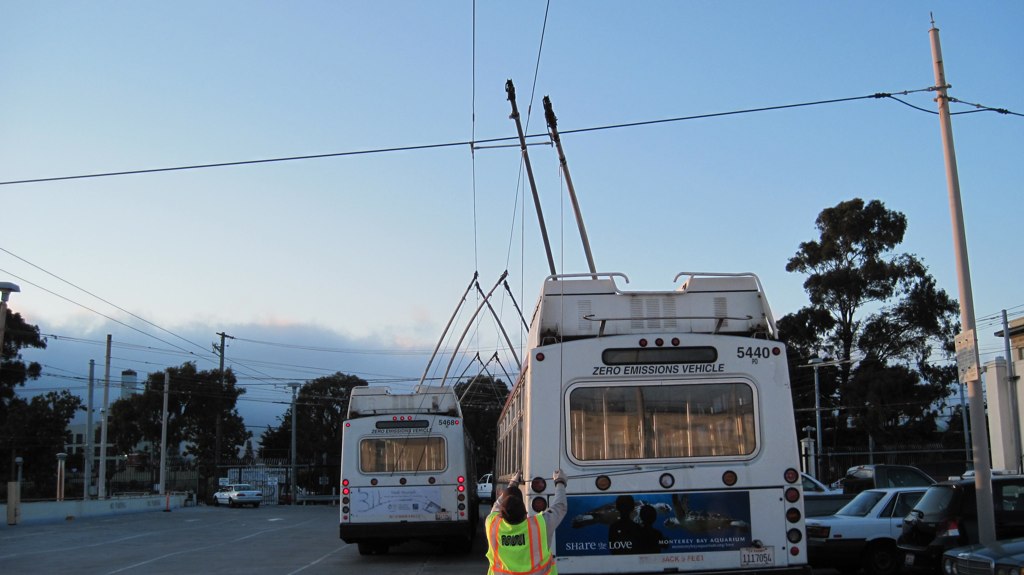
In order to keep spacing even, sometimes the lead coach operator will come to the back of the bus and pull poles. This will allow the emptier bus a chance to fill up by picking up intending passengers at the next stop and even out the load between the two buses. On certain pull-outs on the 14 and 49 line, a pull-out coach may be behind its leader when they both arrive at the next terminal, such as City College on the 49. The leader coach, already in service, must make way for the newer coach that leaves the terminal first, even though they arrived behind the other coach already in service. This can happen in the morning during peak period, or in the afternoon before peak period. The newer buses have a poles down button the operator can push to make it easy for the following coach to get around. The older coaches require lowering the poles manually. And regardless of the type of coach, poles should be cradled before any coach moves. So the drama begins when the question of who should drop their poles to pass, and when.

On the 22 at the outbound terminal by Third Street, a pull-in coach arrives after its leader may stay awhile for a recovery break. On the 30 Stockton, the same situation used to occur at Beach and Broderick. Same goes for the 41, 45 at Greenwich and Lyon. Overcoming anger in trying to get around was solved if I pulled their poles and went around. But if I locked up their retrievers in the process, or caused a problem by touching their coach, I soon found this was not a good idea, and could result in payback. No, I must be the one to go around first by dropping my poles. If the other operator was indisposed and unavailable, I could always find out later what their preferences are. In the meantime, I got to go.

I would get so angry when an unattended coach had its’ poles up at the terminal and I had to go around. I would also not understand why an operator would leave the bus sticking way out in the traffic lane with its poles still on the wires so that a trolley could not pass. “What the hell are you doing?” was not a good way to start communication. “Is there anything I can do to help?” definitely got me out of there a lot faster. Whether a youngster locks up the rear door by letting out the air, or a defect with the lift prevents the front door from closing, it is a simple matter to either move the bus, or ask to drop the poles. Case closed and now I am free to move. Except when I am not.

I try not to rush when I am on my pull-in trip going home. I find if I have an expectation about when I am to check out, and the time changes due to delay, I have to accept this ‘nature of ’ my job as a driver. The end time is not always exact, and I can’t leave my job such as punching out on a time clock. This is what officeworkers and store clerks must realize when they take a driving job. I have learned it does not pay to make plans too close to my off time. Many a drama in the break room or dispatch office has been started because of an expectation that does not match the needs of the line. I would see how unattractive someone would look in appearing to be a whining baby about not getting their way. Only until I was in the same boat and being denied a day off myself! Ouch. Oh well, the nature of the beast.

But I tell you one thing. I will never let my vacation time go to zero. Nor will I let my sick time go to zero. I have found out the hard way, that when I need a day off, and I don’t have it, the ability to remain calm and professional becomes difficult. I have been told to never let them see you sweat. And running out of time off seems to be a good example. God made aspirin for a reason!

amazon.com/Dao-Doug-Driving-Francisco-Perspective-ebook/dp/B0792SDK4L/ref=sr_1_1?crid=1YR3HZGRV4YNT&keywords=THe+Dao+of+Doug+Finding+zen+in+San+Francisco+transit+a+bus+driver’s+perspective&qid=1645641596&sprefix=the+dao+of+doug+finding+zen+in+san+francisco+transit+a+bus+driver’s+perspective%2Caps%2C168&sr=8-1

The Ninth Level of Hell

Whenever I find myself in the ninth level of hell behind the wheel of a large automobile, in my case, a trolley of Muni, I try to ask myself how did I get in such a place? And it is by an essay such as this that I can backtrack to find my part in how I got there, and to hopefully avoid ever having to experience this again. Without having to put on my favorite Talking Heads album. Hell, even getting to type this page was at least the seventh level of hell, and I wasn’t even driving a bus!

Just getting a change in my default printer on my net book took forty minutes. Endless tries to not get my first printer off of default, and to check wireless connectivity took most of the first fifteen minutes. The damn first-note program refused me to change to my second printer, and once there, I ran out of black ink, and the old cartridges would not fit as the number 56 is bigger and has more ink than the damn new ones numbered 60, which have less ink, yet cost the same. I clicked to the company website to see about selecting a new cartridge and got it all in German, from a German website.

And whoever thought getting a new wireless router to share printers on a LAN should be sent to Guantanamo without a key or visa. Even with the USB cable plugged-in directly, one still cannot get the printer out of its dumb printer stopped mode. And then opening the mail program to send my rich text files in my windows starter net book, did actually work seamlessly and so fast, I was pleased to see this aces the mail application on my MacBook pro.

But of course all my emails downloaded to my net book and I couldn’t stop the avalanche of viagra and cash prizes I had won in my spam filled cue. Finally, after deleting all the emails off of my emailing program on my net book, I shut down the computer, which wouldn’t close for new updates (lord knows what they were,) and on to my macbook, where low and behold, my email was there with my first four rich text chapters of this book. And after a few stuck-on- stupid spinning wheels that would not download, I got all my .rtf files converted to pages, and could print them on my first printer which still has black ink. Yes! Total time elapsed: 1 hour 20 minutes. Geez.

Final Solution. Go to preferences cue and search apple for Software Updates.

Needless to say I have my issues. And driving the bus seems easy compared to my office travails. I am looking over this previous paragraph of vomit, and seeing my tranquility has been disturbed. Just as it does when I am behind the wheel of a large automobile, or in my case, a bus. But my spiritual research has indicated that I have the freedom of choice in how I be with respect to what is going on around me. I may not be able to think my way out of the ninth level of hell, but I can choose at any time, how I feel. And when I can’t get in to the Zen zone, I had better take a deep breath and reboot.

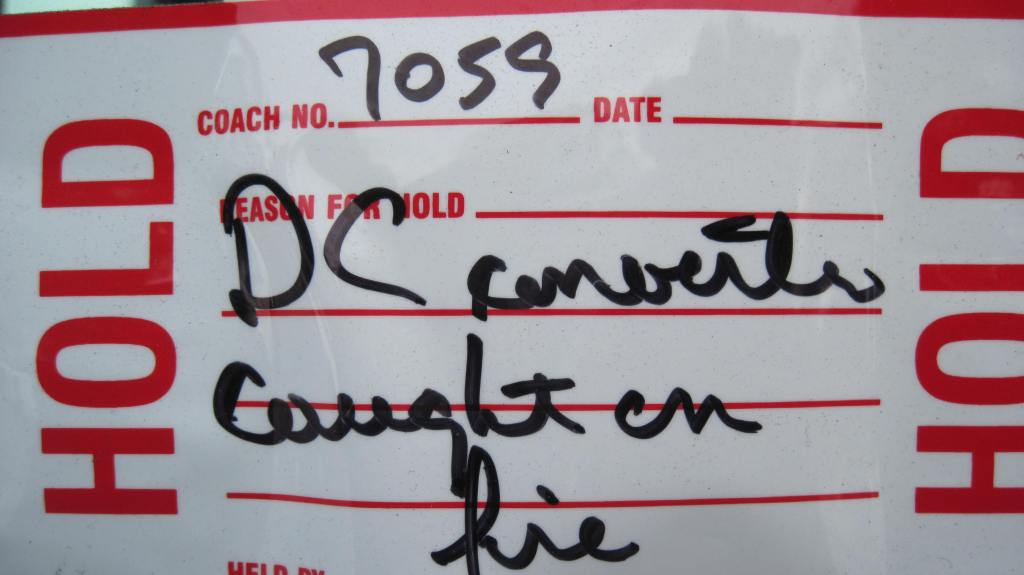
The fare box was jamming up and I needed to keep resetting it. Passengers were complaining about being pushed and shoved. I was without help in front or behind, and no buses were in sight. I was losing it. I made a decision. I can’t stay in this mind set. The 18th Street switch was right in front of me. I clicked right on to 18th, and left Mission. “This coach is Out Of Service” “Awww.” came the response from the packed bus. Unauthorized Pull-In. I opened all doors and people slowly streamed off the bus. Not without some comments about my abilities or my mother! This was the only time I recall I defied procedure and went out of service without permission. At this time I lacked the ability to control my load and check in with myself about my mental state.

Fortunately, I had another senior operator on board and she told me what I needed to do, and what to say to the dispatcher when I went to ask for another coach. She had boarded and was returning to the barn to pick up her car. Her day was over. I had forgotten about this ninth level of hell, and how she may have saved me from suspension or dismissal. She recently reminded me of this event. Wow. In my own self centered-ness, I had conveniently blanked it out. But I am glad I recalled this when I looked at how I had veered from topic. Interesting how I am in denial about all of this.

So, I guess all I can say in conclusion is that we all get in to our own ninth level of hell, and can only hope and pray we have an angel around to help us when we can’t do it alone. Thanks to the operator that happened to be on board riding, for helping me reach 17 years with the railway, and for keeping me employed through the years!

Would you like to make Chrome your default browser?

What bothers you and why?

The browser wars between Chrome and Safari. There are just enough of us that use the Mac iOS on Safari who can’t edit a mailing address on large state servers using Chrome and Microsoft apps and browsers. I couldn’t get my California State Franchise Board refund without a pdf copy showing my new address on a lease. My medical coverage was dropped from the San Francisco County Health Department website because I couldn’t update my new address in another state. I’m using an iMac not a Dell computer or HP desktop pc.

Shopify apps require Chrome to work smoothly. Those countdown clocks you see on sales sites don’t edit correctly or display correctly on Safari when you’re not on Chrome. It’s a problem.

Web host masters in charge of managing the institutional website usually provide a manual way of handling such issues, but if the website does not allow for email digital attachments-a person’s personal profile information may fall through the cracks.

Word to the wise. A Samsung android phone and a pc laptop are indispensable to a writer and or editor who interfaces with business websites using Chrome—on Microsoft Edge or office.

The insidious, “Would you like to make Chrome your preferred browser?” starts off okay, but eventually you won’t be able to exit your browser without a forced shutdown. Ah the data analytics. We are just users. So yeah, it bothers me.

Headway

Power failure due to the heat

“When is the next bus coming?” “Is there another bus behind you?” “How long before you go?” All of these questions are actually about headway. Headway is the time in minutes between buses. People usually ask me what is the best line to drive. And I say to you now the real question is, “What line has the best headway when I am scheduled to work?” Which follows to the important question, “What line has a headway where the loss of a leader allows for enough time to have a break at the terminal?” Or, when I won’t “get killed,” or “hit” with an impossible passenger load? Loss of a leader means the bus in front of me is not in service or not out.

A “not out” is a radio term for letting the following operator know they don’t have a leader. And I have found the 24 Line and 49 can be okay to work without a leader most weekday mornings. Some would argue the 6 line is okay without a leader, but I have not found this to always be the case. A lot depends on who is working the bus in front of me.

And the term “working” carries with it a loaded gun meaning, because not all operators seem to be working when they sit behind the seat. So having a non-working leader with a not out in front of me can make for a challenging 4 hour period without a break. And I have found if I go more than four hours without a working leader with double headway, I at some point, leave the Zen zone. And I need to be aware of the warning signs that I am beginning to break down emotionally. I am now good enough where I can outrun or outpace the equipment. A bad bus with low air or slow doors can make matters worse, but I have enough body energy to overcome most defects. It just is a matter of time before I begin to leave the Zen zone and start to risk angry passengers or unprofessional conduct. Some times the transit Gods step in and the bus complains and groans to a stop. Time out for calling the shop.

When I was new, I had trouble in ignoring the defects the coach was signaling to me, and kept going instead of taking a time out for myself. This subjective call differs from person to person, and I have had to do a lot of work on myself to see I cannot make the call about someone else’s personal break down point, or judge whether or not I thought they should or could keep going in service.

I recently had slow doors and doors that would not close all the time. I was dragging down the line. I was heavy, and too many people were waiting at the next zone. I began to pass up. The key is to know when to start picking up again. Sometimes I overdo the pass-up and get a “love letter” from the superintendent. I turned the corner on to Otis by 12th and passed up about eight people. Though I did have room for them, there was another bus behind me. But this time they didn’t see it, or weren’t in the mood to wait. Whoops. I can feel it right away. The rule is to stop and ask them to take the next coach, but my Zen was gone from having “made it” past busy Van Ness. I made a mistake, and sure enough, pen went to paper to result in a confer and consult with my union rep and superintendent. But I do find myself more relaxed than in the past. I am only human. My coach had defects which I chose to take me out of the Zen zone instead of slowing down and asking for help. Minding my own business was all I needed to ‘worry’ about.

Being a victim never works.

Getting along with my coworkers was perhaps the last feather in my cap. Accepting I could not make the call on someone else’s coach or how they operate, was the first step in not getting mad about someone or something outside of my control, and put me in the Zen zone I so admired from senior operators who never seemed to be phased with what was going on in the bus in front of them.

When I was asked by another more senior operator about how many buses I was driving, I didn’t get what she was asking. But I get it now. I only have one bus to operate, and that minding my own business was all I needed to take care of. Trying to do too much usually got me in to the superintendent’s office, or to sign for “love letters” at the dispatch desk from a passenger complaint. I knew I was on a good track when these events stopped happening to me! The only mail I get now is a Christmas card from the superintendent in December. This is mail I like to get! Merry Christmas!

So the feeling I was owed more time gradually became less and less important, and the statement from senior operators who I only have one bus to drive finally came home. And as the years have passed, I see it matters less and less what others do or don’t do. What is important is what I do. Work the rule, and call for help if I need it.

The guessing game about which run and line has a reasonable headway has become less of a hard homework problem, and more about just leaving on time and doing what Central Control always assures us to do when we call in late and heavy: to do the best we can.

All alone: Let the Show Begin

On Mission Street. Old timers don’t mind being all alone on Mission. As a new operator I just could not fathom this. No coach visible in front looking up from Second Street to Tenth St., or looking up from 14th to 22nd. If I didn’t see my leader in front of me as I left the Ferry Plaza, I would hope for help from the 49 cutting-in at S. Van Ness, which is at 12th Street. The 49 can be a help or a curse. If the 49 has extra headway on Van Ness, then it too, is full to the aisles, and can be a drag all the way out to Ocean Ave. This makes for a very slow outbound trip to Geneva. And I still don’t understand why I have had such a difficult time getting over this. That is, being packed, stacked, and racked, without help and running late.

From the tranquil interior of the superintendent’s office, especially when I am in trouble, comes the directive that the skip stop rule does not apply when there are no unusual delays, and no coach one block behind with the same destination. My definition of unusual delay seems as subjective as how far I can stretch a rubber band. I have skipped stops, during certain runs on a particular sign-up, because of my fears about what happens when the coach gets loaded to capacity. Interestingly, there are no capacity limits stenciled-in on the front of the coach such as found on a tour bus. This remains a mystery. And when I get in to this fear mode, usually with anxiety creeping into my voice and shutting the door on people, trouble is not too far away.

But oddly enough, this is why I love the Mission as opposed to Chinatown. Mission is a four-lane road, although narrower than any standard midwestern town, in San Francisco, it is a blessing because this is wider than most of our streets. Mission Street is also flat, and has fewer people driving from out of town, so most motorists are cool in that they are familiar with how to get around the buses. Cars usually stop behind our coach when we are splitting the lane, and they can see the red light. The question most people ask me about how we drive is, “Why do we drive down the middle of the street?” And the answer is: “We are taught to drive that way!” This got a lot of laughs when I do my Driver Doug as a stand-up routine!

Coming in contact with car doors was costing the railway thousands of dollars a month in claims, so keeping a four foot right-side clearance became mandatory. This means splitting the lane down Mission Street, which is too narrow to accommodate a bus in the right lane without putting the right side at risk from doors, skaters, and bikes. Like any experienced San Francisco driving resident, they know we will soon be out of their way when the light goes green, and we pull off to the curb to pick up at our next stop.

This familiarity makes driving on the Mission, in my opinion, fun. Motorists seldom create problems, and the way is flat and wide enough to pass obstacles. Flat is good because it saves the knees and legs when braking. Especially if the coach is heavy. But the fear I have about running late and heavy and without help in front or behind is because of what begins to happen inside the coach with the passengers. “Say excuse me.” “How rude.” “Ouch, you stepped on my leg, my leg is broken.” “Front seats are for those with disabilities, move back.” “I have a disability, bitch.” Don’t tell me what to do mf.”

And the list goes on. Fights break out. Pickpockets flourish. The chances of going out of service increase. And I guess the wisdom of many operators is to let this happen because it saves emotional energy. I have such a deep core belief in demonstrating skill in my job I consider going out of service a failure. I believe I am not using my skills appropriately to avoid going out of service. When I get written up by a passenger for taking on the load of another bus, I also feel this emotional drain. Since my job is not that of a carpenter or builder, I cannot see my handiwork as a finished product. I cannot leave a legacy so to speak, by using superior building materials, or as such, putting in four or five nails per shingle instead of skipping nails and laying down faster.

All I can do for self satisfaction as a bus driver, is to avoid fights, going out of service, and not put a burden on the operator in the coach behind me. This is how I define my success. Unfortunately, their are no awards or praise forthcoming if I prevent a breakdown, or if I skip stops to keep the bus from overcrowding. In fact, my odds for safe driving or Operator of the Month go down. All I risk is a complaint from those who get passed up, or a complaint or accident report if a fight breaks out. And so I try to find a middle ground whereby those who get passed up don’t call 3-1-1, or those in my coach have just enough room to not step over one another.

And sometimes, when all alone on Mission, this becomes too challenging to find a compromise. Because if I pass up those on the corner, and there is no bus behind me, then I believe mass transit has failed to provide adequate service. Either way, service is lacking, and all I can do is try to let the folks riding I am trying to do the best I can.

This is where a good interior PA mic really helps. If they can hear me clearly when I am passing-up a stop to exit before the light, or between two corners, so I am losing more people than I gain, all is well. Interestingly, there usually is a God space to do this. Sure enough, I can find a break in the parked cars to open all my doors and let folks exit safely. There is an emergency clause in our rulebook which says we may pull to the nearest safe place to stop. I construe this emergency stop rule to mean that if I am overcrowded, even without unusual delay, this constitutes a safety violation, and that my skip stop and pass up is my highest priority. Unusual delay becomes regular delay when equipment and operators are in short supply.

With the installation of the drive cams on our front window, something interesting has happened. And the training inspectors, who are of my experience level and seniority, seem to have also been giving added grace by understanding that when the coach is full, certain flexibilities exist in picking up loads, and stopping. The biggest headache I have is trying to use the kneeler or lift when the coach is full. It does not seem practical or safe to pick up a wheel chair when the aisle is full. And the coach protests at having to rise when heavy, once we have lowered the kneeler. Also the wheelchair lift can get stuck if our air is too low.

If I had pixie dust to get intending disabled passengers to understand my point of view, it would be this: Yes, I want to pick up all those needing a lift, because I like the fact everyone can make their way around our city without a car. And yes, I like to feel good about myself by helping those that our less fortunate in mobility. Please be ready to board when the coach arrives, so I can see you. Let me help you by making sure you get on first. “Thanks.”

https://fineartamerica.com/profiles/douglas-griggs/shop

School Trip

The skills needed by teachers are helpful in being a transit operator on school trips. I don’t like receiving a coach from relief that has had a morning school trip where fast food wrappers and spilled drink cups litter the floor. I keep in mind the rider on her way to an important job interview, and the ice cream cone that fell in her lap from a young rider who lost control of her ice cream ball on top of the cone. Other memorable events are the completely full coffee cup that gets knocked out of hand when someone with a backpack passes by. Or the friendly town drunk who leaves the bottle open by the back seats and falls down to spray the odor of alcohol all over the back seats and floor. These are not the best first impressions one needs on the way to school or to work.

I always try to do harm reduction in cleaning the coach, first chance I get, but sometimes this is a few hours down the road. The best defense is a good offense, but I try not to be offensive in my comments to young people about taking their trash or wrappers or containers with them as they board the coach. But as getting to school is a predictable event with a predictable start time, the saving grace, if one could be so bold, is that you get the same riders at the same time and place every day, and because of this, you can predict who and when the trash dumpers board. And stopping them from boarding after reminding them the previous day to take their trash, shuts down much of the mess later in the week, and can have a beneficial effect on keeping the floor clean.

There is nothing like being in the Zen zone with a bunch of students going to school, and walking down the aisle after everyone has left at the terminal, and finding not one piece of dipping sauce, not one egg sandwich wrapper, and not one coffee cup by the back seats. “You’re an awesome bus driver.” never hurts either.

https://www.amazon.com/s?k=The+Dao+of+Doug&crid=1ZWQPWRRV28EW&sprefix=the+dao+of+doug+%2Caps%2C194&ref=nb_sb_noss

Not All Stops are Equal

When buses are missing, the time between buses doubles so waiting time increases. It can become very unclear to those standing at or near multiple line bus stops why the bus passes by. The bus is full because double headway means double passenger load.

One phrase used frequently by bus drivers are the phrases, “my time” and “your people.” Such as, “He left on my time,” or “I am picking up her people.” The tone in which this is said is in proportion to the tension felt by those waiting. Use of a Jerry Springer Show dialect, with a sliding bobble head neck drives home the point of coming to work to do work, or to just stay home.

All the frantic yelling and screaming is moot if you are no longer in the scanning range of the operator or outside the zone. The scanning range of an operator is one to two blocks ahead of the direction of travel. Once the front door passes by where you stand, lucky is the day the bus stops. And I do appreciate your thanks when I do stop. But stopping is the exception to the rule when I am late and I am full.

If no one rings to get off, and the bus is full, the bus doesn’t stop. It becomes important to see how full a bus is as it approaches. Looking away on a cell phone, or talking to someone else and facing away from the direction of travel, all compound the chance of a bus not stopping if no request to stop is made on board on a crowded bus. These are the unwritten rules of not wanting a bus: If you are not facing the operator as the bus is a half a block away, and you are alone, and you are on Van Ness or Mission, we usually will not stop. In San Francisco there are so many passing by, or standing, or sleeping (or whatever) in the shelter, we have learned to look at your hands to see if you are holding the fare. This is called looking for those who are ready.

So baby stops, not at a light, or far side from the cross street, are not equal to major transfer points nearside at a stop light. Increasing your odds for pickup become relevant if no bus is seen coming, or you see the taillights of a bus just having gone by.

A red light can save you when headway is long, or a bus is full. A good question to ask yourself while waiting, is, what are the chances of someone wanting to get off at this stop where I am waiting? It also pays to be aware of when the next bus is due. Do you have a clock in the shelter where you are waiting? If not, is there another bus stop a block or two away that does have next bus? If you are waiting at a minor stop with no clock, and no way to see a bus coming, should you move to a better line-of-sight stop by a stop light or transfer point, so as to increase the chances of a stop? The answer is Yes!

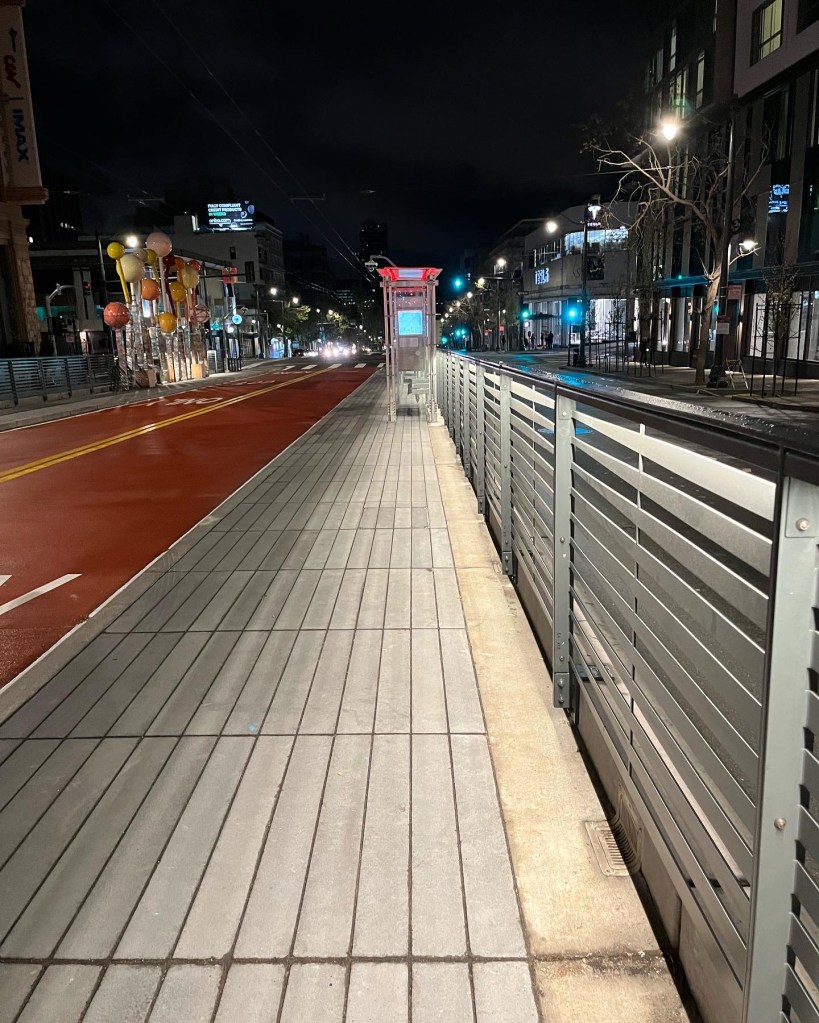
Odd numbered street stops have been removed in the Inner Mission to reduce dwell time and running time for the 14 line and this makes it important to know where to stand and have your pass ready to tag-in with your phone or card. As soon as you leave the store with your wallet out, get ready to have your phone or fare ready to go. This compliments our ‘red carpet’ treatment on the pavement: transit gets priority over car traffic. The newly painted red lane reduces congestion from the influx of the 5,000 ride share cars coming in to the city from the East Bay.

If, however, that other stop has a large number of people waiting, sometimes it pays to backtrack to a stop with less people waiting so you can get a better spot inside the bus before it gets too full. Giving up a major stop is good if you can tell on your smartphone or the shelter next bus time clock, that another bus is only one or two minutes behind the first coach. Usually this first bus is packed, and the next one is okay. So sometimes getting on the first bus is bad.

The chances of a fight breaking out, “Quit Pushing!” “Get off my Leg!” and such always occurs on the first, more crowded bus. The chances of this bus going out of service are also greater.

Think about it. When you see a mob of people getting off of a bus that stops working, it is a mob of people. Very rarely is it an un- crowded bus. This crowded bus is usually late and arrives after a long wait for buses. Try to avoid getting caught by noticing how many people are waiting when you first arrive on foot to the bus stop. Sometimes if you get on a local neighborhood bus or another line with less people, you can transfer later down the line and be on time.

So what am I saying? I am saying if you are smoking a cigarette, talking on your cell phone, looking away from the street, all alone or sitting down, and look like you haven’t seen the inside of a gym in years, forget about it! All the shouting and cursing in the world isn’t going to make the bus stop, unless you can beat it to the next red light and get the cap number of the bus driver! Good Luck, and see you next time!

https://www.amazon.com/s?k=The+Dao+of+Doug&crid=1ZWQPWRRV28EW&sprefix=the+dao+of+doug+%2Caps%2C194&ref=nb_sb_noss

Loading Zone

In the ebb and flow of traffic, the space cushion between vehicles goes up and down. As traffic turns from medium to heavy, the matter of inches can come in to play as to whether traffic comes to a standstill or not. When a limo or ride share is picking up or the motorist leaves the vehicle unattended for just the few seconds it takes to get to an ATM or get a coffee, the attitude of the car and it’s distance from the curb can determine if the lane is shut down and blocked. This then creates an abrupt left merge situation to lane two, and brings both lanes to gridlock. This setup for a backup is completely avoidable if the first parked vehicle would stay within 6 to 8 inches of the curb.

The pecking order of when and how delivery trucks set up to offload, also affects lane closure and gridlock. The first arriving number one truck may park in perfect order, but a second truck parks too close on the opposing traffic lane and makes for intense squeeze play that need not be if a longer gap is left open. Intending through vehicles build a backup line which prevents the oncoming lane from clearing truck one, thus preventing two way traffic from clearing. This occurs in a commercial zone where lots of cafes and shops line the street. Upper Haight in the Haight Ashbury and 18th Street between Delores and Guerrero are classic jam spots for the 33 Ashbury.

Once a delivery driver becomes familiar with his or her drop-off route, adjustments are made to the delivery schedule whereby no two vehicles create a rolling delay because they wait for the other delivery to clear, and go around the block to alter their drop off time. Experienced UPS and FedX drivers are good at this. Mainly because they have another address close by and can adjust. Trash trucks can also go around the block and work on other houses or businesses if other trucks block their trash can pickup. This usually works for smaller bakery trucks and bobtails. But fifty-three foot out-of-town tractor trailers from distribution hubs in the Central Valley can cause longer line delays.

The one line delay that can block both lanes in either direction is a loading dock zone. Fifty-three foot tractor trailer rigs attempt to back in to a dock perpendicular to a not-so-wide San Francisco street. These trailers take finesse and skill from the class A truck operator to make a pass in three moves maximum, else the blocked pedestrian, cycle, and vehicle traffic begin unsafe maneuvers. Office Max on Arguello near Geary, Big Lots on Mission near 30th, and the Whole Foods on 17th at Kansas are to name just a few. This just adds more delay to those patiently waiting in their lane. I have to pop the brake and relax and pretend I am watching a truck driver training video on how to back in to a loading dock.

Sixty-foot trolleys are being added to the 5 Fulton line* and it will be interesting to see how this works on Central Avenue by the Fulton Market grocery store. *editor’s note (2005-2006) A loading dock was placed on a small residential street with a trolley turn located on both corners, either side of complex which takes up the whole block. Full-length tractor trailers attempt to back in the dock whereby a space in parked cars is needed to access the dock by placing the tractor on the opposing curb to make the back-in.

The solution to this is to paint a red curb clear on either side of two residential driveways across from the dock. This means taking away parking space. Here’s the rub. Taking away parking requires a procedure that takes a long time. I cannot fathom why transit needs do not gain priority over the car. Especially in a city like San Francisco. A truck making delivery to a grocery store can block commuters on the bus for up to six minutes because they can’t back in to the dock because of a parked car across the street. Our event marker button on camera may help by taking a screenshot of the offending vehicle.

At the 45 terminal at Greenwich and Lyon, the red zone curb clear needed for the buses to wait their time to go downtown is not placed correctly on the block. Room for two more buses would solve the problem of coaches blocking driveways on the approach to the terminal. There are no houses on the terminal side, yet permission to move the red zone takes years to change. I hope the value of transit can be seen by all as we move in to the next generation of travel. I can’t understand why the planning department cannot use the eminent domain and public good to make the necessary changes for transit.

The battle cry goes up along Chestnut Avenue when bus zones need to be extended for longer trolleys. Everyone loves the fact that new larger equipment is to be added for service, but no one wants to sacrifice the three parking spaces necessary to increase the curb red zone. These delays add confusion to our General Sign Up and cause some operators to have to pull out from an alien division or extend a pull-out route from farther away from where our barn is or where we end our day.

The finale of long trailers in San Francisco occurs when a tractor trailer driver from out of town decides to go up 17th Street from Market to access Cole Valley, or takes Leavenworth from the Tenderloin to access 101 North over the Golden Gate Bridge. The loading stanchions for hooking and unhooking below the trailer scrap on the dramatic elevation change before or after crossing a steep grade. The trucks stall going uphill, or get wedged going downhill.

This recently happened when a truck got stuck crossing Union to go down Russian Hill. The only way to break free is to drag the tractor down the hill. The noise of the trailer’s hitching posts dragging on the street definitely awakens anyone in a three block radius! No alarm clock needed on this commute! Tour buses are also big offenders on Russian Hill. During Super Bowl 50, a beer truck got stuck on Jones and California by Grace Cathedral. Obviously this was a new driver on call for the extra work for the large visitor population we had hosting the Super Bowl. Tractor trailers at least have flexibility at the hitch joint. Buses are one solid mass and damage to the frame may result. I’d hate to be in their dispatcher’s office when this call comes in!

Also telling are when a new fleet of delivery trucks make to the streets. New employees are easy to spot by where and when they park. They must adapt their parking so as to not create a car jam so that cars waiting in the queue at a red barricade oncoming traffic stuck behind the newcomer. Passengers intending to board at a bus stop would also do well to adjust where they stand based on double parked vehicles nearby or next to the stop zone. While you may be standing where the bus usually stops, if other cars stand or stop in the zone or double park at the top of the key in front of the zone, this alters where we bus drivers’ can put our nose to the curb. Usually we make a flag stop: we don’t try to come to the curb and keep our coach parallel to the curb one lane away.

The simplest rule to keep the Zen is to leave a broad birth for smaller vehicles unable to see ahead, a space to move in front of my coach when they impatiently pass. I try to move to the right as much as possible so they can see the obstacle ahead, but many times this is unsafe for door openers and bicyclists. Even when passing a double parked truck, with my high beams flashing, oncoming motorists appear oblivious to my move and block me from returning to my lane. I remember I am the paid professional on the clock and a no worries attitude heals the block the fastest! I can find my Zen at any loading dock or any hill!