Over There

“Should I wait for the bus over there?” Silence. No response from the operator. Can he or she see where you’re talking about? Does the operator see your finger and guess which corner or direction you are pointing toward? This question usually is not answered. If I am in the middle of something like the crosswalk, the turning car, the waiting truck, the cyclist approaching, I don’t have a second set of eyes to find the direction or spot you are pointing to.

As soon as I can qualify and describe a landmark in the big view in front of the bus, things become clearer. If inside the coach, I must come to rest before I can safely give you the answer you need. I have to look at this from a point of view other than my own. I can stop and open the door where you are standing in the aisle behind me, offer a suggestion based on the scene in front, and wait for you to decide what to do. I need the space to stop, look, and listen.

I have tried to simplify this by saying, “Yes.” But nine out of ten times, the question is repeated again. “You mean over there?” “Yes.” “Going that way?” “Yes.” “Or is it that way?” “No.”

Third time is not a charm. The answer is yes and the case is closed. And so is the door. “Hold on, we’re rolling!” I may not have eyes in the back of my head if my interior rear view mirror is above or below where your finger is pointing; and even then, just what part of the finger am I supposed to look at? The one finger that always leaves no doubt—the middle finger sticking straight up in the air!

Pulling In

One common comment people make when waiting for the bus is the question, “How come I see like three buses going in the opposite direction when I have been waiting 15 minutes for a bus and nothing is coming?” And this has to do with where the buses come from, and where they are headed when they pull-in. “Are you a 49?” is asked a lot when buses along Van Ness have the head sign reading, “Market.” There is no line number displayed on the left of the head sign, just the words in bold, “Market.” The truth is that this coach could be a 41 Union, a 30 Stockton, or a 49 City College pulling in to the wires on Eleventh Street and ending its run for the day.

Trolleys do not magically transport from their last terminal to the bus barn. They have to return to the barn on the wires, usually along a corridor that connects to the pull-in wires at various locations like 17th and South Van Ness, 16th Street and Bryant, Eleventh and Mission inbound, or 10th and Howard outbound. So when headway, the distance or time between buses, is gradually increasing after rush hour ends, knowing which direction the pull-in coaches are headed, helps, because service is superior in this direction. 49 line buses that go out of service inbound at Eleventh Street from Mission don’t turn left on to Van Ness, and so the headway immediately increases for those waiting to go inbound to the Fisherman’s Wharf area or North point. Someone waiting at a big corner like Van Ness and Market at 6 p.m., would see three times the number of buses headed outbound along Van Ness, because these buses are pulling-in.

The good news is, if you know the pull-in direction of buses heading back to the barn in the early evening, you get great service with buses almost empty and quiet. This is a great spot to find the Zen zone. Working a run with pull-in operators who do work is a great way to start a twilight shift with a gentle beginning. When operators do not pick up, or I am missing a leader, the load on Van Ness becomes an impatient, angry drag down.

When I pull-in from the 30 Stockton or 41 Union or the 49, I always try to pick up those waiting along Van Ness even though I am a short-line coach. Technically, based on the information on our paddles, our run’s timetable, we are a 49 line coach. I have found if I pick everyone up, it helps the bus driver behind me going all the way to City College because he or she only has one major stop to pick everyone up: at Market. Sometimes I get permission to go down to 14th Street so that my passengers can connect easier with a 14 to continue outbound. It doesn’t “cost” me anything in time to do this as a pull-in from 14th Street is actually sometimes faster than 11th, and it prevents a huge group of people from waiting at Market by Van Ness station.

There is nothing worse than having a huge group of people waiting for the next through bus and you are pulling in. By picking up folks willingly and taking them to a transfer point on Mission, it reduces delays for my follower and helps those waiting. Having a working PA mic makes my voice easy to hear and understand really pays off. This eliminates the battle cry from angry passengers on board when I turn off the line to go to the barn.

Sometimes, however, being mister politeness-man does not help. Anger remains unabated and no one understands how I am trying to help. In these cases, the right to remain silent is actually the best policy. If it has been one of those days, I have found it best to remain silent. Any thing I say can and will be used against me in a passenger service request. We have learned as operators that being helpful to stay in service to get folks closer to a transfer point, doesn’t always work. More drama does not mean better service!

When I was new with a high cap number and low seniority, the probability was high the runs I found available in the afternoon had a pull-in at the end of the day. And if you have a lower cap number, and want to work days with big money, you may have to choose a day run split whereby you also have to pull in after a long twelve hour range during the day. The point is, after working for many hours, the last trip is a short line trip which involves taking the coach off the regular route and switching over to wires on streets which lead to the bus barn.

Interestingly enough, no matter how many years a San Franciscan has under their belt in living in the city, or riding a bus, if they don’t have a friend or family member who has worked for or is working as a transit operator, they are clueless about what happens in the morning hours from 8:45 a.m. to 10:00 a.m. and around 6:15 p.m. to 8:00 p.m. Certain runs and certain buses end service during the end of a peak period of frequent service, to less buses and a longer headway.

Most people don’t understand when peak period is, or that the headway between coaches changes every four hours, and is clearly marked at any shelter with a map. Most have confusion between express and limited service, and are unaware express service operates in only one direction depending on the time of day. Express coaches run inbound in the morning and outbound in the afternoon, and this of course, requires you know which side of the street you need to wait on to catch the bus in the correct direction of travel. And what lines go downtown, or which lines go crosstown and never see Market Street.

One intending for a coach headed in a direction towards the bus barn should look not at the line sign, but the destination as well: Especially during the times when headway changes. And after 14 years of service as a bus driver, the ratio or number of people looking at the destination sign of the bus has remained about the same. Less than one-in-ten standing on the sidewalk waiting for a bus, actually acknowledges the bus destination before boarding. And if the operator informs those boarding about the destination of the coach, patrons are confused or clueless about why the bus is a short line coach. Just as in the run from hell I worked in 2007, there seems to be an unlimited well of new, misinformed, or confused passengers about bus pull-ins after peak periods.

I guess if I could wave a magic wand of desire to change behaviors which chronically delay or add to tension between riding public and our union members, it would be this issue. It is simply a matter of awareness and pattern. And no matter how many years or how many hours at work we have been in the seat, the patience must be mustered to quickly and clearly explain that this bus is ending at 11th Street, or 30th Street, or Market, or 17th and Bryant.

Crunch Zone

I picked up a man in a wheelchair near downtown at Third Street outbound and was amazed at how smooth and fast he boarded and locked in. I could tell he was a regular rider. Instinctively, I knew he was going to get off at 16th and Mission, and sure enough, when I asked, he stated he was going to 16th. I told him I was glad to have a regular rider who knew how to ride Muni. He talked about his learning curve on how to work the flip-up seats and about where to get on and get off. If there was any heartfelt strength of purpose to distribute this book to the masses, it is not about the money or the power or the vanity of being an author, but to get out the wisdom about how to ride, so that the bus system moves faster and creates fewer headaches for those getting around. Nowhere is this wisdom needed more than in the crunch zone.

At first, I wanted to call this chapter, “Crunch Time,” as it pertains to the operation of a bus from 3:30 p.m. to 6:30 p.m. However, the pattern of movement between two stops was as predictable as the time frame, and I realized a more accurate description of gridlock was in certain zones between stops. And the idea for this chapter was born in the conversation with this wheelchair rider as he glided away from downtown with me in a calm, roomy coach. If there is an opposite to being in the Zen zone, this chapter is it. I found out he wanted to go up Van Ness to Geary, but was passing up the transfer point by four blocks. Now I know why. He was avoiding having to board a trolley in the crunch zone.

On the 14 Mission, the crunch zone exists between 16th Street and 7th inbound in the morning, and Fourth and Eleventh outbound in the afternoon. The sequence of events is so repetitive and coincidental that one could plot a graph of predictability on an actuarial table for an insurance company. Come to think of it, the City of San Francisco is an insurance company. I don’t know how this would help with claims, but like this man who was on my coach, avoiding the problem areas makes for an easy ride, even if it means traveling beyond the shortest distance between two points.

Indeed, I found this out as a rider in my thirties, new to the city in the 1980s. In getting to my warehouse in Hunter’s Point and Bayview from the Tenderloin, the shortest route was the 19 Polk. But the fastest way was to go inbound on the Geary bus to catch a 15 Third. I made a large checkmark inbound to outbound rather than go crosstown direct.

And this is true of the crunch zones between the 49 Van Ness and the 14 Mission. Especially if you are in a wheelchair, carrying a large cumbersome object, or using a grocery cart. Also, if you have difficulty in getting up the stairs or need a seat right by the door, oddly enough, the best offense is the defense of traveling beyond the closest stop to your destination. This means backtracking to board where the bus is less crowded. Many riders have learned this about getting on a train under Market Street.

The crunch zone for the 49 Van Ness builds as the bus moves inbound to the streets numbered in the teens until 14th Street, where room runs out and there is nowhere to sit or stand. Cyclists, walkers, and those receiving food bank items filling a grocery cart all wait in the crunch zone. If there are two coaches bunched together, usually everything is fine. But if there are gaps between buses, a pass-up frequently prevents crowding problems.

On the 49 line, the crunch zone exists between 16th Street and Eddy inbound, and from O’Farrell to Otis outbound. Load factors and working leaders influence the zone by making it longer or shorter, but in general, I have to make sure people boarding do the right thing by sitting or standing in such a way as to prevent fights or arguments at the following stops. Crunch zones also lie in the Inner Mission between 18th and 30th outbound in the p.m. Also, before 24th St. BART inbound in the morning commute. People listen better before their space is threatened.

This is a golden key to the crunch zone. I, too, have a better vibe and tone if I ask someone to move before the crunch zone hits. And when those who have moved see that those I next pick up need the first two seats, the message has hit home in a way that is not threatening or defensive. Score one for the Zen!

Always In Service

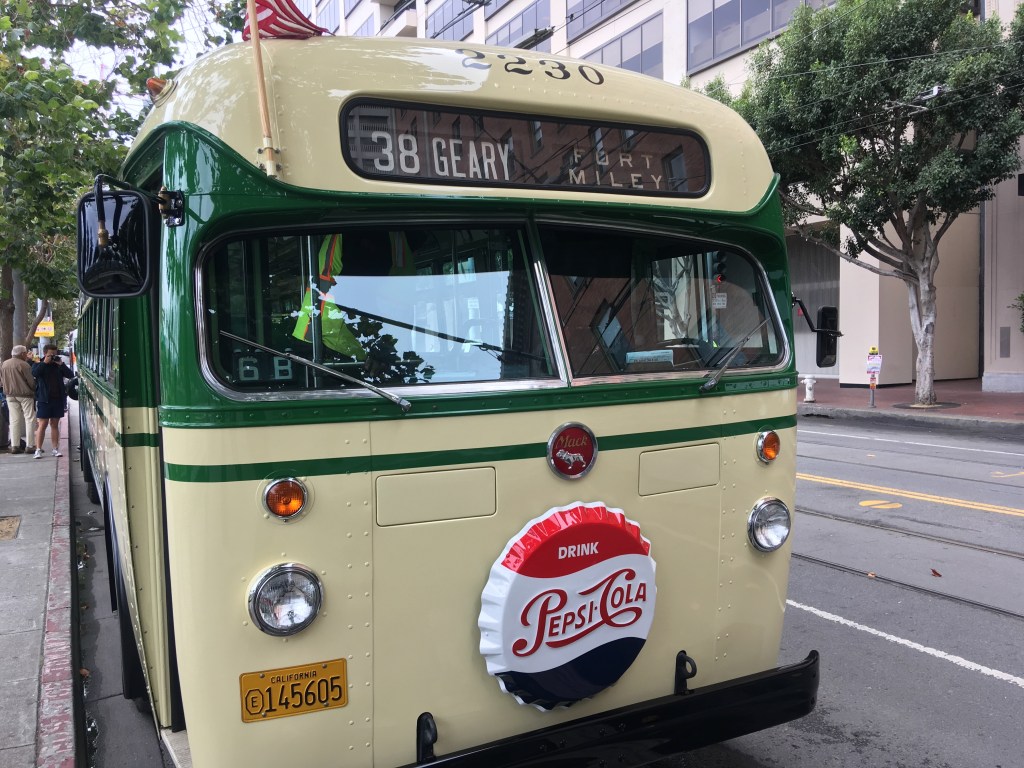
Unlike motor coaches, trolleys are always in service. This is in the rulebook although very few people understand this. If I put up the sign that says “Garage,” it does not mean I will not pick you up. I am putting up “Garage” so you can see my destination clearly. Many times when I put up the short destination, people don’t see my short line destination stop. I have been written up for posting “Garage.”

The street inspectors don’t understand that when I put up “Garage,” it does not mean I am out of service. The street ops person does not realize I am trying to make my job easier by not confusing passengers, and I am trying to telegraph I am not a regular line coach. We do have the sign, “Ask Driver,” but on the old coaches, the line sign still stays up.

I guess most operators, when they put up “Garage,” don’t stop to pick up people who are waiting. I know I sometimes put up “Garage” when I have had a long day, and am tired. If I have been missing a leader for more than a trip, and have carried a heavy load and been late on schedule, I have been known to put up “Garage” because I believe I have done more than my fair share for the day. I don’t feel like dealing with more questions about where I am going after a killer day. The last thing I want to have happen is get in an argument with someone who wants to go farther than my pull in point.

There are times when I announce my last stop and someone comes forward to ask if it is okay if they go with me say to 17th and Bryant. I have always, and without hesitation, said “yes.” Because I am a trolley man. And trolleys are always in service. When I have an Eleventh Street destination outbound from Ferry Plaza on the 14 Mission, and I pull into the zone at 9th Street, I announce that this is my last curb on Mission. Notice I say last curb. This is accurate and simple. I did not say this is my last outbound street stop. We click left at 10th and turn on Howard before we turn left on to 11th, but we don’t have a sign that says Ninth. It seems short of the mark. In just two blocks, there is the option to get on 4 buses during the day, or two buses at night. But no matter how sincere or patient I am, this message is lost due to language barriers or inattention.

I heard another operator getting in to some trouble to pass-up a wheelchair or lift request such as at Fourth Street or at Sixth, because “I am only going to Ninth,” just as I had done on an earlier sign-up. This was the same man in a wheelchair, who time after time got passed up or brushed off because we operators assumed he was going to ride beyond our pull-in. He was fast boarding and departing and really did not take up much extra time. Over the years, he became adroit at getting the coach and run number of operators who did not pick him up.

This has led to many complaints for many different drivers, when our rush to be done caused us to get a complaint, a letter, or mail from the dispatcher, a ‘love letter,’ so to speak, because this was a valid complaint because we passed up a customer with a right to get to our short line destination. After the angry cries from those I shut the door on my quick passes outbound to Ninth, I vowed to put up ‘Garage’ on my head sign. I realized eventually, it was emotionally much easier to take my time and let everyone board, but let them know I was a short line coach: And how to talk quickly and without lying.

Sure enough, the one wheel chair passenger waiting at Sixth or sometimes Seventh, did want to go to Ninth, and I would never have allowed this ride to occur if I barreled on ahead without time for those waiting to tell me the short ride was okay and that they were only going to Ninth.

I have found I almost always have one or two passengers who are willing to travel beyond my last regular stop, and in 14 years, I have never had a problem in doing this. A wonderful victory was a nice man in a wheelchair from Larkspur who rode the ferry in to my terminal at the Ferry Plaza and after small conversation, found out he wanted to go to Costco at 11th and Harrison. This was on my pull-in route. What a great feeling to take him beyond Mission Street and drop him across the street from Costco, without him having to make a transfer and waste time looking for the 9 line or 47. Being able to get to this point of finding a joy that remains hidden when most of us pull in with a one track mind, has a lot to do with the spirit behind writing this ‘how to’ manual on the Zen of San Francisco transit.

Our car culture lacks the sense of community built on the bus when we talk and communicate with one another. I still have this man’s business card he gave me when he got off at Harrison and 11th. I found out about the history of his nice apartment complex, and his life after retiring to a great place to live. And all this richness would have been lost, or reduced to a piece of mail warranting a conference with my superintendent for possible discipline, when instead, I got a connection from another passenger who got great service.

When pulling-in on the Mission wires from the other direction, the same dilemma occurs at 26th and Mission. We click right, on to 25th, to use the pull-in wires on S. Van Ness. I travel all the way down to 17th Street and S. Van Ness, which is only one block away from 17th and Mission. To wait for the next Mission bus, can sometimes be twenty minutes (see Daly City 702.) I have a passenger who desires a location within one block of the Potrero gate. Such as by the KQED television station, across from our yard, or in some other residence or business in nearby media gulch. All the hurry up and go home energy becomes a relaxed, enjoyable ride for one person I make special by dropping them off within a block of their destination. And the knowledge I saved them time without additional transfers instills that they are a part of a transit family within a great system. ‘Unnecessary conversation’ sometimes pays off. This goodwill can have expansive positive effects on the perception of drivers as a whole, and goes a long way to hopefully preventing calamities or funding arguments down the road.

Moms and Babies

After morning rush out come the moms and babies. Well, sometimes they are on morning rush if the day care center is on your way inbound. But generally, the babes come out from 10 a.m. to noon, or before school gets out around 3 p.m. What a wonder to see a newborns’ face. Or even better, the toddlers who look up with wonder, or climb fast to get first dibs on the best seat. And here is where I believe recruitment begins. Get them to see and observe the bus driver as a friend early on, because you never know what sort of impact it will have down the road.

I usually recall my first experiences on the bus or subway when I was young. I always wanted to sit in the front seat. And sure enough I see boys doing the same thing on my bus: Or on an almost empty bus, the race to the back seat. And the mom’s comments about what not to do. I enjoy the occasional moment of perfect timing when I have a captive audience of young eyes, and mom is distracted by someone or something else and I have them in my grip. “Now I want you to run as fast as you can to the back seat.” And to see their eyes light up as finally they get to do what they wanted to do in the first place. And it’s really fun on a bus that is sixty feet long. This is when mom is busy folding or prepping the stroller or the million and one other things she is carrying, that use of the diversion is a plus. Usually a nice young man helps out the mom with all the items she has to juggle just to get to the steps, much less climb.

But my complacency is sometimes rudely awakened. A senior with a bag was boarding a few stops after I had boarded a stroller. I had asked the mom to move back behind the wheel well which is located under the first two seats. The first two seats are higher off the aisle because of the wheels underneath. And when push comes to shove, there is no space for dangling legs or stroller wheels to go. If someone runs in to a leg or a cart, there is no space under the seat to act as a cushion for extra movement. I had asked her to move back, and she obliged, but not past “no man’s land,” and not to the flip up seats. I should have raised the chairs up for her stroller, because when the wheels are locked, everything is kosher for any new seniors with a load, because there are still other seats available.

Well, my attention was drifting, and when the senior tried to sit, he was blocked by the stroller. The senior became angry at my allowing the stroller to be in the blue zone, or area for seniors. Whoops. Many times, awakening the baby by taking them out of the stroller creates a scene: A scene complete with sound effects. Wailing, screaming, sound effects. Let ‘sleeping dogs’ lie has always been a good call for a child who is seen but not heard, but this can backfire later with more seniors boarding as we get closer to downtown. Making sure the space in the front stays clear is the best defense, and keeps the Zen.

The Stroller Incident

Without even having read this chapter, I am sure there are operators who once they saw this subheading, rolled their eyes to the back of their head. Likewise, regular riders of the 22 Fillmore certainly have paragraphs of stories they could add to this chapter. Anyone who has rode past Fillmore and Haight has the story of the “stroller incident.”

When a mom and her armada awaits to board, I have to take in a deep breath, here goes. Please stand by. Perhaps we could put up a test screen. The kids can stand by the door and block, or be told in no uncertain words to MOVE and GET IN THE BUS. And there they stand, looking up in their innocent eyes, why me? And the stroller is now ready to bulldoze through the aisle, which is great with me because moving to the rear gets the bus out of the zone and moving down the road. But heaven help the poor unsuspecting student with their ear buds’ music on full blast in a multitask texting mode, or the senior with sore legs and weak knees having the fully loaded stroller run over their toes. And the wrath of the mother yelling to get out of the way and don’t tell me what to do.

But not all stroller incidents involve the mom being angry. The other type of stroller incident involves the all too common conflict of interest on who has a higher priority to use the front seats. When a large stroller and mom are boarding, I make sure she moves past the first chairs to the flip top area where wheel chairs go. Popping the brake, standing up and leaving the cockpit to flip up the wheelchair seats is a mind saver in avoiding future conflict. By being out of my seat and asking the one person to vacate for an incoming oversize object, works faster and better when I am present in the here and now. Usually, the person sitting in the area got on when seats were plentiful and “cheap,” and is not a disabled person. I have found out the hard way that leaving the aisle blocked with carts, strollers, fishing rods, surfboards, trikes, or Lord Knows What, adds to the likelihood of Fall On Board, and a reset of my safe driving record. As to those with oversize objects waiting in the zone, all I can say about this is the question, “What were you doing when you saw the bus was to arrive in 2 minutes?” Or “What were you doing while you were waiting for the bus?” Now, in all fairness, mom’s have a million and one things to be keeping track of, but perhaps that may be part of the problem. Certain stroller manufacturers make strollers not unlike an armored personnel carriers made for the military. And the gondolas of diapers, bottles, and playthings can turn a simple carriage in to a military industrial complex.

And so the best advice I can give is: bring help, or carry a lighter load. Usually those who have never taken transit before and are going to the park for the first time on a bus, are the ones who take a long time. And I find if I take an effort to help, all goes well. Am I a part of the solution, or a part of the problem? Often, someone at the stop is there to help. But it is when the coach is full and everyone has on their coat of arms, that problems such as the stroller incident occur. Do tell.

https://fineartamerica.com/profiles/douglas-griggs/collections/friends+and+fans+of+muni+diaries

I can be Positive even if I’m not Happy

Daily writing prompt
List 30 things that make you happy.

We asked Driver Doug to list his top Thirty things that make him happy.

30. Seeing the “On Time” arrival and departure display at an airport next to my flight number.

29. Hearing my barista say, “Would you like to use your points for a free drink and sandwich?”

28. Logging on to zoom and being accepted by the host immediately and seeing my name displaying correctly.

27. Going to my PO Box and seeing keys for my recent orders.

26. Opening a credit card statement online and seeing all zeros on the balance box.

25. Catching a bus right away and not having to wait at all, especially if the operator holds the door open.

24. Seeing someone happy to see me.

23. Having a passing dog nuzzle me even if they don’t know me.

22. Having enough people present before a zoom meeting to ask for readers.

21. Seeing a rainbow and watching it become brighter and bolder.

20. Seeing the sun come out between clouds just as I think or say something positive.

19. Hearing the rain beating on the roof or windows outside.

18. Receiving thanks for stepping-in to help.

17. Seeing blueberry pancakes taking up the whole plate.

16. Looking around in my row and seat on a plane and not seeing any babies or tots within at least ten rows.

15. Seeing no line at the coffeeshop in the morning when I am running late to make my own cup.

14. Getting out of a business meeting in ten minutes.

13. Seeing I have a new subscriber on my Word Press blog.

12. Seeing I have new views on my FineArtAmerica page.

11. Feeling blessed with a coincidence.

10. Praying sincerely and having a knowingness that the message got through.

9. Getting a ride from a friend who knows how to drive safely.

8. Yielding to someone at the checkout who has one item, and let them get ahead of me when I have more than ten items.

7. Leaving SFO for Palm Springs with no delay on the taxiway.

6. Looking at all the congratulations on my birthday.

5. Feeling trade winds breezes in the afternoon in August, and knowing I’m not living in Phoenix or Orlando.

4. Getting attention in almost any form, time or place.

3. Hearing and seeing someone laugh at my sarcasm or share.

2. Buying a friend breakfast and they don’t recoil or refuse.

And the number one thing that makes me happy is:

1, Hearing my favorite song intro on my nano when I start my walk.

The Argument You Cannot Win

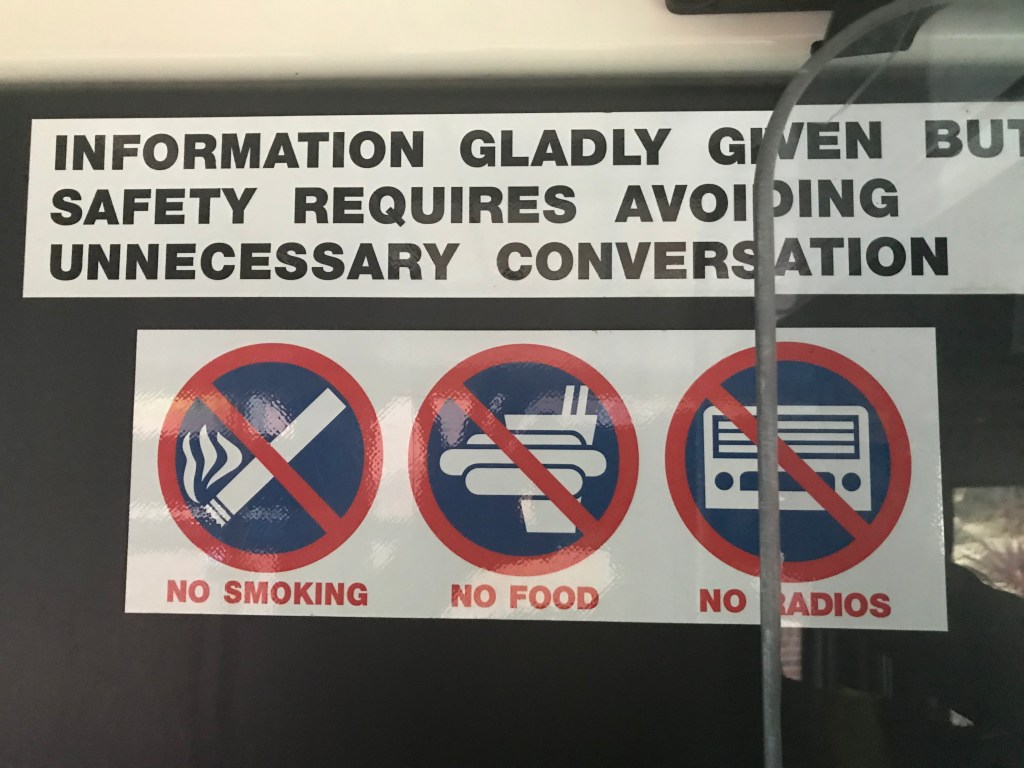
A good bus driver should be seen and not heard. Well, I certainly don’t fall in to this category, no way. Most operators follow the golden rule of: Information gladly given but safety requires avoiding unnecessary conversation. When a passenger wants to “be right,” the best advice is to let them “win,” so I can once again reduce the distraction and move-on. If I have asked to see their transfer, and they show it in such a way that I cannot see the time or the day, I ask for the regular fare. If they become angry when they hold the transfer in my face, I say thank you, and this usually ends the drama. But there are those who must enjoy confrontation, and being right. “I am sorry, but I did not see your transfer when you first showed it to me.” By this time I am wondering why I asked for the fare in the first place, but I always check my inflection and voice to make sure I am being neutral in my tone. But even still, this has no effect, and some question me as to why I am being so rude. And this brings me to the argument you cannot win. I don’t see why they are calling me rude. I am just doing my job. And even when another passenger comes to my aid by saying that I am just doing my job, this has little effect on the drama.

If someone has a “helpful” suggestion on how to get to a destination, and they already have my answer, fine. I have learned I don’t need to argue the point. Everyone has a different pattern that works for them on how to get from point a to point b. Since Muni has so many different lines, when a question is asked about how to get somewhere, different answers come every time another person is asked. It is not that anyone is lying. It is just there are so many ways to skin a cat to get to where you want to go.

We don’t have eyes in the back of our head, and we are not mind readers. If riders cannot show me their fare before they cross the yellow line, all I am required to do is to state the fare. Usually they don’t acknowledge me at all. And I have found this is actually a good thing. It is not on me to be the policeman for the fare. We have fare inspectors for that. When I let go of judging them and trust it is not up to me to determine if they are being honest or not, my day goes much better. The less drama the better. I am a bus driver and not a stage performer on Broadway. Though I have been on Broadway for one block between Fillmore and Steiner when I am on a run on the 22 line, I usually am not on stage! Keep me in the Zen, and oh by the way, if you look over and to your left you will see Mrs. Doubtfire’s house.

The Bigger They Are. . .

“The bigger they are the harder they fall” seems to be completely unrelated to this, but after filling out the number of accident reports I have over the years, I think somehow this does seem to matter. Every occurrence relates to what I was first told in my final interview upon hiring, and in my classroom training during the discussion on accidents and writing the accident report. It is the only class that has stood out in my mind over the years; and was a very clear take on what this job meant as a part of our larger economy, and was so right to the core that even through challenging contract negotiations over the years with our union and management, and even with public comment in the news, these words still, to me, ring true.

This was during the mid to late nineties when Netscape was the Godsend, and Yahoo was unstoppable. “Yes, they have great stock options and a creative workspace, but what they don’t have is your longevity at one job.” And other senior operators in various classes at the training department, and even in the Gilley room, have echoed this sentiment in a slightly different way with the simple encouragement to, “Stick around and see how it goes.” My favorite is, “Sit Back and Watch the Show!”

I identified with this on a deep level, and I am glad I did. No matter how hard this job was to be, no matter how awful I thought it was, was to persevere and keep at it. And sure enough, just like any other job, I started to see the repeats. The patterns of the same thing happening over and over, and how to deal with whatever, became a natural working part of my mind.

This one trait I have learned from my Grandfather who was up early every day to commute in to New York City to work for Con Edison, from my Dad behind his desk in the study to prepare another grant request to the National Institute of Health, and from Wilton who got up at 5 a.m. to work in the shipyards at Newport News: keep on trudging. All these men had something in common: they never received any accolades or promotion for their steady paced work, but they kept at the same job for all of their life.

And that steady paycheck was something I never really had, with like 8 W-2s during I think it was 1978, or the five I had in 1987! My heart goes out to any young person struggling in their teens or twenties who doesn’t see the benefit and simplicity of keeping to the grindstone for a period of time like years instead of months. The fallacy of cut and run, whereby I quickly grasp a job description, and then move on, was not the real truth. Overcoming challenges and seeing them through were actually more important for long range skills in developing intimacy with others.

To be sure, I also envy the youth aspect of trying different things, but at some point, I realized my life could be simpler if I just kept to one thing at a time, and gave it more time than I thought I should. Walking off a job in 40 minutes or after one day, seemed to be more of my modus operandi, than to wade through difficulty and ask for help. If I could have just waited it out to get a few suggestions on how to break down a task into smaller parts to see past the other side of failure. If any sidebar to this chapter exists, it would have to be to put young brashness aside to get feedback about what has worked in the past for others. And the cost of this simple action, to ask for help, which is to say, to not ask for help, has probably been the largest missed opportunity cost in my life which could have saved me lots of grief.

To get back to the training class, I vividly remember our instructor’s first question to our group of cadets, if you will, freshly being minted by the city to become a transit operator. The instructor asked, “What is the first thing I have read time and time again on accident reports, or heard from an operator in a conversation about and accident?” And what confuses me and has left me completely confounded year after year, even though I piped up with the correct answer as soon as he asked it, was the lack of simplicity and clarity I possessed in writing out my reports. I always wondered why it took so long for the division trainer to grade my report. Now, I get my answer about an accident within a day or two from the accident. And I could not see why other operators knew why this was happening, and why they got their verdicts so much quicker than I did. And I have been teased and mocked to almost no end about the War and Peace, or Gone With The Wind, lengthy essays on my reports. I talk too long and I write too much, and my only surmise is because I am too much a thinker, and spend too much time in my head. I guess it’s why I am enjoying this book so much. I get to get it out of my head; all the stuff kept in there, without ever putting the pen to paper, and thus clearing my own internal hard drive.

Most of my prose in the accident report was always assuming what the other driver, pedestrian, or cyclist was thinking, or why they did what they did. In true Joe Friday Dragnet form, did I need to hear, “Just the facts, just the facts.” Because this is where my disconnect comes from. To keep it simple, and just report what happened, not what I think happened. I loved the Dispatcher’s reaction to my reports: rolling their eyes and handing it back to me, or their frustration at having no room to sign the report because my words bled over into their section. This was helpful in seeing I needed to cut down the verbiage, and at one point, I realized I should do a rough draft of just the accident description part of the form, and then, after feedback from the dispatcher, rewrite it shorter and simpler, about what actually happened, without all the guesswork about why people did what they did. So, even though I got the answer right away in my first accident class with our instructor, I did appear clueless many years later in reducing the report to the simple actions leading to sideswipe, t-bone, squeeze play, or fixed object. If I could have read other reports, or known the simple food groups of how accidents are classified, I would hopefully have done better, but I am not counting on it!

So have you guessed what the simple answer was and is? Cue Richard Dawson in Family Feud, to say we polled a recent transit operator class and got their best response to, “What does a person say after having a collision or accident?” Answer Is: “I didn’t see you!”

“The car just came out of nowhere.” And blah, blah, blah. So I make sure I am checking side to side, left-right-left, so there is no guesswork about who is encroaching on my lane, my territory. And tracking rate-of-speed is the best way to guess when a motorist is going to make a foolish unsafe move. Impatience can usually be seen a mile a way when sight lines are clear. But in congested, built-up San Francisco, we usually have limited sight distance. Buildings come right up to the corner, or there is almost always a beer truck, bakery truck, or parcel delivery truck parked on the curb or double parked, right up against a crosswalk or corner. And this is where considering, The Bigger You Are, the Harder They Fall, really becomes important. The transit professional has a word for this when this happens: it is called billboarding. You can’t see the forest for the trees, and there is little reaction space to avert a threat that comes from behind the obstacle. Use of the friendly toot, or light flash can be useful, but the bottom line is to adjust by slowing down.

And in the career flow of office politics, it probably doesn’t hurt to employ this idea to your job and duties. No one really knew what I was doing in all the cleaning of the bins in back storerooms, but, tooting one’s horn about getting things done, may be helpful to make sure the right person knows where the credit is due. This can apply towards future job evaluations, and moving up to the bigger office.

New Year’s Eve

Halloween is only three days away as I write this chapter, and it’s a Saturday and already I have seen costumes last night, and even earlier in the week. But the holiday season vibe is picking up and everyone is in the change of gears of the season. The air is crisp and clear. The trees and grasses are making themselves known in the warm still afternoon air by the scent they let out as we walk by. But I don’t know about you, but when I recall working on All Hallows Eve, and driving through the Castro on the 24 or the 33, my brain jumps ahead to the next disaster, New Year’s Eve. For some reason, especially on New Year’s Eve, there is the prevalent thought to let it all go. But now, not having had a drink in 17 years, and not really missing it at all, I begin to see a false promise about New Year’s Eve. What the heck is the deal for a calendar click, and why does it call for a drink?

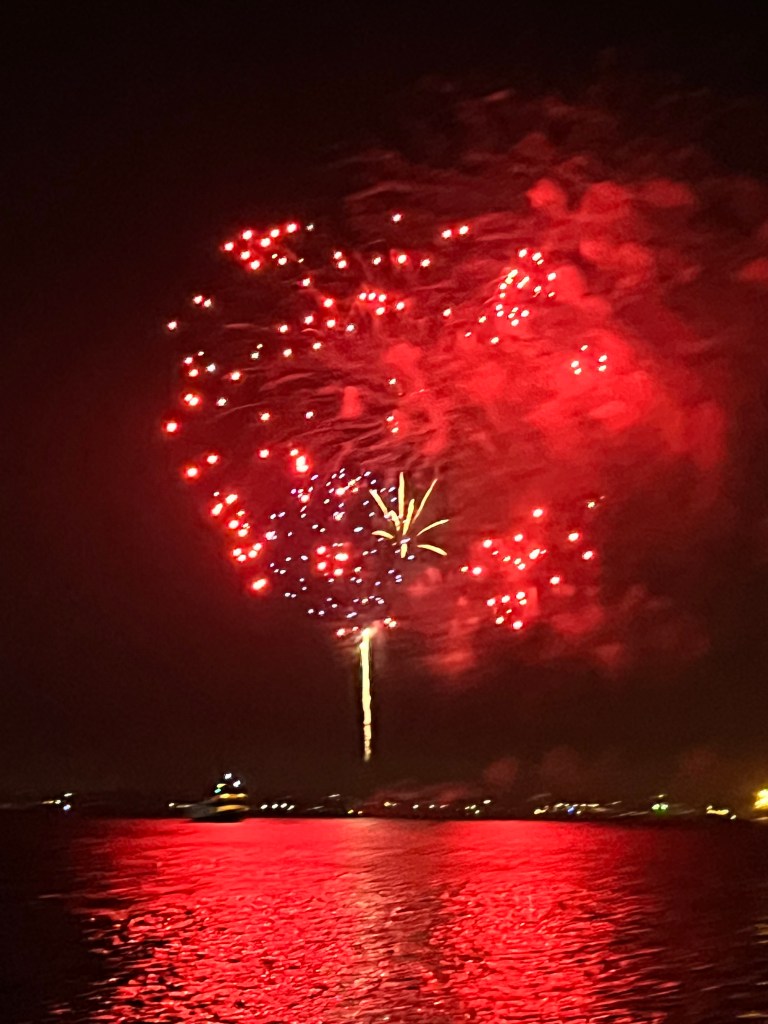
But of course, to celebrate the New Year! Oh, yeah. But you might find that transit operators have a different idea about it if working on New Year’s Eve! Perhaps this title should read, “You Get What You Pay For.” If Muni is free from 8 p.m. on, what do we know from experience about things that are free? Such as the futon frames we see scattered on our sidewalks, or the Christmas trees on the corner on January 7th? Worthless. Those riding home at 9 p.m., great deal. But as 10:30 p.m. approaches, and folks are headed out to party, the buses become not unlike the 8x in Chinatown, packed. And so on to the most memorable story I have about New Year’s Eve, or should I say, New Year’s morning, at about 2am.

There on the island on Duboce, just outside of the tunnel, stood over 100 people taking every square inch of the island. And this is a two-car island. With overflow intending passengers waiting on the curbside sidewalk. But trains leaving downtown and the Ferry Plaza fireworks were exiting the tunnel and going out of service to return to the barn at Balboa Park. The cars were full and dumping off more people to wait to go out to the avenues and the Sunset. Muni’s free service ended at midnight that year, I think it was 2009, and only the regular motor coach N Judah service remained. One standard diesel bus every half hour. It doesn’t take a genius to figure out that one standard forty foot motor coach every half hour, does not cover those coming from two car light rail vehicles every ten minutes.

I was pulling-in on the 22 line and gasped at the huge crowd waiting at Duboce and Church. Once again relieved that I was a crosstown line. And to my horror of horrors, I looked left at Market and saw a young lady driving an outbound N Judah motor coach on Market, ready to make the turn to Church and then left to Duboce. Oh my God. If ever there was a ninth level of hell this was it. She had a relatively empty bus, as those downtown were taking the underground to head away. If I could relive this moment, I would have run to her coach at the light before she turned to Church and warned her about what lay ahead on Duboce. Take the Haight Street route and don’t look to the left! Put on your neutral face and pray you can make it through the stop sign! I never knew what happened, but suffice it to say it was not pretty. This operator, who ever she is, should win some kind of hero’s medal of honor for having to make her next stop. I read in the paper the next Monday about complaints about owl service, but nothing, nothing, in writing the day after, could do justice for the battle cry that must have gone up when she made the turn to the island. All I can say is girl, you deserve a vacation to Hawaii or some other fantastic place. Whew! It was really cold that night, and I wonder how her next trip went. Peace be with you!