The Kneeler

“You’re supposed to lower the kneeler for seniors,” or “Thanks for lowering the steps,” sarcastically spoken after departing to the sidewalk does not help much. A request for the kneeler with a condescending tone (as if I’m a mind reader) after ascending or descending, may not reflect where my attention is focused at the time. The rule is to request the kneeler before alighting or stepping up. We are not in the know about the status of your hip joint, your back, your neck, your legs, and so on, if we have not seen you before.

We try to gauge need based on observing your gait. In coming from behind the shelter or from the seat after we have opened the doors, we may not be able to see your approach. Yes, there are those for whom a kneeler would be obvious, but asking for a kneeler after using the steps seems ass backwards. Putting a foot on the first step and not moving can work sometimes, especially if accompanied by a glare of disdain. The sense of entitlement I pick up on, however, does tend to make me pause sometimes in lowering the stairs. The quickest verbal command to get the steps to descend is a “thank you.” Veteran riding seniors know to say thank you as they reach the stairway, and just like magic, the steps go down. Condescension not required for lowering or ascension—just ask any angel.

Another secret for getting what you need from the bus driver is to come to the front door if your stop got passed up. The button by the back doors sometimes does not register on our dash board and does not work as regularly as the chime cord by the windows. Being able to hear the bell is also a plus. Even if your volume is low, taking off one bud lets the driver know you can hear him/her talking. This courtesy has been lost on most folks.

Screaming or yelling may work, but a quick move to the front at the first safe place past the zone is better; if safe, we will lower the steps so you can get out not far from the previous bus stop. We are allowed to do this per safety rule but not out the back door. Late rings with a demand from the back steps do not usually result in an open door; coming to the front, however, does. We can see if a cyclist or skater is approaching, and we have better control over the doors. The pause or delay in stepping down the back stairs creates extra seconds of time that could mean a collision upon stepping down versus a safely-lowered kneeler up by the next crosswalk at the front door. We can also move the bus nose closer to the curb than at the back.

Another trick I make sure my student in line training understands is to use the front door/rear door toggle in front of the door dial. By delaying the front door from opening and opening only the rear first, migration of souls sets in, and the slow exiting senior has a chance to make it to the front steps before those on the sidewalk bulldoze up the steps. This also saves on the call to “move back!”
“Coming out!” Is a helpful verbal cue, but if you let us know where you plan to get off when you board, and we can see that you need extra time, we can delay opening the front door so you don’t get the bum rush by those on the sidewalk. This federal ADA law (Americans Disability Act) protects you when you depart. Help us help you! I enjoy protecting your right to step down first, but if I don’t know when you are getting off, those extra precious seconds are lost upon folks who bum rush up the stairs from the curb. Let me help you by requesting your stop, so I can put a request to a face and see where you are going to sit when you board.

Humility and redress with the appellation, “operator”, does work better for getting what you need when you have to get off. Two golden words, “thank you,” help preserve the Zen when coming to the front door for special requests.
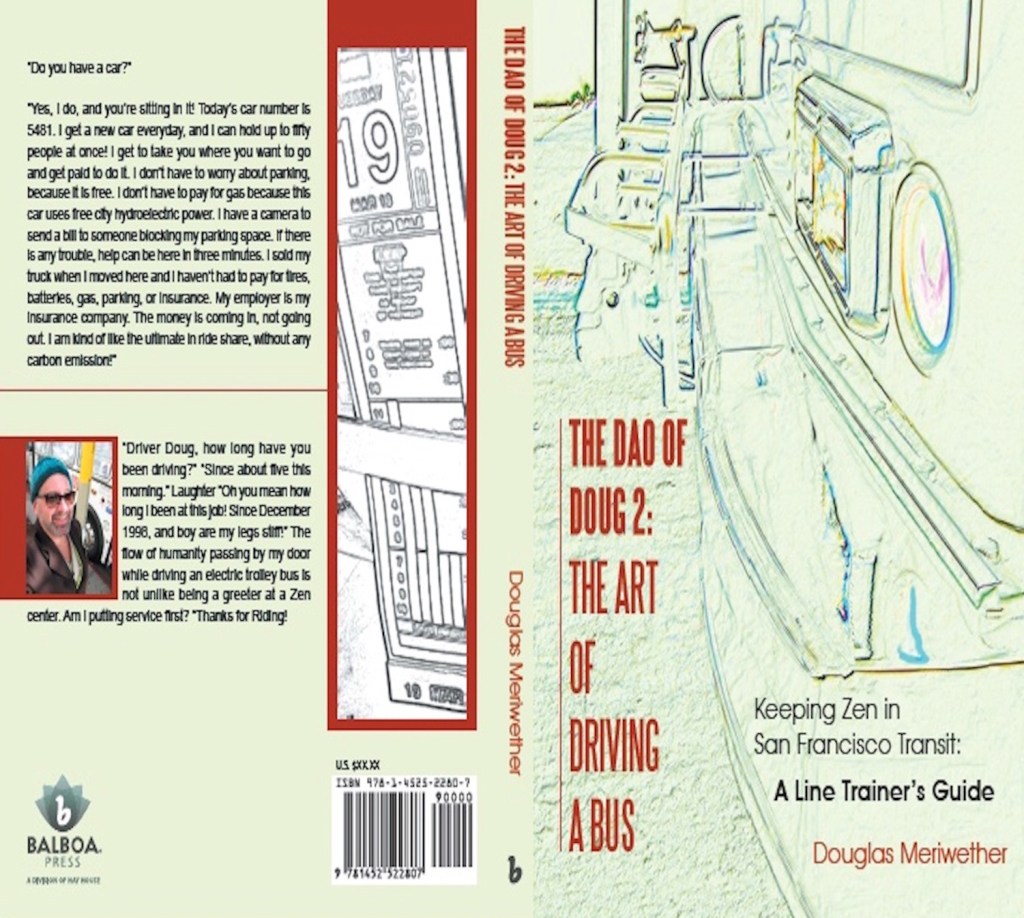
https://www.amazon.com/Dao-Doug-Driving-Francisco-Trainers-ebook/dp/B07946XH69/ref=sr_1_1?crid=3A5DBQE241P34&keywords=the+dao+of+doug+2%3A+Keeping+zen+in+san+francisco+douglas+meriwether+balboa+press&qid=1692410983&s=books&sprefix=the+dao+of+doug+2+keeping+zen+in+san+francisco+douglas+meriwether+balboa+press%2Cstripbooks%2C195&sr=1-1-catcorr

The Cloak of Invisibility

If you would like to see a magic trick or illusion played out day after day, look no further than a ride on 14 Mission. The secret of becoming invisible is to sit in a wheelchair, particularly in a large group. The more, the merrier. It matters not where you sit on the sidewalk in the wheelchair. Those intending to board are only interested in their own desire. The thought of waiting for others or considering a need other than their own, does not compute. We have our “blinders” on and don’t notice the changing conditions around us, such as someone with special needs waiting or approaching the bus stop after we have arrived.

In order to be of service, I need to walk that fine line of allowing those waiting to board first to “awaken” to see the person in the wheelchair who may be behind them or to the side. I have to be on guard with my tone of voice and how I express myself. It is important to note that, from the driver’s perspective, most conflict arises when approaching the front door from behind and to the right. The blind spot is larger when the doors are open, because they partially block the side and rear views. Hiding behind the open doors causes hurt feelings.

I have an incredible opportunity to be a guide. Sometimes, it is simpler to let those passengers board first if the time between buses is short. If the number of those intending increases beyond four or five, with more boarding in the rear, loading the chair first is best. Those who are allowed up the front steps first usually sit down in the first two chairs under the wheel well and block the aisle. Others sit down in the flip-up seats where the wheelchair needs to secure. Young people with ear buds on and others with children enter through the middle door and sit in the wheelchair area, inattentive to my request to make room.

This is when I find it simpler to get up and face them with hand signals to rise. Raising the flip-up seats myself, before the chair lift is used, is the fastest way to get going if the person in the chair is alone and has no help, or if no passenger on board helps to raise the seats. Most of the time as operators, we don’t have to get out to raise the seats because someone else offers help. Other times, help is available, but few know how to pull down and away to unlock the seats to raise them for the wheelchair. This is when I need to convey patience and cheerfulness and demonstrate how to lift the seats. I choose to believe that I am “lighting a candle” for others to see.

I am powerless over controlling passengers on my bus, but I also have a responsibility to those who need to get where they are going in a timely fashion. The biggest challenge I face today is to balance these needs without going over the top in anger and frustration and to keep the coach moving without a fall on board or a security incident. Humor can go a long way in diffusing a tense situation, but there are those who are so broken in spirit or illness who do not want help and are unable to think of anyone other than their own selves. Humor here does not work. It is perceived as an affront.

Most riders in wheelchairs have the faculty and support they need to obtain the equipment they require to be mobile. Others are unable to walk without support or must arrange for a special-needs transit, yet they insist that Muni take them back and forth, unaware of the impact they are having on the line. Still others insist I call the police over any small, perceived trespass, without regard for the welfare of those needing to get to their destination.

Case in point. A man at 16th and Mission attempts to block my coach and tells me to call the police. Another man, who was arguing with this man, just put his bike on the rack and entered through the rear door with a baby stroller loaded with his personal belongings. “He has my stroller!” says the first man. I beckon the man in the street to my window and suggest he ride with me in the back. The second man yells profanity at the man on the street and throws the stroller out the back door.

“He’ll get what he’s got coming to him,” the first man responds calmly, walking to the sidewalk to retrieve his stroller. I nod in agreement. Sure enough, this angry man forgets to take his bike off the rack at 6th Street, where he rushes to get his belongings off without the stroller. He walks away with a nice woman in a wheelchair, who had plenty of time to board when the two were arguing at 16th Street. I ask the two bouncers on the corner club to remind the angry man that I’ll be back in half an hour in the other direction so he can claim his bike. They nod in agreement.

When I get back to 6th Street, here is a different man, smiling and at peace as he removes his bike from the rack. God does not work in mysterious ways. Especially when I try to do the right thing! Another police call saved for another day. Another incident report after work unwritten. I can make my timed transfer just before 3:00 a.m. and catch my ride home.

Unfortunately, those with aimless purpose sometimes seem to have such a large sense of entitlement. I am at a loss on how to tame this beast. I have to say as little as possible and light the candle for another time, another place. Don’t feed the pigeons is code for keep quiet. It goes against my Gemini nature to defer and delay a conversation about choosing where to sit, and this is a key reason for writing this book. I hope this message gets out to those who are regular riders, so that problems go away.

A recent spate of fights over seating in the front area of the bus has me thinking about how to clear this crunch zone before conflict develops. As agent Smith tells Neo in the movie, Matrix, “Do you hear that, Neo? It is the sound of inevitability.” Not unlike a train approaching in the subway tunnel, lack of available space increases a head-on collision. This crunch zone always occurs in the Inner Mission and by Van Ness and Market. Thank you, Director of Transit, for locking seats in the upright position!

The other cloak of invisibility problem I find over seating and right of way is the passenger with ear buds on, occupying two seats with a coat or bag over another seat. The ear buds act as an invisibility shield: You can’t talk to me because I can’t hear you. Especially if my eyes are closed!

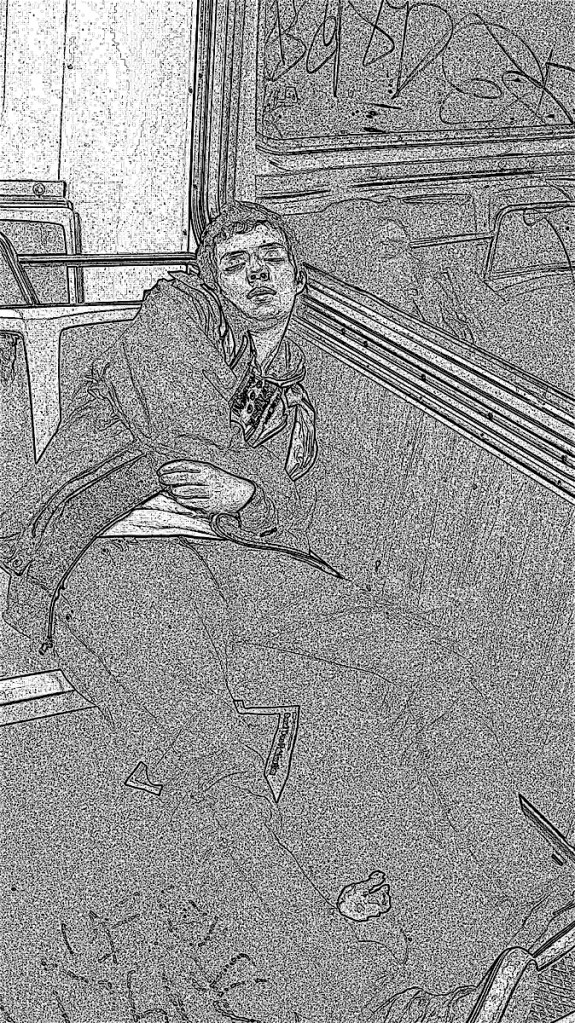
I sat next to this girl who adds to drama because she takes an aisle seat, covers the window seat, and becomes unavailable for talk as the bus fills up to capacity. If someone sits down on her coat, a battle of wills can ensue. It is always a good idea to ask before entering someone’s zone of personal space, as is being alert when seats are no longer available. This is a problem if you can’t hear us because your ear buds are on, and you appear to be asleep. Overcoming the fear of losing aisle space and seats for seniors has been a long and challenging journey for this transit operator in San Francisco. When you board, especially with a bike, or when others are nearby, unhook an ear bud by the fare box and keep the Zen going. Thanks!

Coach Trade and the Defect Card

more dead than alive!

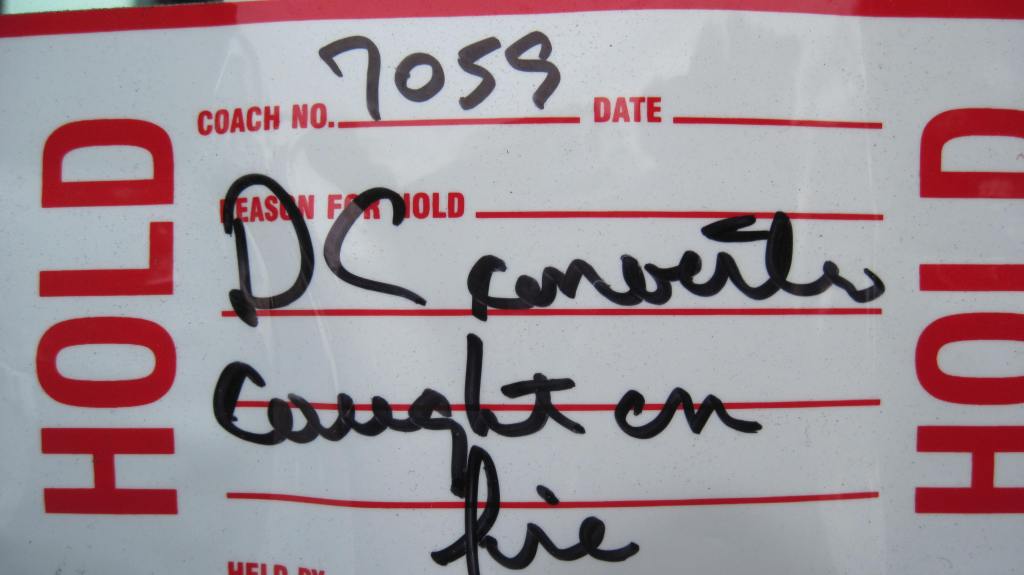
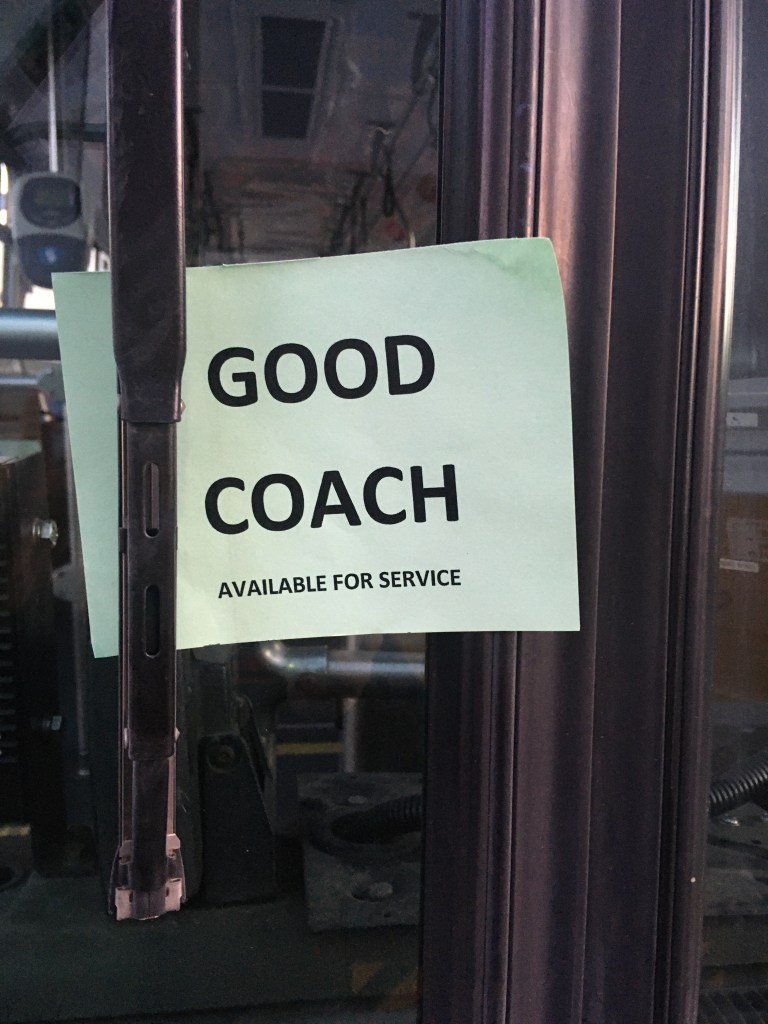
As the buses warm up and get used, the dynamics change. What was once a great bus in the first four hours of service, becomes a creaky cantankerous old complainer. The back doors stop closing. The kneeler fails to rise. The brakes start to grab. Or the horn starts to blare without even touching the wheel. And, so a chapter about the defect card.

In all my coach trades made, only once did the person I was relieving with my pull-in coach, fill out the defect card so I would know what to show the tower when I brought the coach in. Only once. Notice I did not use the pronoun operator, but the term, person: Because an operator is required to fill out the defect card. As fate would have it, on the one time I needed a defect card when I pulled-in, I did not have it. There is definitely a lesson behind this one. Apparently, my defect card slipped out of my paddle when I went to a coach at an alien division to pull out a motor coach. And this was at the same division where an inspector wrote me up for not having a timepiece. This was the same inspector involved in the witching hour whereby I left the Ferry Plaza alone with a forty-five minute headway after a no power situation. Interestingly, I was the only coach with power to make it down to the terminal. And so, perhaps, may be a situation for payback was at hand. But if the Railway Gods have shown me anything, it is by doing the next right thing by working the rule, all is well, and the Zen zone protects.

I have to get over myself and not worry about what other people do. So when it comes to the defect card, if I can get a good idea about what is wrong with the coach, so be it. I can fill out the card myself.

I have found I get a better idea of what is wrong with a coach if I test drive, or rather, road test the coach myself. One common refrain from a “repeater” coach is when the equipment has a chance to cool down: most problems go away. I have withstood the test of time so that my body and experience can outlast the equipment. Not true for everyone. And if my physical body can outlast the equipment, then it stands to reason I must know the limits of the equipment and adjust.

One of the dilemmas I have is with the air. If a kneeler is weak, I have to determine which stops I can “get away” without using the kneeler. Most seniors reply with shock about why I am not getting the steps fixed, if the bus is not working. But they don’t seem to understand by taking this bus out-of-service, the next coach will be even later, and without any seats at all. So, by staying in service and making due, no brownie points are forthcoming. Staying in service and making due just results in more complaints and no extra help.

So all I have left to do is to fill out the defect card and call on the radio if I have a safety significant defect. Wait for orders, and continue to march. There are no rewards (maybe on Maui) for an operator who tries to make due. I have been one of those operators, but this missive is causing me to realize this may have to change. But when I see a new operator having difficulty with their coach, I am reminded about how far I have come. Some operators like fast doors. Others like slow ones. It is not up to me to judge another’s preferences. We all have our own style of driving. As soon as I give up my own defects of character, the easier the coach trade and pull in. Amen.

Marmon Pull-out from 11th to Ferry 2016

Timed Transfers

If you are taking a bus in the wee hours of the morning, a good place to find out where to go to meet one is at a bus shelter with a map of the transit system. In the corner of the map is a gray box that shows the owl lines. Owl lines are the bus routes that operate 24/7 and in the period between 2:00 a.m. and 6:00 a.m. The schedule of the owl buses does not change from weekdays to weekends, and generally, you can count on their arrival every thirty minutes. Because no traffic or construction delays exist in the early morning, the schedule for these buses is very accurate. I have found in taking the N Judah at 4:30 a.m. to be so accurate that I could set my watch to its schedule when it arrived at Haight and Clayton.

Because the late night buses run so smoothly, certain crossroads or transfer points exist between these two lines and are designated timed transfers. Not too many people notice this detail on the map. And perhaps, very few ever need to know when the N Judah comes inbound in relation to the 22 Fillmore. But when you really need to know, and it’s zero dark thirty, and you see the 22 turning the corner on to 16th from Church as your N Judah pulls up two blocks behind the 22 at Market, the bummer is a hard one to get over. The 22 and N are not a timed transfer and miss each other by about three minutes. Ouch. Add another half hour to your morning commute to your 5 a.m. start time at the job.

I just looked at a new map and headway timetable in a new shelter and now see that the timed transfer symbol has been removed from the owl map! There goes another chapter idea down the drain before it even went to print! Though Muni (short for Municipal Railway) does not now recognize timed transfers between buses at night, that does not necessarily mean buses do not meet at certain corners. The 90 Owl and L Taraval still may meet at Market and Van Ness. As a bus driver aware of these timed transfers in the past, I am more likely to wait for the crossing bus, having knowledge about passengers wishing to make the connection.

Unfortunately, with the reduction in service and with new hires, this connection is lost. And the reality of losing a half hour in an early morning commute to open up a coffee shop or warehouse is lost upon newer drivers. The fact that the new map no longer shows timed transfers is a wee hour loss that few, if any, realize, but it’s of great importance to those few who need to get around in the early hours.

My first free copy of the ZenZone went to my coffee shop manager, who had to transfer in the Richmond to get inbound to Geary and Fillmore to open up at zero dark thirty. I told him he could use the hardcover addition as a means for getting the attention of the operator stalling at Park Presidio. He finally gave up trying to open the store on time and now works near his house. The travails of those traveling to work early are increased by service cuts. The precision and timing of transfers is lost when gaps occur between transfers, and ridership suffers. The cuts that occurred in 2010 “cost” riding time at night. It was the same with the cutbacks to the terminals on the 24. Every time a terminal is shortened, ridership declines. Ask anyone on the 2 Clement, with its shorter terminal at Park Presidio and 15th Avenue. Cutting terminals is the first step in eliminating a line altogether.

So, the essence is if you have to travel on a regular basis, get to know the regular operator, and get the times of a critical jumping off point. If you miss the next bus, find out from that operator when his or her leader goes by. It is possible that, over time, you can make the connection, as the other operator will wait for you. When lines are not adjusted, the chances increase that the same operator will stay with that run after a new signup. This helps with consistency and predictability. Even if Muni does not now acknowledge timed transfers, it does not mean you cannot still make them between lines.

A good rule of thumb is not to wait crosstown in the avenues, but head inbound first. Then take the 22 headed inbound away from the barn. The main thing is to try different routes to see which one works for the shortest commute.

Today, agencies work together to keep their All-Nighter runs to meet at Van Ness and Market. This would be a huge score for keeping Zen in mass transit. If you raise the fare, add more time onto the transfer.

LPO (Late Pull-Out)

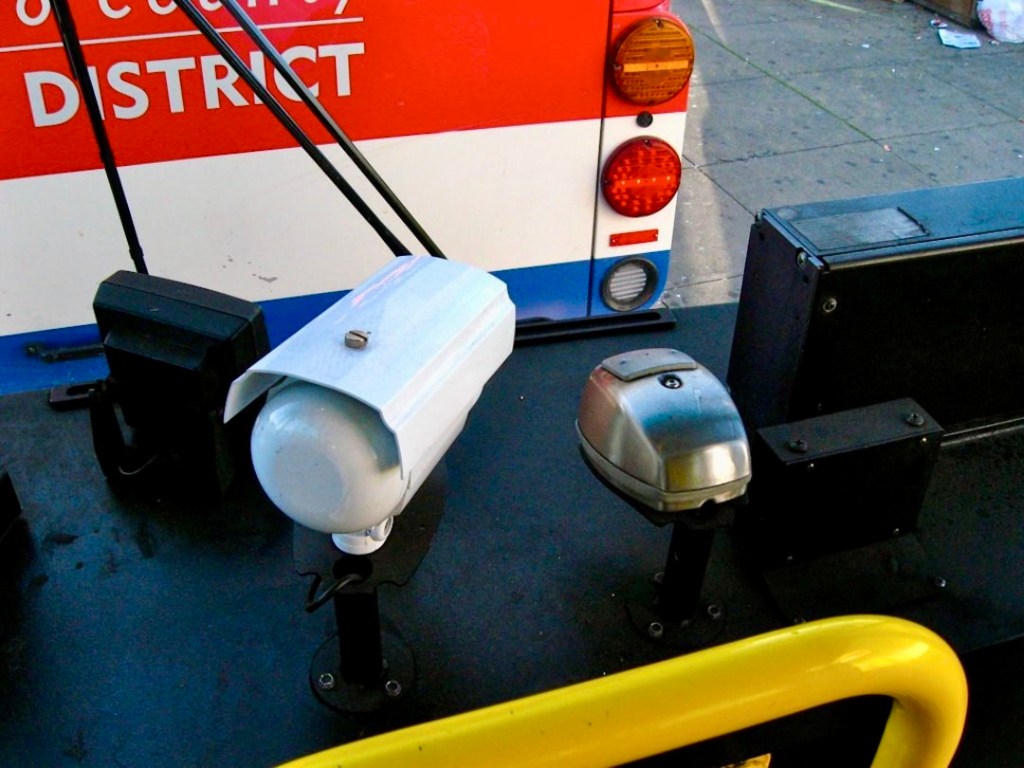
The installation of cameras on the front windscreen has had one beneficial effect. Those monitoring our pull-out time see how much extra time is required to move deficient coaches out of the way. With trolleys at Potrero, we have so many coaches dead on the tracks that we are trapped in a canyon or gauntlet of unmoving buses, such that if the lead coach in front of us is caught in restrictive mode at start-up, we are blocked from pulling out on time.

A good yard starter is found turning on coaches well in advance of their pull-out in the morning to see if a reboot is necessary. The installation of computers and memory chips on buses may be great for global positioning monitoring and data checking brake function, speed, and door-opens, but these devices can create hassles with morning sickness on the equipment when it has been a cold night with heavy fog. Moisture adhering to carbon on the various components and electrical sensor points creates annoying warnings, such as hot body, that cut into the calm of morning pull-out. (I have always wanted a hot body, but not on my assigned coach!)

In the afternoon, finding a good coach can be like hide-and-seek, and I was blessed with being able to talk to my leader on her cut-in pull-out as to why she was having difficulty making the pull-out on time. The secret to making sure all is well is to allow for more than ten minutes of extra time when arriving to the pre-op point. If this is not possible, then communicate the problem in a way that does not ruffle feathers. Not a good idea to upset the shop and crew working on your equipment before you pull out in the morning.

Oh gee, the coach is in restrictive mode, or the inductive dial is turned to the right. Oh, the coach was turned on in day run. Did I check to see if I was on night run with all my lights on? And the pre-op list goes on. The key to having no trouble has been to show up early to make sure the coach is on and not in restricted mode. I have to check the master dial and make sure the coach is not in neutral on the ETI or in neutral on the Flyer. I also have to make sure the bus was not left on in EPU (emergency power unit or battery mode) last night, or else I am not going anywhere. The precious extra fifteen minutes we are given on our paycheck to pre-op the coach comes in handy when we have to get the yard starter to call the shop to assist us with a jump or a reboot of the circuit board to get us going. If I wait until the last moment to reprogram the fare box, I could hear a nasty alarm that the box is open or has no power.

As creatures of habit, we usually save the fare box to last, but this, too, can lead to a late pull-out. So the key is to show up before pull-out to make sure the bus is in gear, in power, and programmed from head sign to fare box so that no surprises await. Checking the wipers to see that they actually clean the window and the mirrors and that they are in a good alignment, can also dog us in being late. Especially if it has been dry, and the wipers haven’t been used for a long time. The wash rack throws mirror arms out of alignment.

If the wipers were left on at a terminal during a misty rain, the window can be smeared with dull blades. And finally, deployment of the lift is icing on the cake to determine if I will have a day of service or a day of waiting for the shop and giving the bus and operator behind me a double passenger load.

I am happy to say I have kept the Zen in pulling out on time over the years and have had very few LPOs to my name. Cutting in on the line is an art in and of itself. Just as with a switchback, entering the line a few minutes late or behind time is a good idea for not getting ahead of oneself, which is to say that an empty bus moves up in headway faster than the following coach that already has a load. Being aware of this helps keep the Zen with your follower.

Beach and Broderick

If there was ever a more tranquil and restful terminal on a busy line, it would be the peaceful residence location of the 30 Stockton terminal when I was working at the Presidio Barn a few years ago. Since I left the 30 Stockton Presidio Division line, the terminal has been moved to Divisadero and Chestnut, a location I thought was a better place. It has a switchback near here, on Francisco, and has a double track of wires for coaches to pass, unlike the single track at Beach and Broderick, which still is used on the head sign of the 30’s out of Presidio, since it does more accurately describe the furthermost stop near a major tourist destination such as the Palace of Fine Arts.

So even though this missive may be somewhat outdated, the problem of headway and timing seem to still be a problem. And some of the problem about this terminal has nothing to do with the fault of management of the line, but in how we communicate with one another about need. And one of the important needs here is having a place to go to the bathroom, or water closet. Hot water, soap, and paper towels, are a precious commodity for a San Francisco transit operator.

Businesses, schools, or residences, and the people who run or live in the buildings close to our terminals have numerous fears about why there should be no bathroom for operators. And this seems to be related to the NIMBY symptom throughout our country. Not In My Back Yard, and I will go to any length to prevent a structure or permit for anything new or different near my house or school or business. And in seeing what the situation is like at other terminals, the fears of these neighbors seem unwarranted and selfish given the lack of problems around the placement of our other bathrooms. The sense of community and purpose for the common good has been lost in our society, and seems to parallel the rise of the car class as the means of travel.

Back in the streetcar days, we would travel together on transit lines that were more numerous and frequent. Most old timers alive today, and those of us who like trains, agree with a certain amount of fondness for the way things were. A lack of congestion on the roads is apparent in most old films and photos of this bygone era. Most would agree these simpler times held a higher quality of life. And some of the seniors who were young and alive then, are the most adamant about not placing a bathroom near their house. And this baffles me. Would you rather we urinate in to cups and pour our tinkle in the gutter by your house? Do you think trash is diminished simply because there is no bathroom?

The old woman who would peer out of her house when our terminal was at Beach and Broderick, I was told was the main source of discontent for having a bathroom there. But doesn’t the convenience of having a terminal outside your door count for something?

The return of the placement of the terminal back to Divisadero and Chestnut makes sense, but still NIMBY-ism is in full force with challenges to install a bathroom. No one seems to be transit oriented today. Those making the call to keep a bathroom for operators away, must not ride the bus and lack any sense of gratitude for why a carbon free mode of mass transit is better for the quality of our life. It is not that they are malicious, they just don’t know.

How Would You Design the City of the Future?

Daily writing prompt
How would you design the city of the future?

In the future of the world of George Lucas–of Star Wars fame–the modern central system city is filled with flying cars moving smoothly, but in a somewhat congested city, with tall gleaming buildings. In contrast to this futuristic world, is the world of Gene Roddenberry, of the Star Trek realm, where cities, like Romulus, resemble a Romanized-style architecture with almost no movement evident, save for an intermittent train passing over a rail line, speeding quietly and smoothly every few moments. I tend to favor Roddenberry’s world–where there are less cars, and simple, quiet, mass transit conduits that move people around. So, improving mass transit, getting souls out of the car and into the bus, would be a part of a design for the future.

If we look at the Netherlands, we see that the bike is king. Grade schoolers ride their bike to school and back, because it is safe. Seniors go shopping on a bike and have their basket on their bike. Our US boulevards with stoplights and heavy traffic, marginalize bikes into a gutter of turning vehicles into strip malls with huge parking lots–or having to cross six lane intersections where the action to ‘gun it’ through an amber light, causes serious t-bone and sideswipe injuries to motorists and cyclists alike. The contrast between Missouri State Route 100 in Ballwin, MO as a contrast to Tower Grove Park South and Arsenal Ave. in central Saint Louis, is a good contrast study in time and history to what the automobile did to Saint Louis city vs. the surrounding counties.

The writing seems to be on the wall–that for each of us to own and maintain our own car–is becoming prohibitively expensive. Moving away from the central city to do a work from home, now makes for heavier car use and higher fuel costs in our budget, and this country has been forced into an SUV world with lower fuel economy, less visibility around our cockpit view, and a shockingly smaller storage capacity in the rear for luggage and oversized Costco runs.

How has the automobile compromised our health? The planet’s health?

To get more to the point, it looks like Holland has a model for using bikes and calming traffic, with less use of the car. Creating safe bike routes and lanes has been adopted on Broadway in Manhattan and on commercial streets like Market, Masonic and Polk Streets, to name a few in San Fran. Maintaining and repairing a bike creates a skill level easier to attain than the complex systems of newer cars, and creates an avenue for growth in learning how to be independent in an economy the US used to have when we were an agriculture-based society.

Large empty commercial spaces can be used for cooperative groups for apprenticeship in trades, and even fun flea market booth areas–to buy and sell to others in our neighborhood. Taking the huge volume of stuff in storage, and making it available in empty storefronts requires a use of small trucks and bobtails, and those qualified to drive them. This need for skilled labor that can be borne out of a new welfare system that requires service and classroom training to receive government funds. The cost of providing skilled laborers a stipend to ‘volunteer’ on their off hours to help train others, even by going along to the job site, has to be cheaper than, for example, the two billion a year San Francisco is now spending on the homeless imported from other states and countries.

Ex-police chief and mayor of San Francisco, Frank Jordan, in a recent interview on California Insider, seems to be on the right track to a better, not beggar-thy-future. You don’t get something for nothing. Providing ‘help’ to someone, without creating incentive, destroys the value that built this country. Dividing us up into smaller and smaller subgroups of victimhood and exploitations, doesn’t make cooperation or cop ovation any better. Ask any alcoholic attending AA meetings, and they will laugh or scoff at enabling an addict or alcoholic by giving out free housing and drugs. It just makes the problem worse and feeds a black hole of dependence with no budget limit in sight.

So, the use of commercial property can be made affordable if the banks take the haircut on debt, and start at a reasonable rent for change to take place. Would you like to stay in business with a write off? Or fail and collapse completely? Competition is another way of saying I will scream louder than you to prove a point that never comes to fruition because the spirit of cooperation is lost.

Cities can be designed with gardens and pathways without the auto, and older empty buildings can be rehabbed or torn down to make way for structures with recycled materials in areas that aren’t prone to flooding or sea level surges during tropical depressions.

Why rebuild on areas destroyed by fire or sea? Do you want to completely get rid of insurance companies? Return fragile ecosystems to their natural state, or at least rebuild with a low-density of hogans or kivas employing the knowledge of our ancestors: Not with a someone or an entity trying to make a buck through monopolistic competition–or government handouts.

To be sure, look at our ancient cities for a key to enlightenment. The reason we can’t see off-world ‘ancient aliens’ is not because any civilization reaches a point of self-destruction, but because our leaders in charge are hidden to enrich themselves only–at the detriment to the population at-large. It isn’t about defunding the police or increasing new government programs to pay out the unfortunate–it’s about remembering who we are and why we are here. We are spiritual beings in a human body. Let’s stop the seventy year-old secrets and come clean on the Prime Directive.

Pulling Out

There are certain key points around the system where operators begin and end their shift not at the bus barn. Eleventh and Mission is a relief point. It is a place where drivers take over the seat and relieve another operator per the run schedule. And at this corner, it is also where defective coaches can pull-in along Eleventh Street to Bryant and park the coach. Its also where buses from five lines pull-in from revenue service to the bus barn.

Because 11th and Mission is a pull-in / pull-out location and relief point, it is somewhat of a congregation point for bus drivers waiting to make relief. Coaches get new operators in staggered time slots, where successive buses on line get relieved. This occurs mid- morning around 10 a.m. And later around 2 p.m. Knowing what peak periods are, when buses are entering and exiting the line, helps with understanding about why headway between buses increases and decreases. Most people don’t seem to understand headway changes every four hours. There are also runs between those getting relieved so that if a bus arrives without a relief operator, hopefully, the driver who passes through without relief will stay in service. And these relief times, controlled by scheduling, can become a factor in spacing and wait time between buses. It can also cause gaps and overcrowding if there is not an operator or a coach to make relief.

One key point about relief points and pull-out wires is the awareness of where they are. Early morning commuters, and those trying to get home after a long day, would do well to understand where these key points are for the transit system in their city. When the time interval is decreasing between buses as morning peak begins, it pays to know where to stand.

Sometimes a few blocks makes a big difference in how long you have to wait. If you are getting off of BART at 24th Street and going outbound to Geneva and Mission or to a stop on the way to Daly City, then it pays (in time, and time is money), to know that just one outbound stop away at Cesar Chavez, all the morning pull- outs to Daly City, make their first stop after they turn off of 26th Street. Someone passing up the 49 at the 24th Street BART Station, is missing the chance to get on any number of 14 Daly City coaches pulling out and making their first stop at 26th and Chavez.

There sometimes is a shadow period of very few buses in the morning as owl coaches pull in, and fresh buses pull out. If you are aware of where these morning buses are coming from and where they enter the line, you can save yourself a lot of time in getting home or getting to work, if you know where to stand. The number of people waiting can also tell you how long it’s been since the last bus passed. The average trolley wait can be determined by the number of people standing. Twelve people waiting means twelve minutes have passed. This is one of those cases where it pays to get on the “wrong” bus to transfer later on down the line. The important thing is to get past the pull-out wires on 26th, where plenty of empty buses are heading outbound to the Excelsior and Daly City.

If you want to go cross town on the 22 Fillmore and were waiting at Harrison inbound, you would find a nice empty 22 going your way. But if you were waiting at Potrero, you might end up being late, and become angry as you saw a 22 turning off route before your stop and going home to the bus barn. In this case, just three blocks determine the difference between getting on a fresh empty bus, or seeing a bus turn off right before your stop. And this can have a big impression on how one views service. There is much knowledge about riding Muni, once understood, reduces the wait time to get somewhere and adds to being in the Zen as a rider.

How Do I Plan my Goals?

Daily writing prompt
How do you plan your goals?
Giveaway thumbnail

One of the simplest, most basic way to plan goals is with a pen and paper in a spiral notebook. Sometimes a pencil is better, and a smaller, pocket sized spiral notebook is better. The problem with phones is screen size, and the inability to read the font of longer bullets or outlines from page to page–all at once–to compare ideas. Writing things downs activates our brain for much better recall as we slow down the texting movement by scrolling with our stylus or pen or pencil.

My goal, in this example, was to write a book. If you look through my other posts, you’ll see over one hundred chapters in anecdotal essay style book about my life as a bus driver, and what I’ve learned over twenty years. This sounds like an immense task, but it all started with a pencil and a shirt pocket spiral notebook.

Since I can’t have a phone on me when I drive commercially, and I cannot be distracted with pings and emails on my shift, I would write key words about an incident on the bus that was funny or unusual, and add outline details, sometimes in short sentences, when I got to my next terminal, or after the day, when I could still remember them and started writing.

For instance, things that happen at the fare box. – a passenger drops coins like a dump truck -then they twirl and swirl their finger to try and let some of the coins go down -someone drops all their pennies on the floor -someone asks a question –Do you call all the way? –How far down do you go? –You came too quick –I’m not ready – and so forth.

And later I would craft my responses to the various bullets. It looks like you got change. Not usually on my first date. – After I get to know you? It depends how much sleep I got. When did you set your alarm?

Then I start to categorize to form paragraphs – the dump truck – tissue deluxe – the jack knife – the dump and run – the question – and so on. And soon after I have enough content for what looks to be a full chapter, I get to my laptop and start writing out the story.

Later that week, usually on a day off, I reread what I wrote and check for tense, point of view, and spelling. This is where learning takes place, and a writer is born. Traveling or travelling are both okay. Buses and busses are both okay, but one is a large coach carrying people, and the other is a verb to clean off tables in a restaurant. Having wikipedia handy to search on another url makes for easier editing, although, eventually, I need another set of eyes to look at what I wrote. This is in the next phase, rough draft.

Most of the chapters you see here on the Word Press blog, started with a pencil and a shirt pocket notebook. They have been edited up to five or six times, depending on how old they are. The ones you see on my blog suggestion appearing below, were in the pencil notebook stage in 2012. The ones you’ll see next month are from 2015, and eventually we’ll get to 2020.

And it isn’t just editing that needs to take place after you have a manuscript. You’ll need design choice selections, press releases, dates for book signing, and advertising and marketing plans for Facebook, Google, or Instagram–to name a few.

Icing on the cake for book publishing, are the learning of the more esoteric ways in attracting attention and getting clicks, opens, add to carts, and sales. Brian Moran of SamCart, David Edward for Artist Marketing Formula are really good at what they do online, yet my most valuable ideas come from others in the group. It’s where I found out about Fineartamerica as a free website to publish my art and photos. Max Trubitski was awesome for Shopify, and there are many others you can find on YouTube and in Facebook that have already done the pencil work, and the rough draft, and are saving hundreds many hours of trial and error to speed up effectiveness in what we do. That’s what classes are all about.

Upper Yard

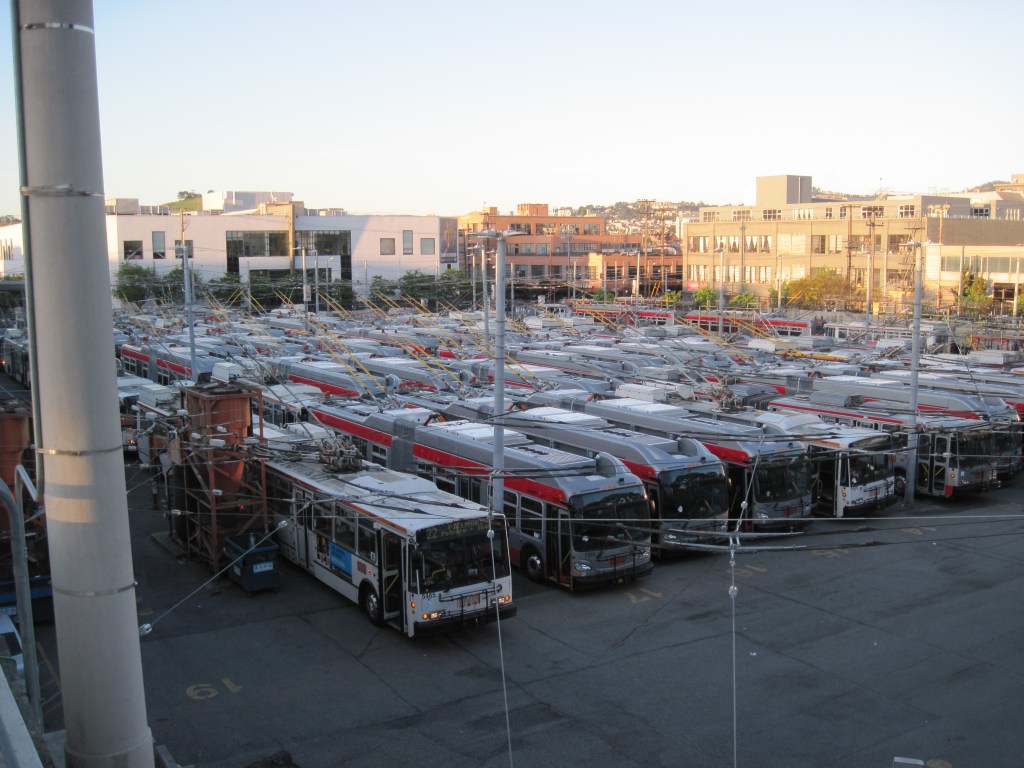
At the Potrero trolley bus barn, we have two levels. Unlike the Presidio trolley barn (which has one level and a tricky pull-out from track one and a pull-out to Sutter) the Potrero barn has many lanes of challenging tracks. There is a horseshoe U-turn maneuver from tracks ten, eleven, and twelve that can lock up an articulated coach in the lower yard by the wash rack.

The upper yard has an S-curve maneuver from tracks thirty, thirty-one, and thirty-two to the street that also makes it difficult to prevent a lock-up or de-wiring. Not only is the far side curb clearance an issue with parked cars, but the traffic on 17th Street does not want to yield or be slowed by a pull-out coach. In the evening, the car parkers run the gauntlet of passing through the tire shop. Potrero has car parkers to speed parking and prevent blocking. This necessity becomes clear when many coaches pull in together in the evening after rush hour is over. The car parkers also insure coaches are left on park charge correctly and that accessories are turned off.

There was a brief time when the car parkers were eliminated, but this led to problems when coaches were found “dead” the next day, or the poles had not been reset from dewirements. Coaches were also parked in a lane different than the one assigned by the tower. The cost of lost time in the morning was greater than the cost of having operators park the cars as a team in the evening.

The group effort adds to an impersonal sense of goodwill at the day’s end, making Potrero a great place to work. I am usually either exhausted or happy (or both) to see the car parkers and the revenue coworker who takes the money out of the fare box. I made it! Another day done, another dollar earned, still in one piece, and hopefully, without a trip upstairs to fill out paperwork. The best feeling is to get on my bike or walk to the bus stop and go home.

Pulling in and parking on the upper yard requires a skill level that takes time to master. There are switches in the yard and in the street, and if some are not working, it makes for a bad afternoon. There is rush hour traffic to contend with on 17th Street and a gauntlet to run through the tire shop garage. Coming to rest on the upper yard tracks is the challenge of navigating around parked cars that aren’t supposed to be there. And the pressure of more buses coming home and backing up traffic on the street. Many thanks go to the traffic engineers who eliminated parking along 17th Street by our bus barn when 17th Street was recently repaved. This bike lane helps us get by in the morning and evening, and it helps the car parkers make their turn onto 17th!