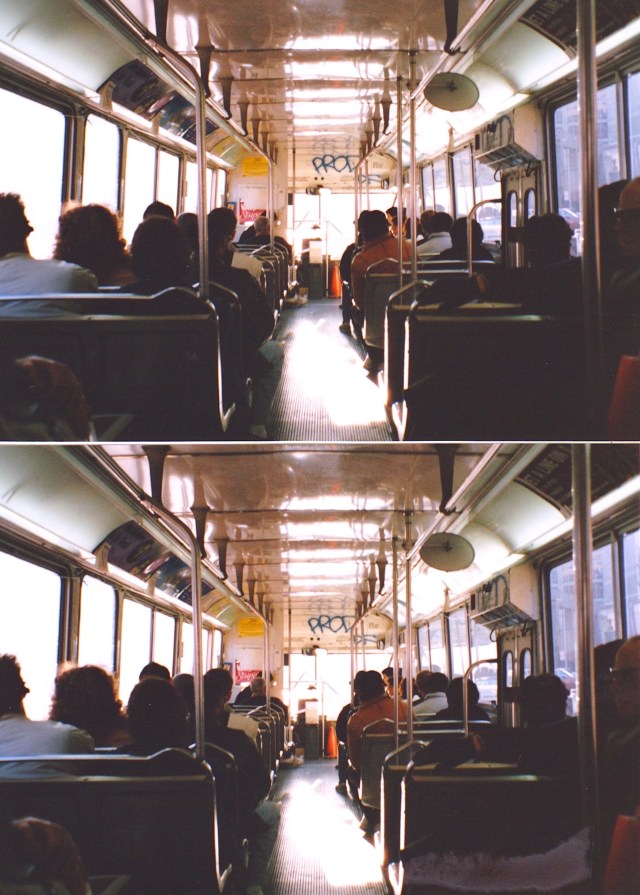
The best time to work Muni is when the bus has an empty aisle and half the seats are open. This occurs in the morning on most major holidays and on Sunday mornings. The aisle is empty and half the seats are empty. The pulse and rhythm, the ebb and flow of passengers is steady state and harmony abounds. During the week midday, usually from 10 a.m. to 2 p.m., with leader in sight, is also a wonderful time. Good job, good pay, and no threats on the horizon. It is the wish and hope of every transit operator to select a run where the Zen time is maximized. Everyone is relaxed and happy and the schedule flows perfectly. Every time I do my homework before a signup I try to find this zone in a run, and try to guess where this zone is, and how it can be sustained for four or more hours per day.
And it is truly a complex matrix. One false move, one error in judgement can be a costly mistake resulting in trips to the superintendent’s office, and love letters from the dispatcher. A love letter is at best, a piece of mail containing a caution and re-instruct, or if close to the danger zone, a warning in boldface, which means, you are off the hook for disciplinary action, but if this happens again within a short time frame, your goose is cooked. The goose being, time off without pay. Imagine coming to work in the morning and the first thing you see is that your paddle is missing from the row. Go see the dispatcher, you’ve got mail. What happened this time?
Everyone asks me what the bad lines are. And my answer is that none of the lines are bad. On another day, I might answer all the lines are bad. Timing is everything. Which is true for a stand up comic, a worker on an assembly line, and as a waiter or cook in a restaurant. So here is what most riders don’t understand: its not what line you are driving, but when.
For example, do I really want to be leaving Clay and Drumm on the 1 California line at 5:02 p.m., as Embarcadero Three’s elevators are filling up to capacity, dropping hundreds of workers to the city streets to pick up a bus to go home? Or should I be at the other end of the line at 33rd Ave and Geary, hours after school has let out, to be headed inbound in non-peak direction, only to arrive downtown an hour after most people have gone home? Do I want to be the first 22 Fillmore leaving after the bell at the Marina middle school, where hundreds of hyped-up middle schoolers with more hormones than they know what to do with, after hours of being cooped up in school, be knocking on my door as I try to pull away from the inbound terminal at Bay and Fillmore? Or would it be better to be leaving Third and Twentieth in Dogpatch, around 3 p.m., hours before all the blue collar workers around Potrero Hill start clocking out? And so it isn’t what, but when which makes or breaks a good run choice.
And I think something could be said about applying this principle to our daily work and our job. Are we usually not so bothered about what we have been assigned to do, or are we really upset or angry over when the task is expected to be completed? Sure, we can try to work late, and I have seen the glazed over look on your faces when you board the bus at 6:30 p.m., or, perhaps follow this suggestion. Try getting your boss to change your arrival time. Fat chance.
There is a pecking order I have discovered in and when people go to work. Early is better. At least when judging by faces I see boarding the bus. First, we have the humble Latino working class off to fisherman’s wharf: The bus boys, the dishwashers, the true working class backbone of the city. Then we have drones. The white “middle class” working stiffs who work downtown for something, something and something, whether it be an architectural firm, or a law firm, or an advertising agency. I see the fresh young up and comers first. They are going places and have probably moved here from somewhere else for their first big break in the big city. They have the smile behind their eyes which is full of promise of a great new job with a resume that probably says I am new and trainable and not bogged down from a drugged family past from having grown up in California. They say, in their eyes, I got away from my one horse town with the single blinker light.
Then come those who have been here awhile. What, forgot to shave this morning? Painted the town last night? Tie one on did you? Or they come rushing out of a doorway without their tie on, to finish the windsor once they get on in the aisle, now crowded, as the inbound arriving time approaches nine o’clock. And after the clock strikes nine come the mid-level managers. Lattes in hand they head for the corner office. Those in echelons whom eschew the time clock for a supervisor role or particular grade or rank in an organization downtown. And the school trip. Youngsters much quieter in the morning than in the afternoon. Quietly and purposefully podded-in to their music, or contemplating their day ahead.
And then the moms and their babies. Off to the daycare, or to do the daily tasks of running a family. And then come the ancient ones.
The seniors off to some food shopping or their appointment to see the doctor. And then, the Zen. The midday time when everyone is at work or at lunch. And this is when rush hour is over, and when most morning runs pull-in. Where we transit operators can lay down to chat in the Gilley room, or go to the gym to work out. Maybe its a trip to the post office, or the store. For those lucky enough to live in the city, we can go home to do chores. But for those straight through runs, this is the Zen time, when things are steady and even, and usually not full of much drama.
And so I have a word of wisdom to impart. Try coming in early for a week. Don’t tell anybody. See how on time and smoothly Muni runs at 7:30 a.m. versus 8:30 a.m. You can always clock in at the regular time: but this time you’ve already made it up the elevator. You have time to get coffee. You are within seconds of the time clock, not minutes. You could actually wait to punch in right on the dot. And guess what, your trip-in was a few minutes shorter, maybe as much as twenty minutes shorter if you didn’t see buses passing you up, stacked to the brim. If I had any magic wand to wave, it would be to stagger start times in half-hour intervals so that not everyone had to be at the same place at the same time. You’d be amazed at how much work you can get done before everyone else traipses in. So if you think its not a good idea to ask your boss for a different start time, try it anyway and see what happens. By lunchtime, I’ll bet you’d have everything done you were planning to get done, anyway. There is so much down time after lunch anyway, you may find a few nice surprises along the way.
So, staying in the Zen zone is the sweet spot that makes living in a big city with a good job with good pay a wonder to behold, with everything right in the world. But heaven forbid the run in front of you happens to be an open run with no regular operator. Or a run that has days off of Tuesday Wednesday, that usually doesn’t get filled on a regular basis. This hit or miss wild card, not knowing who is ahead of you, or whether or not you have a leader, creates possible destruction of the Zen zone. Should I adjust up or down in my running time? Will I be running hot if my leader cuts in late with a last minute detail from dispatch? Did I piss off the dispatcher the other day by questioning how they do their job? Am in a payback situation? Payback is a bitch, a phrase or term I will never forget. Especially when Central Control has me on ignore, or the inspector at the checkpoint won’t even look at me as I pass. And this is when the Zen zone can become Muni’s ninth level of hell.
There are nine levels of hell at Muni, which, now that I think about it, should be at least another Chapter in this handbook, but suffice it to say here, one should leave the ninth level of hell after one trip, because the ability to sustain the ninth level of hell is very limited, and though there are heroic epics of being able to sustain this for four trips a day for over two weeks at time, eventually, the dam will break. And become the damned: The valley of the damned.
I will never forget the signup from hell–with no end in sight. I was warned by a member of the executive board, that this was to be a long signup. I remember making my choices for my choice slip before the signup at the Presidio. And my hero, my union rep., was standing right beside me as I saw the run with big pay and weekends off, still available on the range sheets minutes before my choice slip bid window. Wow, I said, here is a big run with weekends off still available. How could this be?
There are times when the runs pick us, rather than us picking them. Interesting, I thought, this must be a sign from the Muni gods I had arrived in my seniority level. I finally was able to get a 300 dollar plus run with weekends off during a good time frame, between 7 a.m. and 7 p.m., with some standby time for lunch. Little did I know, there was a reason why the run was still open. It was the icon for the ninth level of hell. It did the 1 line from 33rd Ave and Geary leaving just after 8 a.m., with an arrival downtown just after 9 a.m. And it passed the avenues just after the last express downtown. Which meant panicked office workers, who just missed the last express, would ask me at the door if another express was coming. No problem, I can do this. After a couple of weeks, they would realize that by 8:22 a.m., if they hadn’t gone out their door, they would miss the express. It would just be a small matter of weeks, and the questions would stop.
But they never did. Week after week, different workers would be late, and a bad dream turned in to a nightmare. But little did I know, two other factors were at hand to add icing to the cake from hell. My leader and follower were out to make my life miserable, whether by intention or design, I set in motion trains of circumstances I thought I didn’t deserve, but were ripe for the picking. And so I believe this is a natural progression to move on to the next chapters, ‘Witching Hour’ and ‘The Ninth Level of Hell.’
Regular Day Off. If a workweek goes by and I have kept my sanity, I can test my body and mind and see if I can work on my day off, my RDO. If I haven’t turned crazy by working my run during the week, I can see if I can “get away” with making extra money on a day off at the overtime rate of pay. I know if I have mastered the Zen of Muni if I can work my regular run, and still have the energy to try more work, if it is available, to get ahead of bills, or save for a vacation or toy. One of several things can happen. If I have had a good week, a few hours of work on the weekend can take the Zen vibe away real fast if I am working an intense line without a leader. The good news is folks who would have to wait twice as long to get picked up, have the service they expect, because operators work on their day off.
The best thing about RDO is going home after the day is done. Just made bank at 41 dollars per, and it’s over! Uncle Sam takes away half, but if a holiday is involved, payday is a breeze. The law of diminishing returns does make itself apparent on payday, though. And I have seen that if overtime hours exceed 26 per pay period, the amount of fatigue or hangover from working on a day off, becomes not worth the extra hours due to taxes. Working three days of overtime in a two week period takes such a toll on personal time, I am no fun to be around on or off the bus. I have to be careful I don’t get a PSR, Passenger Service Request. PSR’s result in mail. We find our paddle missing in the receiver’s office before we pull out, and we have to go see the Dispatcher and sign off for our mail.
Trying to explain our life to our loved ones at home, our roommates, or anyone who tries to reach us by phone is a chore. We are not sitting at a desk in an office. Our schedule can change at any time with traffic, construction, fires, parades, protests and equipment failure. If you have a jealous lover, or in a home situation without trust, then this job may not be for you. Sorry, got to go! I have to move my bus up because my follower needs room at the terminal. I have only 3 minutes to take a bite, can I call you back later? I am sorry my phone is off, I am not allowed to have it on!
I now try to say, I gotta go, or I won’t be able to call you back for an hour. Voicemail is great for leaving a message, but don’t expect us to be on the line if you call right back: we are already on the road! Most of my friends now know what to expect when it comes to unavailability on the phone, but it does take some getting used to. Sometimes months. Sometimes years. We can’t just call whenever we like. The schedule is just a guideline, really! Kind of like the Pirates Code on Pirates of the Caribbean! But just as Captain Jack Sparrow, we too have to make it up as we go. So if you do have an Operator on your address book, know this: we never know what is going to happen next. If you wonder why we aren’t arriving at the arranged- for time, hey, we took Muni!
Keeping it Zen adds that sixth sense, the intuition that helps our loved ones and friends understand, dinner may get cold before we get home!
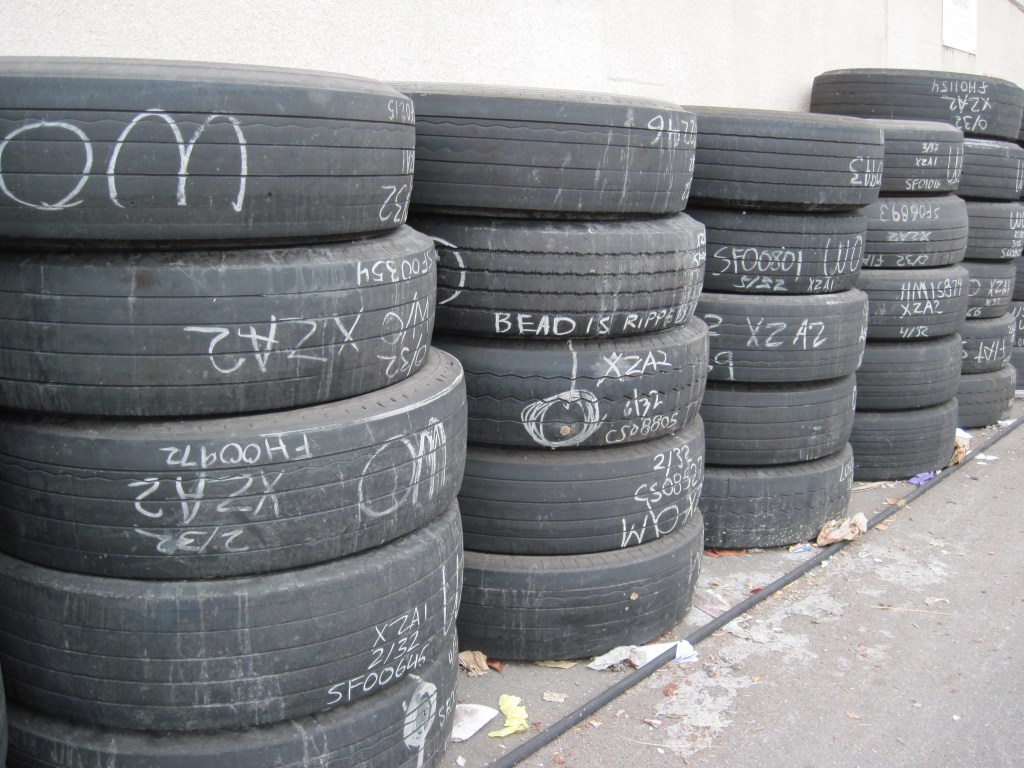
The wheels on the bus go round and round all through the town, except for when there is a construction detour, or another patch job in the making from the Water Department, or PG&E, the utility company! The wheels go round and round, even if the tire tread doesn’t. But you would never know, because the only thing rougher than the tires are the street surfaces.
Only once did my bus get a flat. An actual flat tire with an air leak where the rubber scrunches down on the street. There was a house under construction, and I ran over a nail. A huge nail. The bus tires cost like 800 dollars apiece and have 27mm thickness. I did not believe they would ever spring a leak. I called for the tire man who came out and fixed the flat. This was the only time I had to make a road call for a flat tire.
When we put flat tire on our defect card, it doesn’t mean we have a tire out of air. Flat tire means our tread has worn unevenly, and when we take our coach up to twenty miles per hour, we hear the drums along the Mohawk. A “thump-thump,” as the worn or flat portion of the tread goes round and round. Only on a newly-surfaced street can we tell that we have a flat tire. But there is not too much worry about here. When streets are resurfaced, they are only paved a block at a time and in small sections. This factor hides the brand new tire with a sometime defective tread that has been put on a bus.
Perfectly round tires are replaced with new, scalloped ones. This is an improvement from tire treads that would separate on a hot day when we turned the front wheel. Those were tires probably were labelled as new, but it is obvious when recapped tires are used instead. You can see the separation line on the cap versus a brand new tire. I will pull in with a perfectly good bus, and the shop man in the tower puts up a chit for new tires. Resistance is futile. If I pull in with flat tire on the defect card, I get a look of disdain, as if I am doing something wrong. New tires seem to be inspected not when they are put on a bus, but when I pull in and turn the front wheel to inspect the tread at the tower. The fault, dear Brutus, is not with the shop, but with the quality of the tires shipped to us as new.
The shop man in the tower makes it very clear what is and is not a safety significant defect in the tire, and any balding tire showing through to the inner nylon mesh is removed per state and federal law. We cannot have a shallow tread of less than 4/32 of an inch on the front wheels. They are rotated to the back, inner rear wheels on the long coaches.
(I have been asked by my editor to clarify terms used in this book, such as the term, “safety significant.” The October 8, 1999 memo of a previous administration is often cited when describing safety significant defects; we are to report them immediately and take the coach out of service. But interestingly, the letter never states what they are. And so now, right here, right now—just like Jesus Jones—I get to be the unacknowledged legislator of “safety significant” as fresh, untainted eyes read this page. One definition of safety significant is something for which parts are available!
Seriously though, I turn to what our protocol is for using the priority button on our radio. A priority is any threat to life or limb of anyone on or around the bus. A door that opens on a moving trolley or train is, therefore, a safety significant risk. A burned-out trim light or a dirty vent panel is not. A new tire with a blemish in the tread may not be safety significant if the tread is maintained at 4/32 of an inch. This is where the defect card, to be filled out and turned-in at the tower as we pull in, comes into play. If, on a tire, I mark “shimmy” and “hard-steering,” the shop responds immediately. If I mark “flat tire,” nothing may happen, especially if I don’t mark which specific tire has the drums along the Mohawk sound.
The only thing worse than a flat tire on a bus is one on a bike. But the good news is that every bus has a bike rack to take you back to the shop for a new one or just some air. I always give you a free ride if your bike gets a flat on the street. Also, just to let you motorists or car people know, if your car is in the shop, I’ll break off a long one for you for taking mass transit for the first time. The first ride is free!
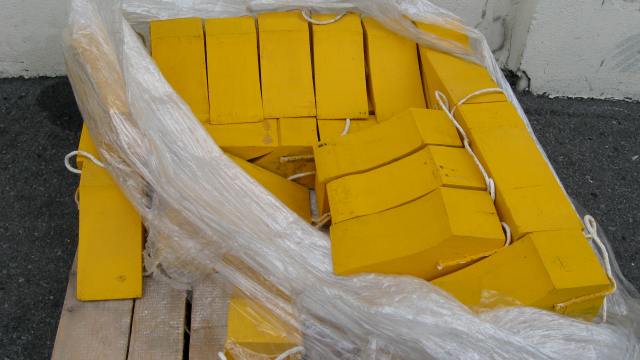
“Unbelievable, just unbelievable.” This is the statement of a resident nearby the La Playa bus terminal by the Ocean Beach Safeway. It was recorded for the Jon Stewart Show. This was a comedy show, and the occasion for the recording was based on the fact that this man’s garage was hit by motor coaches more than once. Motor coaches rolled away from the terminal and ran-in to his house. Not once, not twice, but three times. On the video, he replays the incident of how he fell out of his chair when the bus hit. Hilarious for a television show, not so funny for the operator of the bus, and in training class. Our training department shows this video to make a point about the importance of using a wheel block to prevent an unattended coach from rolling away.
Ocean Beach is not the only place where motor coaches rolled on the loose. Daly City, at the end of the 14 line, buses have also caused much damage to buildings and cars. The front wheels can roll over the curb and run in to parked cars, or if the wheel is not curbed, can roll all the way down the hill and in to a building at the first intersection after the pull-out from the terminal. One may wonder how this could happen. Inattention to detail is usually the first line on a disciplinary letter we receive when we are in trouble. There really is no excuse. I sometimes forget to use the parking brake when I am in the yard which is flat, when I am in a rush. If I am adjusting a mirror on track four, I sometimes only open the doors instead of setting the brake. But whenever the seat is vacated, the brake must be set. I can only imagine what could cause an operator to forget to set the brake. Perhaps there was a distraction from someone asking a question, or the rush to get to the bathroom. In any event, it is hard to justify any reason why the brake is not set. I have not found anyone who could agree this could be excused.
When I was out with an inspector being re-qualified (Requal) we came to the outbound terminal on the one line at 33rd and Geary. Requal occurs after we have a chargeable accident. We have to be graded and evaluated by a training inspector to make sure we are doing everything correct to insure safety. But every now and then, it is not the operator on the training coach who gets into trouble. Sometimes, a blatant error is found by another operator on another coach. Case in point. Out at 33rd and Geary at the One Cali lines.
A coach was all the way back in the zone, and had not moved up as other coaches had moved up. I could not clear the cross walk on the turn before the terminal, so the inspector grading me asked to be let out and to move the unattended bus up to the lead space in the zone. The door was closed, so he put his hand in the driver’s window to open the door from the door dial. As soon as he pushed it, the bus released the air brake and started to roll back in to my coach!
In one sweaty moment, the instructor was able to collect himself and rush to the open driver’s window and stop the coach by opening the front door using the door dial. The bus stopped within two feet of my bumper. After overcoming the initial shock, we waited for the operator to return. Although words were said, no write up occurred.
I later found out disciplinary action was taken, and I saw the operator one last time before he went in to the superintendent’s office for his hearing. I never saw him again. There is no excuse for not wheel blocking the coach, or for not using the parking brake. He had about ten years with the company at that time.
With good eyesight and hearing, it doesn’t matter how old you are to start working as a driver with any company. One important fact not too many people understand about driving jobs is that age discrimination is virtually non-existent. Because the testing of blood pressure, vision and hearing are mandatory for licensing, and demand is high, driving jobs are always available. But inattention or complacency can rear it’s ugly head at any moment, and with it comes the loss of the job.
“Baby needs a new pair of shoes.” That’s what I say when I am hitting hard, or I see sparks at night off of my collectors. Shoes are the carbon blocks sitting inside the brasserie or metal brackets that form a slot at the end of our trolley poles. This is the point at which we collect our power from the overhead. The shoes sit inside of the collectors. 600 volts of direct current are fed through the feeder wires, which come from certain utility poles, which carry the wires upon which we travel.
Next time you are on a hill by some trolley line, look for the poles, which are carrying the power. You can see the wires coming directly out of the pole and on to the overhead. If too many buses are too close together, especially on a steep hill, the power breaker will go off and we will temporarily lose power because the feeder wire cannot handle the load. This shut-off of power, or a tripping of the circuit breaker can occur leaving Chinatown on Sacramento Street heading outbound up the hill to Nob Hill, and also on Union Street leaving Van Ness inbound. It didn’t take me long to learn this fact.
Heading inbound on the 41 Line, I was not too far behind two smaller coaches that started across Van Ness as I pulled in to the zone to pick up a few runners. But because the next stop at Polk is on a steep hill with a short green light, the two buses did not clear the Polk Street stop as I crossed Van Ness and began to climb. Sure enough, as I got close to Polk, they started to move on to Larkin. But this is one of the steepest grade in the system. Since no one was waiting at Polk, I did not kill the light, but proceeded ahead before the light turned red. I figured the other buses would be on to the next block before I crossed Larkin, just as business as usual such as in the Mission line I was familiar with. Big mistake. My pull on the power caused the bus in front of me to slow down dramatically, and I put the pedal to the medal, but the bus came to a stop. I looked back and saw another bus crossing Van Ness and beginning to climb. There were now four buses in three blocks, loaded with passengers getting to work, and two of us were stopped.
I put on the parking brake and waited for the bus in front of me to start moving. Fortunately, he was able to start moving forward once I stopped draining energy from the wires. But another bus behind me was starting to climb from Van Ness, and sure enough, I saw the bus in front start to slow down as the bus behind me started to hit the steep grade. I won’t follow too close from now on. The feeling of powerlessness when I put my foot down on the power pedal, and start to lose power on a hill, with a full bus, is not something I would like to experience again.
Having a traction brush fail is also another scary movie. In departing Chinatown for Nob Hill, I lost all forward traction on the bus. And the parking brake would not hold the coach, either. All I could do is hold my foot on the service brake, and call for help. One thing I did forget about was when the air in lines reaches a certain point below 60 pounds per square inch, the emergency brake will pop up and hold the coach. But this is a small comfort when the air in the lines is not holding the coach at a higher pressure. Did I really want to test the pop-up and see if it would hold? Luckily, it did. But I sure hope I never get that coach again when I am leaving Chinatown during peak period!
After rain for a week, all the carbon dust built-up on the wires gets washed away. This is great for keeping our hands clean, should we need to use the ropes to replace our poles on the wires; but not good for wear and tear on the carbon shoe. It cuts faster in to the wire because there is no more dust to act as a lubricant. The groove in our shoe gets deep. Our collectors hit the hangars and crossovers with a loud ka-chunk, and our poles drop down off of the wires. We need new shoes.
There is a special slot in the range of the poles where we can hold the pole down to look at the shoes. This is at about a 45 degree angle from where the pole attaches on to the roof of the bus. We can look to see if the carbon is cracked or deeply grooved. Sometimes when we look there is no carbon at all in the collector! We cannot drive the bus forward from that point and must not move until the shop arrives and replaces the carbon. And when we have new carbons, we still have to be careful in crossing other wires, because the slot in the new carbon is very small, and the poles can fall off of the wires easily.
Now, the shop checks every coaches’ carbons when we pull in after a.m. rush. They also check the temperature to see if our shunts are working and we have enough swivel. This helps keep the Zen!
Paying attention to how hard the coach is hitting the wires is good for staying in the Zen of driving a bus in San Francisco.
As I walk to my corner coffee shop at zero dark thirty in the morning, I see another splayed design of “ejecta” on the sidewalk from someone’s drinking spree last night. At least this “hot lunch” occurred outside of the aisle and stairwell of a Muni bus. When someone pukes on the bus, we can pull the coach in with what we call a hot lunch. This means my follower will have a double load and less time for break at the next terminal. I believe this is why God invented newspaper, for travelers who make messes on and in the bus.
Newspapers wedged between the seats or crumpled on the floor make for a quick and convenient remedy for keeping the bus in regular service. I usually don’t throw newspapers off the bus when it is raining or if I am working weekends or when school is out. I may need the paper to clean rain-soaked floors or mirrors or clean up any other mess of fluids left on the bus. The art becomes using the paper so as to not need gloves to touch any part of the blood, feces, or vomit. And yes, it would be nice if we had bathrooms with hot water at the end of the line. Soap and towels are the luxury of a tour bus operator, I guess.
Teen girls are the number one offender when it comes to puking on the bus. Hopefully, I can spot them before they get on. Usually, their girlfriends are helping them walk up to the steps. I ask, “Hey, why don’t you wait a few more minutes and get your balance first?” or “How far are you going?” If they show no sign of listening, or no intention to step off and wait for the next wave of heaving, then I say, “Okay, sit near the door and let me know when you have an emergency!” At least this minimizes any damage to the floor of the aisle. If the steps do get hit, it can be dangerous, depending on the type of vomit.
You know, you have your clear, almost invisible kind. This dissipates quickly and has no odor. It can provide extra traction as it hardens or dissolves and is mostly from stomach acids and esophageal mucus. It’s a bonus if the teenage girl hasn’t eaten. Then, of course, there are the slippery, half-digested refried beans. The rice can provide traction, and the birds do like this if it makes it to the sidewalk. If she is with guys, they usually dump her and get off the bus early. They laugh and think it’s funny. Some friends, indeed. And if she’s with a girlfriend, the point seems to be to get home as fast as possible. So even though she is being “helped,” am I really doing my duty by not calling for help? Should this be an ambulance call? The possibility of alcohol poisoning exists, and use of a stomach pump may be in order. Perhaps I could let them stay at the stop and call the police. The balance of a major family event stands on the tips of my fingers with a call to Central Control.
Will there be a hospital and ambulance bill? Is this just another weekend learning experience for two friends? Should I intervene or get on with moving my passengers down the road? Being a night-time driver on the Mission requires making snap judgment calls between an emergency treatment or a quick, first-aid remedy. I usually go with first-aid: Have them step off the rear door before the heaves get too bad, and then use the newspapers to sop up the goo and to keep the walking tread dry. Then a scoop-up of the papers at the next terminal or a swing-by at a convenient trash can.
It can be a drag if the person puking doesn’t want to exit and continues to heave while sitting on the bus. The other passengers become uncomfortable if I don’t do something. I cannot ignore sick people on the bus, unless they are way in the back, and the bus is full, and no one comes forward. Fortunately, the empty stomach is what causes the problem in the first place, so there is not too much to clean up. Hopefully. The insanity of getting on the bus to go home is impossible to override if the person sick is with a group of “friends.” As with everything else, going with the flow keeps us moving.
So if you are riding on or driving the 14 Mission after dark, especially on weekends, make sure you have a copy of the morning edition!
On Market Street, there are two places on a block to catch or pick up a bus. If you have your Incredibles superhero costume tights on, you should know the newer ETI Skoda trolleys weigh about ten tons sans passengers, so be careful you don’t pull your back muscles when you catch the approaching bus and lift it above your head. For most of us mortals, however, taking a bus on the curb or on an island is recommended.
The curb stops are located mid-block, and the island stops are near an intersection by a corner or a cross street. Unbeknownst to most San Franciscans, however, is a method to the madness of these two sets of stops. Island stops outbound take you south of Golden Gate Park to the Sunset, and curb stops, located mid-block, take you outbound to the Richmond, which is north of Golden Gate Park. So, if you were heading to Cliff House, Lake Street, Land’s End, or the Legion of Honor, you would move to a curb stop after exiting a BART station under Market Street. These destinations are north of Golden Gate Park.
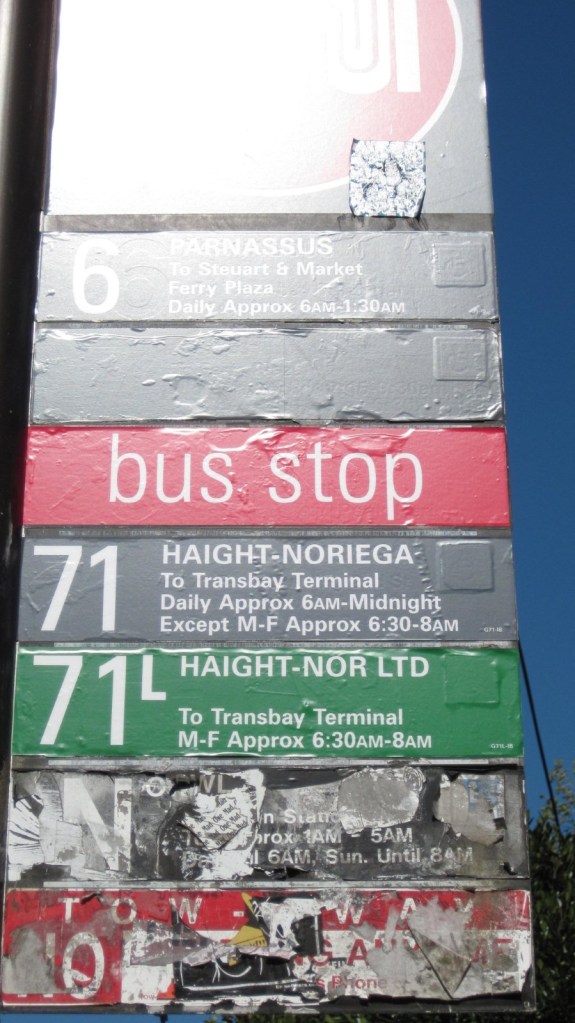
The 5, 21, 31, and 38 all go to the residential area (the Richmond) between the Presidio and Golden Gate Park. The 6, 9, 9L,71, 71L all stop on the outbound islands at an intersection on Market and take you to the Inner Sunset or points south of Golden Gate Park.
The 9 and 9L service the Bayview/Visitacion Valley area by diverging off of Market just before Van Ness. The point is that all these buses eventually leave Market Street, some sooner than others. The 1 never actually touches Market and is a good escape from downtown from Embarcadero BART if a special event is taking place on Market, such as a parade or protest. And we have tons of them.
The single aspect that puts San Francisco in the number one spot of living up to the phrase, “The City That Knows How,” is our flexibility about street closures and reroutes for ongoing and recurring special events. I don’t believe any other major metropolitan area has as many street fairs, farmer’s markets, special events, and parades as we do. The President was here again last week. Our Governator would also have meetings at a downtown hotel. The Defense Secretary was here to sign off on his Halliburton millions, and the list goes on for motorcade delays like marathons and races, the Bay to Breakers before Memorial Day weekend, various street fairs, Juneteenth, The Cherry Blossom Festival, Chinese New Year, The Dragon Parade, Freedom Parade, Dore Alley, Castro, Folsom, Fillmore Jazz, and Union Street fairs, North Beach art shows, art crawls, bike races, Fleet Week, and on and on. All have alerts and special reroutes and delays.
The only other thing to talk about is the islands on Market. If you look carefully at the Muni bus stop pole, the sign says weekdays only for certain buses. Those looking for express service would do well to read this information.
bust top
These flag poles have information most bus companies don’t provide at a stop. Inbound versus outbound is important for express service, as an X bus only works inbound in the morning and outbound in the afternoon. The exception is the 82X, which can be picked up on Main Street by the Federal Reserve building both in the morning and afternoon. This express is a loop that operates like a crosstown express loop during the morning and evening rush.
Charter and tour buses ferrying workers to the peninsula have filled in this lack of loop service not provided by city transit. A series of loops in the city would reduce the pickup and zone sharing at bus stops made by the shuttles, but this costly change in the past has not been justified by the riding numbers. The new density created by all the towers and buildings going up, however, may need a serious revisit on this possibility. Muni could run crosstown loops to connect with peninsula shuttles or Cal Train.
The express signs add the terms a.m. or p.m., and this is as important as the weekdays reminder! Keeping my Zen on, I try to collect these lost puppies, but sometimes it isn’t possible to capture everyone. Woe betides the operator on the F line on the weekend and good luck as an information specialist! This is why I love just driving the locals around on a Potrero barn coach.
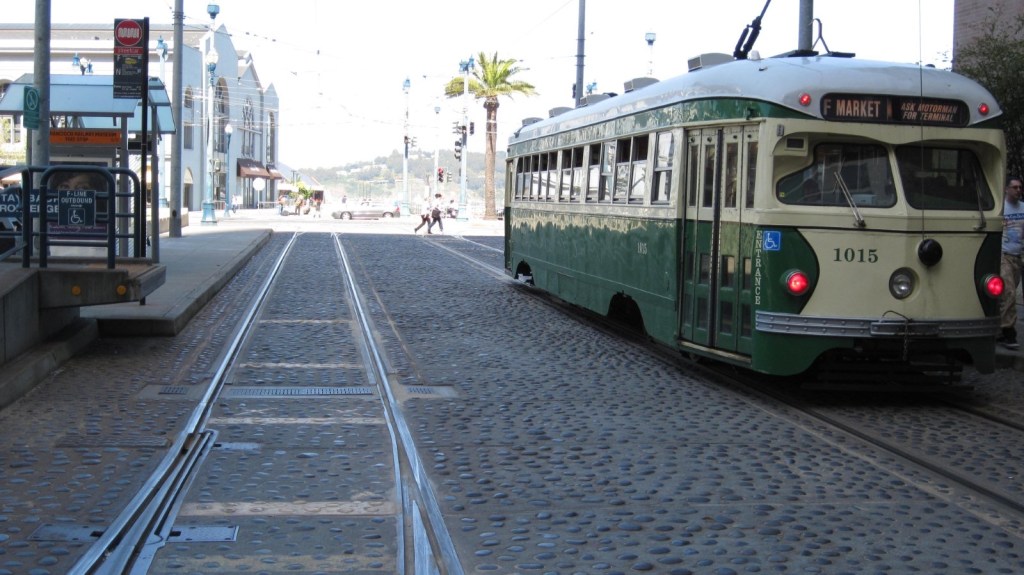
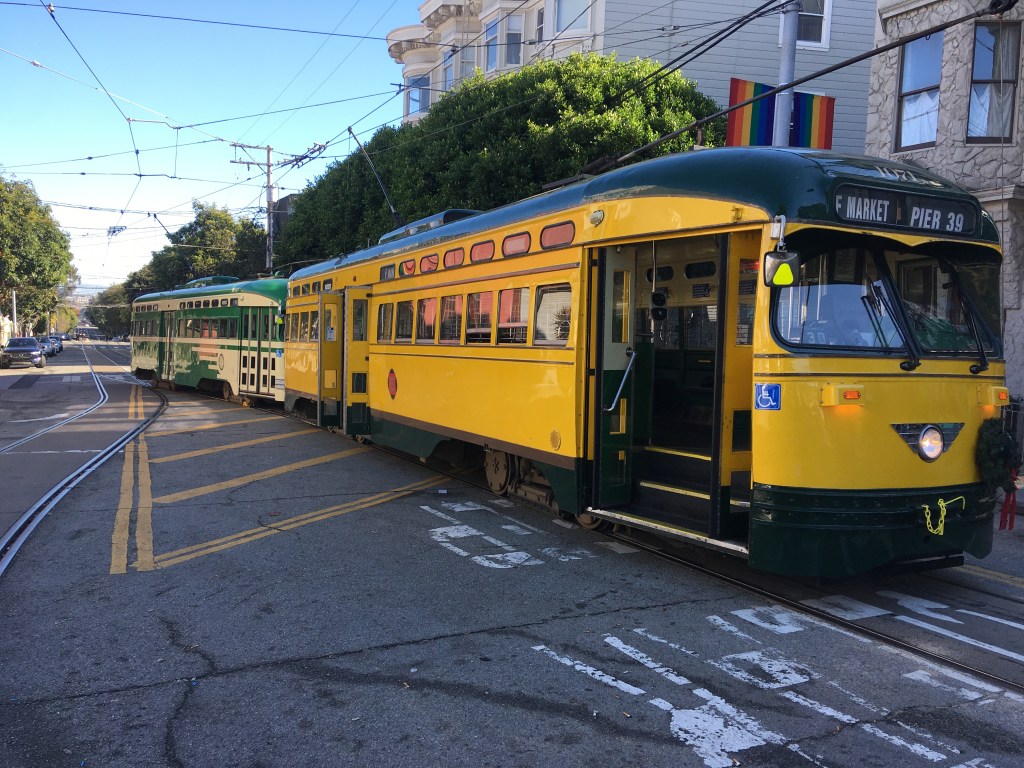
My friends always ask me about what line I am driving. Then they ask about the F Streetcar line on Market Street. The railway has a number of historic streetcars from around the world, and they have been restored and repainted in colors from cities such as Melbourne, Philadelphia, Milan, and Kansas City. It is a wonder to see these multicolored street cars make their proud way down Market Street.
Like most streets in San Francisco, we just use the name of the street when we converse. So we refer to our promenade thoroughfare as Market. We rarely add the word street, except when directing those to our numbered avenues or streets. The avenues are out west by Ocean Beach, the Sunset, and the Richmond, and streets are downtown, SOMA, or in the Mission.
Curiously, few visitors or first-timers are aware of this. The question, “Do you go to 25th?” can be answered incorrectly by just saying yes or no. If on a crosstown bus, we must get avenue or street from the visitor. If leaving downtown, we must also ask, “Do you mean street or avenue?”
Twenty-fifth Avenue is nowhere near 25th Street, so by answering yes, someone can be misled by several miles from their intended destination by only giving the number without street or avenue. This can add over an hour to transit time. Directions are critical when talking on the phone or writing information down on a piece of paper. Most of those who fail to meet a friend or get to a new residence or employer are missing a key piece of information when they obtain it over the phone.
The next problem is not having the phone number to recall the person who gave the directions. Or not carrying a charged cell phone to make another call while on the bus. If I am driving in a peak direction, I refer the person asking questions to another person on the bus if it looks like he/she doesn’t have all the information needed to arrive at the intended destination. After two attempts, I have to disengage. Not being sure of a stop request can be a distraction while I drive, so I have to be careful that I am still friendly in ending the conversation. Sometimes, a lack of understanding about safety creates a discourteous impression, and I have to keep my Zen if I am to stay out of trouble.
Make sure you get the cross street when asking for directions. Make sure the other party is not giving you a side street as a cross street; a side street is only one or two blocks long. Many of us are unfamiliar with these side streets or alleyways. I would love a driver test about the streets of San Francisco, and I know certain shuttle companies do have this. I would like to see a tourist question guide added to our training. “Do you go to BART?” “Do you go to Fisherman’s Wharf?” “Do you go to the train station?” Inevitably, the time and place where these questions are asked are as predictable as the tides. (Good idea for my next book!)
Keeping the Zen in transit means having the cross street down before boarding a crowded bus. Having the connection point and knowing the interval or headway between bus lines also helps to reduce lost time between transfers. The transfer cost between modes and agencies is a primary reason for loss of ridership to the automobile.
One of the common comments I get from operators, even those with time and with lots of experience, is the refrain, “I never call central.” Or “Those guys are clueless.” And I have found operators on the extra board fall in to this category more than the average operator working a regular run on the same schedule every day. Extra board operators get to be assigned a new run on a daily basis. This is great when a sign-up drags on for months, and keeps monotony and boredom at a minimum, and it also prevents an attitude to develop from regular problems or passengers, because the operator is not on the same schedule day in and day out.
I believe some operators are “hiding out” on the extra board so as to reduce their accountability with the regular riding public. And this can be a very good reason. Especially when there aren’t enough operators to cover all runs. But for me, I like the regularity to plan my time off by having a fixed schedule. Also, if there are recurring problems on my run and line, I get to take a look at what I am doing to cause these problems, and see if I can make them go away. That’s why I like to do my “homework” during a sign-up and see if I can make a choice preventing headway problems or overload, though this is not always clear. Especially in not knowing who will sign on a low paying run as my leader.
“Central” is our shorthand for OCC: Operations Central Control. Even though nine of ten interactions with Central may not appear fruitful or necessary, it is the one in ten times when a call to Central, or from Central, is immensely helpful. And it is this one in ten that makes keeping a professional calm tone on the air really pay off.
Central operators come to identify us not by run or coach number, but by our voice. And if they have come to recognize my voice and attitude as one of helpfulness or being brief and concise, all the better. One more tool to have at my disposal when I may need it. Yes, Central cannot necessarily see what is going on in and around my coach, so bearing this in mind, I don’t get upset if they state something contradictory to what I know or can see.
A lot about what Central can see has changed recently. The new drive cams mounted on the front windscreen (windshield) has helped, as do the newer cameras in the newer coaches. Central Control is no longer in the dark about what is going on in front of our coach, and I believe this to be a good thing. Some would say this is an invasion of privacy, but I disagree because we are a civil servant in a job serving the public. Cameras are being installed around the common areas at our division for security purposes, and the drama queens are upset. If you are a public servant and carry yourself professionally throughout your day, what is the problem?
Yes, I do believe George Orwell is right: big brother is watching us in more and more places, but I try to keep this aspect on a positive note, hoping these images would capture an event that would protect me from abuse and falsehood. Much of the cost of litigation can be stopped dead in its tracks by the images captured on the coach. I look at the drive cam as my friend–So far so good.
I said that only one in ten calls may appear helpful, and these calls usually end in a tag line from Central we operators come to know all too well. Below are a list of the tag lines Central gives us, and the emotional component that goes along with them. These phrases may seem simple and innocent enough on this paper, in your armchair or desk as you read this, but believe me, when we get these directives, we are under a much higher level of stress or unusual headway.
“See the Inspector”
Usually occurs when things are very busy. Central Control may be having high call volume sometimes due to a major line delay such as when the tunnel gets blocked. We are silently expected to work an extra load without a break and we need a switchback for a mental break, or because we have been working for over two hours without a break. Sometimes, on a straight through run, we may have gone for four hours without a fifteen minute break. So we call for a switch back, usually ten minutes short of our final terminal. The answer from Central Control is to “see the inspector” for time and place. But nine times out of ten, there is no inspector! I usually pop the brake and wait and see. If no one comes to the door, I can call again, but this adds to the delay, and other coaches may be blocked behind me. “Take it to the end, and call back later.” is the usual response. Not getting the break we need, when we need it, adds to the frustration.
“Take It to the End”
Usually a Central response after “See the Inspector.” And even if we do make contact with the inspector, he or she says, “Take It to the End.” Good is the day I can follow this instruction without a problem. If I am all alone, without a coach behind me, I follow this order, but if my follower catches up to me by the time I reach my last short route switchback, I call again. Many operators wise to this make sure they stay four minutes or more so the lead coach doesn’t get a switchback. This makes for a long day unless we can turn it in to a game, or our coach shuts down and we need a road call.
“Do The Best You Can”
When I cannot take on any more passengers because my bus is full, I call to let Central know I am beginning to pass up stops. This phrase comes in to play when we are late and heavy. Many of our coaches have defects not safety significant, but are randomly occurring and cause delay, such as slow doors, and slow brake release. Fare box problems and lack of heat or air can also us to not feel we have been given what we need to do our job properly. Not being able to use the wheelchair lift or kneeler due to low air is just another curse to hear, “Do the Best You Can.” But at some point, going out of service may soon become reality. This most frequently occurs when a bus is already missing in front of us. We are taking on more people, which adds to the bus performance issues, and adds to needing relief.
“Put It On the Defect Card and Continue in Service”
This usually pertains to a bad fare box or Clipper card service not working. But when a defect concerns our ability to pick up wheel chairs, a call is mandatory. Many times, the bus won’t move if the lift does not stow. This is a bummer to have to clear the coach and tell everyone that the bus it out of service. So most times, of all the orders, this one is usually the fastest and easiest to follow. Hopefully, we can continue in service, but this is usually an order before another call to state we can’t continue.
Things tend to go wrong in groups. Getting out of the bus to push the wheelchair lift to stow is one technique. Resetting master control and shutting off the bus sometimes makes the problem go away. Clicking on the traction control or rear door lock can make a problem go away, at least for awhile. This can make relief interesting. Because as a bus gets warm and stays in service, the performance starts to deteriorate. I am amazed at those who can make it to the relief point on time and not break down. So the lack of writing anything down on the card, and bringing it to the relief point, is an honor in and of itself, even though many take issue with this and feel the relief operator is not being honest. But given our own situation to end a part of our shift on time, bringing the coach to a relief point is better understood.
Breaking down and having to pull out may not be any easier than calling Central at the relief point, and calling the shop. So the decision to stay in service is up to us and not Central, and the order to continue in service lends itself to conflict with others: passengers and coworkers alike.
“Help is On the Way”
Make sure you have something to drink or eat in your bag. Make sure you have your reading glasses or reading material also. As any professional driver can attest, you never know when your shift will end, or how long you will have to wait in the dark or cold wind, for a road crew to assist you in getting back on the road. We are required to call back at regular intervals to check and see when help will actually arrive.
There are some good times and some bad times to ask for help, especially during a shift change. Faced with the prospect of waiting in the cold, we do try to keep going as best we can, without delay. But many times this is impossible because the bus will not move. “Help Is On the Way” can have our eyes rolling because it seems like a bad joke. We operators can balance this equation when we get asked the question, “Is there another bus behind you? “Yes,” we say, as we close the doors. Thank God you never said “when.” And even when it is asked with the phrase, “just right behind you?” since we were never given any units of measure, such as in blocks or in minutes, the answer, “yes,” is still an honest one!
But lest we forget, we never know who is listening, so it is best to remain calm and stay professional. Doing so has given me the switchback or pull-in I really need to go home just at the right time. Answering incorrectly can put me under the microscope for other problems, and this usually does not end well in the superintendent’s office.
“See the Dispatcher”
It’s like go see the boss. You are in trouble, and have to go to the Principal’s office. Perhaps this is the most insidious message from Central because of the ambiguity. What could possibly be the reason I need to see the dispatcher? Is it an off the cuff, oh-by-the-way, afterthought in a message, or a stand alone call. It’s effect for bewilderment and despair is best used alone. Do I have mail? Did the man waving his cane at me as I passed him up call 3-1-1? Did the guy in the wheelchair who blocked my bus, completely full, on Van Ness at Market have a friend in the MTA office? Did the woman who said she knew the Mayor personally, as she repeated my cap number under her breath as she stepped off, really actually know the Mayor? Was that sarcastic comment by the lead dispatcher this morning a tip off they knew what was coming? I must be employee of the Year! (hah) These and a thousand other thoughts roll around in our heads as we try to guess why Central, in their busy day, thought it necessary to call us about seeing the Dispatcher. Maybe it is a drug test. What would happen if I just happened to forget as I trudged up the steps after pulling-in? In any event, I can’t remember any good reason for when I had to see the Dispatcher. Which begs the question, is it better to pick up mail at the end of the day or right before a pull-out in the morning? After work may be the winning answer.
And now I see I be lying, because there was the time I received two commendations in one day! And today they actually let me go home from my doctor’s appointment, instead of having to return back to get my letter signed! So like any ‘good’ operator, I embellish the story with pain and suffering to gain sympathy, and hope this will change the outcome of discipline to a favorable decision. It never does. The decisions are usually made in advance. It’s kind of like the Cardassian system of justice. Guilty until proven innocent.
But when a passenger comes forward with a phone number and a line of support, it all seems to melt away. Which reminds me to say it is always a good idea to have a courtesy card in our jacket pocket. These are cards which a passenger can fill out as a reference to an unusual occurrence on the bus. Usually a phone number is enough. We (should) keep them with us, so all you have to do is ask. When someone observes I am doing a good job, and goes out of their way to let me know, the Zen zone returns, and the rest of the trip is uneventful.
“You’re supposed to lower the kneeler for seniors,” or “Thanks for lowering the steps,” sarcastically spoken after departing to the sidewalk does not help much. A request for the kneeler with a condescending tone (as if I’m a mind reader) after ascending or descending, may not reflect where my attention is focused at the time. The rule is to request the kneeler before alighting or stepping up. We are not in the know about the status of your hip joint, your back, your neck, your legs, and so on, if we have not seen you before.
We try to gauge need based on observing your gait. In coming from behind the shelter or from the seat after we have opened the doors, we may not be able to see your approach. Yes, there are those for whom a kneeler would be obvious, but asking for a kneeler after using the steps seems ass backwards. Putting a foot on the first step and not moving can work sometimes, especially if accompanied by a glare of disdain. The sense of entitlement I pick up on, however, does tend to make me pause sometimes in lowering the stairs. The quickest verbal command to get the steps to descend is a “thank you.” Veteran riding seniors know to say thank you as they reach the stairway, and just like magic, the steps go down. Condescension not required for lowering or ascension—just ask any angel.
Another secret for getting what you need from the bus driver is to come to the front door if your stop got passed up. The button by the back doors sometimes does not register on our dash board and does not work as regularly as the chime cord by the windows. Being able to hear the bell is also a plus. Even if your volume is low, taking off one bud lets the driver know you can hear him/her talking. This courtesy has been lost on most folks.
Screaming or yelling may work, but a quick move to the front at the first safe place past the zone is better; if safe, we will lower the steps so you can get out not far from the previous bus stop. We are allowed to do this per safety rule but not out the back door. Late rings with a demand from the back steps do not usually result in an open door; coming to the front, however, does. We can see if a cyclist or skater is approaching, and we have better control over the doors. The pause or delay in stepping down the back stairs creates extra seconds of time that could mean a collision upon stepping down versus a safely-lowered kneeler up by the next crosswalk at the front door. We can also move the bus nose closer to the curb than at the back.
Another trick I make sure my student in line training understands is to use the front door/rear door toggle in front of the door dial. By delaying the front door from opening and opening only the rear first, migration of souls sets in, and the slow exiting senior has a chance to make it to the front steps before those on the sidewalk bulldoze up the steps. This also saves on the call to “move back!”
“Coming out!” Is a helpful verbal cue, but if you let us know where you plan to get off when you board, and we can see that you need extra time, we can delay opening the front door so you don’t get the bum rush by those on the sidewalk. This federal ADA law (Americans Disability Act) protects you when you depart. Help us help you! I enjoy protecting your right to step down first, but if I don’t know when you are getting off, those extra precious seconds are lost upon folks who bum rush up the stairs from the curb. Let me help you by requesting your stop, so I can put a request to a face and see where you are going to sit when you board.
Humility and redress with the appellation, “operator”, does work better for getting what you need when you have to get off. Two golden words, “thank you,” help preserve the Zen when coming to the front door for special requests.