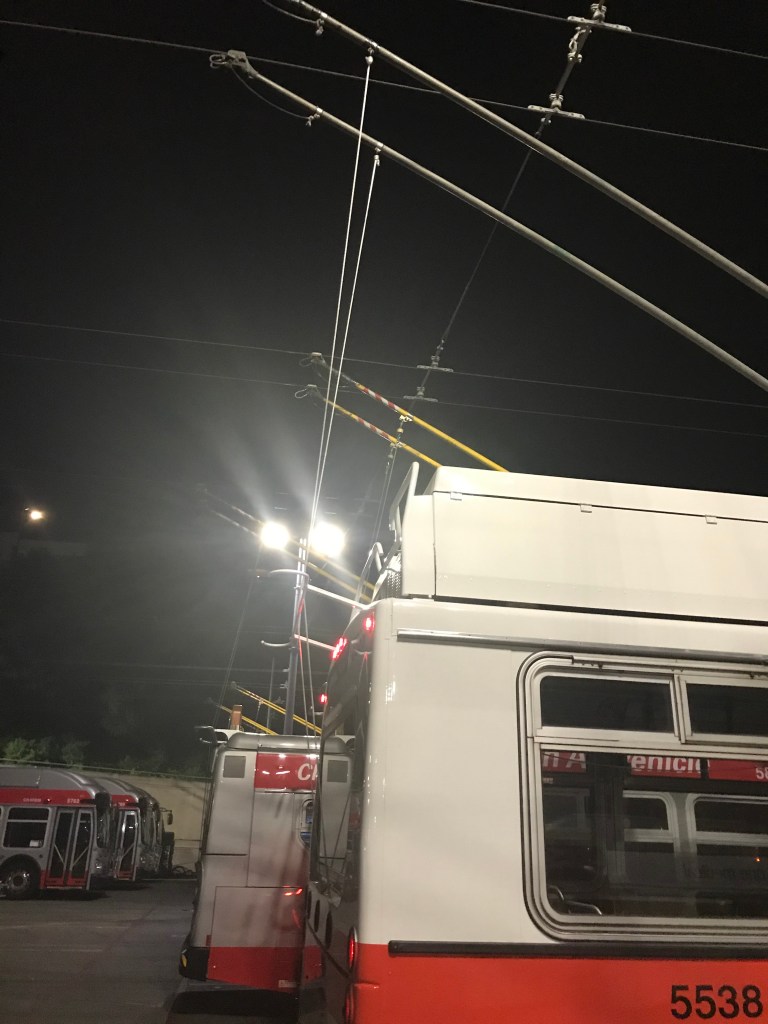
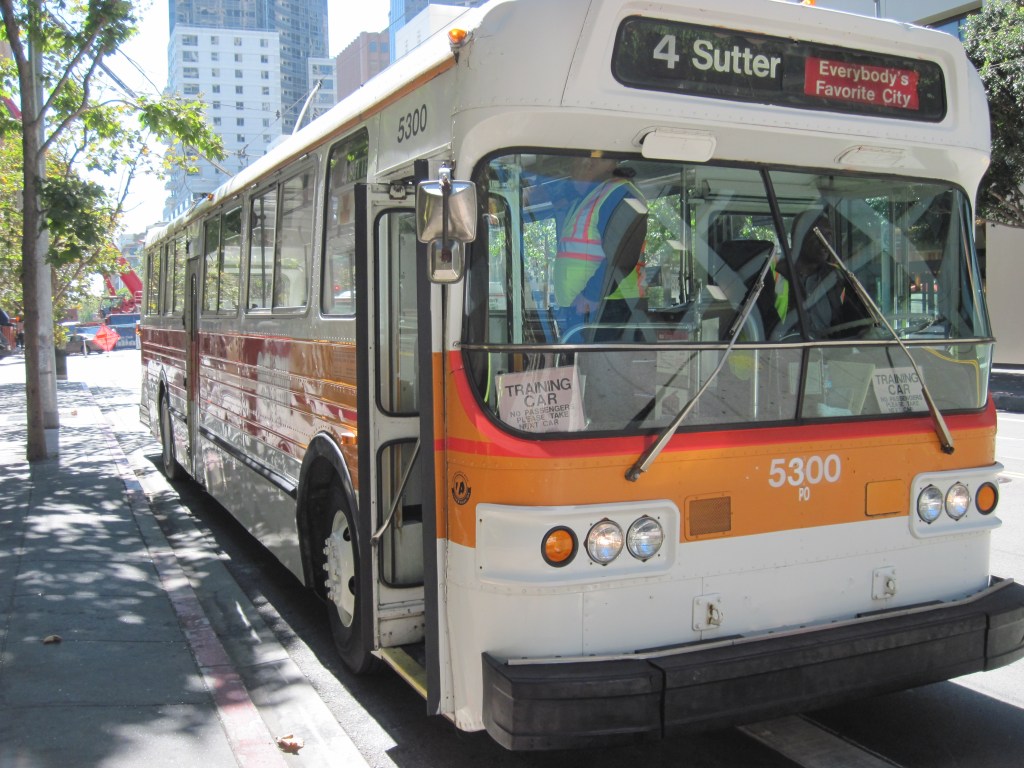
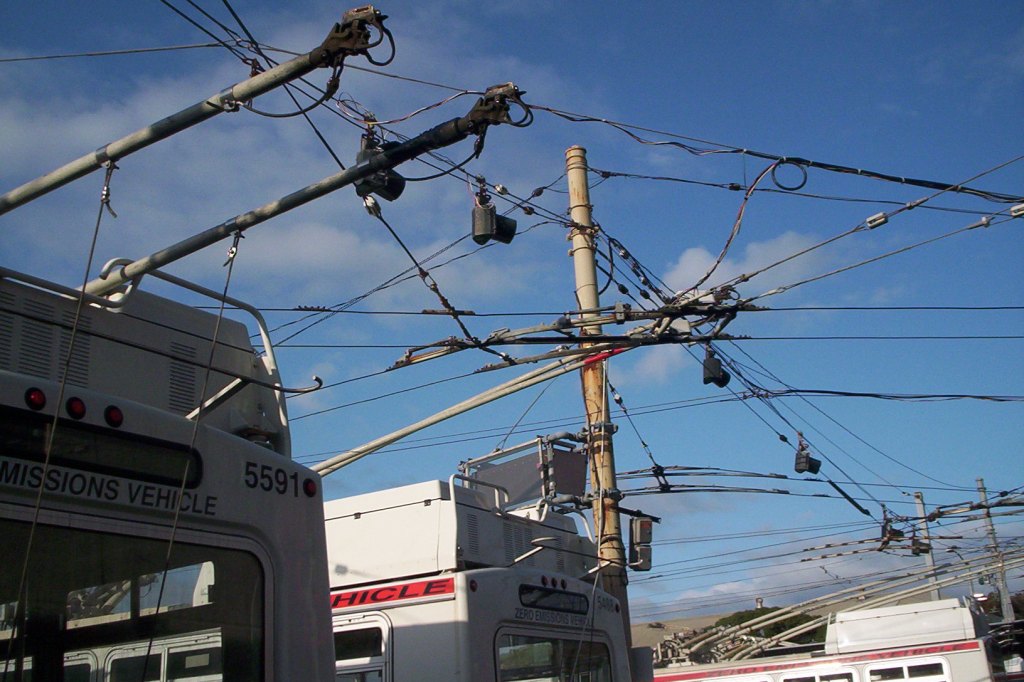
At the Potrero trolley bus barn, we have two levels. Unlike the Presidio trolley barn (which has one level and a tricky pull-out from track one and a pull-out to Sutter) the Potrero barn has many lanes of challenging tracks. There is a horseshoe U-turn maneuver from tracks ten, eleven, and twelve that can lock up an articulated coach in the lower yard by the wash rack.
The upper yard has an S-curve maneuver from tracks thirty, thirty-one, and thirty-two to the street that also makes it difficult to prevent a lock-up or de-wiring. Not only is the far side curb clearance an issue with parked cars, but the traffic on 17th Street does not want to yield or be slowed by a pull-out coach. In the evening, the car parkers run the gauntlet of passing through the tire shop. Potrero has car parkers to speed parking and prevent blocking. This necessity becomes clear when many coaches pull in together in the evening after rush hour is over. The car parkers also insure coaches are left on park charge correctly and that accessories are turned off.
There was a brief time when the car parkers were eliminated, but this led to problems when coaches were found “dead” the next day, or the poles had not been reset from dewirements. Coaches were also parked in a lane different than the one assigned by the tower. The cost of lost time in the morning was greater than the cost of having operators park the cars as a team in the evening.
The group effort adds to an impersonal sense of goodwill at the day’s end, making Potrero a great place to work. I am usually either exhausted or happy (or both) to see the car parkers and the revenue coworker who takes the money out of the fare box. I made it! Another day done, another dollar earned, still in one piece, and hopefully, without a trip upstairs to fill out paperwork. The best feeling is to get on my bike or walk to the bus stop and go home.
Pulling in and parking on the upper yard requires a skill level that takes time to master. There are switches in the yard and in the street, and if some are not working, it makes for a bad afternoon. There is rush hour traffic to contend with on 17th Street and a gauntlet to run through the tire shop garage. Coming to rest on the upper yard tracks is the challenge of navigating around parked cars that aren’t supposed to be there. And the pressure of more buses coming home and backing up traffic on the street. Many thanks go to the traffic engineers who eliminated parking along 17th Street by our bus barn when 17th Street was recently repaved. This bike lane helps us get by in the morning and evening, and it helps the car parkers make their turn onto 17th!
Pulling out from the upper yard reminds me of the patience and Zen awareness I need with the equipment I am controlling, or it may control me.
One recent writing prompt on my Word Press channel–was to describe, “What would I do if I lost all my possessions?” I started to write about the two men I see here on Oahu that were fortunate enough to survive the Maui wind fires from Hurricane Dora, and are basically having to start over here on the neighboring island of Oahu. To be sure, the outreach to Maui fire victims has been somewhat reassuring, yet, no matter how I would try to capture how I feel about this whole thing, something just isn’t right.
At first blush, I would say, “Buy more crap over again!” –but for those who had captured the American Dream at some time in their life, the start over again seems more like becoming homeless without hope.
Then I remembered this recent video from Michael Bordenaro on YouTube–who is one of my favorite channel hosts– who basically captures the “theft” of losing everything in a slow-motion train wreck in our dollar’s purchasing power.
In this video, with some great examples from his viewers, are the stories of buying a house more than 20 years ago such as a Publix market grocery store employee, and showing what that salary would need to be today with respect to inflation, and then plugging in the same numbers for house prices, and showing that the average house price in the same area where they were bought in the seventies, eighties, or nineties, are now double or triple the price adjusted for inflation. How did this come to be?
Michael Bordenaro sites stories from us, his viewers, about what job we had when we were able to afford to buy a house on a blue collar salary.
My guess is financialization*, as defined by Wikipedia as:
*Financialization (or financialisation in British English) is a term sometimes used to describe the development of financial capitalism during the period from 1980 to present, in which debt-to-equity ratios increased and financial services accounted for an increasing share of national income relative to other sectors.
Did we vote on spending in the Viet Nam war or for the decade in Afghanistan? Did we approve the 100 million-dollar-a-month spending limit on wars that “don’t count” because the are too small? Are we now being force-fed to overspend more than 100 Billion on an Ukraine war we never endorsed?
Dear David Lin and Professor Hanke, (YouTube)
Could you do a video with John Williams of shadow stats to describe what is happening here to our ability to possess a home? Would we storm the capitol and ask the Veep to stop the election results? Oh, we already tried that. And that man was our President, who’s now being tried for inflating real estate values.
After being called on the carpet for a pass-up on Van Ness, my leaving time from the North Point terminal was questioned by the assistant superintendent. I had departed about four minutes late. Thankfully, the data also showed I was four minutes late upon arrival. This information was obtained from using the sheets of data generated by our global positioning satellite. I had a short coach that day instead of the usual sixty-foot articulated trolley. My response was that I had not been given the equipment I needed to perform my duties professionally.
I don’t know exactly when it happened, but at some point, runs from Potrero were assigned a short coach for the 14 Mission lines and the 49 Van Ness buses. It is now acceptable practice to give certain runs a “short,” forty-foot coach instead of a sixty-foot articulated trolley. I did a yard count of coaches a couple of years back, and out of one hundred fifty trolleys in the yard, only seventy-five were available. The other half had hold tags and needed parts for replacement. This changes everything about how to operate the line during the crunch zone. If you ever go by a bus barn during the day, notice how many trolleys are still in the yard. They are awaiting parts.
Running to an occupied bathroom, taking a stretch or getting a drink of water, make personal necessities seem like the cause of lost time in terms of recovery at the inbound terminal. The previous signup had given us twenty minutes at this time frame. This was cut to ten minutes, and as I would usually run four-to-six minutes late, I lost most of the time to recover. One operator walked off the job at this terminal and left the bus here at North Point because of the stress of the short recovery time at this inbound terminal.
So here I was in the assistant superintendent’s office for disciplinary action because I ran out of room on my short coach after leaving the terminal late. In this case, a man using a cane had asked to be dropped off in the zone at Eddy farside, not nearside. I opened the door at a bus bulb where the sidewalk sticks out at the crosswalk. I did not know when he boarded, and couldn’t see that he needed assistance due to a blocked view inside the crowded coach. He was sitting behind me in the “Black Hole,” and he may have entered through the back door. Because the man was so calm in demeanor, his request so low in tone, I disregarded it and told him to exit nearside. My manager understands this use of the emergency rule, but I leave the hearing wondering about the outcome.
The use of GPS data is an excellent tool for obtaining leaving times of coaches, but it just gives a snapshot, not the big picture. When an inspector is present and observes the leaving times of several coaches over a period of at least thirty minutes, a realistic headway average is obtained, and traffic and driving conditions are much clearer. This is why I object to bringing up GPS data in a disciplinary hearing because “eyeball” physical presence is much more objective. I miss seeing the same inspector on the corner every day.
Inspectors are no longer stationed at checkpoints or relief points on a daily basis. Radio information about breakdowns, headway, and pull-in or pull- out orders are no longer available in-person on the street corner. As such, a rapport no longer develops between operators and the corner inspector. When I do call Central, I find that they think twenty minutes is too much time for a layover. This cutback, along with the lack of equipment, has made my senior driving years at Potrero a greater challenge in keeping the Zen.
On a recent Friday with a standard forty-foot coach, I found that my leader in a sixty-foot articulated trolley went out of service at the Ferry Terminal. I immediately adjusted to slow down and plan for a heavy trip. As I prepared to leave my last terminal, a man leaned on my coach and refused to move away from the side of the bus. On the previous Friday, a man pounded on my door to be let in while I was moving to the curb in battery mode, going around my leader who went on a 702 (radio code for personal necessity) break.
I now understand why these leaders go out of service around this time. The 14 line becomes the ninth level of hell during peak afternoon rush hour. Drinkers and emotionally distraught riders do not mix well with the downtown crowd just trying to go home from work. Heavy smokers and addicts with the aroma of coke or meth imbedded in their wool overcoats can be a triggering experience and make it hard to breathe. Trying to get the mix right of methadone and an 8-ball without an incident is an epic experience.
This is why calling for a 702, a twenty-minute break, may be required more often, especially from new hires because recovery time has been reduced. The long-term effects of less travel time may end up costing more by trying to in-fill employee absences with the daily detail. Hard to tell and hard to judge. I am grateful I learned the job when our division had over ninety daily hours of stand-by time. Now there are less than five hours of stand-by on the range sheet totals. (See the chapter on Range Sheets to understand all these other types of non driving time.)
Pulling in on this particular holiday weekend Friday at my last stop at Ninth Street, a man refused to get up out of his seat, sitting in the Black Hole right behind the cockpit. My holiday weekend was being held up by an angry man who claimed I passed him up at a stop no one on board requested. Could I get him off the bus without incident, without damage to the front doors, or without causing a major medical emergency? Fortunately, he departed, but not without a rage-filled discourse. Whew! I called Central to clear a line delay, and my favorite operator wished me a good weekend. Yes! A friend at Central Control!
Closeup of the new radio system.
But the agony of the mental twist is about paperwork on a holiday weekend pull-in. To me, this is why a job as a civil service worker on the line with the public, is the reason many of my friends stay away from putting in a job application—because of the people. This reading may not capture your imagination, but believe me, when you are sitting behind the wheel, it is a big deal.
Now, how could I write this up without going to a pass-up hearing at 1 South Van Ness? I keep hearing the angry, bloody man calling in my cap and coach number as he sat behind me on his cell phone while I prepared to pull in at Tenth. Was he really making the call or just trying to mess with me emotionally? As he chided me for negligence and being inconsiderate, I couldn’t help but break out in a Cheshire grin. My biggest fear, getting another pass-up PSR, was unfolding before my very eyes.
If I mentioned a bloody face, my failure to ask for medical assistance could show a lack of empathy. But was it also reasonable to assume that I was protecting those on board from a medical emergency by not allowing him on the bus? I had passed by the bus shelter before I saw him madly waving at me, and it seemed a toss-up as to whether the pass-up was valid or not. I had another woman complain that I did not pick her up here, although I had stopped and opened my doors a few weeks earlier. Ironically, there she was, sitting in the bus shelter, looking at her smart phone for the next limited bus, as the bloody man came running. I had scored a victory about reading head sign destination with her complaint, but here was another.
This is the dilemma we face in a split second choice to pass up or pick up. But it is hard to intuit all of this in the seconds of passing by the bus shelter. The trend lately has been to make the stop and let it play. So, I considered this to be an error on my part. How much of a big deal it could depend on how honest I was. This job provides the ultimate opportunities for patience and adventure.
It’s now been two weeks since several angry passenger incidents (including those above), and all is calm. I have had nothing but smiles and thanks. It seems lunar or astrological in the timing. My personality remains the same, the equipment is still a short coach, yet all is well. I question my blame on the equipment. Now it seems not so genuine.
When an old, long coach dogs you on the doors, it can be like a slow motion train wreck where the buses pile up behind you as you drag down the line. After some meditation and prayer that I be shown what to do, I did have to admit that the coaches I had been given were defect-free. The short coaches moved and caused no mechanical delay. My frustration had been at the back door jam-up, not with the performance of the vehicle.
I had one of those great, Electra Glide in Blue days, with no one in front of me or behind me. Central Control informed me I did not have a leader, and I could move up four. Yes!. No write-up at 30th for being hot. No one dragging me down in an old, long coach. Freedom. I was shown the grace of having a small coach and why my desire for a long coach was misplaced. Go tell it to the mountain. I eventually got two unpaid days off for too many pass-up complaints. Oh well, suck it up and continue to march. We learn early on that tomorrow is another day.
This is truly the long and short of it when it comes to keeping Zen (and my job) as a trolley man. New prototypes are being built now for delivery and will hopefully be ready for revenue service towards the latter part of 2015. This new equipment, sixty brand-new articulated trolleys from Canada, via Seattle, will change the nature of our job. Clean, functioning equipment that actually moves faster down the road is like building extra minutes onto our paddle; it also lessens physical stress in our knees and legs because braking and acceleration are new and responsive.
We may get several lost lines back with this new equipment because we did not have enough long coaches. Heard tell that a nearby bus barn will house the short trolleys, and our barn may be housing long coaches only. It makes sense, as sixty new long coaches will take up much more track space than what we have now. If I can just hold on long enough and keep the Zen!
This devilish mode is found in the morning when someone turns on the coach in neutral; it’s a bummer when you need to pull out on track four. Nowhere can the ghosts inhabiting some buses be found more frequently than in the flashing red light on the dash that notes propulsion down or reduced performance. On some coaches, it is the horn or the windshield wipers that go on or off unexpectedly; on others, the problem can be in the vents or in trying to open the driver’s window.
One bus has its spiritual signature on the back window emergency lever. It won’t lock, and if you try to seal the window, the whole window comes out. As experienced operators, we eventually get a working knowledge of what quirk each coach has. We can log a diary of the coach number and what the “defect” is, so that when we get the coach again, we already know what to do or not to do. Over time, we don’t even need to look at our diary; we already know instinctively.
Restricted mode is tough because it can change from coach to coach and from time to time. All we can do is try to follow the manufacturer’s specifications to the letter and hope we don’t omit any step or procedure that might start the cascade all over again. For example, waiting a full two minutes with the coach turned off before we restart. (Needless to say, if stopped in a busy intersection, motorists may have other ideas about waiting a full two minutes while the bus is blocking traffic.) Turning on the bus when in neutral is a no-no for some, but on other coaches, it is required.
Leaving the heat or blowers on can create an energy drain that some buses won’t tolerate when “waking up.” Likewise, turning on the blower motors too soon after turning on the engine can also create payback complaints from the bus.
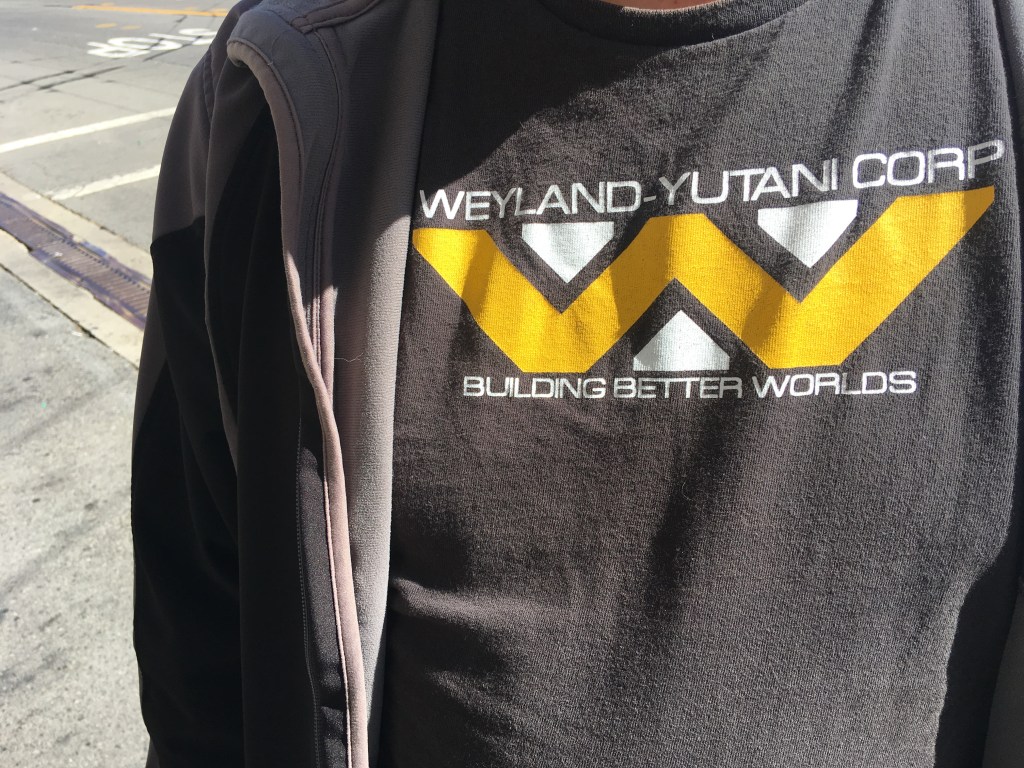
In the pre-op test before becoming an operator, the first line item action is addressing the coach. I literally greet my coaches before I board. If I fail to do this, I can quickly get into trouble. I do talk to my buses when I approach them from behind in the yard or from the front in the garage. If I am finely attuned, I can sense a problem as soon as I am assigned a coach by the yard starter. And of late, my intuition seems uncanny in its accuracy. If I am asleep in my awareness, however, I can get bitten by doors that won’t close or a radio that doesn’t work or a power drain that brings the bus to a halt. I try to coax them back to life, but if they fail me at an inopportune moment, I do happen to tell them a thing or two, like Sigourney Weaver as Ripley in the movie, Aliens.
The point of no return seems to be when I have tried to reset master control for a third time without success. I reach a point where no more tricks or clicks will bring the coach back to life. It is time to call for help. Imagine my shock when the radio won’t transmit, especially if I happen to be in the middle of an intersection.
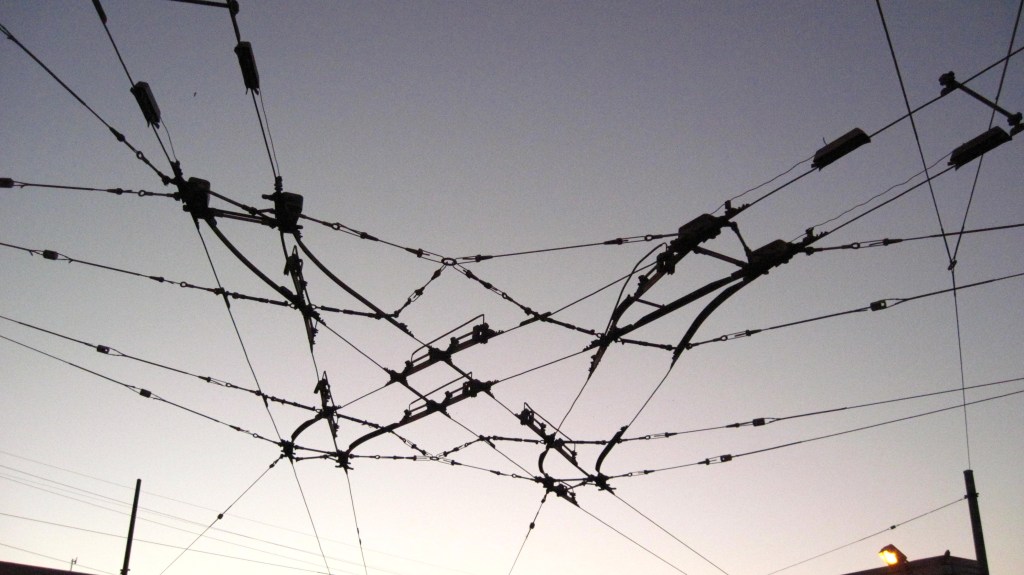
But my overhead power karma is good, and I usually can get out of a blocked situation fast. I always try to help another stuck operator to keep my matrix clear. Many such problems are those that never “stick” because of our fit spiritual condition. A good pre-op pays huge dividends on the road later in the day. I am always relieved when I find a problem on track four and not at Sansome and Sutter.
It wasn’t until I looked through my old journals that I finally found an answer I had been looking for about why I was on the black list of an important street operations inspector who has dogged me for many years. And I have been replaying in my mind, what I could have done differently to have saved the job of an inspector that was volunteering his time for the good of the order during a power failure along the Mission line.
There had been a power failure on Mission somewhere probably due to wires down, or a short or heat sensor going off and tripping the breaker to turn off power to the wires along Mission near downtown where Mission parallels Market Street, and perhaps to about 25th Street in the heart of the Mission. I had made it to the inbound terminal at Ferry Plaza and waited for 45 minutes until power was restored. I was amazed at the sense of humor I had as I told the inspector this trip was going to be one for the history books. No coaches in front of me from downtown to Van Ness, and all I had was a small coach. And little did I know what was in store for me at the 11th Street stop near Van Ness. I was packed, stacked and racked, and was ready to pass up the large crowd waiting at the stop. I had no intention of stopping to pick anyone up because I was completely full from picking up all stops from downtown.
And to my horror, I saw an inspector herding like a shepherd, seniors off of the curb towards my bus in the traffic lane. I had intentionally stayed away from the zone to pass up those waiting, but was stopped in traffic waiting for the light. Big mistake. I have since never got caught waiting for a light after a pass up. I learned early on where and when not to get in a stall if a pass up was necessary.
So here were passengers being guided towards my front door with no room at the inn.
“I can’t take any more people, this coach is full,” I said to the inspector. “Make room. Ask people to get off to make room for these seniors.” And a mutinous roar went up in the bus, “Hell, no.” “Make them wait.” I shut the door and moved ahead with traffic that was f lowing after the light went green. I better cover myself on this one. I pushed the button to call Operations Central Control. After run, line, and direction, I asked the question, “Is this coach full?” I held the mouthpiece up to the aisle. “Yes!” responded the entire group crammed in the bus.” Whew. I had an alibi. As long as the passengers were on my side, I knew I would be okay and not get in to trouble. But I definitely want to stay out of controversy, and obey my general orders.*
*the views herein may not reflect those of the SFMTA or its employees.
They say its a bitch, and it really is. Problem is, half the time I never knew I was receiving payback. I was having a bad day without knowing I was the cause. And it took me years to see the cause and effect my actions of pissing off others had when this energy boomeranged back on me.
The first most obvious payback was one on one with other operators. That’s when an operator waits the full time at the terminal, and then, after waiting past my leaving time, goes out of service. By the time they call Operations it is too late. The damage has been done. I have double headway and am leaving late. The clincher is when I have no follower so I can’t rely on help from behind. And the worse place for payback is at Bay and Fillmore. No way can the three major stops of Chestnut, Lombard, and Union be passed up, and no way can I enjoy an empty or light segment of load before the mid way point on the trip. Oh well. There goes the Marina Green Middle School’s Out bell! Better luck next time.
Or the famous Daly City 702. Where two twilight operators, usually junior to the pull-in coach behind them, take a twenty minute break so that the pull-in operator has a long headway to pick up passengers from Evergreen, Lowell and Geneva all the way in to the inner Mission. Instead of shadowing behind two in-service coaches, the operator has to pick up an extra load for the three miles in to the pull in wires. And not just for one day, but over and over, day after day.
And when passengers retaliate, it is usually up front and obvious. They pull your poles to disable your forward power traction motor.
Or they release the air from the rear door, so that your interlock engages, and you can’t move the bus forward at all. May be they stand in front of your bus. Perhaps they park their wheelchair in the street. Or throw their bag in to the side of your bus. In any event, you are not going anywhere. And I can mark my progress as an operator when this stops happening to me, even at classic corners like 16th and Mission. I am happy to say by being in the Zen zone, I have not been blockaded by passengers for years.
If you want to make a difference about service, don’t expect immediate results. If more than one person calls in a complaint, odds are better. Getting the time and place correct counts: are you inbound or outbound? And the coach number is usually adequate. But the operator’s descriptions can be humorous. I was once called a Latino male. I was thrilled. I didn’t even care about the complaint. I was glad to be thought of as from Spanish or Mediterranean dissent. Hair styles and glasses also seem to add to the humor. Sometimes this is the best part when reading the complaint.
But heaven help the operator under the microscope of management, lying in wait for a minor mistake, as if there aren’t enough things to worry about, already. In using the full set of rules to the exact letter of the law, it is only a matter of time before the suspension comes. Opening a door early, or squeezing a lemon out of a stale green, odds are you are going to get written up for not following the rules. But, by swallowing my pride, not taking things personally, and looking at all my actions to change my behavior, once the penalty is received and not disputed, I have been given a new chance to avoid the penalty box. I am born again with a clean slate, and can make sure I don’t keep repeating the same mistake over again. I look for feedback from my passengers. If I keep hearing thank you’s when people step off, I know I am on the Zen track.
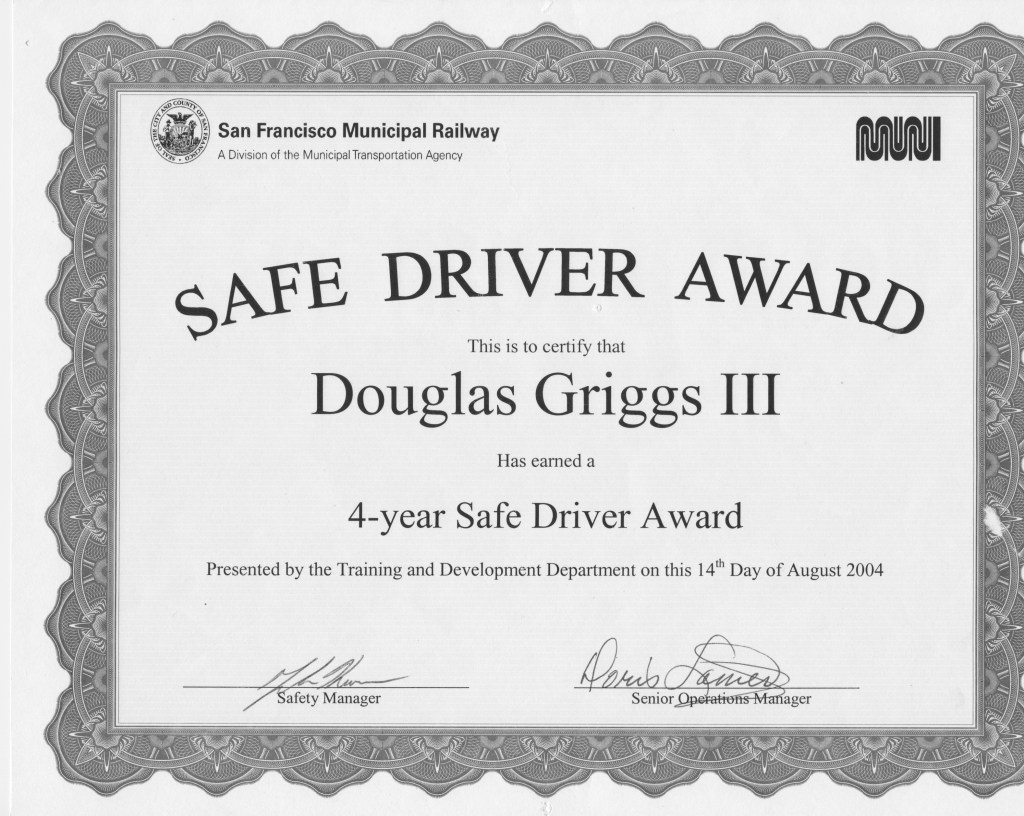
Next time you see an operator wearing a safe driver patch, ask yourself what it reminds you of. Is it a nuclear or biological warfare hazard symbol? Perhaps it is a design not unlike the fallout shelter signs of the fifties and sixties. No, this is the safe driving award patch for a transit operator who has had no accident for 365 consecutive days. The cost of this patch could be about twenty-five cents (maybe even a dollar for inflation), but the price is incredibly high!
As any transit rider can attest, the odds of making this happen are incredible. All one has to do is ride in the seat across from the cockpit in a trolley for just ten blocks to see the continuous threats and trespassing from pedestrians, skaters, cyclists, motorists, and delivery trucks. And to extrapolate this continuous, hyper-aware adrenaline state day after day, month after month, for up to a twelve-hour range for a day shift, the elevation to heroic status of a San Francisco Transit Operator is not that boastful or unrealistic.
But guess what? The one-year patches were eliminated. Perhaps the arm’s length of patches on the shirt sleeve or Ike jacket was tacky looking. I don’t understand why this needed to be taken back. It reminds me of the new rule to allow cell phones on airplanes or to stop charging for parking meters on Sunday. It feels like a step backward in progress.
Thanks to the vilification of operators as “Fat Cats” in the news during the economic downturn of the late 2000s, and a misapplied label of a nontaxable, health benefits check (described as a “bonus” check), our annual trust fund check before Christmas was removed. And no more automatic cost-of-living increases of twenty-five cents per hour twice a year, per city charter, to keep up with inflation. No more benefits check, no more annual safe-driving award patch. Ouch. And, of course, the politician doing this service work is no longer in office. So now, my purpose in writing this second missive is to shift sentiment back in a positive way so that we can all be proud of taking a bus.
But many riders I talk to are glad that we operators, as a class, have been brought back down to earth in our job description and pay. These are the lucky to have a job group. Call in sick within two days of a new sign-up, and you may lose your run. You are put on the extra board, or you are kicked down to last place in days off on an owl run, as an example.
If you work a seventh day straight, you don’t get overtime if, during any day of the second week, you miss a day of work. These are the inefficient work rules taken away by a voter-mandated proposition G. Lately, however, this tide has shifted to where many riders say we don’t make enough. We have gone for over five years without a raise and had a sick-out protest over conditions offered in the next contract.
If someone was caught in traffic coming over the bridge, their run would be given to a stand-by, on-report operator, and they would be detailed on the next open run. They did not need to call if they were driving and in traffic. This situation was portrayed as not being able to show up for work and was eliminated years ago in proposition M. But for years and years after M’s passage, the anger of not showing up and not calling in was used as a weapon against the supposition that we had it too good. The point being, our rules were set up for minimal drama and with the understanding that we would not strike if our wages kept up with inflation.
I heard of the tumult in Wisconsin and other such previously “blue” states that the halcyon days of benefits and pay are over. Indeed, most government workers’ benefits now exceed those in the private sector, except when they don’t. As witnessed by the huge bonus checks received by those working in technology, I certainly do not begrudge this. The spotlight has shifted off of us as a class, and onto the tech workers. Most vivid is the example of Muni being blocked by the tour buses taking tech employees to work in the morning or home in the evening using our bus stops.
Once again, the idea being pushed is that income inequality is awful, and that penalties should apply, such as a use fee for a tour coach to use a Muni bus stop. Rather than see a rising tide lifting all boats, the lock and dam should be shut until all the dinghy’s leaks can be plugged.
But I digress. I still don’t see why a safe driver patch that is such a challenge to obtain and costs so little should be canceled. As a former Boy Scout who loves trading and collecting patches, it wasn’t the five years of no raise or the removal of the three thousand dollars of benefits per year caused by a voter-mandated change in our city charter. The kick in the solar plexus was the removal of the annual safe driver award patch.
Lest you get the feeling that I enjoy being the victim, let me state for the record that, while I do relish the familiarity of this victim energy, I do love the elation that comes from meeting a seemingly impossible goal without any fanfare or regal ceremony. It is so familiar to get into the blame mode or the look what they are doing to us mode, but this option offers no solution.
When we are done with our work, we are done. If we have made plans outside of drive time, this precious commodity of our personal time can’t be bought for any price! Though it sure seems like the boat has a slow leak. Is that hissing sound coming from the parking brake? How much air are we supposed to maintain in pounds-per-square-inch per minute with the lines open or with the service brake applied? The only air leak is the hot air from politicians taking away wages or benefits.
There was only one simple message for this patch design—the image and symbol of the safe driver award. As for the Nobel Peace Prize, the Medal of Honor, the Distinguished Service Cross, and the Silver Star, the Safe Driver Award should be ranked alongside them. Gallantry in action or wounds suffered in combat—these seem like just another day behind the wheel of a city bus.
Then there are those who pass the twenty-year mark. These are the true masters of the Zen. Indeed, most of my failures and accidents have caused me to be a better operator, but I still have not made it to ten years of safe driving, even though I have been at the job for sixteen years. This book is written for those like me whose annual safe driving does not match years of service. Those first few years were hum-dingers!
Cue dead roll music: flute, drum and fife, bagpipe, and hell, a bugle corps! Keeping Zen should be that state of bliss, a way or a path of success from where, when we look back after having climbed the mountain, the view is fantastic.
But wait, does this mean that we are trudging in pain all the way up the rickety bridge or rocky trail? What kind of a life is that? No, the secret of Zen should be with us at all times. We need to know that it is always available to us, and we can see the vantage point, even though we are not yet there. The spiritual quest can be found on any yoga floor, on any bus. No longer isolated as a pod person in a separate machine, we are together on the bus. No wonder the little ones love the bus!
What’s the best piece of advice you’ve ever received?
The best piece of advice I’ve ever received was to do nothing and stay in Hawaii. As a twenty-nine year resident of San Francisco I thought it would be a good idea to go move back there now that COVID is over—to find my heart—and be reunited with it.
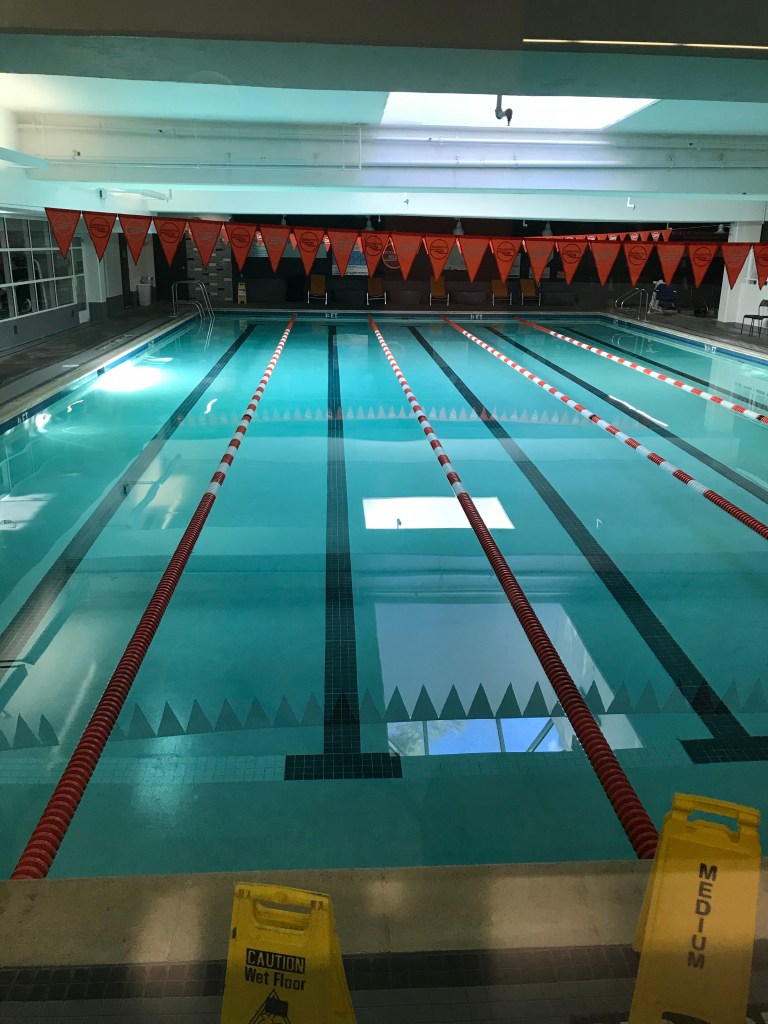
Gym and pool closed October 17, 2020.
I moved to Honolulu during the Covid lockdown in 2020 because Mayor London Breed closed down the gyms for the third time in October, and I was angry about it and said that I was going to swim in the Pacific Ocean in Waikiki.
I didn’t think they would close down the beaches, but little did I know, they did. If I had asked for advice, they would probably have said no—and to just go ahead and visit for a couple of weeks. This never dawned on me!
Getting a case of island fever, I decided to move back to the mainland last month. I didn’t like how my electric bill was so high and how warm it was outside in the afternoon here in August and September. I was also shocked at what happened in Maui from the weather and wind from a passing storm.
My family and friends, however, convinced me to stay in paradise. The hassle of moving back and forth was not worth the time and effort, and the suggestion to stay and visit San Francisco occasionally seemed like good advice.
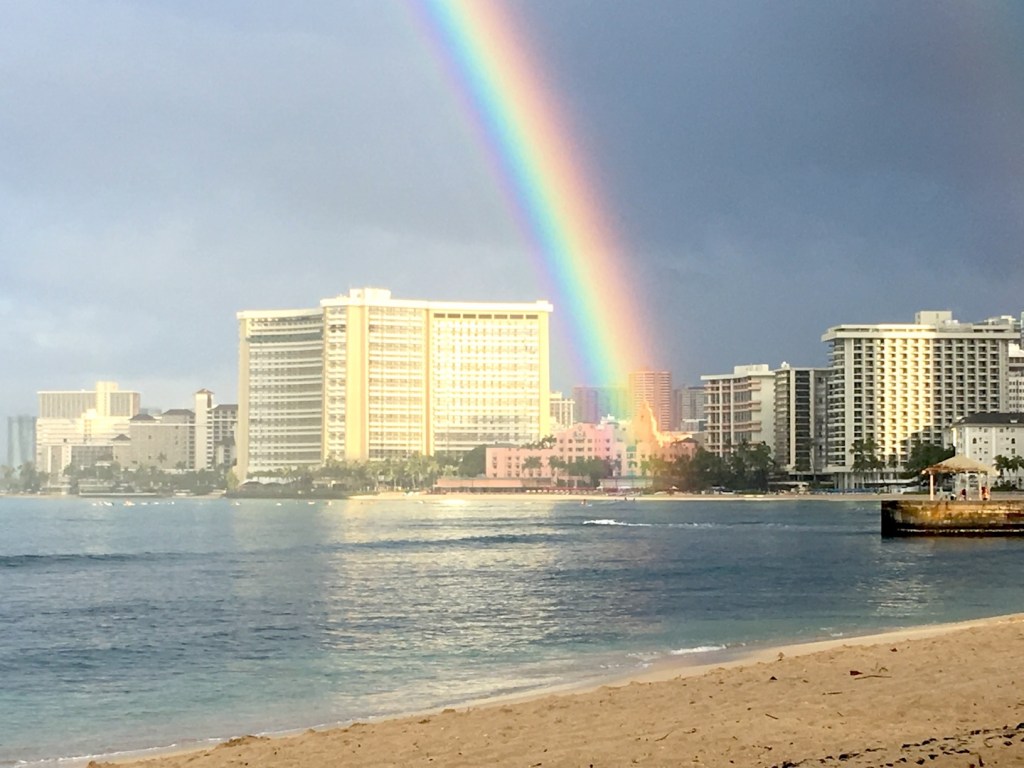
Many times the best choice is to do nothing. Not to move can be the best option. It isn’t easy to live on Oahu, but it is very easy to find gratitude here, especially after a rainy spell—when a rainbow suddenly appears.
One of the tools always at the disposal of an operator is the 702. This is the three digit 700 code of numbers that describes certain incidents over the radio to Central Control. And the code number 702 means the operator is taking a twenty minute break as a comfort stop to use the rest room, or, to collect oneself after a shaky security incident or some such event or events after a heavy stressful trip. And this is made clear in training, that the schedule is not important, and if you need a break, a 702 is always allowed, primarily because this is a necessity for safety: To keep the driver sane and safe as recovery time at a terminal may not be enough.
And perhaps there are operators out there that know when and how to use a 702 effectively. I do remember one time on the 24 line when I used a 702 and it seemed to send an effective message to the temporary inspector at 30th and Mission that I was not going to run to the end of the line because I had been late all day, and my switch at Cortland and Hilton was refused. I felt elated I had done the right thing and the break was well deserved. But this is the only time in 13 years I can remember taking a 702, and taking it because I was denied a switch.
There were many more times I could have done this, and may be my accident record or disciplinary record would have been cleaner if I had taken this option that is always open to me. But my desire to stay in service usually always wins over, and I seem to doubt that the fine line between staying in service and taking a break is spread evenly throughout the system. Or that operators use this as a necessity instead of a privilege, and whether or not this right is abused. Because we hear of talk in the Gilley room of those that are constantly taking 702’s, and the havoc it can wreak on their follower. How would one define that which is abuse, and how could one stop it or determine any discipline should be meted?
And this intellectual exercise always ends in futility: Because it is the emotional feedback in the present that is the key. What other’s think, and trying to adhere to the schedule is my drawback to blocks of receiving. And being present in the moment about the near misses or angst from passengers, should be the key to take a brake, and take a break. Only when I start getting thank you’s from passengers do I know I am back on the right path.
When I am neutral about my leader taking a break, and not worrying about the outcome, can I clearly see whatever passenger load I may have to take, all will be well, if my attitude is not one of being put upon, but of being of service. I then begin to build compassion for the other operator doing what they need to do to stay safe. If I try to compare their actions with my own needs, I fail. If I take a step back, and focus on doing the next right thing, the pain of taking on a double load goes away, and I find those I pick up are grateful for my handling of a heavy load. So I have realized it is not how hard I am working, or how late I am, but how I am feeling inside, and where my focus is. By not allowing myself in to victim mode, all is well, and a 702 from my leader is inconsequential to how I view my day. Actually, when I am doing well in a busy day, I see the number of people I pick up has little to do with my success.
But the Daly City 702 seems to be the ultimate challenge to letting things go. An operator friend of mine was describing the Daly City horror of his two leaders both going on break at Daly City, the outbound terminal of the 14 Mission, a straight shot from the county line to the heart of downtown with the terminal at the Ferry Plaza. He had a pull-in from Daly City, and was in a small coach. When two 60 foot coaches would go out of service, he had not enough room to take all those who were waiting. And they would become angry when his full coach would pull up to the stop with a short line destination of 30th Street: halfway to downtown, and short of the first major BART station.
And all of the tools we are supposed to take to cover yourself failed. I too had been in this position one the 1 California, and the 30 Stockton. Not enough time or room to take in all who were waiting. And if this was a one time thing, no biggie. Tomorrow is another day. But when his two leaders were going out of service day after day at the end of his busy shift, just as my leader was passing up on a daily basis, staying neutral becomes next to impossible.
Calling Central Control for a switchback to avoid Daly City was denied. Talks with the yard starter for a bigger coach would only yield a larger coach for a day or two. Miscellaneous reports filed after work could backfire as being labelled a snitch. Complaining about the God given right to a break holds no water. The only apparent thing left is to take the matter in to our own hands, and let the cards fall where they may. And this means putting up Garage, or going out of service without authorization. In a way, if no inspector seems interested in doing anything about the problem, then hey, what the hey, I can get away with pulling in out of service. And many operators do go out of service on their pull-ins, and cause a heavier load for the next coach following behind. The hope is that retribution, or what goes around comes around will come full circle, but the time frame of payback seems remote and unfair in the here and now.
I took switches unauthorized at Folsom, to make relief on time, and sarcastically went on the air about it, and it took three years from the day, to finally make amends to the street inspector who heard my sarcastic call about taking switches on my own. What was I thinking? I wasn’t. I was angry. I could not seem to get his attention at Union and Columbus, the midpoint of my last trip. But in hindsight I should have popped the brake and talked to him direct. My thinking had already been off, because I refused to go to end of the line and see how late I actually would be at relief. This is my downfall. I take matters in to my own mind without waiting to see if my relief is really that angry with me being late. As it was I was making relief early. I never really gave going to the end of the line an honest shot. And I was placing too much thought on what my relief thought of me or how “bad” it would look if I was late. I was so concerned about what this senior man thought of me that I sacrificed my duties and responsibilities on my own last trip.
So my friend did what we do. He put up garage and picked up no one. He switched back early at Lowell. He picked up what he could, and then became express, not stopping to pick up the small pockets of folks at the intermediate, smaller stops. And to try to stay out of trouble, mix it up so it is impossible for anyone monitoring to make conclusions about what we are doing wrong. But all this has the exact opposite effect. The attention comes to us, and what we are doing wrong, and not on the operators that are causing the problem. This got me in hot water, and is where discipline falls on the person trying to make the best of a bad situation, and not the true cause. The saving grace that has kept me employed is I must divorce myself of what other’s are doing, and just operate the best I know how. And I have learned the hard way in the beginning, not to make bold statements about others, or boast about what I am doing to others. I never have had a good social skill to discern my enemies from my friends. But when I do get honest, the answer always comes. I never talked to anyone, and I never got the answer. But I do now.
Payback only comes in the form of the next sign-up. And if a sign-up from hell continues, oh well. The length and duration of pain can be meted out in the long run, and I have to look at it this way, or else I am doomed to discipline I think I don’t deserve.
So I always talk directly to my follower and leader, and never let it go beyond that. When I find out why they do what they do, I take it in stride and feel confident I have done all I can do. And this has led me to the Zen of driving an electric bus.
It seems like a quiet Friday today, I think to myself. The bus has several seats open; no one is standing in the aisle. The bus is most definitely in the Zen zone, even though we are halfway through the trip in the middle of the line. How can this be? The answer is usually right in front of your eyes. If you scan through the windscreen (windshield) a few blocks ahead, you should see the tail lights of another trolley running late or on my time. Until recently, I thought this was a form of heaven on earth, a time to make good money without the fight over a seat or space.
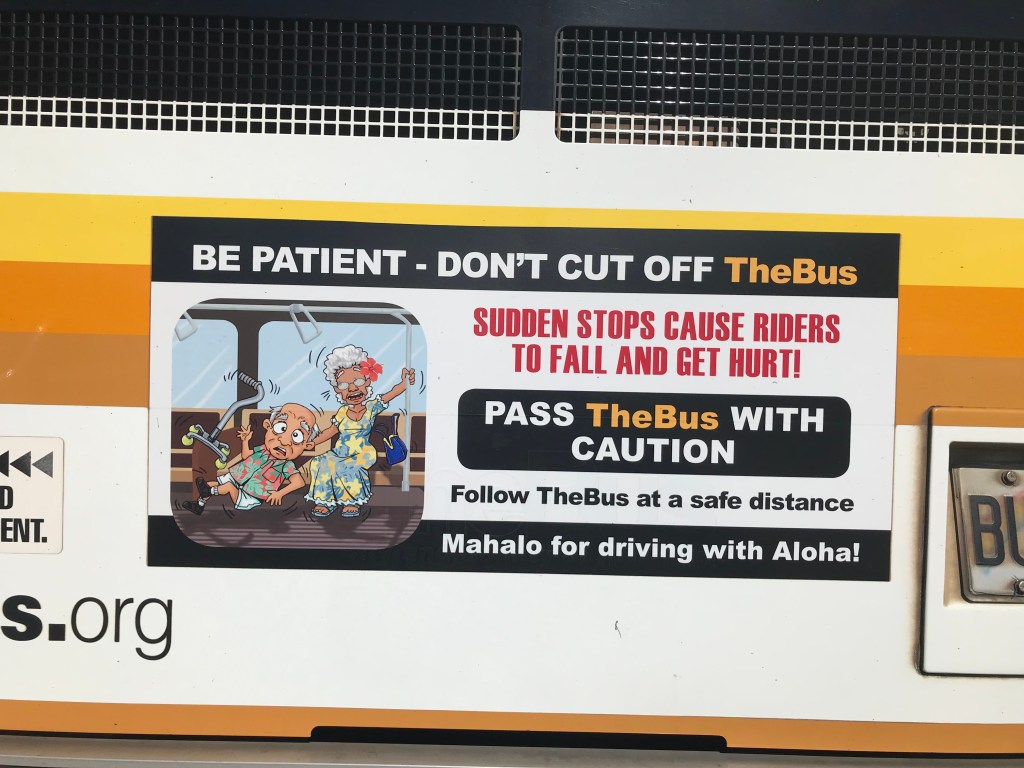
But with GPS, DVAS, and computer technology on the bus recording every door opening and every stop, I realized I must adapt more acutely to this record-keeping by observing the one block spacing rule. Following too closely is a no-no that can generate a citation from an officer of the law if contact is made at a stop sign or light when rear-ended by another car. As bus drivers, we can also receive a written warning based upon the actions of our operation if we stay too close to our leader—the bus in front of us. If the DVAS clock display is off by six minutes, I must call Central for a time check.
The problem for me is mental. I am in such a runner’s mode, having been trained on the Mission lines without a leader, that I am preprogrammed to shave every unnecessary second off of dwell time in the zone. I can move up four minutes without leaving early from the terminal. And when Central gives me orders to move up four, I have to signal this to my follower so as not to create a hole in time behind me.
Here’s a case in point on the 49 Van Ness. There was no help from the 47s. Four minutes would not have made a difference, as three coaches of help from the 47 were not there. By checking door movements, it was obvious I was skipping stops. And by leaving late, it could be seen that I was “playing games.” But none of this had anything to do with my desire to get down Van Ness without incident. The written record of passenger complaints against me was actually about overcrowding and lack of other service to Caltrain on the 47.
Letters to the editor in local news press reflect the same angry sentiment we bus drivers have when we get disciplined with days off without pay. The Bus Rapid Transit Lane is trumpeted as a plan to speed the commute but is of little value in the here and now when buses are missing, and angry commuters see a full 49 passing them up.
Red carpet rolls out on April 1st (no foolin’)
So “follow my leader” is usually a sign that my leader is full and needs help. If I follow too closely, pass-ups can result in late runners or confusion about which bus to board if intenders have been waiting too long and clog the doors of the bus in front. The natural beat that occurs between buses with a regular interval of seven minutes gets ruined when bunching occurs.
So, what I have learned is to disable my move-up mode, and hold doors open at an empty zone to keep spacing at more than just a block. I have found that three blocks is usually the shortest space required to keep things flowing. If I have a bus behind me catching up and getting too close, I must not let this force me to speed up. These subtle pressures can build and lead to a write-up. So, even though technology is providing the black and white data for discipline, key factors like other bus lines or DVAS clock time missing or being off by several minutes render an accurate or predictable snapshot impossible.









 The Dao of Doug: A Bus Driver's Perspective