a) “The pizza delivery boy was late and apologized, so I got a free pizza and ate it all at the terminal. You don’t expect me to wolf it all down in five minutes, do you? I am not allowed to use my phone while I am driving, so I had to call my order in after I got to the end.”
b) “The brakes failed, and I had to wait for the shop after filling out an accident report for the three beamers I took out rolling down Russian Hill. The shop wanted me to fill the bus up with as many people as possible to see if the brakes would hold.”
c) “I did some shopping at Fisherman’s Wharf and don’t want you to rain on my parade. Wait here for the next bus right behind me so I can pick up the folks at the next stop. Since you’ve waited an hour already, another fifteen minutes is nothing.”
d) “I’m terribly sorry for this delay. I am in a hurry with a triple load and don’t have time to argue with you. You can get on the next bus right behind me.” Shut the door and drive off.
The correct answer is, of course, b). This gains sympathy from the angry mob and gives an accurate view of the equipment and service. Also, it hints that affluent owners of hi-end vehicles will get their due. This unites the angry mob in a can-do attitude.
Although this may not be an actual verbatim test question provided during the civil service exam, the insight provided here may improve your skill score. As a transit professional, you are required to handle difficult situations quickly and respond to questions without hesitation. While some books on the subject of driving a bus may provide guidance as to how to remain calm in a dense, congested city such as San Francisco, let’s face it, we may not have the patience or time to assume a lotus position and meditate.
When intending passengers become a large mob, it doesn’t bode well for my day. If BART is shut down or our metro tunnel is blocked, large numbers of commuters congregate at our trolley and motor coach surface stops. I need the space in my head to answer questions, and still pull away in a timely fashion. I also have to maintain space at the front of the aisle so I can see out my mirrors and the front door.
I took a cab home the other day, and the cabbie said that on a talk radio show, a regular caller was complaining that our buses run around empty and that funding should be cut. I laughed and said that the reason our buses are empty is because they are being towed back to the shop. Our trolleys are up to twenty years old and “go to sleep,” especially in hot weather.
This caller obviously was a car person who may never have taken mass transit. I can assure the readers that our buses are crowded from morning rush well into the night at 10:00 p.m. Our 22 and 14 lines never really run empty. A safety officer imported from another city commented how amazing he thought it was that our buses were still crowded hours after rush hour. So, seriously then, we need new trolleys, and we need them now!
If I try to use this reasoning with the riding public paying their “fare” share, they usually become angry. They say I am going to make my money regardless of what they do or do not put in the fare box, and they are correct. I just believe it adds to a lawless kind of attitude that doesn’t take personal responsibility. Those who are grateful for our transit system pay their fare and are generally courteous and helpful. Keeping Zen means keeping my side of the street clean and not worrying about what others do.
I thought I should do a lot of psychedelics and do drugs, to be like Timothy Leary or drink and be like Ernest Hemingway. Perhaps I could be freed from the burden of the rules of society and be an edgy artist or writer who has street cred by abandoning the Establishment.
Hah.
I was just a happy hour drinker who kept on drinking until the lights flashed at last call.
But I stopped drinking and thought about how I could leave a legacy behind me that didn’t involve the authorities or broken promises.
I started journaling in my pocket notebook about my life in San Francisco as a Transit Operator and kept at it without looking back.
The most important part of the whole process was seeing the Ingram barcode on the lower right hand corner of the back of my first published book!
Every time I see a KDP email from Amazon saying that I have a new royalty payment I smile,
“Big mouths run hot.” So says our elected leader in the receiver’s office before picking up my outfit one morning. Apparently, a common thread running through arguments rebutting a write-up for running ahead of schedule is that of complaining about other persons, places, or things like our equipment as causes for running ahead of schedule. But it doesn’t take much to understand the simplicity of why a bus is ahead of schedule; it’s the operator behind the wheel.
And I have found myself in big-mouth mode often. In fact, before a suspension hearing, my union rep repeated to me (as he does every time I am in trouble), “You talk too much,” or “You ask too many questions.” And he is right. I find myself asking how I got into this mess, and in retrospect, it becomes clear that I just need to shut-up or say that I don’t know. Others are trying to help me by giving hints or obvious clues to tip off silence, but my monkey-Gemini mind seems incapable of holding back.
And holding back is a valid technique to avoid running hot. Running hot is running ahead of schedule by more than one minute. Most of my friends and riders give a look of disbelief when they hear that we are not allowed to run one minute ahead of schedule. With on-time performance so low, I understand why this rule may seem over the top, and I agree. But, like my manager says, the first step to run on time is to leave on time and not to run ahead of schedule. There seems to be less of a concern from management in running late, but as someone in the seat out on the road, running late has many consequences, none of which is as uncomfortable as the seat in the superintendent’s office.
Running late in the Mission between 18th and 23rd almost always results in no terminal time at the end of the line. Use of the kneeler for walkers and use of the lift for laundry carts and wheelchairs can drag down other trolleys. Loss of terminal time may not necessarily take any emotional toll or add to stress. So, although the bus is very crowded in this middle- of-the-line crunch zone, the consequence of complaint or accident is low. Outbound from the Ferry, however, I have found that getting too crowded does influence complaints and service disputes. So it is where we are running late that influences our trip. Getting into the crunch early on is bad news. The chance of going out of service goes way up.
As passengers, you would do well to look and see if another bus is coming. Use the clock inside the shelter to see if one is following in a few minutes. It is the use of this kind of resource that can make our railway run more smoothly. Please stop and take a look at this aspect of passenger load on the operator and the drama that ensues when no more seats or aisle space is available. Whether it is an operator crying at the barn or a passenger screaming in the aisle, use the next bus clock to your advantage. Good things come to those who wait.
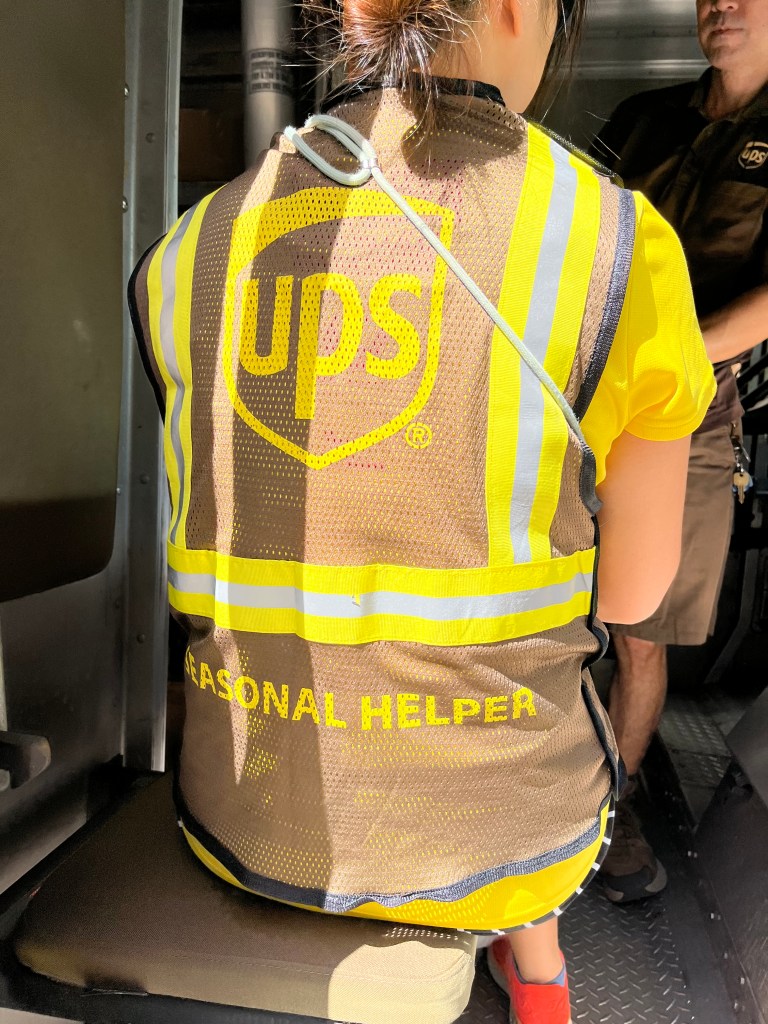
A good neighbor starts with me at the lobby door when I see the UPS man with packages. I can buzz him in or carry my neighbors’ package up to their door. I’m aware if they’re at work if their parking spot is empty. I can text them that they have a package, or, depending upon the vibe, sign for it and hold it until they get home.
Sure enough, when I am away, they do the same. I feel so good when I’m gone that they got an eye on my door.
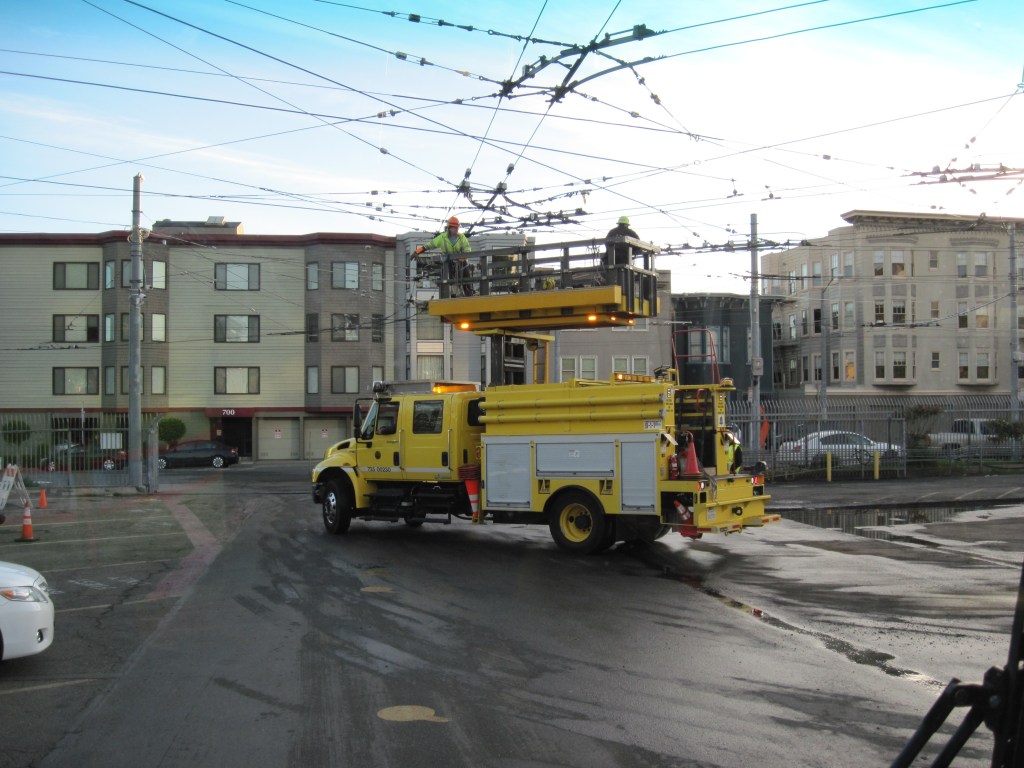
The switch to pull-out off of track five never works when we a late. Or, if once in a blue moon the yard starter’s call to the overhead crew is answered, we have a working pull-out switch for three days. All the coaches behind the switch don’t trigger the selectric box because the boxes are at an angle aligned for too sharp a right turn.
The same goes for Bryant outbound to 16th outbound and South Van Ness inbound to 16th outbound. But those two latter sets on the street are very rarely used, so it is of little import. The switch on track five is at a place where coaches pull out every day. We read the mantra from our superintendent that we are to pull out on time. A bulletin is put in our paddles as a reminder of our duties. We are also never to leave the coach once pre-op has started, but we’re to call the OCC for assistance. The only problem is the Central Control Kingdom did not read our bulletin about calling for help with the problem switch. The Shop Kingdom did, and does beat to a drummer close to home. It is made aware of a bulletin we receive, and because of our many interactions throughout the day via the yard starter, we end up on a page very close to (or at least within) the same chapter of the same book. But getting the other kingdoms on the same page may never happen with Muni.
The Superintendent Kingdom is like a referee during a game. They are interested in rules violations similar to yellow flags, red flags, and penalty boxes. The only tools available are the rules. If the rules are not followed to the letter of the law, then a penalty results. These penalties are, in order, caution and reinstruct, warning, three-day suspension, five-day suspension, fifteen-day suspension, thirty-day suspension, and termination. If this progression of discipline is extended with a bold-faced warning an italicized warning, and a bold-faced, italicized warning, then I can relax somewhat. I have been given extra grace before suspension.
On the other side is Operator of the Month, System-wide Operator of the Year, and a monogrammed sweater and a check. The check is somewhere in the neighborhood of two-to-five hundred dollars. I can set this as a long-term goal before retirement, but I consider myself a success if I can learn from my mistakes, overcome adversity, and help others. This is the “Lojong” of finding Zen: overcoming adversity by meditation and practice. Increasing awareness of Eastern philosophy in our Western mindset is another aspect of this book. If there ever were adverse conditions to overcome, the life of a San Francisco transit operator provides the perfect opportunity for the Lojong. (See glossary.)
Getting back to the start of a day on track five. After the switch has been “fixed,” I show the newer operators the trick to activate the switch by using the arrows painted on the lane as a guide to activating the electric correctly. Months go by before the overhead crew comes out again. I can hear them saying, “We just fixed it.” Actually, I saw them working on the switch at the back of lane four the next day. If the message they received was to “fix the switch upon which we pull out,” I can see how they would consider this other problem area, back by the wash rack, as an answer to this call.
As to the operator’s point of view about getting things fixed, the wrong part or switch gets looked at due to confusion about where the problem is occurring. See the chapter, The Overhead for part descriptions and functions.
As a general rule, operators don’t call Operations Central Control to report a faulty switch on track five. Instead of going on-air about a problem, we would remind the yard starter if we see her as we pass by the gate on epu. Epu is the battery power that the ETI coaches have so we can move without our poles on the wires. This epu pull-out is a good thing in that it forces us to check and see if our bus has battery power, should we need it later on in the day. We try to look for the good in every situation, as annoyance does nothing positive for our day, especially as we begin by pulling out on track five.
If in pre-op on a coach on five we find that our coach won’t move in battery mode, we’ll have a blocking situation whereby every coach behind this one will be late in pulling out. By following the instructions of bulletin PO 13-010, dated October 2, 2013, that we are not to leave our coach when pulling out, I call Central for assistance in my LPO. Central responds by asking me to locate the yard starter to meet the dead bus ahead blocking me. I respond by repeating the request, “Are you authorizing me to leave my coach to find the yard starter?” The terse reply begs the question that I can locate the yard starter faster than they can call.
But this has no foundation whatsoever in reality. Their job is to help us pull out on time. Period. But the institutional inertia is such that now their duties include a call they are not in the habit of making. Hence, you can see why we, as operators, remain silent in calling to fix the switch and to report another coach blocking and delaying our pull-out. Someone may end up in the penalty box.
We are also to cradle our poles in the harp before we move in epu mode. The yard is flat, and there is very little sway in the right turn we make, so in moist, foggy weather, we usually hit the poles’ down button and move through from track five to four to the gate to put our poles back up. If we have good battery power, we cradle our poles and make the right turn out the gate and onto Bryant to return the poles to the wires. It is important to leave enough breathing room behind us for traffic to go around us safely as we put up our poles. This happened today as I pulled out, and all went well until crossing the first intersection at 17th and Bryant. My leader in the yard made a left turn on 17th to head for the 6 line. It was cold overnight, and we recently had lots of rain. The switches can be sticky until the sun has had its say. My poles followed his track to the left and I dewired. The selectric boxes did not reset the toggles after I passed by them straight on. Fortunately, my collectors did not catch on the wires, and I hit the poles’ down button and checked to see if I was clear of any tangle. Good. I engaged EPU to clear the intersection and to step to the back of the bus and cradle my poles in the harp.
When I got ready to put my poles back up, I noticed that I had no brasserie on the end of my pole. My collector ripped off the pole and was somewhere in the street. Okay, I’d better engage EPU to the next safe location.
So here was a day when, before I even got into revenue service, I needed my EPU three times, and I had only traveled two blocks! I was ordered by the inspector on the corner to pull the coach in on EPU. Yes! I didn’t have to wait for the shop. I knew I would have to fill out paperwork when I pulled in that evening, but I would make sure it was a good report. I took extra time to make my writing neat, clear, and easy to read. Many of us have the can’t-be-bothered attitude when we want to hurry up and go home.
The unwritten rules are perhaps the most important to an operator in a trolley division. The unwritten rule of a short and concise report written with a good hand can go a long way to receiving a cautionary warning, and not a warning, especially not a warning, or hopefully not a warning! Keeping away from messy paperwork is keeping the Zen as a bus driver.
Interesting that the question says who, and not what. For the first time in looking at these prompts, I looked at how others’ replied, and saw some very interesting patterns. Folks that obviously don’t have that kind of money would spend it on a single project that could easily be a sinkhole of loss in about three years such that the one million dollars wouldn’t be enough to keep the project going or be sustainable. The views are self-centric, not in motive, but in understanding the collaborative nature of asking for help from others–and what the real costs are in sustaining a major project in today’s dollars.
The idea to give back to family is very basic, but it isn’t just money that endows family estates in the long haul. It’s education and mentorship connections that the family has built up over generations. This every Jew I’ve met understands, and yet it is amazing how jealous and envious other neighbors become of their gifts–they steal it in war, or kill them en-mass, because they don’t understand how to give for their own family tradition of generations to come. The danger comes later: don’t let the enemy of my enemy be my friend and seek revenge. The Arab folklore describing the man on his horse riding into town with this message was beheaded! (Ah yes, the French government and the Knight’s Templar. George Lucas continued this Friday the 13th event when the Empire tried to kill off all the Jedi.)
Destroying an entire culture and everyone in it due to a few bad apples has never solved anything but endless war. Same is true of spending money without considering the consequences. How many celebrities’ storied losses have we’ve seen when the tax man cometh. Hopefully it isn’t a pound of flesh that is due!
Giving away something for nothing is exactly what San Francisco 501c3’s do for the homeless. It sounds so helpful and kind to give away shelter for free–but the reality is that this model hasn’t worked at all–except for the perpetuity of their ever increasing budget! As for the several million alcoholics who have stayed sober in Alcoholics Anonymous since the late 1930’s–they know what it takes to change their lives.
The homeless don’t want shelter because they don’t want responsibility or the rules that come with it–such as modeled in a successful family unit. They’ve never learned success from their family of origin. One has to take action and work for a goal in order for it to stick. The naive notion of giving away money to family members will only magnify the black and the white sheep–and create dissension with knives out–just like at the reading of the will!
I could go on and on, but I think you get my point. The secret is actually very basic. Do nothing. Give of yourself to the charities you adore right now–not after some unlikely event in the future. Note I said Give of Yourself, which relates to the “Time is Money” Golden Key. The above responses do have a hint of truth in them–and that truth is written very clearly in the Bible–by your fruits shall you know–be given, or added unto. If you are sitting back waiting for the windfall to come, and saying “I want a million dollars to give.” The universe will respond and put you in want for a million dollars. Forever as you shall deem.
I suggest having a conversation with God first, and perhaps, read Neale Donald Walsch’s book of the same name, “Conversations with God,” and see where it takes you.
Did I answer the question? Not really. Who would get the money? I would give the money to me! I’d invest it in oil, uranium, and silver. Then, after a tripling in value when the dollar collapses, I can give those whose creative energy manifests in their work of art, a residency for their art, and bring true value to our community–in a piece of art–that remains of timeless value for all to see. And it cost me nothing!
After three tax years, I’d like to see how much the money I paid myself has grown. I’d withdrawal my initial one million dollars, and give away all the rest to artists. I’d wait three years to spend it–and wait and see who comes along!
In short, there is only one person to trust. And that rule is written on every coin of sobriety given in AA to the millions who have stayed sober and changed their life from misery and skid row. “To thine own self be true.”
It took me several years to learn this term. I found out about it after overhearing Central Control responding to a street operations inspector on the corner inquiring about a run number. “That run is a not-out,” was the response to a blank space in the headway between buses.
The rules are as clear as the black and white numbers of a railway timetable about our leaving times, minutes between coaches, and checkpoints along the way. The only thing is we have no printed timetables. (I have to admit, I added that last sentence to make it sound more dramatic.) The truth is it really doesn’t matter that we have no published timetables. And as the street inspectors have been removed from Chestnut and Fillmore, Sutter and Fillmore, 16th and Bryant, Third and 20th, and other places, such as Potrero and 16th and Kansas and 17th, it makes little difference anyway.
Just like the prelude to an elimination of a line, cutting service reduces ridership and lessens the attraction of riding a bus in the first place. At some point, cost reduction becomes self-fulfilling, and so we, too, as a class of operators, become adjusted to the new realities of having a bus or buses missing in front of us. This adds to pass-ups due to full coaches and leads to the missive, “to throw out the schedule” when operating a coach on the line.
I heard a lot about cost-cutting four or five years ago. Now, I hear a sarcastic and condescending tone about making up a schedule and making up stops. With an on-time performance of around 60 percent, I just laugh at this comment. If we had a level of punctuality of over 85 percent, then I could see the point in running on time. But as it is, a difference of 62 versus 63 percent makes no visible difference.
The hard part of all of this is guessing how to adjust headway and speed, not knowing what kind of a day we are going to have. The standard response is to make all stops until the coach fills up, and then begin skipping stops. I object to this sometimes because the folks in the middle of the line get passed up more frequently and get lousy service. This becomes more apparent during special events, when large crowds wait along avenues by Golden Gate Park after the Bay to Breakers race or the Barely Bluegrass festival.
Some coworkers disagree with me about letting passengers know that there is a bus missing in front of or behind me. I believe knowledge is power, and most of my riders are glad to be informed. But I do get the drift that many of my coworkers abide by an “ignorance is bliss” mode.
In any case, knowing that I don’t have a leader by an open run helps me in knowing what to expect. I am not one to be a cry-baby to the dispatcher or the union about how bad I have it with an open run. I have seen others attempt this drama to little effect. Big mouths and cry-babies run hot, and so I have to dial it down when it comes to what headway I am experiencing.
I love it when I am away for a week, and I hear complaints from my regulars or the operator doing my run. What was once a quiet and uncomplaining operator on a run becomes an “O my god” when I am away. I always love hearing about how bad it was when I was off, and an open run leader is no exception. Interestingly, when I come back from vacation, the open run in front of me magically gets filled. There may be a reward in heaven for me working without a leader, but I do get a taste of this when I come back from being away for a while.
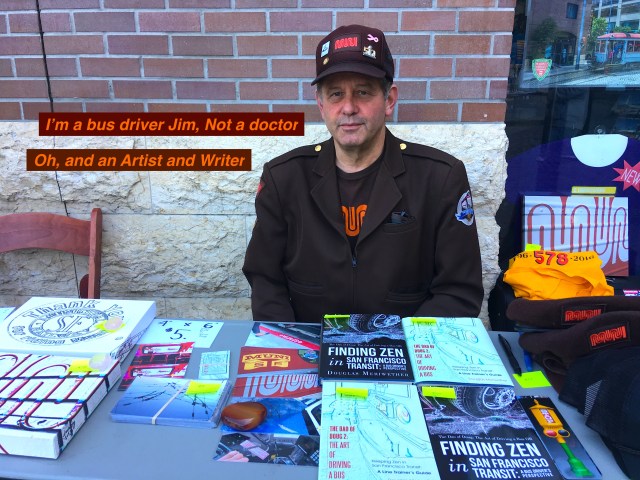
Transit Operator and also Driver Guide and Tour Bus Endorsements, CA to present. Commended by several Mayors as driver guide during Conference of Mayors
Twice Line Trainer Qualified, Over 14 years safe driving, Expert Operator Achieved at Potrero Division.
1989-1996 Experienced in Materiel Management, Kaiser Permanente HMO : Commended for reducing chronic stock outs by changing par levels and bin location and bin size to reduce evening house calls to zero from ten to twenty calls per shift in a post op critical care step down unit.
Specialties: Commissioned Officer 1982 Officer Candidate School, Marine Corps Development and Education Command, Quantico, VA 1981 BA University of Missouri – Econ minor Dean’s Honor Roll.
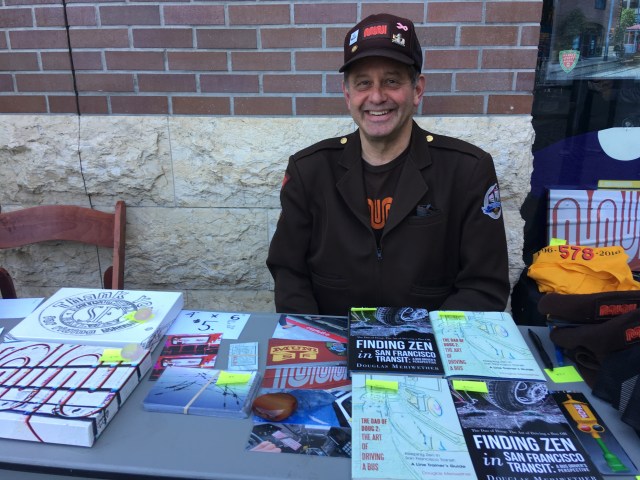
The Dao of Doug 2: the Art of Driving a Bus: Keeping Zen in San Francisco Transit: a Line Trainer’s Guide
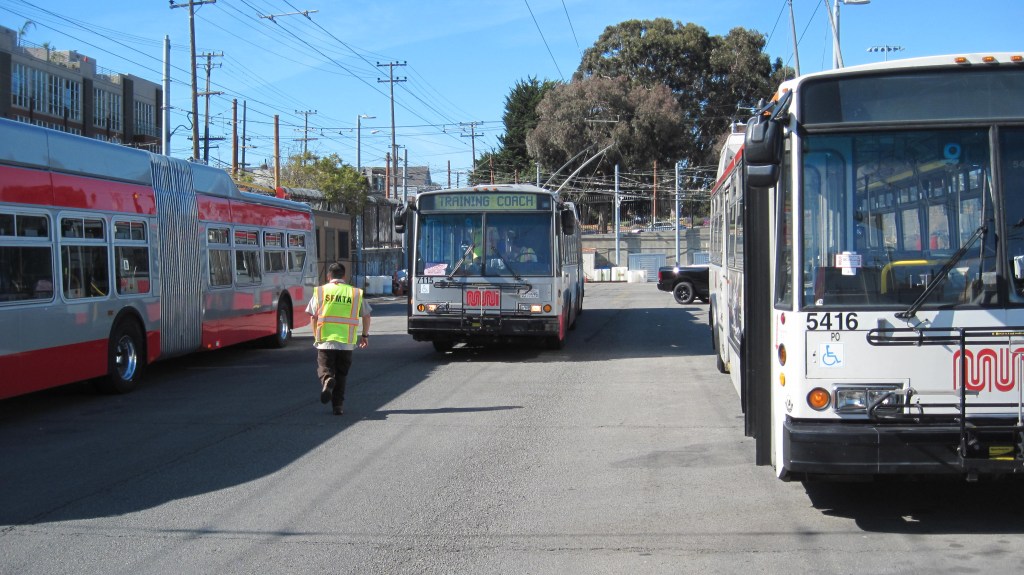
Do you have a car? Yes, I do, and you’re sitting in it! Today’s car is number 5481. I get a new car everyday, and I can hold up to 50 people at once! I get to take you where you want to go and get paid to do it. I don’t have to worry about parking and I can call on my phone here to get help from a crew of people set up to help me keep going.
I don’t have to pay for gas because this car uses free power from O’Shaunessy Dam at the Hetch-Hetchy reservoir. Parking is free, and I have a camera to send a bill to someone who is blocking my parking space. If there is any trouble, I can call for help from my phone, and it can be here in three minutes. The police are my friends and co-workers and also here to help.
I sold my truck when I moved here to pay for the deposit on my apartment, and I haven’t had to pay for tires, batteries, gas, parking, or insurance since I got rid of it. My employer is my insurance company. The money is coming in, not going out.
I enjoy driving very much and am glad that I am not polluting the air by driving you to where you need to go. It’s kind of like the ultimate in ride share, without any carbon emission! Thanks for riding in my car today!
Make no mistake, I do sing on the bus. And although I am a bass clef brass baritone player, I consider my younger brother as the musician in the family. I’ll claim the writer title as I have an English degree from the University of Missouri – Columbia. Completing my degree became a challenge as I became increasingly angry and frustrated at failing to see how the memorization of stale facts was important or necessary to thrive as a young adult in the job market.
When I slammed the door shut on the Dean of Arts and Science because I failed the Romance Language requirement for graduation, I didn’t realize that the taking of Spanish conversation was the only practical class I would later use as a bus driver in the Mission district in San Francisco! The Dean’s door glass remained intact after I left the office. It was the classic institutional wooden door with his name hand painted in black on the glass panel inset. Just as in a roadrunner cartoon with Willie E. Coyote, there was a delay in reaction; it later shattered in to a matter of pieces not unlike the shards seen in a damaged bus shelter, or curbside from an auto break-in overnight. Walking on Broken Glass, by Annie Lenox seems to be a reprise in the music of my life as a transit operator in San Francisco.
Another possible label to this missive would be the title of a book of a writer employed at UMC when I was in the creative writing sequence in 1980 and ‘81. I had the pleasure of being in Thom McAfee’s writing class. Thom was the published author of a book with a title that seems to typify the life of a transit operator in any major city in the U.S. or the world, for that matter. The title of Thom’s book: Whatever Isn’t Glory.
And so it goes. My vice-principal, so to speak, associate superintendent at my bus barn, politely asked me to wait for the right turn red light at a brand new terminal loop by City College at the Phelan Loop off of Ocean Ave. I wondered why he was sent to this terminal and why he asked me to wait for a green. Little did I know that the next day, everyone in upper management would be watching on a screen at central control via my new drive-cam mounted on the front windscreen.
The next day, I pulled away from the terminal as usual when the coast was clear: not a car in sight and no student pedestrians coming from classes; without waiting for the light to turn green. The sensor in the ground did not adjust the countdown in any measurable way, and, like the newly painted lane markers, was completely useless in functionality. In my mind, the engineers had failed again. The electric trolleys should have been given the two right tracks, the diesel number 8’s the longer space on the left track. The 8 had more recovery time than the trolleys and hence needed more room. Why anyone put an arrow in the red light was beyond me.
I had heard later from a friend in engineering, and a worker at the loop that it was a mistake to not get input from the drivers about redoing the terminal. So I was to be the whipping boy to demonstrate how we operator’s were to use the right turn: go when the way was clear, and to ignore the signal.
Beep. Beep. My radio went off after I made the right turn on my first red arrow. Did you see that you went through a red light? I was distracted by answering a passenger’s question and should have just used this as an excuse. Instead I argued with Central’s unnecessary intrusion. Big mistake. This was the frame for book 2, Keeping Zen, under scrutiny until a suspension could be issued. It wasn’t until about I was halfway through writing Dao 2 that I realized what had happened. I should have just kept my mouth shut and agreed with Central Control.
Later that same day, on my lunch break downtown, a senior in a wheel chair was right behind the leading wall in Powell station, ready to push himself in front of an outbound train. I immediately wheeled him away from the edge of the platform and asked for help from the station agent. But in leaving to get help, he jumped off of his chair in front of an M Oceanview. Luckily, he was out of his chair and was far enough away from the front wall such that the operator of the M had just enough time to slow and stop. Because the senior was out of his chair, he landed conveniently between the two rails, and was not seriously injured. Here is the dramatic extreme of discipline on the first day of a new lane configuration, and a rescue of an attempted suicide in the underground.
But the happy ending to this violation was a year later when I did the 49 trolley on my day off and got ready to leave the Phelan Loop terminal. Yes, this time I planned to wait for the light to turn green!
But when I looked up at the overhead signal, and instead of a red arrow, I saw a solid red light! They had changed the red arrow to a solid so it was legal to make a right on red! I was floored! Victory! I don’t care if this sounds selfish: I’ll take it! This was an unsung heroic action in which I played a part for change. I felt the bigger victory in the solid red than pulling away the man on the platform!
So rather than being a hero, I was set up to face the music, so to speak. I understand that not needing help from above or below is not the same as having a use for an angel or light worker of this universe. As Neale Donald Walsch points out in Happier Than God not needing God is not the same as having any use for God. As God has said, and shall always say, I am always with you, even unto the end of time.
That the end of time may be short at the end of the line, does not mean I should try to ‘make time’ by pushing a stale green, or moving before a red turns green! The biggest demon I face is believing that I do not have enough time. And that demon is me!
*the views herein may not reflect those of the SFMTA or its employees.
At the Potrero trolley bus barn, we have two levels. Unlike the Presidio trolley barn (which has one level and a tricky pull-out from track one and a pull-out to Sutter) the Potrero barn has many lanes of challenging tracks. There is a horseshoe U-turn maneuver from tracks ten, eleven, and twelve that can lock up an articulated coach in the lower yard by the wash rack.
The upper yard has an S-curve maneuver from tracks thirty, thirty-one, and thirty-two to the street that also makes it difficult to prevent a lock-up or de-wiring. Not only is the far side curb clearance an issue with parked cars, but the traffic on 17th Street does not want to yield or be slowed by a pull-out coach. In the evening, the car parkers run the gauntlet of passing through the tire shop. Potrero has car parkers to speed parking and prevent blocking. This necessity becomes clear when many coaches pull in together in the evening after rush hour is over. The car parkers also insure coaches are left on park charge correctly and that accessories are turned off.
There was a brief time when the car parkers were eliminated, but this led to problems when coaches were found “dead” the next day, or the poles had not been reset from dewirements. Coaches were also parked in a lane different than the one assigned by the tower. The cost of lost time in the morning was greater than the cost of having operators park the cars as a team in the evening.
The group effort adds to an impersonal sense of goodwill at the day’s end, making Potrero a great place to work. I am usually either exhausted or happy (or both) to see the car parkers and the revenue coworker who takes the money out of the fare box. I made it! Another day done, another dollar earned, still in one piece, and hopefully, without a trip upstairs to fill out paperwork. The best feeling is to get on my bike or walk to the bus stop and go home.
Pulling in and parking on the upper yard requires a skill level that takes time to master. There are switches in the yard and in the street, and if some are not working, it makes for a bad afternoon. There is rush hour traffic to contend with on 17th Street and a gauntlet to run through the tire shop garage. Coming to rest on the upper yard tracks is the challenge of navigating around parked cars that aren’t supposed to be there. And the pressure of more buses coming home and backing up traffic on the street. Many thanks go to the traffic engineers who eliminated parking along 17th Street by our bus barn when 17th Street was recently repaved. This bike lane helps us get by in the morning and evening, and it helps the car parkers make their turn onto 17th!
Pulling out from the upper yard reminds me of the patience and Zen awareness I need with the equipment I am controlling, or it may control me.