We’ve Been Waiting an Hour

“Where the hell have you been?”

a) “The pizza delivery boy was late and apologized, so I got a free pizza and ate it all at the terminal. You don’t expect me to wolf it all down in five minutes, do you? I am not allowed to use my phone while I am driving, so I had to call my order in after I got to the end.”

b) “The brakes failed, and I had to wait for the shop after filling out an accident report for the three beamers I took out rolling down Russian Hill. The shop wanted me to fill the bus up with as many people as possible to see if the brakes would hold.”

c) “I did some shopping at Fisherman’s Wharf and don’t want you to rain on my parade. Wait here for the next bus right behind me so I can pick up the folks at the next stop. Since you’ve waited an hour already, another fifteen minutes is nothing.”

d) “I’m terribly sorry for this delay. I am in a hurry with a triple load and don’t have time to argue with you. You can get on the next bus right behind me.” Shut the door and drive off.

The correct answer is, of course, b). This gains sympathy from the angry mob and gives an accurate view of the equipment and service. Also, it hints that affluent owners of hi-end vehicles will get their due. This unites the angry mob in a can-do attitude.

Although this may not be an actual verbatim test question provided during the civil service exam, the insight provided here may improve your skill score. As a transit professional, you are required to handle difficult situations quickly and respond to questions without hesitation. While some books on the subject of driving a bus may provide guidance as to how to remain calm in a dense, congested city such as San Francisco, let’s face it, we may not have the patience or time to assume a lotus position and meditate.

When intending passengers become a large mob, it doesn’t bode well for my day. If BART is shut down or our metro tunnel is blocked, large numbers of commuters congregate at our trolley and motor coach surface stops. I need the space in my head to answer questions, and still pull away in a timely fashion. I also have to maintain space at the front of the aisle so I can see out my mirrors and the front door.

I took a cab home the other day, and the cabbie said that on a talk radio show, a regular caller was complaining that our buses run around empty and that funding should be cut. I laughed and said that the reason our buses are empty is because they are being towed back to the shop. Our trolleys are up to twenty years old and “go to sleep,” especially in hot weather.

This caller obviously was a car person who may never have taken mass transit. I can assure the readers that our buses are crowded from morning rush well into the night at 10:00 p.m. Our 22 and 14 lines never really run empty. A safety officer imported from another city commented how amazing he thought it was that our buses were still crowded hours after rush hour. So, seriously then, we need new trolleys, and we need them now!

If I try to use this reasoning with the riding public paying their “fare” share, they usually become angry. They say I am going to make my money regardless of what they do or do not put in the fare box, and they are correct. I just believe it adds to a lawless kind of attitude that doesn’t take personal responsibility. Those who are grateful for our transit system pay their fare and are generally courteous and helpful. Keeping Zen means keeping my side of the street clean and not worrying about what others do.

Motor Coach

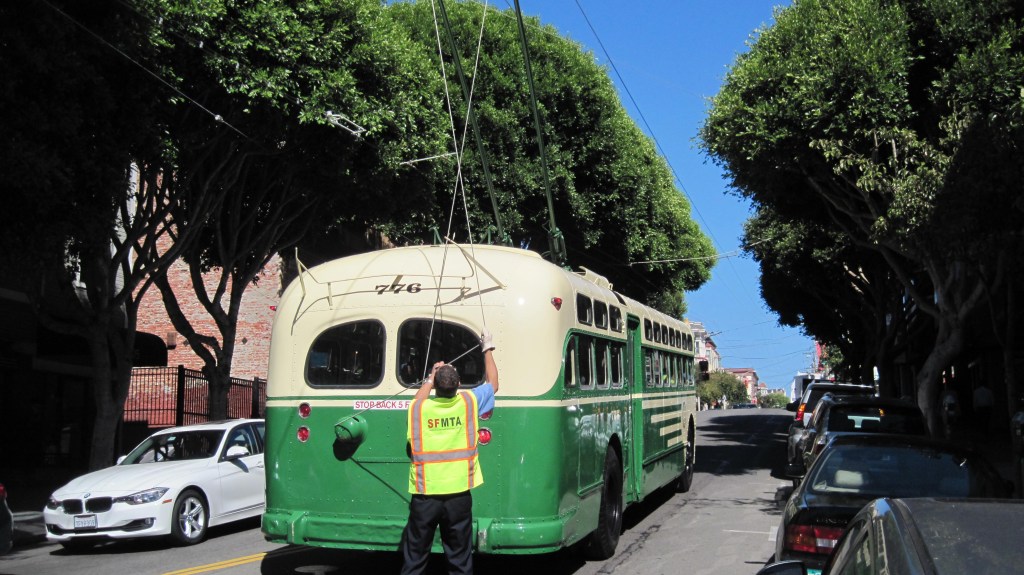
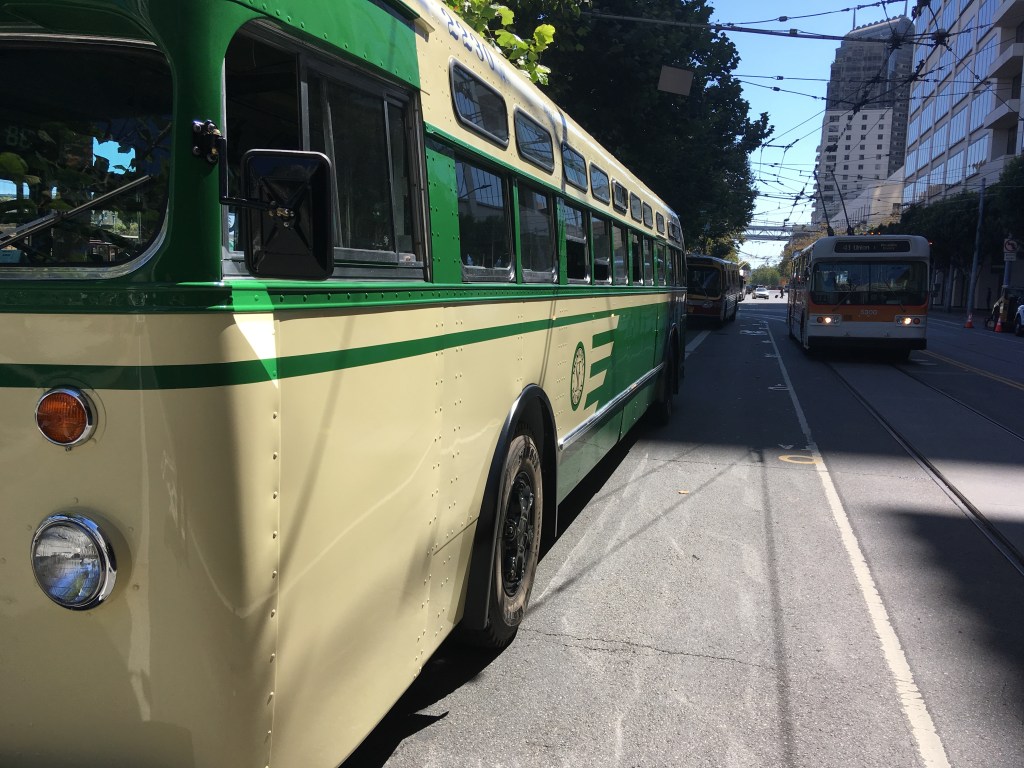
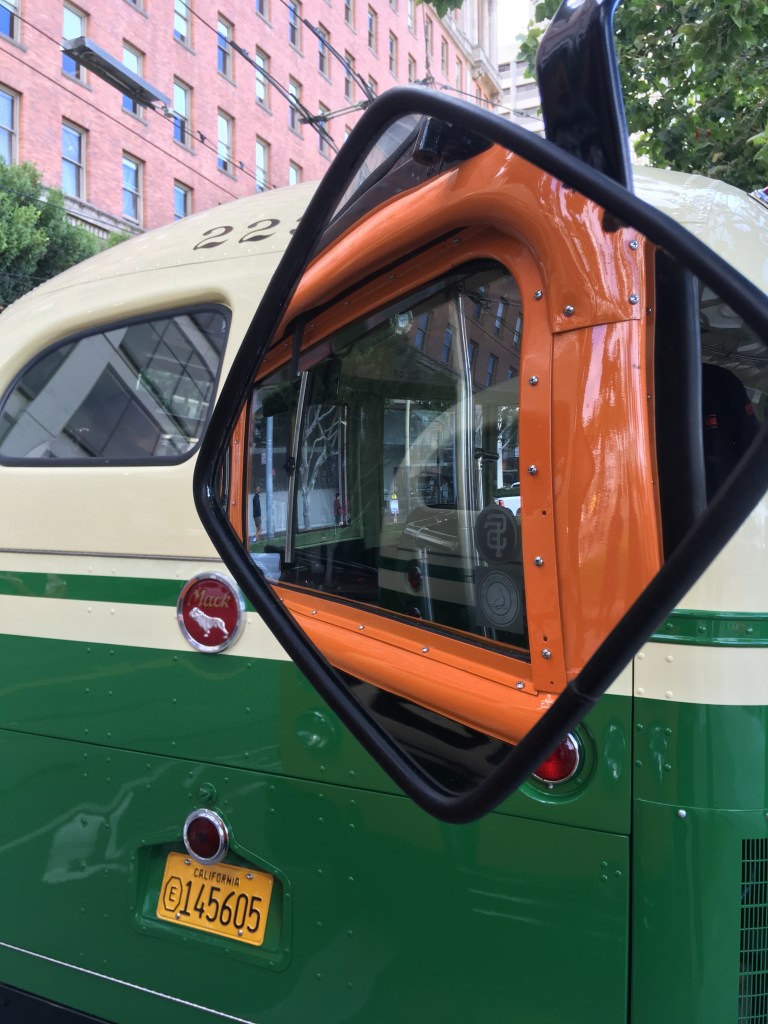
When our barn falls short of equipment, we are assigned to Woods Division to get a diesel or motor coach. I love trolleys, and I love that San Francisco did not do away with streetcars and trolleys. Nowadays, trolleys look like buses. They have rubber tires and the body of a bus, except for the fact that they have two poles on the roof that attach to double wires carrying 600 volts of direct current. Because our tires are rubber, we need to have a second ground wire to complete the circuit. Though I have designated this book’s title as from a bus driver’s perspective, I am actually driving a trolley. My range of motion and ability to change lanes is more restricted because I trolley my poles on the overhead wires. Operators of trolleys must always be aware of the dead points or breakers in the overhead and never exceed their operating range. They should always keep in mind the range and length of the poles on the roof of the bus.

Historically, streetcars look much like the barn style trolley and have only one pole in their roof because the steel wheels on the rails are grounded by the earth. Streetcars came into casual conversation as they became more streamlined in the 1950s during the PCC era. The term “trolley,” when spoken, came to mean the cable car style of body that was square-like and made of wood. The cow-catcher or people-catcher in front of the cab was a good thing to have along Market Street. The density of people boarding on multiple tracks is a wonder to behold in the historic photos of the time. I find it interesting that these days we have concrete islands between lanes on Market Street to keep boarding safe, now that the trolleys no longer have people-catchers. But there are times along Mission Street that I wish we still had them.

Most of my coworkers are not too thrilled to have to go to an alien division and operate a motor coach in place of a trolley when our barn simply does not have a coach available for us. I do, however, like the motor coaches for the 22 Fillmore line, because the back doors are wider and further to the rear. This feature helps with the aisle crowding and speeds boarding and alighting. I also like the fact that the middle door step is not the abracadabra mechanism on a motor coach. I can click the rear doors shut, even if people are standing on the back steps. When heavy and late, the motor coach can be a life-saver for my emotional state.

Anyway, I am down with motor coaches and don’t mind going over to Woods to pick up one. I actually like the ride over on my bike. The Dogpatch behind Potrero Hill is actually an interesting neighborhood that seems like it is in the country, miles from the city. And yet the skyline is right there in front of you when you look down from the hill. This is where much filming takes place because of the dramatic, unobstructed view of skyline. The movie Bullet was shot on Pennsylvania Avenue just up from Dogpatch on Potrero Hill. When I say up, do I mean up! The escarpment here, from the ramp and the bay to the vistas of downtown, is dramatic, as is the over-crossing on 280 Freeway on the 22 line. We climb from Dogpatch to Potrero Hill. This is definitely a place to keep the Zen!

Low Fat Turkey Bacon or Double Smoked Cheddar?

What are your feelings about eating meat?

There are incredible things in the animal fats that help our bodies improve in immunity. We Americans just go overboard on everything.

Cardiologists would do well to test me for insulin levels–and include the test that shows recent insulin levels–when I go in for an MRI scan on Friday. All these dramatic discussions about keto diets and vegan food plans omit the sickness within my cells for overeating and eating every two hours: all the cells in my arterial sheaths, are all a symptom of cells that have lost their ability to expand and contract and remain flexible during periods between meals. Refined sugar from processed foods including steel pressed breads, shuts down my liver and also affects my kidneys, which have no time to do their job without any fasting periods. It’s about how our bodies are built.

“I’d like a tall black coffee.”

” Would you like cream and sugar with that?” [Pause]

“No, I’d like a black coffee–with no cream and no sugar.”

(See how insidious our culture’s pressure is on sugar?)

Free Ride

For those riders who are ready, a free ride is an opportunity to imagine what Muni would be like with no fare box at all. A smile and thank you is all it takes as a regular breezes by the yellow line to find a seat. The Zen zone is strong and the crunch zone seems A long time ago in a galaxy far, far away. Now is the time it becomes easy to spot those who have not mastered how to ride the bus in San Francisco.

I can put the defect card over the bill meter or clipper tag-in device with the words, Free Ride, Clipper not working. But this is not enough for those intent on paying a fare without the casual greater awareness of what is going on around them. Their tunnel vision is restricting their ability to learn and adapt to changing conditions around them. This can be fear based, or newcomer based. Either way, the free ride benefit of saving dwell time in the zone is completely lost upon these folks. I must find my Zen to minimize this loss of time and distraction. Usually hand signals work best. Waving my hand over the fare box and motioning to step past works best. I was able to get my Muni Diaries audience to practice this at my performance as Driver Doug!

They all started to make the waterfall motion as I kept repeating the motion over and over on stage. Ninety nine percent of intending cash fare boarders get it, even though they may pause to create brief bumper cars with the person behind them attempting to stick the dollar under the defect card. Or they attempt to tag over and over and over and over again. Chinese seniors are the number one record holder of consecutive tags on clipper when the system is not working. When clipper is off, and no sound emits from speaker, I can praise Tibetan Monks, Allah, or Prime Creator!

Being spiritual helps when a wardrobe malfunction occurs in lifting up a shirt or jacket with the pass on a lanyard around the neck. Or with a hip check running in to the person ‘next door’ also trying to pay the fare. Creating a fast track lane and an exact change lane by motioning with hand signals from my seat at a big stop brings smiles of relief from the crowd. Step Up Please! Exact change on the right, Clipper on the left! And the Zen of knowing when to use the two lane step up!

Those in the shop at the tower or on air at central control very rarely contain the empathy of what life is like for hours on end in the cockpit when something not safety significant is not working properly, or intermittent. At the end of the day, it’s not whether our request is heeded on the defect card, but rather how we let such a distraction become an entertainment. The musts of demonstrating the patience of a Muni bus driver can come in to play even in a free ride situation as their are those determined to pay a fare no matter what. Perhaps they just got dinged by a fare inspector. Maybe they have a strong resentment against those that do not show their fare and cheat the system, and they be damned if they board without a beep. Interestingly, this group is just as confounding as those that fumble without fare at the front door blocking the steps. If you don’t have your card out and need to ask a question, let others at the stop, who are ready, go first.

If you are a coach pulling-in, it never hurts to ask for a transfer when you get off. Back door boarders have this one down. Because the coach is a short line coach, a new transfer with more time is usually given. We cannot waste transfers and may have longer ones already cut. Whether you got on for free or not is not the pressing matter. What is on our mind as an operator is to go home! I forgot to get a transfer when I got on. This works great instead of the hostile name calling, going out the back door empty-handed. The next regular coach is usually right behind the short line pull-in coach, and if you are fast at exiting the front door, you can get a new transfer. Being polite and respectful to the operator pays dividends for a free ride, especially if my momma is not involved in your request.

So the free ride should become fun and easy. A smile and a nod is all it takes. If someone continues to dump coins or wedge a faded dollar in the slot, I can become Austin Powers, Church Lady, or O’be Wan Kanobi. Oh behave. Could it be Satan? May the Force Be With You. Or the English Church version: Peace Be With You.

Not All Stops Are Equal

When buses are missing, the time between buses doubles so waiting time increases. It can become very unclear to those standing at or near multiple line bus stops why the bus passes by. The bus is full because double headway means double passenger load.

One phrase used frequently by bus drivers are the phrases, “my time” and “your people.” Such as, “He left on my time,” or “I am picking up her people.” The tone in which this is said is in proportion to the tension felt by those waiting. Use of a Jerry Springer Show dialect, with a sliding bobble head neck drives home the point of coming to work to do work, or to just stay home.

All the frantic yelling and screaming is moot if you are no longer in the scanning range of the operator or outside the zone. The scanning range of an operator is one to two blocks ahead of the direction of travel. Once the front door passes by where you stand, lucky is the day the bus stops. And I do appreciate your thanks when I do stop. But stopping is the exception to the rule when I am late and I am full.

If no one rings to get off, and the bus is full, the bus doesn’t stop. It becomes important to see how full a bus is as it approaches. Looking away on a cell phone, or talking to someone else and facing away from the direction of travel, all compound the chance of a bus not stopping if no request to stop is made on board on a crowded bus. These are the unwritten rules of not wanting a bus: If you are not facing the operator as the bus is a half a block away, and you are alone, and you are on Van Ness or Mission, we usually will not stop. In San Francisco there are so many passing by, or standing, or sleeping (or whatever) in the shelter, we have learned to look at your hands to see if you are holding the fare. This is called looking for those who are ready.

So baby stops, not at a light, or far side from the cross street, are not equal to major transfer points nearside at a stop light. Increasing your odds for pickup become relevant if no bus is seen coming, or you see the taillights of a bus just having gone by.

A red light can save you when headway is long, or a bus is full. A good question to ask yourself while waiting, is, what are the chances of someone wanting to get off at this stop where I am waiting? It also pays to be aware of when the next bus is due. Do you have a clock in the shelter where you are waiting? If not, is there another bus stop a block or two away that does have next bus? If you are waiting at a minor stop with no clock, and no way to see a bus coming, should you move to a better line-of-sight stop by a stop light or transfer point, so as to increase the chances of a stop? The answer is Yes!

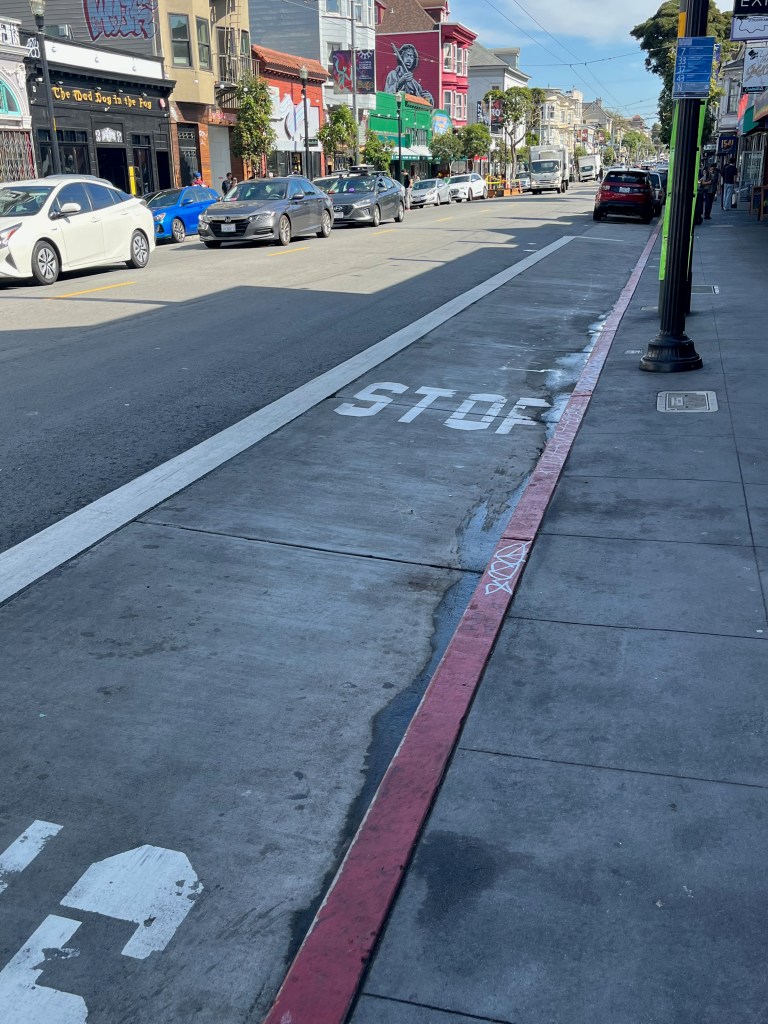
Odd numbered street stops have been removed in the Inner Mission to reduce dwell time and running time for the 14 line and this makes it important to know where to stand and have your pass ready to tag-in with your phone or card. As soon as you leave the store with your wallet out, get ready to have your phone or fare ready to go. This compliments our ‘red carpet’ treatment on the pavement: transit gets priority over car traffic. The newly painted red lane reduces congestion from the influx of the 5,000 ride share cars coming in to the city from the East Bay.

If, however, that other stop has a large number of people waiting, sometimes it pays to backtrack to a stop with less people waiting so you can get a better spot inside the bus before it gets too full. Giving up a major stop is good if you can tell on your smartphone or the shelter next bus time clock, that another bus is only one or two minutes behind the first coach. Usually this first bus is packed, and the next one is okay. So sometimes getting on the first bus is bad.

The chances of a fight breaking out, “Quit Pushing!” “Get off my Leg!” and such always occurs on the first, more crowded bus. The chances of this bus going out of service are also greater.

Think about it. When you see a mob of people getting off of a bus that stops working, it is a mob of people. Very rarely is it an un- crowded bus. This crowded bus is usually late and arrives after a long wait for buses. Try to avoid getting caught by noticing how many people are waiting when you first arrive on foot to the bus stop. Sometimes if you get on a local neighborhood bus or another line with less people, you can transfer later down the line and be on time.

So what am I saying? I am saying if you are smoking a cigarette, talking on your cell phone, looking away from the street, all alone or sitting down, and look like you haven’t seen the inside of a gym in years, forget about it! All the shouting and cursing in the world isn’t going to make the bus stop, unless you can beat it to the next red light and get the cap number of the bus driver! Good Luck, and see you next time!

I’d Never Do Your Job

I come from a background where money may not be the root of all evil, and it was acknowledged that it did indeed grow on trees, but that there were two types of money: Good money and bad money. You never wanted to throw good money after bad. And there was a nuance between money earned and money given. Or money found by luck, or money made easy. I never heard too much about money made easy. Honest money made was the best money. A penny saved was a penny earned. But, boy did that sound like a lot of plodding and not too much fun. So it should come as no surprise, if I worked hard to make money, it should therefore be good money. I was pleased to find work as a transit operator in the city by the bay, the Bagdad by the bay, the city that never sleeps, which was a hard job but a good paying job. I hit the family ancestral jackpot. I was making good money at a hard job in line with my family history.

But I noticed early on in my Muni riding days, that some drivers looked relatively relaxed, and nothing seemed to phase them. And some were actually fun to talk to. And that there did seem to be a way in which to make their work look easy and relaxing, and yet is a high paying job. So the seed was planted early on that this might be a good job for me. As a Gemini sun sign, transportation and continual movement fits my sign.

My 4th grade art project was a drawing of the silver GM coaches that serviced the NY Port Authority from Jersey during the 60’s. Bus Driver is a job I have desired since the fourth grade. I have heard those who are successful in their jobs later in life, had a passion for those activities or skills from an early age.

But unlike Civil Engineer, Medical Doctor, Dentist, or Lawyer, Bus Driver did not seem to appear on the success roster. But I didn’t really care. Ralph Kramden was my hero. I saw no matter how half baked an idea was that I could hatch, as long as I had my friends, and made a connection with others, everything would turn out okay. When Jackie Gleason would exclaim, “How Sweet it Is!” I got it. I guess you could say the in a way, “The Honeymooners” was my imprint version of “The Wonder Years,” many followed in their youth in the eighties.

Fast forward to San Francisco and the late nineties. Newly elected Mayor Willie L. Brown Jr., Esq., was mandated to fix Muni in his first 100 days, and he took immediate action to hire more bus drivers. I went to the Moscone job fair and put in to get on the list. Finally, at age 39, I was finally making a plan about choosing a job that seemed more like a career or occupation than just a need to get another paycheck fast. I encourage anyone living paycheck to paycheck, or between jobs, to pause and look deep about what kind of service they want to provide to others. I would sit near the front seat when I rode the bus with Grandma. I liked it when the bus driver would talk to me. I still do, conditions permitting, and I feel like I am actually in a recruitment mode. Early first impressions can and do have a lasting effect on our life decisions later on down the road. Get them when they are young, and so I present myself as doing a fun job.

The first thing that comes up about why someone would not want my job is, “the people.” But where in the world do we not have a job involving other people? And if I am to be resentment free, can I not take quiet time every day to see what amends I can make to determine my part in any negative reaction? To me this is where the rubber meets the road. The path that separates the men from the boys. I see so many miserably quiet lives departing the bus after work daily I sometimes feel like I am the only happy bozo on the bus! Gee, is it that bad? And if I smile, I try to break the grimace of the boarding face. Usually it works.

I guess I need to do more research about why someone would never do my job, but I guess in a way it adds to my job security. Most people don’t realize once the mental hurdles are pushed into the background, it is the physical stress that can take its toll and put continued work in to jeopardy. Stopping and starting, braking on a downhill with a full load: day in and day out. As Harrison Ford quipped in one of his action movies after incredible odds, “It’s not the years, it’s the mileage.”

When my body starts to give me pain in a certain area, I take care of it immediately! I take care of the warning signs before I can barely step off the bus at the terminal because my hams and quads are all locked up. Repetitive stress requires repetitive stretching and massage.

Just as I have learned to eat on the fly, or pick food choices which are simple to munch on with only a few minutes of recovery time, so too, must we stretch and find a trainer or massage therapist we can meet on a regular basis to prevent our bodies from shutting down. I find myself going to Yoga on a regular basis. Going on leave is not the answer. Shutting down and doing nothing is never a good idea. So as long as we keep moving, we stay employed and enjoy the benefits of steady pay.

I envy musicians and artists who can bring home the bacon with their creative abilities, but also do other part time jobs to stay busy. There can be freedom in scheduling a week with personal choices rather than the ball and chain of a railway timetable, but I guess each lifestyle has it ups and its downs. There are those of us with stable government jobs who would do well to understand the creative mix of those who rotate with three part time jobs and free lance, to make ends meet. The lack of understanding about what needs be done to be work flexible, might lower tensions among the classes of workers who board the bus. Getting to the Zen zone keeps this in balance. I certainly have had to deal with these demons at the fare box, or when someone is running to get to the door.

Secure the Coach

Part of testing a new operator in being qualified by a state inspector is coach securement. As this book is written by a trolley operator, the added requirement of coach securement is in cradling the poles by the hooks near the harp at the back of the coach. Many a day goes by where a coach is taken out of service on the line and the operator fails to secure the coach in a timely fashion. Of course, there could be a lot of argument about what qualifies as timely fashion, but the bottom line is no coach can stay on the wires from behind an unsecured trolley with its poles still on the overhead wires.

Hell No! When my leader goes out of service with a full coach on my time, I am glad I remember the one block spacing rule and not get too close. I can drop my poles and go around. Nothing worse than double headway and a full load. Hell no! means I am not going to continue for the rest of the trip with angry intending passengers waiting at the curb and have a full bus with no room. Hell no! means I can pass by the coach and continue on to the next stop without missing a beat. My follower can take all of his people, and I can pick up all of my leader’s people still waiting at the next bus stops. This causes minimal disruption to the line and keeps buses spaced properly.

This is against the rules which state pass ups are only after an unusual delay and another bus with the same destination is one block behind. I will roll past an out of service bus as an unusual delay, and pass up those passengers so I don’t drag down the line and make the gap even bigger. This is a violation of the letter of the law, but the letters don’t account for the emotional tension that comes on board a few stops later when I am full and cannot pick up. I choose the path of least resistance.

Show how it’s done. When there is no bus behind me I have an obligation to pick up those stranded by the bus that went out of service. It is these times I get my swerve on and take care of business. As long as I have no one in front of me, I have a clear shot to move up and put an end to the dragging coach. As I don’t work with my hands like a construction worker, it is harder to get a sense of satisfaction in seeing a finished project. The day is a great one if I can get to a terminal before my leaving time: Just a ‘thank you’ as the last person departs! Just the hope of a thank you from the last passenger getting off at the end of the line. “Step down here for a great walk along the waterfront of Aquatic Park and check out the swimmers in the bay. Alcatraz views are plenty so make sure your camera is handy. Ghirardelli hot fudge sundaes are also only two blocks away!” These statements of gratitude are the only ‘things’ I get to ‘make.’

If and when we get help and the shop or an inspector on the scene, there actually is a friendly pat on the back!. The shop or inspector taps our rear below the last window to let us know our poles are placed back on the wires and we are clear to use the power pedal and continue on our way on the wires. “Nice day.”

My Channel

What are your favorite websites?

The biggest wonder I’ve seen in my time are the improvements in the internet and media sites. I’ve always wanted to be a radio star, a game show host, or an open mic comedian. YouTube makes all this possible! We can be our creative selves and be a host, a moderator, or even a weatherperson!

Ryan Hall Y’all is a fantastic weatherman, better than channel on television. In-depth interviews on economic news on Kitco are so much richer than the three-minute interviews and sound bytes on network channel news.

So too, can I now have my own channel! And yet, I’ve gone complacent– taken video and blogging as no big deal. It really is. I’ve felt sad about younger generations being given short shrift economically in things such as housing and saving–but also see then tech advantage given to them (and me) now.

I suggest meditating and contemplating what it is you really want to do–what you are good at–and what you love. I need look no further than the channels I like to visit: I admire all the tarot channels and other esoteric fields that lay open to us to create on our own YouTube channel. The power of advertising and increasing viewers and followers can pay huge monthly dividends when viewership crests over ten thousand visitors.

Start your own YouTube channel. Watch in grow.

https://www.youtube.com/channel/UCV2YwyNXSK0ozP73hWyNohw

Stop Request

One defect that does not usually appear on the defect card is that of a stop request. Most of the time as operators, we become so familiar with our routine that we almost don’t need the stop request lights or bell to know where and when people are getting off the bus. Likewise, we know where we must stop and open the doors, even if it first appears that no one is intending to board in the zone. Hospital stops are a no-brainer for stopping and lowering the kneeler automatically. Certain stops around corners and with limited sight distance are also good places to stop, even if we hear no ring. Hermann is such a stop on the 22, as is Kansas, before turning towards 17th. Recent changes to our operating rules made by voter initiatives and technology have given a strong voice to our riding public and have provided managers with tools to enforce the rules and make those of us who operate the buses more accountable for our actions.

It used to be that you guys were just as tired and fed up (as we were) when you were on your ride home, so there was no way you were going to dial the Muni number on your land line to an office that was by then closed about being passed up by a Muni bus.

Today, with cell phone in hand and a simple 3-1-1 on speed dial, a call can be placed immediately and a written record and ID number generated on the spot. When I was being observed, I received a call within five minutes from Central Control about someone I had passed up three stops back. Wow! That is a big change from the first ten years I spent behind the wheel with only the land line number, 673-M.u.n.i. So even if I put in a miscellaneous form, no way was I getting out of a hearing or discipline on pass-ups on the 49.

The bottom line I learned from all this was that not observing the one block spacing rule can get me in trouble when my leader is close in front, and another bus (such as the 14) is behind me. I have to realize that new riders are not hip on how to signal a coach at a multiple-line stop. Not being ready is not a valid excuse as a pass-up. The only one needed to be taught a lesson was me!

Twelfth and Otis is one of those “around the corner” stops that need be made, even if we don’t see anybody waiting as we turn the corner on the 49 from S. Van Ness to Otis Street. A coworker recently commented on a PSR he got for a pass-up at this stop. No one was waiting at the stop and he kept on going. I, too, have done this many times but have been written-up for accumulating too many of these no-stop bus stop actions. Coaches send digital information from their onboard mother board about how many times we open the doors, for how long, and at what stop. Every action on the bus is recorded, including PA-announced stops.

With the simplicity of calling a three-digit number (311) and a digital camera file in cloud storage (not on a 72 hour loop that erases and re-records), those of us who have been around for ten- plus years must adapt to this change. We must realize that pass-ups to manage our passenger load or headway must be made—even if they cause intending passengers a delay in boarding a coach. Coming to the curb and opening the door may no longer be enough to satisfy the requirement for making a stop. Moving away from the curb can only be done if there is no bill-boarding (restricted view, such as the inability to see around) from other large vehicles. Hence a four second spacing rule between such large vehicles, to keep the view ahead maximized.

It’s difficult to override a habit I have developed over a period of time. I have been so obsessed with continuing to make the schedule at all costs that I have reduced dwell time in the zone at certain stops. I am overcoming this tendency by trying to stay in one place and keep my doors open longer. Still, there are some late-runners that don’t make it in time, and I have to let go of the outcome. I must be clear of fear as to whether latecomers will call in on 3-1-1 and complain that I passed them up. There appears to be an invisible ledger of karma that can keep trouble at bay if I have waited for runners. The same is true for right-of-way with other cars. God usually gives me a signal that my grace is about ready to expire. If close calls start occurring with unusual frequency, I immediately pray for a larger space cushion between vehicles and waiting for passengers to board and sit.

There seems to be an increased perception from those who miss my bus that I am not doing my job when I do not stop. I accumulate too many pass-up notices within a three-month time frame. Once again, our mirrors only capture a small zone alongside our bus, and we may not see someone running from across the street or perpendicular to where our coach is standing. Just yesterday, as a passenger, I saw this happen several times while occupying the last seat at the back of the bus. People would run from the BART station steps on the side of the bus, and I could see them running, but the operator could not see them and pulled away. This makes us look bad, but we aren’t intentionally passing them up.

This hasn’t been easy, especially with new riders. I have to do what has been suggested: slow down and not worry about a full bus. These are the two biggest demons I have had to fight on the job with headway changes, and if I can cross the retirement ribbon finish line with my operator status in good standing, I will have crossed victorious! Keeping Zen is all the challenge I will ever need. And it is as basic as this topic and the action in a stop request.

The Late Ring

Proper place to stand at a bus stop.

I approach a stop that I sometimes pass up without a ring or without anyone standing on the curb. Still no chime or no dash light. I coast without accelerating. I make the decision to stay in the traffic lane and pass the point of pulling to the right to bring the door to the curb. I pass the bus stop. “Wait, wait! I pulled the cord!” Most times, I can flag stop the coach and let them off. But at other times, I must continue forward to the next safe space. This does not always go over well. Anger arises because I pass by a stop. And I have come to use my intuition to know when this is likely to happen. Sure enough, I can stop without a ring at a baby stop and see someone exit the back door without a ring. Indeed, operators with years of experience do develop extra sensory perception.

And after trial and error of being told about our mother or our birthright, we adapt our sixth sense as to when and where we will need to stop without a request. Greenwich on Van Ness, Kansas or Hermann on the 22 line, and 29th Street on the 49. The list goes on.

There are glitches within the DVAS and GPS which cause just enough of a delay in ringing a stop that I have learned where these are, have slowed accordingly and have called out a stop just to make sure. Even then, I still must find the closest safe place to come to rest and let someone out. I have learned it is easier to just let them off as soon as possible rather than go to the next stop. As a line trainer, I let my student know where these places and stops are, so they don’t have to go through a painful learning curve. As with many things, the devil is in the details.

When the doors close, and the bus begins moving, this is an okay time for a passenger to pull the chord for the next stop. Or at least a block and a half away from the next zone. If we are making a turn, you have to understand that our eyes are focusing on pedestrian threats and traffic, not on the overhead stop request display. If no chime sounds, please be aware of this. Most conflict arises from the assumption that the chime sounded when it did not. As operators, we note where this happens frequently, and stop and open the door automatically. If we don’t, then sure enough, the battle cry comes forth from the back door. This is how you, the passengers, can train us, the bus drivers.

We, too, can train you to ring at the correct moment; otherwise, you get dinged by having to walk back to the previous stop. Ringing late for Broadway and Steiner means you are going to Vallejo. To those reading these words on a flat sheet (such as a map), you may not realize the hill involved between these two stops. If, for example, you want Nob Hill on the 1 Line inbound, and you don’t get off at Taylor, you are in for a rude awakening for the Fairmont on Mason. The uphill grade is the maximum allowed before a street becomes a staircase!

Truck drivers unfamiliar with the streets of San Francisco find out about our grade changes the hard way, as do tour bus drivers. A large tow truck must be employed to get the vehicle clear from a cross street scrapping whereby the long, seven-ton vehicle or trailer must be removed from the wedge created by a flat street crossing on a steep grade. I hope the Union 76 Truck Stop outside of Sacramento has a grade map near the break room for drivers heading into town from the Midwest.

New riders can always be found out by the way they depart. They are the culprits of the late ring or of no ring at all. “I rang the bell!” Sitting on the back bench, they wait until the bus has come to a complete stop before they get up from their seat. They try to make their way through the aisle to the back door. By then, the regulars have stepped down to activate the doors and are long gone. As the doors begin to shut, they step down after the doors close, and I am ready to leave the zone. I know where these late- bloomers lie, so I have learned to look at the back door one last time to see if some person or group is holding us up.

Sure enough, the “late-ring-crowd” finally makes it down the steps. When I am training a new operator, my extra set of eyes can help the student be alert to when and where this happens. It always comes at the worst times—when we are late and without a leader. Often, we get behind the wheel to move up our coach into a better headway. God, please help this book find itself into the hands of a late ringer. Keep the Zen!