Eagles’ Feathers

Describe an item you were incredibly attached to in your youth. What became of it?

The feathers of an American Eagle are protected and can only be kept by Native Americans. An Osage Indian bequeathed a beautiful piece of eagle’s feathers somehow fastened together to form an an attractive apron of sorts that could be held up during a ceremony dance or worn as a costume codpiece or headband dress. It was sacred and beautiful. He gave it to me as I portrayed an Indian Chief based upon the legend story of the Lennie Lenape Delaware Indian tribe who brought a coming of age ceremony currently used in a secret ceremony for the Boy Scouts.

I kept the piece in my closet and it got stuck on something else moved in the dark and the feathers were ruffled and bent.

Years later, after dismissing an unreliable and unruly roommate who stole from me, I searched for the piece and it was gone. I felt horrible and heartbroken.

I lost something irreplaceable, which corresponded to my loss of sobriety. This photo of a Native American Icon below is all I have as a medium to reflect on my vigilance in pursuing awareness of how I live today.

Hayes Valley Garden Keeper

Ponce de Leon’s Moderna Secret

What are your thoughts on the concept of living a very long life?

I’ve found the Fountain of Youth in food plan support group of Food Addicts in recovery anonymous. There I learned that flour and sugar in processed foods were a mortality hazard.

My sponsor would comment how much more serenity I have when I removed sugar and flour.
Freedom

Up and Atom

Daily writing prompt
What could you do differently?

I could be myself and not worry about what other people think. They’re on a different path, and if I knew their story, I would see that they’re doing their best with what they’ve been given. I can stay on my side of the street.

Like the three frogs on a log, we can continue to sit still and take no action. We can sing our song under a full moonlight in the swamp, or jump into action and follow up on our resolve–our decision to start the new year with the person we are, not the person we hope to be. We all have the choice to live our life the way we choose–TODAY! Yeah, it’s just that simple. The Good News–Neo did this in the Matrix, and he learned to fly!

Daily writing can help. It helps me slow down my brain and see what’s happening with others in my life. What am I getting out of this relationship?

If we get our lines crossed, and our poles fall off the wires, we get out of the cockpit, go back to where the problem is, and put our poles up back to the source of power. We no longer need be powerless.

Recovery Document with symptoms I have: Solution, Meditation not Meds.

New Years Eve

Halloween is only three days away as I write this chapter, and it’s a Saturday and already I have seen costumes last night, and even earlier in the week. But the holiday season vibe is picking up and everyone is in the change of gears of the season. The air is crisp and clear. The trees and grasses are making themselves known in the warm still afternoon air by the scent they let out as we walk by. But I don’t know about you, but when I recall working on All Hallows Eve, and driving through the Castro on the 24 or the 33, my brain jumps ahead to the next disaster, New Year’s Eve. For some reason, especially on New Year’s Eve, there is the prevalent thought to let it all go. But now, not having had a drink in 17 years, and not really missing it at all, I begin to see a false promise about New Year’s Eve. What the heck is the deal for a calendar click, and why does it call for a drink?

But of course, to celebrate the New Year. Oh, yeah. But you might find that transit operators have a different idea about it if working on New Year’s Eve! Perhaps this title should read, “You Get What You Pay For.” If Muni is free from 8 p.m. on, what do we know from experience about things that are free? Such as the futon frames we see scattered on our sidewalks, or the Christmas trees on the corner on January 7th? Worthless. Those riding home at 9 p.m., great deal. But as 10:30 p.m. approaches, and folks are headed out to party, the buses become not unlike the 8x in Chinatown, packed. And so on to the most memorable story I have about New Year’s Eve, or should I say, New Year’s morning, at about 2am.

There on the island on Duboce, just outside of the tunnel, stood over 100 people taking every square inch of the island. And this is a two-car island. With overflow intending passengers waiting on the curbside sidewalk. But trains leaving downtown and the Ferry Plaza fireworks were exiting the tunnel and going out of service to return to the barn at Balboa Park. The cars were full and dumping off more people to wait to go out to the avenues and the Sunset. Muni’s free service ended at midnight that year, I think it was 2009, and only the regular motor coach N Judah service remained. One standard diesel bus every half hour. It doesn’t take a genius to figure out that one standard forty foot motor coach every half hour, does not cover those coming from two car light rail vehicles every ten minutes.

I was pulling-in on the 22 line and gasped at the huge crowd waiting at Duboce and Church. Once again relieved that I was a crosstown line. And to my horror of horrors, I looked left at Market and saw a young lady driving an outbound N Judah motor coach on Market, ready to make the turn to Church and then left to Duboce. Oh my God. If ever there was a ninth level of hell this was it. She had a relatively empty bus, as those downtown were taking the underground to head away. If I could relive this moment, I would have run to her coach at the light before she turned to Church and warned her about what lay ahead on Duboce. Take the Haight Street route and don’t look to the left! Put on your neutral face and pray you can make it through the stop sign! I never knew what happened, but suffice it to say it was not pretty. This operator, who ever she is, should win some kind of hero’s medal of honor for having to make her next stop. I read in the paper the next Monday about complaints about owl service, but nothing, nothing, in writing the day after, could do justice for the battle cry that must have gone up when she made the turn to the island. All I can say is girl, you deserve a vacation to Hawaii or some other fantastic place. Whew! It was really cold that night, and I wonder how her next trip went. Peace be with you!

Uh oh, turning two wasn’t so fun.
G
\seB

End of the Line

“Last stop people.” Another day closes. I can pull in knowing I passed the test in avoiding collisions with other cars, trucks, pedestrians, skaters, and cyclists. Most important, I didn’t make contact with any rideshare drivers looking down at their phone and being inattentive. The thousands of ride share cars coming in daily from out-of-county was not a development I wanted to see in my last years approaching the retirement ribbon. The wandering homeless and mentally ill drifters add spice to travel when a salt and pepper diet may not be desired. Especially when traveling home after a tiring day at work. 

Dealing with the tour buses taking techies to San Mateo and Santa Clara Counties was annoying at first, in the mid-2000’s when the large 45 foot shuttles hogged our bus zones, but we overcame this by adjusting our times and learning how to stop behind them, or to wait for them to clear. The Horse of a Different Color is the rush of small rideshare vehicles clogging Market and stopping anywhere and everywhere after abrupt lane changes and U-turns!

The last stop is that of the subsidized light rail fantasy being promoted now in San Antonio, Nashville, and Tampa. Voters have more than once signaled they don’t want to pay for underground tunnels or light rail systems, yet the boondoggle continues. 

Now that rideshare vehicles are but a phone click away, ridership on all bus systems is down. Detroit, Sacramento, and Memphis have shown a 30 percent drop since 2010. Austin, Cleveland, Louisville, St. Louis, and Virginia Beach-Norfolk are down over 20 percent. Low gas prices could be to blame. Unfortunately, traffic delays are up, costing 300 billion a year in the U.S., and average of $1,400 per driver. Even in sacred transit friendly Portland, OR, only eight percent of the commute population uses transit, down from ten percent in the 1980’s.

The Institute of Transportation Studies at U of Davis, California, documents a six percent reduction in transit and shows half of all ride-hail trips would not be made at all if walking, using a bike, or taking transit. Perhaps this missive written from my point of view as a Transit Operator will become more of a sentimental historical document, rather than a crowd-breaking move to more transit riders. Indeed, the only thing breaking is transit infrastructure!

The good news is Stockton Street will soon reopen and our first new streetcar has passed certification in our underground tunnel. A new central subway tunnel and rapid transit lanes are under construction to keep our fleet moving faster than traffic. This shouldn’t be so hard to do!

I have been blessed to keep end-of-the-line problems to a minimum by waking sleepers as soon as I see them slump, and by knowing where they want to get off. The key is to issue a wake-up call by leaving the seat and gently announcing their stop. Allowing them to fall into deep sleep costs valuable terminal break time, or when pulling-in. 

Having a hospital at our new outbound terminal has been a curse and a blessing. Persuasive powers come into play to follow their distracted thoughts to check in to detox or the emergency room. Encouraging inflections of tone in my voice will probably fall on deaf ears with hospital security, and all to often I face the full-blown mental crisis up the hill on my terminal when attempting to leave! Dropping off an alcoholic in his cups to a hospital emergency room is not unlike a bouncer trying to push a problem drinker onto a bus driver.

Thank God Golden Gate Park is next to the hospital, and the dealer’s den on Haight street are also close by as a distraction to alcoholic ranting and raving from a rider in the back seat, lest he decide he needs to go downtown, and not detox after all.

The deal is this: Don’t let them stay on before we go around the block to our terminal. Our terminal should be a time of refuge—a time of peace and quiet. This can only be attained by: popping the brake, and assisting our dear rider off the bus before we go around the block. They can then disappear into the night like rodents that scuttle away when the lights come on. I have friends wishing to study to be a drug and alcohol counselors, and I believe bus drivers could use some classes! Trying to tell an alcoholic what to do is not an option. Being suggestive and prayerful works. Maintaining dignity and respect is the only key that works in the lock.

The road to happy destiny at the end of the line can come with experience, not just from more money in the budget for new rail lines.

Lane Closed

This is a common orange construction sign found all over the city. Fortunately, I am driving the white 2004, 2005 ETI Skoda trolleybus from the Czech Republic, and I have 16 foot trolley poles for maximum travel maneuvering.

Not so with the new sixty-foot Flyer trolleybuses with 14’ 6” yellow poles limiting their lane traveling space whenever construction cones are found. Indeed, this was one reason I decided to change trolleybus barns and keep using the buses with the longer poles.

Sure, the new Flyers have a poles down and cradle function, which means the operator does not have to leave the cockpit to switch to battery power, but it is always preferable to not have to stop and change power modes, much less, get out and put the poles back-up manually. The pause in applying the brake to switch to the auxiliary power unit, and then to stop and brake to return to 600 volt power, does put a crimp in the beats of flow during a green light cycle of the traffic lights; even with inspectors on the scene to help. This is especially true when three lanes are crimped down to one.

The green ahead at a major intersection is timed assuming a three-lane flow, not one. If the lead car in the queue wants to turn, it has to wait for the pedestrians to clear, and so do all the other cars blocked behind the lead car. A five, ten, and fifteen second add setting could be programmed into the signal box for such occasions, and delays could be reduced. The standard answer for such non-action is that this would adversely affect other nearby lights and intersections, but because traffic is constricted, the artery is un-clogged and free. True, cross traffic would build because they may have ten less seconds to cross, but because their lanes are all open, their backup is not as pronounced as the blocked street. The answer as to why no change can occur sounds final and predetermined, and usually makes me frustrated and then angry.

When the 30 X gets caught in the Broadway Tunnel, and I hear riders at Clay and Drumm relenting of their tales, I know the delay is critical to their job start time. Creating a wide bypass along Bay to Embarcadero instead of going through North Beach may eventually be added in a bulletin in our paddle when we pull-out, but having to wait two or three days after complaints to make the change is poor planning. It’s like there is no understanding about the consequences of single lane inbound backups on a Columbus Ave. to Stockton Street.

The great news is when street inspectors are added to get motorists’ attention to start moving forward at the end of a cycle, and to hold back pedestrians when a sixty-footer has to clear the crosswalk and turn. I realize it’s easy for me to be an armchair complainer, as a passenger stuck in traffic, and with our resources pushed to the max with construction everywhere, I understand the road of happy destiny is found by relaxing and understanding everyone, including the flagman, is doing their best. It is here , I notice the backhoe guys get orders to stop digging and move out of the way when I pass. I then see it is obvious they are under strict orders to let trolleys go by and clear the wires from their backhoe.

I see it must be incredibly frustrating for the construction guys to keep stopping and dropping what they are doing to allow a bus to go by. They must be surprised at how often we pass by, in either direction. Indeed, allowing us to go through slows down their work and adds days on to the work order. 

Manual control of the signals should be used more often, such when a major arterial is reduced to one lane, especially on the inbound morning peak, should a traffic control officer man “the box” and give the arterial more time green to flush motorists through the congestion point. My division trainer points out that management is very aware of my published blogs on Muni, and I do hope this point gets hammered home for change. 

One traffic control officer with the button “on the box” to manually override the green for a longer cycle on the impacted transit arterial, can do wonders to save re-routes and traffic delay. The fear about impacting other signals’ traffic patterns is overblown, as traffic on the other streets is minimal and should not be given the full cycle. 

Indeed, our traffic engineers need to consider double cycle programming built-in to signals for traffic lane closures. This is to say that one pedestrian cycle is eliminated every other cycle, and or, cross streets miss a green so the impacted transit arterial gets a full twenty-five, thirty-five, or forty-five second green every other cycle. I don’t know how you could code this into the lights for a switch, but I need to stress that our engineers are not using this “harm reduction” into their traffic cycles. 

I laugh when I say harm reduction, but this is exactly what it can do. Two SFMTA inspectors were tending to a motorist’s fender bender at Sutter and Mason during a single lane turn and single lane narrows for over a block, and this gridlocked traffic all the way back from Union Square to the Financial District. The fender bender could have all but been eliminated if the green light flow was opened up for a longer green. Too much stopping and starting creates more confusion and leads to the dead man’s pause of who goes first which eats up time and causes split-lane blocking. This version of blind man’s bluff, of who-go, you-go, eats up the clock and piles more gridlock backup.

I had the delight of seeing our engineering team proudly standing by a completed curb clear at Polk and Union, and I smiled back. Little did they seem to know that I was headed toward the jam of the month at Columbus and Green. This is a classic location for cutting out a pedestrian cycle and giving Columbus a longer green as our Skoda Trolleybus creeps along through the green on battery power.

With all the construction going on around town, I need longer poles. The construction workers seldom place the cones with the correct space needed for our poles to clear. Truck drivers also park too far away from the curb and their trailer box also interferes with the ropes attached to our trolley of poles. There seems to be no route or line that avoids lane closed signs because they are literally everywhere in the city.

Whenever a lane is closed and I can’t make it safely through, I pop the brake to engage the parking brake. I go out and rearrange the cones correctly, or step out of the coach to talk direct with any flagman or street supervisor. Staying put in the cockpit is usually not a good idea because I can’t be seen or heard by the person in control of the closed lane. I can get in trouble fast if I don’t understand what lane they want me to crossover to, or when it is safe to pass. Bulletins in our daily timetable help to let me know where the problems are.

Passengers get confused about where to stand when lanes are closed. I try to signal them with my lights or by hand gestures when I see them standing by a closed stop in a lane under construction. Sometimes my bulletins don’t match up with the signs, and the construction sign dates marked on the temporary zone signs don’t coincide with the how far the project has progressed. The dates and bulletins don’t match the actual scene. 

In these cases, I have found it best to pick up intending passengers at both the nearside and far side corners, and make sure they get a ride or get off where they need to go. Passengers can become impatient if the bus zone has been moved a block down the road and I am stuck in traffic, only made worse because a lane is closed.

On Hayes Street lane closures make for an interesting game of chicken as we must pass by a block with only one lane open. If the Flagmen are distracted by the Inspector, they miss the oncoming bus entering the gauntlet in the other direction. They will wave me on when it is not safe, and I ultimately am responsible for my passengers and my safety record by ignoring the wave from the inattentive flagman, and staying put.

If they don’t really change heart and pay attention, I can always play with lawn bowling or bocce ball rules whereby the cone is the marker and I try to see how close I come to the cone at my rear tire without knocking it over. The most awesome week is when I can touch the cone and spin it to move into the correct position without anyone having to move it. This is one of my reminders I am having a great day, even in a line delay. I got past the narrows and am on my way to the gold, just like a skier in the Winter Olympics

The road of happy destiny is coupled with manually operating signals on the box, especially during Christmas Rush at Fifth and Mission. When I see two meter maid electric scooters blocking a left turn from Third Street to Geary at Market, during the Christmas tree lighting in Union Square, I pick up the handset to TMC and make a call of gratitude. (This works better than telling them where to go and slamming down the handset.) Saving fifteen minutes of delay on Black Friday is truly an early Christmas present from operations!

The trolleybus of happy destiny is definitely not a bus that is rushing down the road! Especially with a lane closed! 

Have a Trolley Jolly Christmas!

Compulsive Honking Syndrome – Full Chapter Version

Dao of Doug Training Vault

One of the treats of classroom training at Muni is the vintage videos with footage of San Francisco in the 1970’s. They show equipment smoothly flowing down Market Street with virtually no traffic and no delay. Screech forward to today’s reality—the sound of spinning tires, rad acceleration on the pedal, and long horn blasts—that are heard daily.  

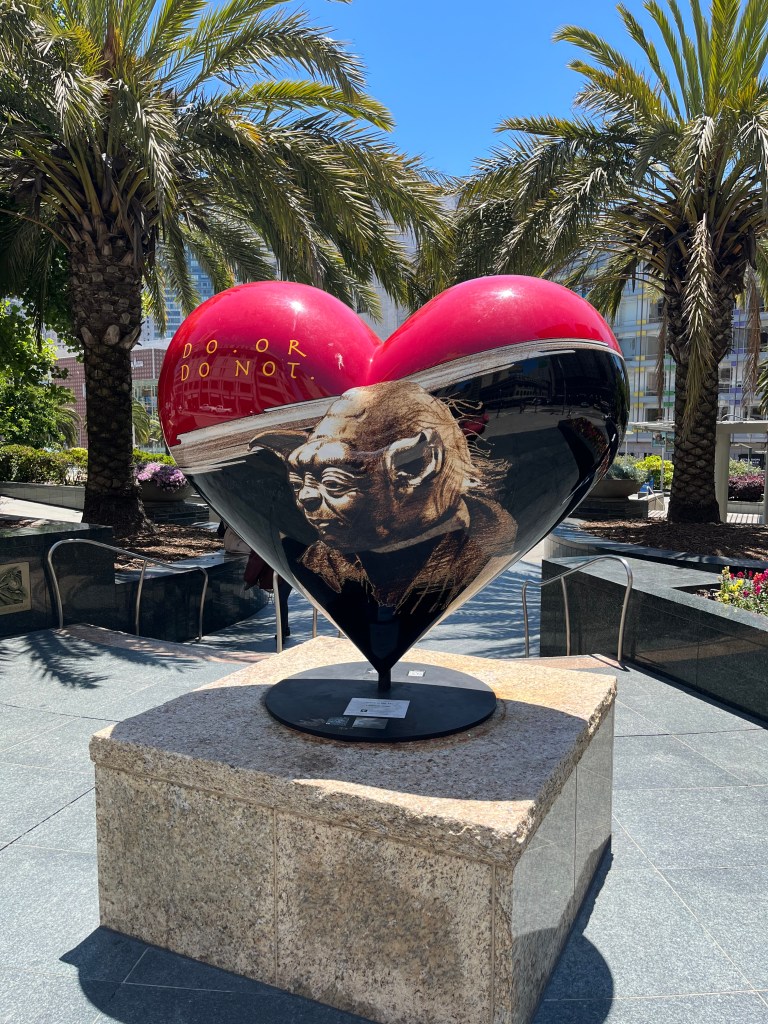
Before a meeting with a friend, he inspired me with a title for this chapter, and he had already come up with an acronym for this common occurrence heard trip after trip in his cab: C.H.S. It stands for compulsive honking syndrome. Or as I jokingly added, a part of a person’s compulsive horn disorder, C.H.D.! A person with CHD may develop CHS if they do not catch the infection early on in their behavior pattern. For once set in the firing pattern of neurons, only through a meditation routine not unlike that followed by a Master Jedi such as Yoda, can the disease be remitted. Or, perhaps, by now reading The Dao of Doug.

The good news, just in: each one of us can change our habits by awareness of staying true to who we really are, and not reacting to a perceived slight by an effing moron or douche bag. In slowing down my body movement by quiet time each evening, I get answers. Find your time. Can you do it in the morning, or is before bed better? In this case, I am an evening person. My do list check off is an up and at ‘em energy best suited to the morning hours. 

I never would have known this had I not stopped to question and analyze why I was jumping to conclusions or rushing to judgment about a person, place or thing that at first appeared to be in conflict with my path. Such as an automobile butting-out from the curb, double-parked, and giving me the horn, simply because they could not see the pedestrian crossing in front of me against the light. 

In fact, there are several common flow patterns that lead to compulsive horn syndrome, and once understood and quantified, can provide the Dao (the manner of living) of non-reaction to breaking compulsive horn disorder. Below are the situations that can trigger CHS and lead to permanent disability with CHD. Note: CHP’s usually cannot cure this disease, even though with a ticket or reminder, they can stop an infection:

Double-Park Backup 

This occurs when looking for parking and just missing the space because you pass by a car getting ready to leave. It also can occur if car number two sees car number one attended and the brake lights are on in such as the motorist is starting the engine. Car two, the perceived offender, seen first by car three, or me in the bus, can’t stand to be blocked in the time it takes car one to pull-away and for double-parked number two to take the space. If car two cannot make the curb on the first pass, beware of compulsive honking syndrome. Also, if car two makes the mistake of waiting for one to pull away, but the driver is just getting something out of the car, with no intention of leaving, car two gets the horn blast for blocking and waiting too long. 

I hear the long hard blasts all the time, and it is disheartening. Sure, the plan is to make SF for the lifestyles of the rich and infamous, the tech dream of tomorrow, but the density toll on wealth providing everyone with a car really disrupts the peaceful energy of yore. Especially with the unrestricted rideshare vehicles entering the city from out of county.

Hide-and-Seek-Parking 

This gets a honk when cars are just waiting, double-parked, for a pickup or space to come their way. The agony is not easy to recognize when cars are simply going around the block over and over to find parking. This wasted time, of a vehicle trip being spent causing congestion but of no use of conveyance is perhaps the biggest drawback to having a car in San Francisco. The simple act of going to one parking garage and keeping the vehicle put would save this syndrome from infecting others. In San Francisco, three rights do not make a left because all streets are not through. It is impossible to just go around the block in many cases, and this adds to car clutter on the streets of San Francisco.

The idea that parking should be free is ridiculous. Why should this real estate be free? The baby boomer’s biggest negative impact are the cars we bring to the city. This city, along with Manhattan, has older buildings with no parking. That’s how cities became functional. Flooding our city with more cars and demanding more free parking is ridiculous and is unsupportable.

Open Curb Construction Sign 

This one got me last week. I let them have it with the tradition of Foghorn Leghorn, because my PA exterior loudspeaker wasn’t working that day. But all my sarcastic skill over the bullhorn would have been moot, as the car was unattended. The car was in a bus stop marked with construction sawhorses, the owner finally returning with take out after a few minutes of waiting. Truth be told, his flashers were on, and I knew it wouldn’t be too long a delay for him to return. I got him with “photon torpedoes” my dash camera, as I took a picture of his plate and bumper up against the temporary bus stop sign. 

This is part of a class war between civilian city residents and city government. I must use my power as a civil servant wisely and consider the conflict I may be bringing to the table. I continually have friends come to me protesting unfair parking tickets and asking how to proceed. These incidents seem to occur with alarming frequency when I take a picture of other vehicles to send them a ticket. Is my issuance of a fine really impacting my passengers’ safety? If driving defensively and leaving myself a space cushion of at least four feet, can I avoid a line delay? 

trusted servant

Corner Fire Hydrant 

This is such the cool place to hang out, no Muni bus driver or motorist should honk if someone stands here. We have our special hydrant at Fillmore and Geary, and another by Peet’s at Sacramento and Fillmore. This red zone, usually open, is actually perfect for a quick stop and pick-up, and most pedestrians are cool with this space. It is scary however, if an intending pedestrian is pausing to cross on the light, and a car swoops in fast and furious to stand and drop off. It’s a major cause for sidewalk, or street rage, the city version of road rage on the freeway.

Curb Clear Muni

In my first five years as a bus driver, these short red zones, by corners where we turn our bus onto another street, had me angry and depressed every time a car was parked on the corner at a curb clear. On the 24 Divisadero, there are many turns that become dangerous if we can’t allow for proper traveling space on our overhead wires. Our poles need to have a wide arc outside the shadow of our driver side window, so we can make the turn without dewiring. Castro to Twenty-Sixth, Noe Street to Thirtieth, Divisadero to Jackson, and Washington to Webster are but a few turns where we need to have no cars parked. 

Now that we have cameras, I feel empowered. With help from the planning department at our monthly safety meetings, we can provide information to get these turns, or curb clears, freshly painted so motorists can see the red. Better them than me in seeing red!

My hope is the addition of small no parking signs handcrafted with the SFMTA star that state that the red zone is a trolleybus curb clear. (And could we make them in neon colors with a red alert tone, like on a Klingon bird of prey?)

Proper place to stand at a bus stop.

Bus Zone Special

These are the guys who never check their rear view mirrors. Did you ride share drivers know a professional driver checks the rear-view mirrors every five to eight seconds? This simple action would prevent those standing or stopping in the middle of a bus zone. We cannot come to the curb to drop off wheelchairs, walkers, or seniors needing the curb!

This would be a justifiable and morally responsible ticketed offense. It is an expensive mistake, and could simply be avoided if you check your rear views to see if a bus is coming. Thank You!

Far side Crosswalk

If a motorist is looking at their “smart” phone or GPS screen in hand or on the dash mounted, their view ahead is compromised. Especially when turning. Using peripheral eyesight is dangerous. This is a prime cause for pedestrian injury and death in our city.

Transit professionals certified annually with a VTT card, Verified Transit Training, have the knowledge to scan ahead one to one-and-a-half blocks ahead to see the scene developing. We are scanning ahead to see any threat developing. It helps that we have large mirrors and are sitting higher up on the road. 

The compulsive horn disorder manifests daily at this crosswalk. A following car, not able to see a crossing pedestrian on the cross street or side street, honks loudly and clearly because they can’t see why the car in front of them is not moving. It’s because the far side crosswalk is occupied. Please, dear motorist, accept the path experienced city drivers follow: a space of time of five to seven seconds is needed before the vehicle in front of you moves. This precious pause saves lives. Crosswalk lives matter.

Stale Green

Did you see the light turn green? If you didn’t, it is a stale green. Slowing down approaching a stale green is transit safe. Speeding up is not indicated, and can result in finding out what your insurance deductible is for body damage to your car: liability damage to those injured or sent to the hospital. Leaving the scene does not make it any cheaper for your bank account or spiritual awareness account. 

Not waiting to clear the zone.

Jumping the Gun

This can result in a serious side-on collision and is dangerous to the person jumping the gun. A fatality at Octavia and Oak resulted in major trauma and the death of a doctor sitting in the back of a shuttle as the shuttle driver jumped the gun on a fresh green. A trucker heading down the hill at a high speed decided to go through the opposing stale green. The result was death. South of Market streets suffer this same fate.

This broadside collision made the news, and is sad because it occurred at a newly opened parkway that replaced an ugly overhead freeway canopy. Of all the scenarios of using the horn, this one is OK. This is an example of appropriate use of the horn. The usual outcome of compulsive honking syndrome telegraphs one message: “I am an idiot and my few seconds of impatience are being broadcast in my horn, as I cannot see why you aren’t moving.” The result is retaliation in that the vehicle you want to move will stay longer in your path.

5150

This is the police code for a crazy person. Muni’s code is 800. Blaring a horn at a mentally disabled person walking in the middle of the street can result in a line delay. The horn does not work to your advantage, but only add to delay as they stand and block your vehicle. Broken glass in the front door, a pulled windshield wiper, or kicks and dents in your fender are a high risk from using the horn in this situation. Stopping and waiting is best. A smile never hurts, either.

Change of Direction

This is dangerous and use of the horn may be OK. The signal of a horn is, “Please make up your mind.” Granted, the person in the driver’s seat is probably being distracted by a back seat driver, or a map being held by another person in the car. This almost always occurs when there is more than one person in the car. A single toot is best. 

Limited Sight Distance

Use of the horn does not help the car in front see any better. Waiting in a queue of vehicles waiting at a traffic circle or four-way stop is when CHD manifests. Allow the person in front to go when they feel it is safe. You are not driving their car, and cannot see what they see. 

One thing we bus drivers learn early on is this: We are not the arbiters of determining another motorist’s skill on what they think is safe, or how skillful they are in experienced driving. We can get clues by the way they are driving before a limited sight distance accident occurs.

My most common expression to be aware I may compulsively use the horn is, 

“What are you waiting for: an engraved invitation?”

Speeding up and honking is not indicated.

Merge and Feed 

The horn will not be needed if you change lanes when spacing and pace are even. Cranking the wheel hard in stopped traffic only blocks two lanes instead of one. If you want to avoid being honked at, make your lane change early, or when the gap in cars is created when traffic starts moving and an inattentive motorist hasn’t looked up from their phone. 

Indeed, texting by others has its advantages when they delay in moving when the light turns green. You can use this advantage to change lanes safely and become a Jedi Master. This is the Dao of Doug on the trolleybus of happy destiny.