A friend asks on Facebook, “What can be done about the homeless encampment that is a bus shelter stop at Leavenworth and Post?” I hesitate to answer this question in the comment box in response to his post about Post. This is where it is a good place to state, “The views contained herein do not necessarily reflect the views or rules of the SFMTA or it’s employees.”
My views are based upon my years of experience and my chapter essays are only taking my personal view into account. My star-cast and life reading from the Cayce society point out I must find my own personal leadership style but must consider helping groups of others or find intimate mates to assist in love and service rather than be my own captain of the ship.
Indeed, these missives bound together in a book are all from self, with my exclusive point of view, usually done without running it through a coworker. I found out the hard way that editing with another pair of eyes, for example, is a necessary standard in helping an author I could not admit.
Rear door boarding is an issue many of my coworkers did not agree with, but I did. Rocking down the Mission, I was able to easily keep to the schedule and reduce dwell time in the zone by clicking open all doors. The largest complaint I get at the fare box is from riders who question what I am to do about checking the fare of those who do not pay by boarding in the rear.
Indeed, I got a call-in on a red light violation as payback for retaliation after asking to see the passenger’s discount card. The rule is always benefit of the doubt, if we believe the fare has been paid, so asking to see the discount pass is not actually in the rules for requesting the fare. Oops.

This fare evader was able to song and dance the fare inspectors with a vague promise to update her discount card, so when I asked again two weeks later to produce the card she called me a jackass. All I got back was “La, la, la, la.” This is why we operators are perceived as not caring about or checking the fare; it just adds to the drama, which can be distracting.
Yes, in a world we both desire, Muni could be free, but let’s be here now. It was hard for me to contain my laughter when she retaliated and withdrew the dollar she ‘intended’ to put in the box, because ever since reading Pinocchio, I’ve wanted to feel what it would be like to change into a donkey! The victim entitlement mode is strong with those who do not, or have not, ever paid, and the gift of a broken farebox two days in a row, after this incident, is a sign to stop asking for the fare. I have to admit I do like the drama, and see if my nose starts to grow!
I was a strong advocate for rear door boarding and it seems management acceded to this request, to the behest of the union, and nowhere does this become more apparent than at a shelter stop where the shelter has become a shelter for homeless, street druggies, and drug dealers. To be sure, minimizing open rear door dwell time can prevent drama from those who do not pay. To me, the open door policy minimizes drama and confrontation, and speeds running time down the line. To others, if feels like loss of control and opening Pandora’s box. This is a tough one to reconcile.
When confronting the dilemma of unclean or blocked seats at a bus shelter, I must tread carefully, and seek wise counsel about what to do. Based on calls to TMC (Transit Metro Control) on the radio, when two or more calls come in to the radio operator, action is taken.
My solution to a dirty shelter encampment would be to have my friend get other neighbors in his building, or those he sees at the bus stop, to call 3-1-1 and put in a service request to clean the shelter. Another point would be to bring up health and safety. These are two golden words that make a difference. All shouting, pouting, and profanity on the phone lines to our call center are not as effective as saying in a detached voice and tone, “For health and safety.”
We are continually reminded from inspectors on the street, and over the radio and in training mode that safety is our highest and first priority. This is the golden rule I present to the riding public and reader of this tome. Use the golden rule to have an effect and affect change.
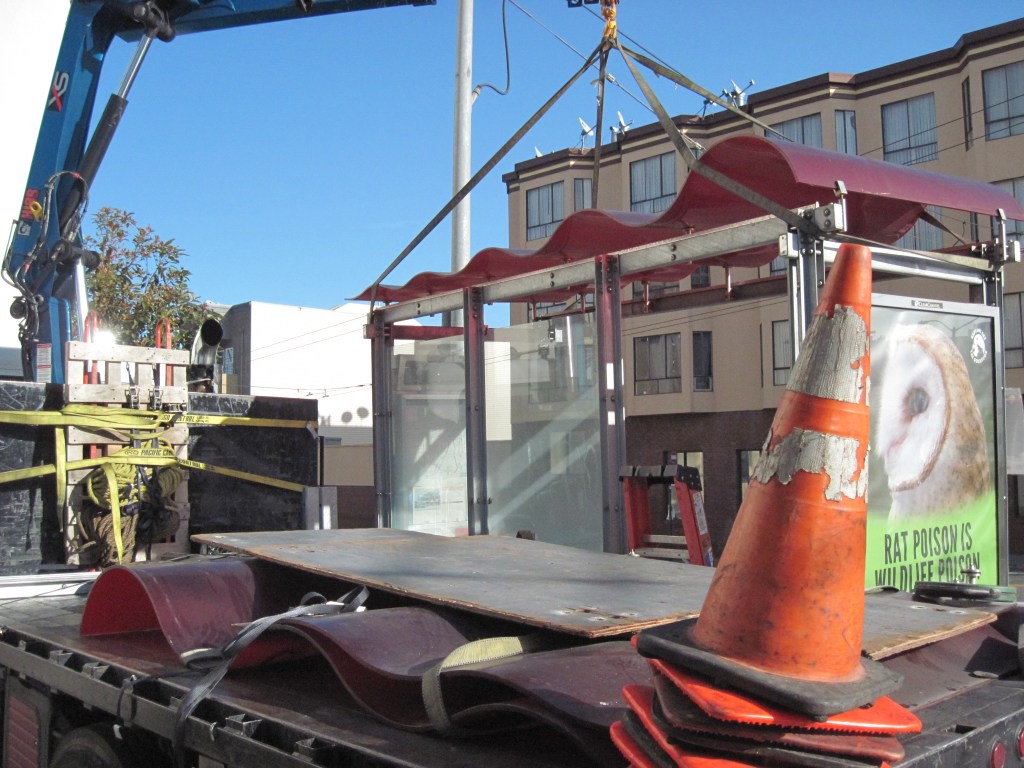
I came up with this chapter topic because I had some cool photos of some shelters being installed by our barn on Presidio Ave. Soon after I took photos of a brand new shelter, youth running from police in presumably a stolen car, took out that shelter. I got a picture of this newly installed shelter and its short-lived life.
Indeed, the road to happy destiny takes many rough turns. Bus mirrors hit the shelter, wheelchairs get caught between the poles, and angry drifters crack all the glass all the time. The shards can be resold as ‘ice’ to unsuspecting ‘Forty-Niners’ new to the city.
Just like panning for gold, the instinctive street wary denizen can sell useless broken glass as a new wonder drug to the latest techie going down from a crystal meth or heroin binge fueled by the bounty of VC: in this era, not the Viet Cong, but venture capital. And so goes the boom and bust cycle of San Francisco. Like the helter-skelter in the life of a bus shelter, it goes up and it comes down.
Just like sitting at the dock of the bay watching the tide, the road to happy destiny does have it victories and defeats.

 The Dao of Doug: A Bus Driver's Perspective