When our barn falls short of equipment, we are assigned to Woods Division to get a diesel or motor coach. I love trolleys, and I love that San Francisco did not do away with streetcars and trolleys. Nowadays, trolleys look like buses. They have rubber tires and the body of a bus, except for the fact that they have two poles on the roof that attach to double wires carrying 600 volts of direct current. Because our tires are rubber, we need to have a second ground wire to complete the circuit. Though I have designated this book’s title as from a bus driver’s perspective, I am actually driving a trolley. My range of motion and ability to change lanes is more restricted because I trolley my poles on the overhead wires. Operators of trolleys must always be aware of the dead points or breakers in the overhead and never exceed their operating range. They should always keep in mind the range and length of the poles on the roof of the bus.
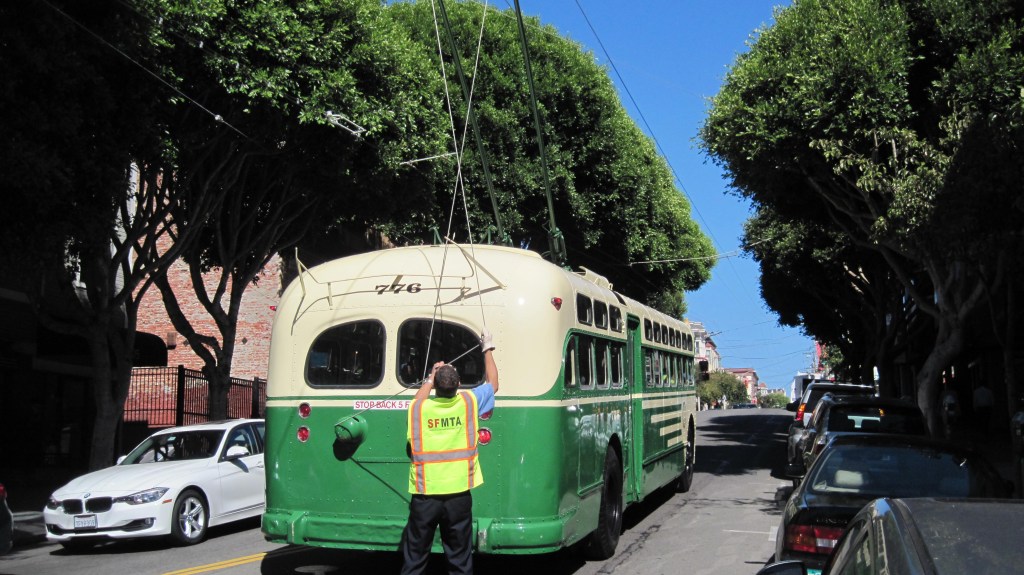
Historically, streetcars look much like the barn style trolley and have only one pole in their roof because the steel wheels on the rails are grounded by the earth. Streetcars came into casual conversation as they became more streamlined in the 1950s during the PCC era. The term “trolley,” when spoken, came to mean the cable car style of body that was square-like and made of wood. The cow-catcher or people-catcher in front of the cab was a good thing to have along Market Street. The density of people boarding on multiple tracks is a wonder to behold in the historic photos of the time. I find it interesting that these days we have concrete islands between lanes on Market Street to keep boarding safe, now that the trolleys no longer have people-catchers. But there are times along Mission Street that I wish we still had them.
Most of my coworkers are not too thrilled to have to go to an alien division and operate a motor coach in place of a trolley when our barn simply does not have a coach available for us. I do, however, like the motor coaches for the 22 Fillmore line, because the back doors are wider and further to the rear. This feature helps with the aisle crowding and speeds boarding and alighting. I also like the fact that the middle door step is not the abracadabra mechanism on a motor coach. I can click the rear doors shut, even if people are standing on the back steps. When heavy and late, the motor coach can be a life-saver for my emotional state.

Anyway, I am down with motor coaches and don’t mind going over to Woods to pick up one. I actually like the ride over on my bike. The Dogpatch behind Potrero Hill is actually an interesting neighborhood that seems like it is in the country, miles from the city. And yet the skyline is right there in front of you when you look down from the hill. This is where much filming takes place because of the dramatic, unobstructed view of skyline. The movie Bullet was shot on Pennsylvania Avenue just up from Dogpatch on Potrero Hill. When I say up, do I mean up! The escarpment here, from the ramp and the bay to the vistas of downtown, is dramatic, as is the over-crossing on 280 Freeway on the 22 line. We climb from Dogpatch to Potrero Hill. This is definitely a place to keep the Zen!
 The Dao of Doug: A Bus Driver's Perspective