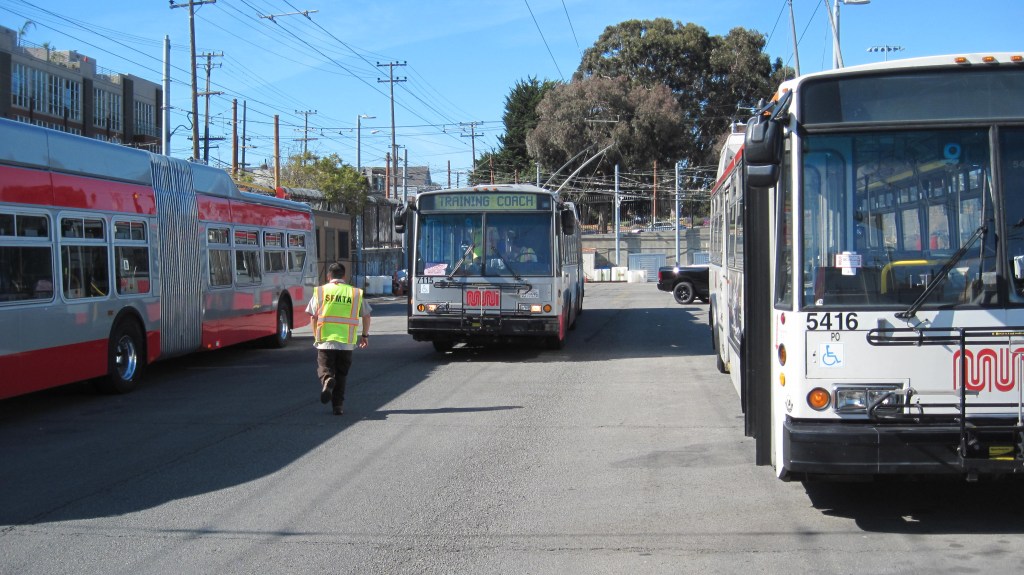
The switch to pull-out off of track five never works when we a late. Or, if once in a blue moon the yard starter’s call to the overhead crew is answered, we have a working pull-out switch for three days. All the coaches behind the switch don’t trigger the selectric box because the boxes are at an angle aligned for too sharp a right turn.
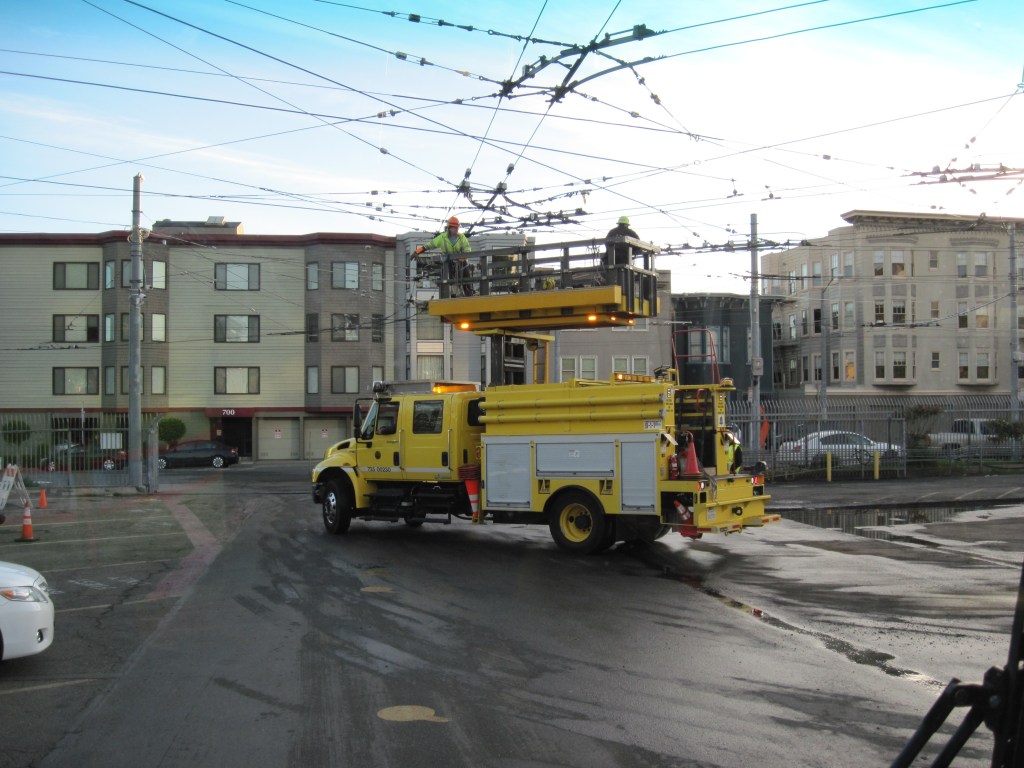
The same goes for Bryant outbound to 16th outbound and South Van Ness inbound to 16th outbound. But those two latter sets on the street are very rarely used, so it is of little import. The switch on track five is at a place where coaches pull out every day. We read the mantra from our superintendent that we are to pull out on time. A bulletin is put in our paddles as a reminder of our duties. We are also never to leave the coach once pre-op has started, but we’re to call the OCC for assistance. The only problem is the Central Control Kingdom did not read our bulletin about calling for help with the problem switch. The Shop Kingdom did, and does beat to a drummer close to home. It is made aware of a bulletin we receive, and because of our many interactions throughout the day via the yard starter, we end up on a page very close to (or at least within) the same chapter of the same book. But getting the other kingdoms on the same page may never happen with Muni.
The Superintendent Kingdom is like a referee during a game. They are interested in rules violations similar to yellow flags, red flags, and penalty boxes. The only tools available are the rules. If the rules are not followed to the letter of the law, then a penalty results. These penalties are, in order, caution and reinstruct, warning, three-day suspension, five-day suspension, fifteen-day suspension, thirty-day suspension, and termination. If this progression of discipline is extended with a bold-faced warning an italicized warning, and a bold-faced, italicized warning, then I can relax somewhat. I have been given extra grace before suspension.

On the other side is Operator of the Month, System-wide Operator of the Year, and a monogrammed sweater and a check. The check is somewhere in the neighborhood of two-to-five hundred dollars. I can set this as a long-term goal before retirement, but I consider myself a success if I can learn from my mistakes, overcome adversity, and help others. This is the “Lojong” of finding Zen: overcoming adversity by meditation and practice. Increasing awareness of Eastern philosophy in our Western mindset is another aspect of this book. If there ever were adverse conditions to overcome, the life of a San Francisco transit operator provides the perfect opportunity for the Lojong. (See glossary.)
Getting back to the start of a day on track five. After the switch has been “fixed,” I show the newer operators the trick to activate the switch by using the arrows painted on the lane as a guide to activating the electric correctly. Months go by before the overhead crew comes out again. I can hear them saying, “We just fixed it.” Actually, I saw them working on the switch at the back of lane four the next day. If the message they received was to “fix the switch upon which we pull out,” I can see how they would consider this other problem area, back by the wash rack, as an answer to this call.
As to the operator’s point of view about getting things fixed, the wrong part or switch gets looked at due to confusion about where the problem is occurring. See the chapter, The Overhead for part descriptions and functions.
As a general rule, operators don’t call Operations Central Control to report a faulty switch on track five. Instead of going on-air about a problem, we would remind the yard starter if we see her as we pass by the gate on epu. Epu is the battery power that the ETI coaches have so we can move without our poles on the wires. This epu pull-out is a good thing in that it forces us to check and see if our bus has battery power, should we need it later on in the day. We try to look for the good in every situation, as annoyance does nothing positive for our day, especially as we begin by pulling out on track five.
If in pre-op on a coach on five we find that our coach won’t move in battery mode, we’ll have a blocking situation whereby every coach behind this one will be late in pulling out. By following the instructions of bulletin PO 13-010, dated October 2, 2013, that we are not to leave our coach when pulling out, I call Central for assistance in my LPO. Central responds by asking me to locate the yard starter to meet the dead bus ahead blocking me. I respond by repeating the request, “Are you authorizing me to leave my coach to find the yard starter?” The terse reply begs the question that I can locate the yard starter faster than they can call.
But this has no foundation whatsoever in reality. Their job is to help us pull out on time. Period. But the institutional inertia is such that now their duties include a call they are not in the habit of making. Hence, you can see why we, as operators, remain silent in calling to fix the switch and to report another coach blocking and delaying our pull-out. Someone may end up in the penalty box.

We are also to cradle our poles in the harp before we move in epu mode. The yard is flat, and there is very little sway in the right turn we make, so in moist, foggy weather, we usually hit the poles’ down button and move through from track five to four to the gate to put our poles back up. If we have good battery power, we cradle our poles and make the right turn out the gate and onto Bryant to return the poles to the wires. It is important to leave enough breathing room behind us for traffic to go around us safely as we put up our poles. This happened today as I pulled out, and all went well until crossing the first intersection at 17th and Bryant. My leader in the yard made a left turn on 17th to head for the 6 line. It was cold overnight, and we recently had lots of rain. The switches can be sticky until the sun has had its say. My poles followed his track to the left and I dewired. The selectric boxes did not reset the toggles after I passed by them straight on. Fortunately, my collectors did not catch on the wires, and I hit the poles’ down button and checked to see if I was clear of any tangle. Good. I engaged EPU to clear the intersection and to step to the back of the bus and cradle my poles in the harp.
When I got ready to put my poles back up, I noticed that I had no brasserie on the end of my pole. My collector ripped off the pole and was somewhere in the street. Okay, I’d better engage EPU to the next safe location.
So here was a day when, before I even got into revenue service, I needed my EPU three times, and I had only traveled two blocks! I was ordered by the inspector on the corner to pull the coach in on EPU. Yes! I didn’t have to wait for the shop. I knew I would have to fill out paperwork when I pulled in that evening, but I would make sure it was a good report. I took extra time to make my writing neat, clear, and easy to read. Many of us have the can’t-be-bothered attitude when we want to hurry up and go home.
The unwritten rules are perhaps the most important to an operator in a trolley division. The unwritten rule of a short and concise report written with a good hand can go a long way to receiving a cautionary warning, and not a warning, especially not a warning, or hopefully not a warning! Keeping away from messy paperwork is keeping the Zen as a bus driver.

 The Dao of Doug: A Bus Driver's Perspective