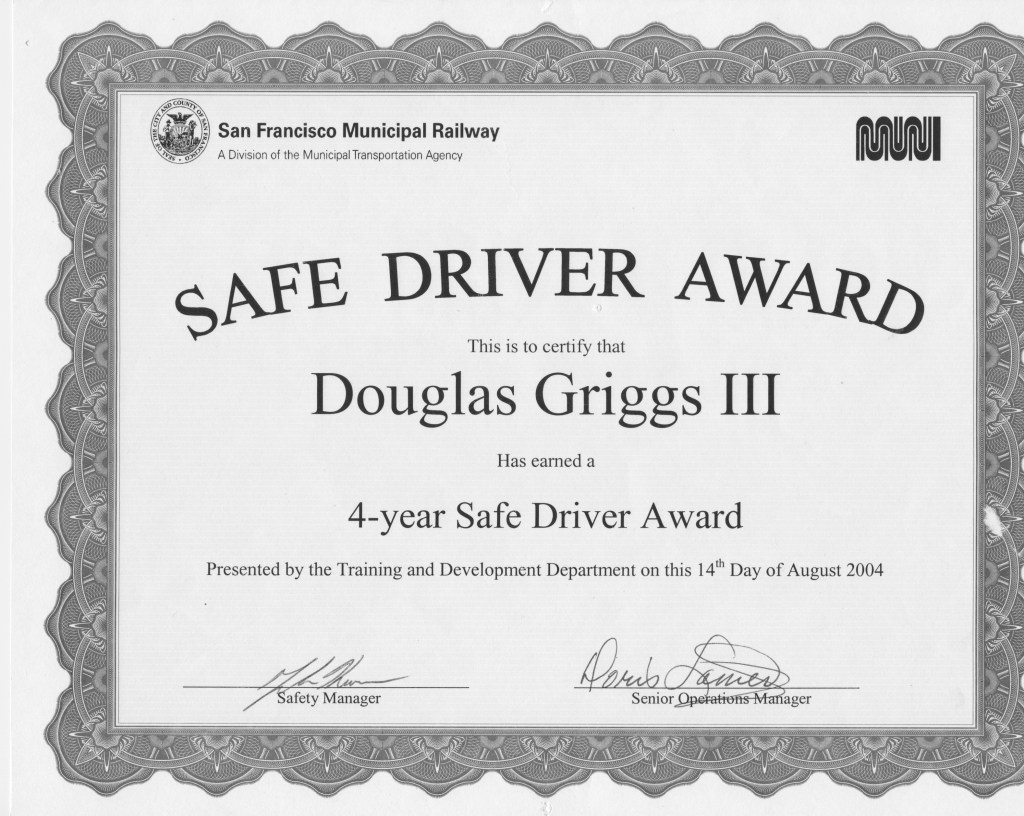
Next time you see an operator wearing a safe driver patch, ask yourself what it reminds you of. Is it a nuclear or biological warfare hazard symbol? Perhaps it is a design not unlike the fallout shelter signs of the fifties and sixties. No, this is the safe driving award patch for a transit operator who has had no accident for 365 consecutive days. The cost of this patch could be about twenty-five cents (maybe even a dollar for inflation), but the price is incredibly high!
As any transit rider can attest, the odds of making this happen are incredible. All one has to do is ride in the seat across from the cockpit in a trolley for just ten blocks to see the continuous threats and trespassing from pedestrians, skaters, cyclists, motorists, and delivery trucks. And to extrapolate this continuous, hyper-aware adrenaline state day after day, month after month, for up to a twelve-hour range for a day shift, the elevation to heroic status of a San Francisco Transit Operator is not that boastful or unrealistic.
But guess what? The one-year patches were eliminated. Perhaps the arm’s length of patches on the shirt sleeve or Ike jacket was tacky looking. I don’t understand why this needed to be taken back. It reminds me of the new rule to allow cell phones on airplanes or to stop charging for parking meters on Sunday. It feels like a step backward in progress.
Thanks to the vilification of operators as “Fat Cats” in the news during the economic downturn of the late 2000s, and a misapplied label of a nontaxable, health benefits check (described as a “bonus” check), our annual trust fund check before Christmas was removed. And no more automatic cost-of-living increases of twenty-five cents per hour twice a year, per city charter, to keep up with inflation. No more benefits check, no more annual safe-driving award patch. Ouch. And, of course, the politician doing this service work is no longer in office. So now, my purpose in writing this second missive is to shift sentiment back in a positive way so that we can all be proud of taking a bus.
But many riders I talk to are glad that we operators, as a class, have been brought back down to earth in our job description and pay. These are the lucky to have a job group. Call in sick within two days of a new sign-up, and you may lose your run. You are put on the extra board, or you are kicked down to last place in days off on an owl run, as an example.
If you work a seventh day straight, you don’t get overtime if, during any day of the second week, you miss a day of work. These are the inefficient work rules taken away by a voter-mandated proposition G. Lately, however, this tide has shifted to where many riders say we don’t make enough. We have gone for over five years without a raise and had a sick-out protest over conditions offered in the next contract.
If someone was caught in traffic coming over the bridge, their run would be given to a stand-by, on-report operator, and they would be detailed on the next open run. They did not need to call if they were driving and in traffic. This situation was portrayed as not being able to show up for work and was eliminated years ago in proposition M. But for years and years after M’s passage, the anger of not showing up and not calling in was used as a weapon against the supposition that we had it too good. The point being, our rules were set up for minimal drama and with the understanding that we would not strike if our wages kept up with inflation.
I heard of the tumult in Wisconsin and other such previously “blue” states that the halcyon days of benefits and pay are over. Indeed, most government workers’ benefits now exceed those in the private sector, except when they don’t. As witnessed by the huge bonus checks received by those working in technology, I certainly do not begrudge this. The spotlight has shifted off of us as a class, and onto the tech workers. Most vivid is the example of Muni being blocked by the tour buses taking tech employees to work in the morning or home in the evening using our bus stops.
Once again, the idea being pushed is that income inequality is awful, and that penalties should apply, such as a use fee for a tour coach to use a Muni bus stop. Rather than see a rising tide lifting all boats, the lock and dam should be shut until all the dinghy’s leaks can be plugged.
But I digress. I still don’t see why a safe driver patch that is such a challenge to obtain and costs so little should be canceled. As a former Boy Scout who loves trading and collecting patches, it wasn’t the five years of no raise or the removal of the three thousand dollars of benefits per year caused by a voter-mandated change in our city charter. The kick in the solar plexus was the removal of the annual safe driver award patch.
Lest you get the feeling that I enjoy being the victim, let me state for the record that, while I do relish the familiarity of this victim energy, I do love the elation that comes from meeting a seemingly impossible goal without any fanfare or regal ceremony. It is so familiar to get into the blame mode or the look what they are doing to us mode, but this option offers no solution.
When we are done with our work, we are done. If we have made plans outside of drive time, this precious commodity of our personal time can’t be bought for any price! Though it sure seems like the boat has a slow leak. Is that hissing sound coming from the parking brake? How much air are we supposed to maintain in pounds-per-square-inch per minute with the lines open or with the service brake applied? The only air leak is the hot air from politicians taking away wages or benefits.
There was only one simple message for this patch design—the image and symbol of the safe driver award. As for the Nobel Peace Prize, the Medal of Honor, the Distinguished Service Cross, and the Silver Star, the Safe Driver Award should be ranked alongside them. Gallantry in action or wounds suffered in combat—these seem like just another day behind the wheel of a city bus.
Then there are those who pass the twenty-year mark. These are the true masters of the Zen. Indeed, most of my failures and accidents have caused me to be a better operator, but I still have not made it to ten years of safe driving, even though I have been at the job for sixteen years. This book is written for those like me whose annual safe driving does not match years of service. Those first few years were hum-dingers!
Cue dead roll music: flute, drum and fife, bagpipe, and hell, a bugle corps! Keeping Zen should be that state of bliss, a way or a path of success from where, when we look back after having climbed the mountain, the view is fantastic.
But wait, does this mean that we are trudging in pain all the way up the rickety bridge or rocky trail? What kind of a life is that? No, the secret of Zen should be with us at all times. We need to know that it is always available to us, and we can see the vantage point, even though we are not yet there. The spiritual quest can be found on any yoga floor, on any bus. No longer isolated as a pod person in a separate machine, we are together on the bus. No wonder the little ones love the bus!
 The Dao of Doug: A Bus Driver's Perspective