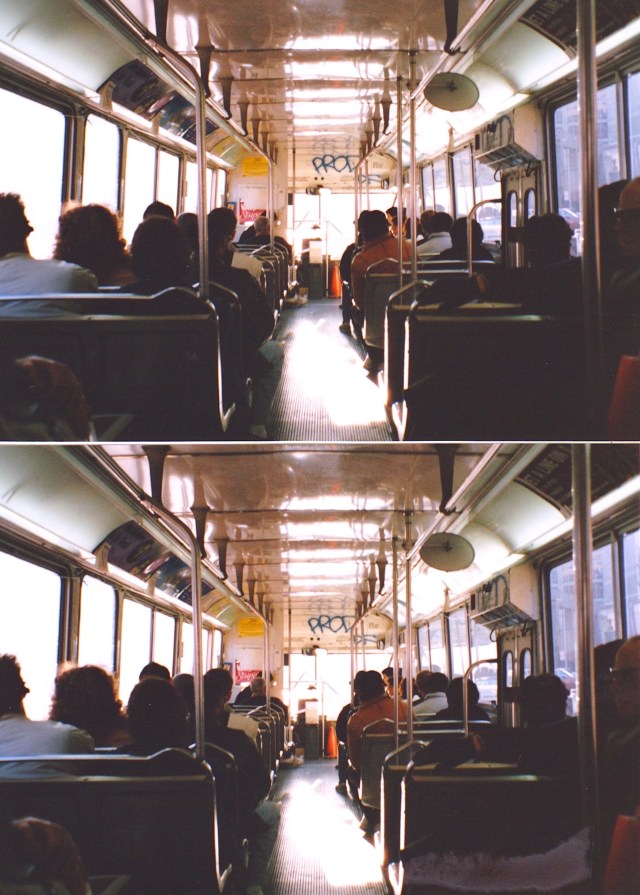
The best time to work Muni is when the bus has an empty aisle and half the seats are open. This occurs in the morning on most major holidays and on Sunday mornings. The aisle is empty and half the seats are empty. The pulse and rhythm, the ebb and flow of passengers is steady state and harmony abounds. During the week midday, usually from 10 a.m. to 2 p.m., with leader in sight, is also a wonderful time. Good job, good pay, and no threats on the horizon. It is the wish and hope of every transit operator to select a run where the Zen time is maximized. Everyone is relaxed and happy and the schedule flows perfectly. Every time I do my homework before a signup I try to find this zone in a run, and try to guess where this zone is, and how it can be sustained for four or more hours per day.
And it is truly a complex matrix. One false move, one error in judgement can be a costly mistake resulting in trips to the superintendent’s office, and love letters from the dispatcher. A love letter is at best, a piece of mail containing a caution and re-instruct, or if close to the danger zone, a warning in boldface, which means, you are off the hook for disciplinary action, but if this happens again within a short time frame, your goose is cooked. The goose being, time off without pay. Imagine coming to work in the morning and the first thing you see is that your paddle is missing from the row. Go see the dispatcher, you’ve got mail. What happened this time?
Everyone asks me what the bad lines are. And my answer is that none of the lines are bad. On another day, I might answer all the lines are bad. Timing is everything. Which is true for a stand up comic, a worker on an assembly line, and as a waiter or cook in a restaurant. So here is what most riders don’t understand: its not what line you are driving, but when.
For example, do I really want to be leaving Clay and Drumm on the 1 California line at 5:02 p.m., as Embarcadero Three’s elevators are filling up to capacity, dropping hundreds of workers to the city streets to pick up a bus to go home? Or should I be at the other end of the line at 33rd Ave and Geary, hours after school has let out, to be headed inbound in non-peak direction, only to arrive downtown an hour after most people have gone home? Do I want to be the first 22 Fillmore leaving after the bell at the Marina middle school, where hundreds of hyped-up middle schoolers with more hormones than they know what to do with, after hours of being cooped up in school, be knocking on my door as I try to pull away from the inbound terminal at Bay and Fillmore? Or would it be better to be leaving Third and Twentieth in Dogpatch, around 3 p.m., hours before all the blue collar workers around Potrero Hill start clocking out? And so it isn’t what, but when which makes or breaks a good run choice.
And I think something could be said about applying this principle to our daily work and our job. Are we usually not so bothered about what we have been assigned to do, or are we really upset or angry over when the task is expected to be completed? Sure, we can try to work late, and I have seen the glazed over look on your faces when you board the bus at 6:30 p.m., or, perhaps follow this suggestion. Try getting your boss to change your arrival time. Fat chance.
There is a pecking order I have discovered in and when people go to work. Early is better. At least when judging by faces I see boarding the bus. First, we have the humble Latino working class off to fisherman’s wharf: The bus boys, the dishwashers, the true working class backbone of the city. Then we have drones. The white “middle class” working stiffs who work downtown for something, something and something, whether it be an architectural firm, or a law firm, or an advertising agency. I see the fresh young up and comers first. They are going places and have probably moved here from somewhere else for their first big break in the big city. They have the smile behind their eyes which is full of promise of a great new job with a resume that probably says I am new and trainable and not bogged down from a drugged family past from having grown up in California. They say, in their eyes, I got away from my one horse town with the single blinker light.
Then come those who have been here awhile. What, forgot to shave this morning? Painted the town last night? Tie one on did you? Or they come rushing out of a doorway without their tie on, to finish the windsor once they get on in the aisle, now crowded, as the inbound arriving time approaches nine o’clock. And after the clock strikes nine come the mid-level managers. Lattes in hand they head for the corner office. Those in echelons whom eschew the time clock for a supervisor role or particular grade or rank in an organization downtown. And the school trip. Youngsters much quieter in the morning than in the afternoon. Quietly and purposefully podded-in to their music, or contemplating their day ahead.
And then the moms and their babies. Off to the daycare, or to do the daily tasks of running a family. And then come the ancient ones.
The seniors off to some food shopping or their appointment to see the doctor. And then, the Zen. The midday time when everyone is at work or at lunch. And this is when rush hour is over, and when most morning runs pull-in. Where we transit operators can lay down to chat in the Gilley room, or go to the gym to work out. Maybe its a trip to the post office, or the store. For those lucky enough to live in the city, we can go home to do chores. But for those straight through runs, this is the Zen time, when things are steady and even, and usually not full of much drama.
And so I have a word of wisdom to impart. Try coming in early for a week. Don’t tell anybody. See how on time and smoothly Muni runs at 7:30 a.m. versus 8:30 a.m. You can always clock in at the regular time: but this time you’ve already made it up the elevator. You have time to get coffee. You are within seconds of the time clock, not minutes. You could actually wait to punch in right on the dot. And guess what, your trip-in was a few minutes shorter, maybe as much as twenty minutes shorter if you didn’t see buses passing you up, stacked to the brim. If I had any magic wand to wave, it would be to stagger start times in half-hour intervals so that not everyone had to be at the same place at the same time. You’d be amazed at how much work you can get done before everyone else traipses in. So if you think its not a good idea to ask your boss for a different start time, try it anyway and see what happens. By lunchtime, I’ll bet you’d have everything done you were planning to get done, anyway. There is so much down time after lunch anyway, you may find a few nice surprises along the way.
So, staying in the Zen zone is the sweet spot that makes living in a big city with a good job with good pay a wonder to behold, with everything right in the world. But heaven forbid the run in front of you happens to be an open run with no regular operator. Or a run that has days off of Tuesday Wednesday, that usually doesn’t get filled on a regular basis. This hit or miss wild card, not knowing who is ahead of you, or whether or not you have a leader, creates possible destruction of the Zen zone. Should I adjust up or down in my running time? Will I be running hot if my leader cuts in late with a last minute detail from dispatch? Did I piss off the dispatcher the other day by questioning how they do their job? Am in a payback situation? Payback is a bitch, a phrase or term I will never forget. Especially when Central Control has me on ignore, or the inspector at the checkpoint won’t even look at me as I pass. And this is when the Zen zone can become Muni’s ninth level of hell.
There are nine levels of hell at Muni, which, now that I think about it, should be at least another Chapter in this handbook, but suffice it to say here, one should leave the ninth level of hell after one trip, because the ability to sustain the ninth level of hell is very limited, and though there are heroic epics of being able to sustain this for four trips a day for over two weeks at time, eventually, the dam will break. And become the damned: The valley of the damned.
I will never forget the signup from hell–with no end in sight. I was warned by a member of the executive board, that this was to be a long signup. I remember making my choices for my choice slip before the signup at the Presidio. And my hero, my union rep., was standing right beside me as I saw the run with big pay and weekends off, still available on the range sheets minutes before my choice slip bid window. Wow, I said, here is a big run with weekends off still available. How could this be?
There are times when the runs pick us, rather than us picking them. Interesting, I thought, this must be a sign from the Muni gods I had arrived in my seniority level. I finally was able to get a 300 dollar plus run with weekends off during a good time frame, between 7 a.m. and 7 p.m., with some standby time for lunch. Little did I know, there was a reason why the run was still open. It was the icon for the ninth level of hell. It did the 1 line from 33rd Ave and Geary leaving just after 8 a.m., with an arrival downtown just after 9 a.m. And it passed the avenues just after the last express downtown. Which meant panicked office workers, who just missed the last express, would ask me at the door if another express was coming. No problem, I can do this. After a couple of weeks, they would realize that by 8:22 a.m., if they hadn’t gone out their door, they would miss the express. It would just be a small matter of weeks, and the questions would stop.
But they never did. Week after week, different workers would be late, and a bad dream turned in to a nightmare. But little did I know, two other factors were at hand to add icing to the cake from hell. My leader and follower were out to make my life miserable, whether by intention or design, I set in motion trains of circumstances I thought I didn’t deserve, but were ripe for the picking. And so I believe this is a natural progression to move on to the next chapters, ‘Witching Hour’ and ‘The Ninth Level of Hell.’
I'm a self-published author with A Bus Driver's Perspective with several themes--
Self-Help and Personal Development:
Recurring topics on personal growth and finding happiness, making it relatable to readers
seeking improvement in their lives, even with the mundane duties of driving a city bus.
Memoir and Anecdotal Essays:
Capturing personal stories and reflections that resonate with readers on a personal
level.
Mindfulness and Zen Philosophy:
Emphasizing the pursuit of Zen in everyday distractions, appealing to those interested in
mindfulness practices.
Transportation and Urban Lifestyle:
Highlights the unique interactions and experiences of bus driving in a dense urban
environment, connecting with city dwellers and commuters.
Plus other fun daily prompt stuff!
View more posts
 The Dao of Doug: A Bus Driver's Perspective