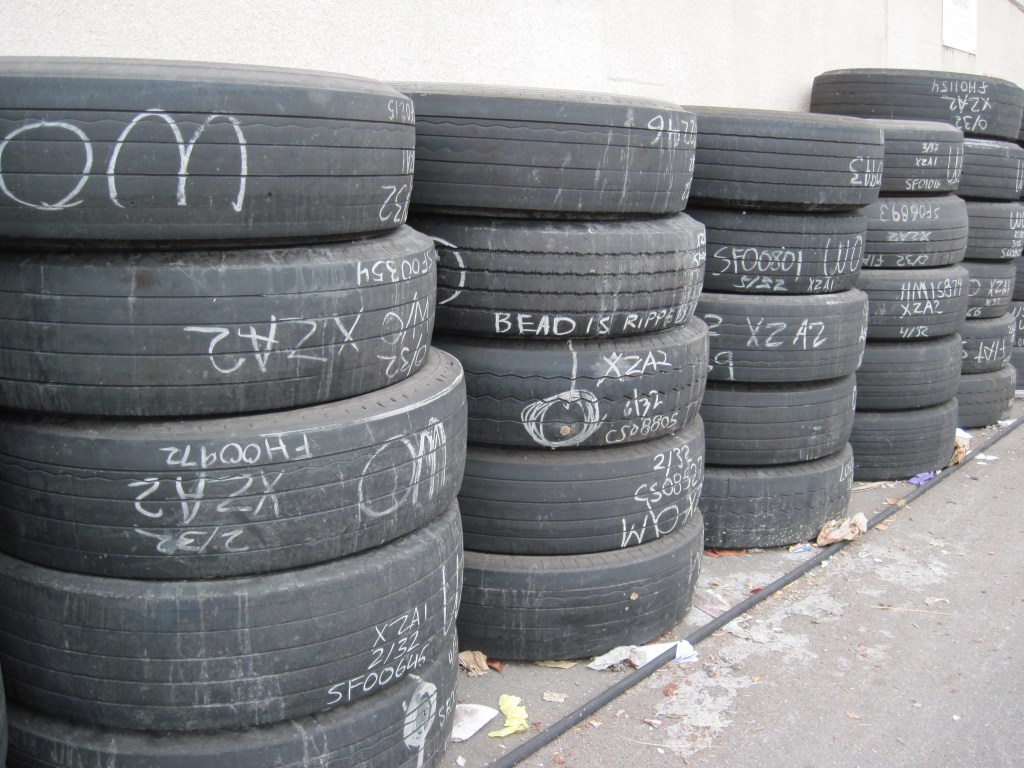
The wheels on the bus go round and round all through the town, except for when there is a construction detour, or another patch job in the making from the Water Department, or PG&E, the utility company! The wheels go round and round, even if the tire tread doesn’t. But you would never know, because the only thing rougher than the tires are the street surfaces.
Only once did my bus get a flat. An actual flat tire with an air leak where the rubber scrunches down on the street. There was a house under construction, and I ran over a nail. A huge nail. The bus tires cost like 800 dollars apiece and have 27mm thickness. I did not believe they would ever spring a leak. I called for the tire man who came out and fixed the flat. This was the only time I had to make a road call for a flat tire.
When we put flat tire on our defect card, it doesn’t mean we have a tire out of air. Flat tire means our tread has worn unevenly, and when we take our coach up to twenty miles per hour, we hear the drums along the Mohawk. A “thump-thump,” as the worn or flat portion of the tread goes round and round. Only on a newly-surfaced street can we tell that we have a flat tire. But there is not too much worry about here. When streets are resurfaced, they are only paved a block at a time and in small sections. This factor hides the brand new tire with a sometime defective tread that has been put on a bus.
Perfectly round tires are replaced with new, scalloped ones. This is an improvement from tire treads that would separate on a hot day when we turned the front wheel. Those were tires probably were labelled as new, but it is obvious when recapped tires are used instead. You can see the separation line on the cap versus a brand new tire. I will pull in with a perfectly good bus, and the shop man in the tower puts up a chit for new tires. Resistance is futile. If I pull in with flat tire on the defect card, I get a look of disdain, as if I am doing something wrong. New tires seem to be inspected not when they are put on a bus, but when I pull in and turn the front wheel to inspect the tread at the tower. The fault, dear Brutus, is not with the shop, but with the quality of the tires shipped to us as new.
The shop man in the tower makes it very clear what is and is not a safety significant defect in the tire, and any balding tire showing through to the inner nylon mesh is removed per state and federal law. We cannot have a shallow tread of less than 4/32 of an inch on the front wheels. They are rotated to the back, inner rear wheels on the long coaches.
(I have been asked by my editor to clarify terms used in this book, such as the term, “safety significant.” The October 8, 1999 memo of a previous administration is often cited when describing safety significant defects; we are to report them immediately and take the coach out of service. But interestingly, the letter never states what they are. And so now, right here, right now—just like Jesus Jones—I get to be the unacknowledged legislator of “safety significant” as fresh, untainted eyes read this page. One definition of safety significant is something for which parts are available!
Seriously though, I turn to what our protocol is for using the priority button on our radio. A priority is any threat to life or limb of anyone on or around the bus. A door that opens on a moving trolley or train is, therefore, a safety significant risk. A burned-out trim light or a dirty vent panel is not. A new tire with a blemish in the tread may not be safety significant if the tread is maintained at 4/32 of an inch. This is where the defect card, to be filled out and turned-in at the tower as we pull in, comes into play. If, on a tire, I mark “shimmy” and “hard-steering,” the shop responds immediately. If I mark “flat tire,” nothing may happen, especially if I don’t mark which specific tire has the drums along the Mohawk sound.
The only thing worse than a flat tire on a bus is one on a bike. But the good news is that every bus has a bike rack to take you back to the shop for a new one or just some air. I always give you a free ride if your bike gets a flat on the street. Also, just to let you motorists or car people know, if your car is in the shop, I’ll break off a long one for you for taking mass transit for the first time. The first ride is free!
 The Dao of Doug: A Bus Driver's Perspective