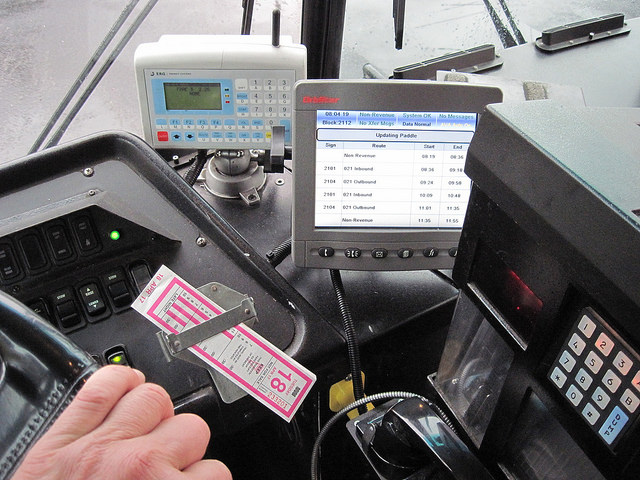
One of the common comments I get from operators, even those with time and with lots of experience, is the refrain, “I never call central.” Or “Those guys are clueless.” And I have found operators on the extra board fall in to this category more than the average operator working a regular run on the same schedule every day. Extra board operators get to be assigned a new run on a daily basis. This is great when a sign-up drags on for months, and keeps monotony and boredom at a minimum, and it also prevents an attitude to develop from regular problems or passengers, because the operator is not on the same schedule day in and day out.
I believe some operators are “hiding out” on the extra board so as to reduce their accountability with the regular riding public. And this can be a very good reason. Especially when there aren’t enough operators to cover all runs. But for me, I like the regularity to plan my time off by having a fixed schedule. Also, if there are recurring problems on my run and line, I get to take a look at what I am doing to cause these problems, and see if I can make them go away. That’s why I like to do my “homework” during a sign-up and see if I can make a choice preventing headway problems or overload, though this is not always clear. Especially in not knowing who will sign on a low paying run as my leader.
“Central” is our shorthand for OCC: Operations Central Control. Even though nine of ten interactions with Central may not appear fruitful or necessary, it is the one in ten times when a call to Central, or from Central, is immensely helpful. And it is this one in ten that makes keeping a professional calm tone on the air really pay off.
Central operators come to identify us not by run or coach number, but by our voice. And if they have come to recognize my voice and attitude as one of helpfulness or being brief and concise, all the better. One more tool to have at my disposal when I may need it. Yes, Central cannot necessarily see what is going on in and around my coach, so bearing this in mind, I don’t get upset if they state something contradictory to what I know or can see.
A lot about what Central can see has changed recently. The new drive cams mounted on the front windscreen (windshield) has helped, as do the newer cameras in the newer coaches. Central Control is no longer in the dark about what is going on in front of our coach, and I believe this to be a good thing. Some would say this is an invasion of privacy, but I disagree because we are a civil servant in a job serving the public. Cameras are being installed around the common areas at our division for security purposes, and the drama queens are upset. If you are a public servant and carry yourself professionally throughout your day, what is the problem?
Yes, I do believe George Orwell is right: big brother is watching us in more and more places, but I try to keep this aspect on a positive note, hoping these images would capture an event that would protect me from abuse and falsehood. Much of the cost of litigation can be stopped dead in its tracks by the images captured on the coach. I look at the drive cam as my friend–So far so good.
I said that only one in ten calls may appear helpful, and these calls usually end in a tag line from Central we operators come to know all too well. Below are a list of the tag lines Central gives us, and the emotional component that goes along with them. These phrases may seem simple and innocent enough on this paper, in your armchair or desk as you read this, but believe me, when we get these directives, we are under a much higher level of stress or unusual headway.
“See the Inspector”
Usually occurs when things are very busy. Central Control may be having high call volume sometimes due to a major line delay such as when the tunnel gets blocked. We are silently expected to work an extra load without a break and we need a switchback for a mental break, or because we have been working for over two hours without a break. Sometimes, on a straight through run, we may have gone for four hours without a fifteen minute break. So we call for a switch back, usually ten minutes short of our final terminal. The answer from Central Control is to “see the inspector” for time and place. But nine times out of ten, there is no inspector! I usually pop the brake and wait and see. If no one comes to the door, I can call again, but this adds to the delay, and other coaches may be blocked behind me. “Take it to the end, and call back later.” is the usual response. Not getting the break we need, when we need it, adds to the frustration.
“Take It to the End”
Usually a Central response after “See the Inspector.” And even if we do make contact with the inspector, he or she says, “Take It to the End.” Good is the day I can follow this instruction without a problem. If I am all alone, without a coach behind me, I follow this order, but if my follower catches up to me by the time I reach my last short route switchback, I call again. Many operators wise to this make sure they stay four minutes or more so the lead coach doesn’t get a switchback. This makes for a long day unless we can turn it in to a game, or our coach shuts down and we need a road call.
“Do The Best You Can”
When I cannot take on any more passengers because my bus is full, I call to let Central know I am beginning to pass up stops. This phrase comes in to play when we are late and heavy. Many of our coaches have defects not safety significant, but are randomly occurring and cause delay, such as slow doors, and slow brake release. Fare box problems and lack of heat or air can also us to not feel we have been given what we need to do our job properly. Not being able to use the wheelchair lift or kneeler due to low air is just another curse to hear, “Do the Best You Can.” But at some point, going out of service may soon become reality. This most frequently occurs when a bus is already missing in front of us. We are taking on more people, which adds to the bus performance issues, and adds to needing relief.
“Put It On the Defect Card and Continue in Service”
This usually pertains to a bad fare box or Clipper card service not working. But when a defect concerns our ability to pick up wheel chairs, a call is mandatory. Many times, the bus won’t move if the lift does not stow. This is a bummer to have to clear the coach and tell everyone that the bus it out of service. So most times, of all the orders, this one is usually the fastest and easiest to follow. Hopefully, we can continue in service, but this is usually an order before another call to state we can’t continue.
Things tend to go wrong in groups. Getting out of the bus to push the wheelchair lift to stow is one technique. Resetting master control and shutting off the bus sometimes makes the problem go away. Clicking on the traction control or rear door lock can make a problem go away, at least for awhile. This can make relief interesting. Because as a bus gets warm and stays in service, the performance starts to deteriorate. I am amazed at those who can make it to the relief point on time and not break down. So the lack of writing anything down on the card, and bringing it to the relief point, is an honor in and of itself, even though many take issue with this and feel the relief operator is not being honest. But given our own situation to end a part of our shift on time, bringing the coach to a relief point is better understood.
Breaking down and having to pull out may not be any easier than calling Central at the relief point, and calling the shop. So the decision to stay in service is up to us and not Central, and the order to continue in service lends itself to conflict with others: passengers and coworkers alike.
“Help is On the Way”
Make sure you have something to drink or eat in your bag. Make sure you have your reading glasses or reading material also. As any professional driver can attest, you never know when your shift will end, or how long you will have to wait in the dark or cold wind, for a road crew to assist you in getting back on the road. We are required to call back at regular intervals to check and see when help will actually arrive.
There are some good times and some bad times to ask for help, especially during a shift change. Faced with the prospect of waiting in the cold, we do try to keep going as best we can, without delay. But many times this is impossible because the bus will not move. “Help Is On the Way” can have our eyes rolling because it seems like a bad joke. We operators can balance this equation when we get asked the question, “Is there another bus behind you? “Yes,” we say, as we close the doors. Thank God you never said “when.” And even when it is asked with the phrase, “just right behind you?” since we were never given any units of measure, such as in blocks or in minutes, the answer, “yes,” is still an honest one!
But lest we forget, we never know who is listening, so it is best to remain calm and stay professional. Doing so has given me the switchback or pull-in I really need to go home just at the right time. Answering incorrectly can put me under the microscope for other problems, and this usually does not end well in the superintendent’s office.
“See the Dispatcher”
It’s like go see the boss. You are in trouble, and have to go to the Principal’s office. Perhaps this is the most insidious message from Central because of the ambiguity. What could possibly be the reason I need to see the dispatcher? Is it an off the cuff, oh-by-the-way, afterthought in a message, or a stand alone call. It’s effect for bewilderment and despair is best used alone. Do I have mail? Did the man waving his cane at me as I passed him up call 3-1-1? Did the guy in the wheelchair who blocked my bus, completely full, on Van Ness at Market have a friend in the MTA office? Did the woman who said she knew the Mayor personally, as she repeated my cap number under her breath as she stepped off, really actually know the Mayor? Was that sarcastic comment by the lead dispatcher this morning a tip off they knew what was coming? I must be employee of the Year! (hah) These and a thousand other thoughts roll around in our heads as we try to guess why Central, in their busy day, thought it necessary to call us about seeing the Dispatcher. Maybe it is a drug test. What would happen if I just happened to forget as I trudged up the steps after pulling-in? In any event, I can’t remember any good reason for when I had to see the Dispatcher. Which begs the question, is it better to pick up mail at the end of the day or right before a pull-out in the morning? After work may be the winning answer.
And now I see I be lying, because there was the time I received two commendations in one day! And today they actually let me go home from my doctor’s appointment, instead of having to return back to get my letter signed! So like any ‘good’ operator, I embellish the story with pain and suffering to gain sympathy, and hope this will change the outcome of discipline to a favorable decision. It never does. The decisions are usually made in advance. It’s kind of like the Cardassian system of justice. Guilty until proven innocent.
But when a passenger comes forward with a phone number and a line of support, it all seems to melt away. Which reminds me to say it is always a good idea to have a courtesy card in our jacket pocket. These are cards which a passenger can fill out as a reference to an unusual occurrence on the bus. Usually a phone number is enough. We (should) keep them with us, so all you have to do is ask. When someone observes I am doing a good job, and goes out of their way to let me know, the Zen zone returns, and the rest of the trip is uneventful.
 The Dao of Doug: A Bus Driver's Perspective