
If you would like to see a magic trick or illusion played out day after day, look no further than a ride on 14 Mission. The secret of becoming invisible is to sit in a wheelchair, particularly in a large group. The more, the merrier. It matters not where you sit on the sidewalk in the wheelchair. Those intending to board are only interested in their own desire. The thought of waiting for others or considering a need other than their own, does not compute. We have our “blinders” on and don’t notice the changing conditions around us, such as someone with special needs waiting or approaching the bus stop after we have arrived.
In order to be of service, I need to walk that fine line of allowing those waiting to board first to “awaken” to see the person in the wheelchair who may be behind them or to the side. I have to be on guard with my tone of voice and how I express myself. It is important to note that, from the driver’s perspective, most conflict arises when approaching the front door from behind and to the right. The blind spot is larger when the doors are open, because they partially block the side and rear views. Hiding behind the open doors causes hurt feelings.
I have an incredible opportunity to be a guide. Sometimes, it is simpler to let those passengers board first if the time between buses is short. If the number of those intending increases beyond four or five, with more boarding in the rear, loading the chair first is best. Those who are allowed up the front steps first usually sit down in the first two chairs under the wheel well and block the aisle. Others sit down in the flip-up seats where the wheelchair needs to secure. Young people with ear buds on and others with children enter through the middle door and sit in the wheelchair area, inattentive to my request to make room.
This is when I find it simpler to get up and face them with hand signals to rise. Raising the flip-up seats myself, before the chair lift is used, is the fastest way to get going if the person in the chair is alone and has no help, or if no passenger on board helps to raise the seats. Most of the time as operators, we don’t have to get out to raise the seats because someone else offers help. Other times, help is available, but few know how to pull down and away to unlock the seats to raise them for the wheelchair. This is when I need to convey patience and cheerfulness and demonstrate how to lift the seats. I choose to believe that I am “lighting a candle” for others to see.
I am powerless over controlling passengers on my bus, but I also have a responsibility to those who need to get where they are going in a timely fashion. The biggest challenge I face today is to balance these needs without going over the top in anger and frustration and to keep the coach moving without a fall on board or a security incident. Humor can go a long way in diffusing a tense situation, but there are those who are so broken in spirit or illness who do not want help and are unable to think of anyone other than their own selves. Humor here does not work. It is perceived as an affront.
Most riders in wheelchairs have the faculty and support they need to obtain the equipment they require to be mobile. Others are unable to walk without support or must arrange for a special-needs transit, yet they insist that Muni take them back and forth, unaware of the impact they are having on the line. Still others insist I call the police over any small, perceived trespass, without regard for the welfare of those needing to get to their destination.
Case in point. A man at 16th and Mission attempts to block my coach and tells me to call the police. Another man, who was arguing with this man, just put his bike on the rack and entered through the rear door with a baby stroller loaded with his personal belongings. “He has my stroller!” says the first man. I beckon the man in the street to my window and suggest he ride with me in the back. The second man yells profanity at the man on the street and throws the stroller out the back door.
“He’ll get what he’s got coming to him,” the first man responds calmly, walking to the sidewalk to retrieve his stroller. I nod in agreement. Sure enough, this angry man forgets to take his bike off the rack at 6th Street, where he rushes to get his belongings off without the stroller. He walks away with a nice woman in a wheelchair, who had plenty of time to board when the two were arguing at 16th Street. I ask the two bouncers on the corner club to remind the angry man that I’ll be back in half an hour in the other direction so he can claim his bike. They nod in agreement.
When I get back to 6th Street, here is a different man, smiling and at peace as he removes his bike from the rack. God does not work in mysterious ways. Especially when I try to do the right thing! Another police call saved for another day. Another incident report after work unwritten. I can make my timed transfer just before 3:00 a.m. and catch my ride home.
Unfortunately, those with aimless purpose sometimes seem to have such a large sense of entitlement. I am at a loss on how to tame this beast. I have to say as little as possible and light the candle for another time, another place. Don’t feed the pigeons is code for keep quiet. It goes against my Gemini nature to defer and delay a conversation about choosing where to sit, and this is a key reason for writing this book. I hope this message gets out to those who are regular riders, so that problems go away.
A recent spate of fights over seating in the front area of the bus has me thinking about how to clear this crunch zone before conflict develops. As agent Smith tells Neo in the movie, Matrix, “Do you hear that, Neo? It is the sound of inevitability.” Not unlike a train approaching in the subway tunnel, lack of available space increases a head-on collision. This crunch zone always occurs in the Inner Mission and by Van Ness and Market. Thank you, Director of Transit, for locking seats in the upright position!
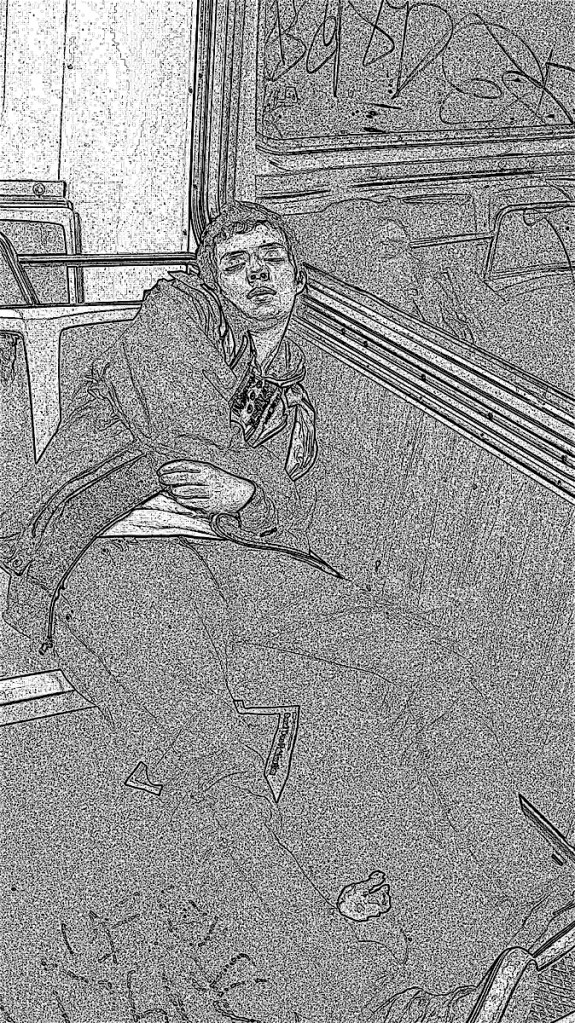
The other cloak of invisibility problem I find over seating and right of way is the passenger with ear buds on, occupying two seats with a coat or bag over another seat. The ear buds act as an invisibility shield: You can’t talk to me because I can’t hear you. Especially if my eyes are closed!
I sat next to this girl who adds to drama because she takes an aisle seat, covers the window seat, and becomes unavailable for talk as the bus fills up to capacity. If someone sits down on her coat, a battle of wills can ensue. It is always a good idea to ask before entering someone’s zone of personal space, as is being alert when seats are no longer available. This is a problem if you can’t hear us because your ear buds are on, and you appear to be asleep. Overcoming the fear of losing aisle space and seats for seniors has been a long and challenging journey for this transit operator in San Francisco. When you board, especially with a bike, or when others are nearby, unhook an ear bud by the fare box and keep the Zen going. Thanks!
 The Dao of Doug: A Bus Driver's Perspective