


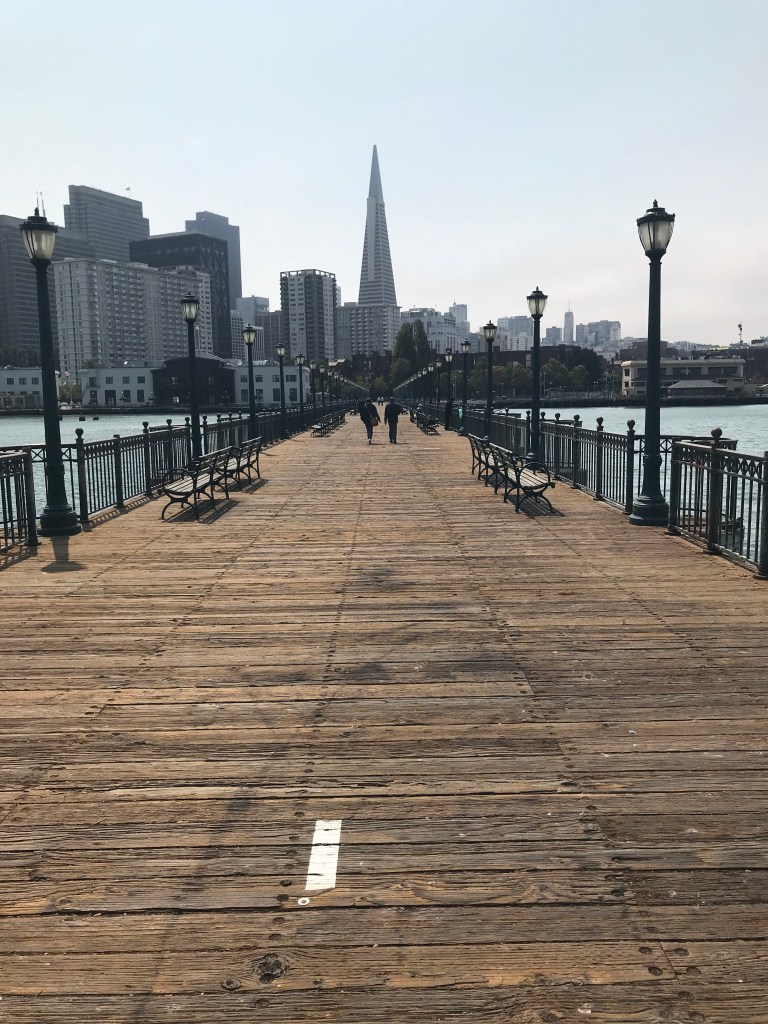
In the future of the world of George Lucas–of Star Wars fame–the modern central system city is filled with flying cars moving smoothly, but in a somewhat congested city, with tall gleaming buildings. In contrast to this futuristic world, is the world of Gene Roddenberry, of the Star Trek realm, where cities, like Romulus, resemble a Romanized-style architecture with almost no movement evident, save for an intermittent train passing over a rail line, speeding quietly and smoothly every few moments. I tend to favor Roddenberry’s world–where there are less cars, and simple, quiet, mass transit conduits that move people around. So, improving mass transit, getting souls out of the car and into the bus, would be a part of a design for the future.
If we look at the Netherlands, we see that the bike is king. Grade schoolers ride their bike to school and back, because it is safe. Seniors go shopping on a bike and have their basket on their bike. Our US boulevards with stoplights and heavy traffic, marginalize bikes into a gutter of turning vehicles into strip malls with huge parking lots–or having to cross six lane intersections where the action to ‘gun it’ through an amber light, causes serious t-bone and sideswipe injuries to motorists and cyclists alike. The contrast between Missouri State Route 100 in Ballwin, MO as a contrast to Tower Grove Park South and Arsenal Ave. in central Saint Louis, is a good contrast study in time and history to what the automobile did to Saint Louis city vs. the surrounding counties.
The writing seems to be on the wall–that for each of us to own and maintain our own car–is becoming prohibitively expensive. Moving away from the central city to do a work from home, now makes for heavier car use and higher fuel costs in our budget, and this country has been forced into an SUV world with lower fuel economy, less visibility around our cockpit view, and a shockingly smaller storage capacity in the rear for luggage and oversized Costco runs.
How has the automobile compromised our health? The planet’s health?
To get more to the point, it looks like Holland has a model for using bikes and calming traffic, with less use of the car. Creating safe bike routes and lanes has been adopted on Broadway in Manhattan and on commercial streets like Market, Masonic and Polk Streets, to name a few in San Fran. Maintaining and repairing a bike creates a skill level easier to attain than the complex systems of newer cars, and creates an avenue for growth in learning how to be independent in an economy the US used to have when we were an agriculture-based society.
Large empty commercial spaces can be used for cooperative groups for apprenticeship in trades, and even fun flea market booth areas–to buy and sell to others in our neighborhood. Taking the huge volume of stuff in storage, and making it available in empty storefronts requires a use of small trucks and bobtails, and those qualified to drive them. This need for skilled labor that can be borne out of a new welfare system that requires service and classroom training to receive government funds. The cost of providing skilled laborers a stipend to ‘volunteer’ on their off hours to help train others, even by going along to the job site, has to be cheaper than, for example, the two billion a year San Francisco is now spending on the homeless imported from other states and countries.
Ex-police chief and mayor of San Francisco, Frank Jordan, in a recent interview on California Insider, seems to be on the right track to a better, not beggar-thy-future. You don’t get something for nothing. Providing ‘help’ to someone, without creating incentive, destroys the value that built this country. Dividing us up into smaller and smaller subgroups of victimhood and exploitations, doesn’t make cooperation or cop ovation any better. Ask any alcoholic attending AA meetings, and they will laugh or scoff at enabling an addict or alcoholic by giving out free housing and drugs. It just makes the problem worse and feeds a black hole of dependence with no budget limit in sight.
So, the use of commercial property can be made affordable if the banks take the haircut on debt, and start at a reasonable rent for change to take place. Would you like to stay in business with a write off? Or fail and collapse completely? Competition is another way of saying I will scream louder than you to prove a point that never comes to fruition because the spirit of cooperation is lost.
Cities can be designed with gardens and pathways without the auto, and older empty buildings can be rehabbed or torn down to make way for structures with recycled materials in areas that aren’t prone to flooding or sea level surges during tropical depressions.
Why rebuild on areas destroyed by fire or sea? Do you want to completely get rid of insurance companies? Return fragile ecosystems to their natural state, or at least rebuild with a low-density of hogans or kivas employing the knowledge of our ancestors: Not with a someone or an entity trying to make a buck through monopolistic competition–or government handouts.
To be sure, look at our ancient cities for a key to enlightenment. The reason we can’t see off-world ‘ancient aliens’ is not because any civilization reaches a point of self-destruction, but because our leaders in charge are hidden to enrich themselves only–at the detriment to the population at-large. It isn’t about defunding the police or increasing new government programs to pay out the unfortunate–it’s about remembering who we are and why we are here. We are spiritual beings in a human body. Let’s stop the seventy year-old secrets and come clean on the Prime Directive.
 The Dao of Doug: A Bus Driver's Perspective