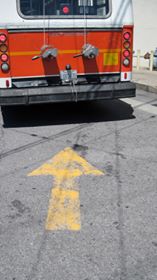
One common comment people make when waiting for the bus is the question, “How come I see like three buses going in the opposite direction when I have been waiting 15 minutes for a bus and nothing is coming?” And this has to do with where the buses come from, and where they are headed when they pull-in. “Are you a 49?” is asked a lot when buses along Van Ness have the head sign reading, “Market.” There is no line number displayed on the left of the head sign, just the words in bold, “Market.” The truth is that this coach could be a 41 Union, a 30 Stockton, or a 49 City College pulling in to the wires on Eleventh Street and ending its run for the day.
Trolleys do not magically transport from their last terminal to the bus barn. They have to return to the barn on the wires, usually along a corridor that connects to the pull-in wires at various locations like 17th and South Van Ness, 16th Street and Bryant, Eleventh and Mission inbound, or 10th and Howard outbound. So when headway, the distance or time between buses, is gradually increasing after rush hour ends, knowing which direction the pull-in coaches are headed, helps, because service is superior in this direction. 49 line buses that go out of service inbound at Eleventh Street from Mission don’t turn left on to Van Ness, and so the headway immediately increases for those waiting to go inbound to the Fisherman’s Wharf area or North point. Someone waiting at a big corner like Van Ness and Market at 6 p.m., would see three times the number of buses headed outbound along Van Ness, because these buses are pulling-in.
The good news is, if you know the pull-in direction of buses heading back to the barn in the early evening, you get great service with buses almost empty and quiet. This is a great spot to find the Zen zone. Working a run with pull-in operators who do work is a great way to start a twilight shift with a gentle beginning. When operators do not pick up, or I am missing a leader, the load on Van Ness becomes an impatient, angry drag down.
When I pull-in from the 30 Stockton or 41 Union or the 49, I always try to pick up those waiting along Van Ness even though I am a short-line coach. Technically, based on the information on our paddles, our run’s timetable, we are a 49 line coach. I have found if I pick everyone up, it helps the bus driver behind me going all the way to City College because he or she only has one major stop to pick everyone up: at Market. Sometimes I get permission to go down to 14th Street so that my passengers can connect easier with a 14 to continue outbound. It doesn’t “cost” me anything in time to do this as a pull-in from 14th Street is actually sometimes faster than 11th, and it prevents a huge group of people from waiting at Market by Van Ness station.
There is nothing worse than having a huge group of people waiting for the next through bus and you are pulling in. By picking up folks willingly and taking them to a transfer point on Mission, it reduces delays for my follower and helps those waiting. Having a working PA mic makes my voice easy to hear and understand really pays off. This eliminates the battle cry from angry passengers on board when I turn off the line to go to the barn.
Sometimes, however, being mister politeness-man does not help. Anger remains unabated and no one understands how I am trying to help. In these cases, the right to remain silent is actually the best policy. If it has been one of those days, I have found it best to remain silent. Any thing I say can and will be used against me in a passenger service request. We have learned as operators that being helpful to stay in service to get folks closer to a transfer point, doesn’t always work. More drama does not mean better service!
When I was new with a high cap number and low seniority, the probability was high the runs I found available in the afternoon had a pull-in at the end of the day. And if you have a lower cap number, and want to work days with big money, you may have to choose a day run split whereby you also have to pull in after a long twelve hour range during the day. The point is, after working for many hours, the last trip is a short line trip which involves taking the coach off the regular route and switching over to wires on streets which lead to the bus barn.
Interestingly enough, no matter how many years a San Franciscan has under their belt in living in the city, or riding a bus, if they don’t have a friend or family member who has worked for or is working as a transit operator, they are clueless about what happens in the morning hours from 8:45 a.m. to 10:00 a.m. and around 6:15 p.m. to 8:00 p.m. Certain runs and certain buses end service during the end of a peak period of frequent service, to less buses and a longer headway.
Most people don’t understand when peak period is, or that the headway between coaches changes every four hours, and is clearly marked at any shelter with a map. Most have confusion between express and limited service, and are unaware express service operates in only one direction depending on the time of day. Express coaches run inbound in the morning and outbound in the afternoon, and this of course, requires you know which side of the street you need to wait on to catch the bus in the correct direction of travel. And what lines go downtown, or which lines go crosstown and never see Market Street.
One intending for a coach headed in a direction towards the bus barn should look not at the line sign, but the destination as well: Especially during the times when headway changes. And after 14 years of service as a bus driver, the ratio or number of people looking at the destination sign of the bus has remained about the same. Less than one-in-ten standing on the sidewalk waiting for a bus, actually acknowledges the bus destination before boarding. And if the operator informs those boarding about the destination of the coach, patrons are confused or clueless about why the bus is a short line coach. Just as in the run from hell I worked in 2007, there seems to be an unlimited well of new, misinformed, or confused passengers about bus pull-ins after peak periods.
I guess if I could wave a magic wand of desire to change behaviors which chronically delay or add to tension between riding public and our union members, it would be this issue. It is simply a matter of awareness and pattern. And no matter how many years or how many hours at work we have been in the seat, the patience must be mustered to quickly and clearly explain that this bus is ending at 11th Street, or 30th Street, or Market, or 17th and Bryant.

 The Dao of Doug: A Bus Driver's Perspective