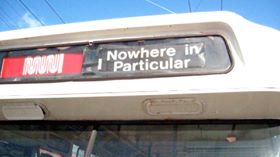
Unlike motor coaches, trolleys are always in service. This is in the rulebook although very few people understand this. If I put up the sign that says “Garage,” it does not mean I will not pick you up. I am putting up “Garage” so you can see my destination clearly. Many times when I put up the short destination, people don’t see my short line destination stop. I have been written up for posting “Garage.”
The street inspectors don’t understand that when I put up “Garage,” it does not mean I am out of service. The street ops person does not realize I am trying to make my job easier by not confusing passengers, and I am trying to telegraph I am not a regular line coach. We do have the sign, “Ask Driver,” but on the old coaches, the line sign still stays up.
I guess most operators, when they put up “Garage,” don’t stop to pick up people who are waiting. I know I sometimes put up “Garage” when I have had a long day, and am tired. If I have been missing a leader for more than a trip, and have carried a heavy load and been late on schedule, I have been known to put up “Garage” because I believe I have done more than my fair share for the day. I don’t feel like dealing with more questions about where I am going after a killer day. The last thing I want to have happen is get in an argument with someone who wants to go farther than my pull in point.
There are times when I announce my last stop and someone comes forward to ask if it is okay if they go with me say to 17th and Bryant. I have always, and without hesitation, said “yes.” Because I am a trolley man. And trolleys are always in service. When I have an Eleventh Street destination outbound from Ferry Plaza on the 14 Mission, and I pull into the zone at 9th Street, I announce that this is my last curb on Mission. Notice I say last curb. This is accurate and simple. I did not say this is my last outbound street stop. We click left at 10th and turn on Howard before we turn left on to 11th, but we don’t have a sign that says Ninth. It seems short of the mark. In just two blocks, there is the option to get on 4 buses during the day, or two buses at night. But no matter how sincere or patient I am, this message is lost due to language barriers or inattention.
I heard another operator getting in to some trouble to pass-up a wheelchair or lift request such as at Fourth Street or at Sixth, because “I am only going to Ninth,” just as I had done on an earlier sign-up. This was the same man in a wheelchair, who time after time got passed up or brushed off because we operators assumed he was going to ride beyond our pull-in. He was fast boarding and departing and really did not take up much extra time. Over the years, he became adroit at getting the coach and run number of operators who did not pick him up.
This has led to many complaints for many different drivers, when our rush to be done caused us to get a complaint, a letter, or mail from the dispatcher, a ‘love letter,’ so to speak, because this was a valid complaint because we passed up a customer with a right to get to our short line destination. After the angry cries from those I shut the door on my quick passes outbound to Ninth, I vowed to put up ‘Garage’ on my head sign. I realized eventually, it was emotionally much easier to take my time and let everyone board, but let them know I was a short line coach: And how to talk quickly and without lying.
Sure enough, the one wheel chair passenger waiting at Sixth or sometimes Seventh, did want to go to Ninth, and I would never have allowed this ride to occur if I barreled on ahead without time for those waiting to tell me the short ride was okay and that they were only going to Ninth.
I have found I almost always have one or two passengers who are willing to travel beyond my last regular stop, and in 14 years, I have never had a problem in doing this. A wonderful victory was a nice man in a wheelchair from Larkspur who rode the ferry in to my terminal at the Ferry Plaza and after small conversation, found out he wanted to go to Costco at 11th and Harrison. This was on my pull-in route. What a great feeling to take him beyond Mission Street and drop him across the street from Costco, without him having to make a transfer and waste time looking for the 9 line or 47. Being able to get to this point of finding a joy that remains hidden when most of us pull in with a one track mind, has a lot to do with the spirit behind writing this ‘how to’ manual on the Zen of San Francisco transit.
Our car culture lacks the sense of community built on the bus when we talk and communicate with one another. I still have this man’s business card he gave me when he got off at Harrison and 11th. I found out about the history of his nice apartment complex, and his life after retiring to a great place to live. And all this richness would have been lost, or reduced to a piece of mail warranting a conference with my superintendent for possible discipline, when instead, I got a connection from another passenger who got great service.
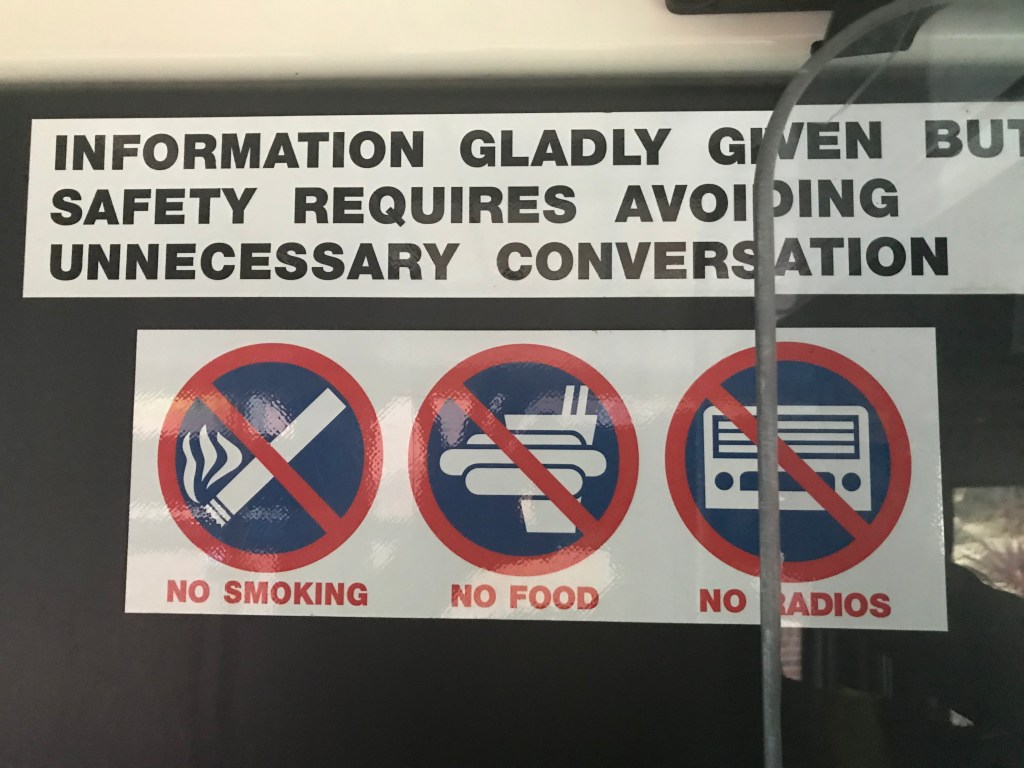
When pulling-in on the Mission wires from the other direction, the same dilemma occurs at 26th and Mission. We click right, on to 25th, to use the pull-in wires on S. Van Ness. I travel all the way down to 17th Street and S. Van Ness, which is only one block away from 17th and Mission. To wait for the next Mission bus, can sometimes be twenty minutes (see Daly City 702.) I have a passenger who desires a location within one block of the Potrero gate. Such as by the KQED television station, across from our yard, or in some other residence or business in nearby media gulch. All the hurry up and go home energy becomes a relaxed, enjoyable ride for one person I make special by dropping them off within a block of their destination. And the knowledge I saved them time without additional transfers instills that they are a part of a transit family within a great system. ‘Unnecessary conversation’ sometimes pays off. This goodwill can have expansive positive effects on the perception of drivers as a whole, and goes a long way to hopefully preventing calamities or funding arguments down the road.
 The Dao of Doug: A Bus Driver's Perspective