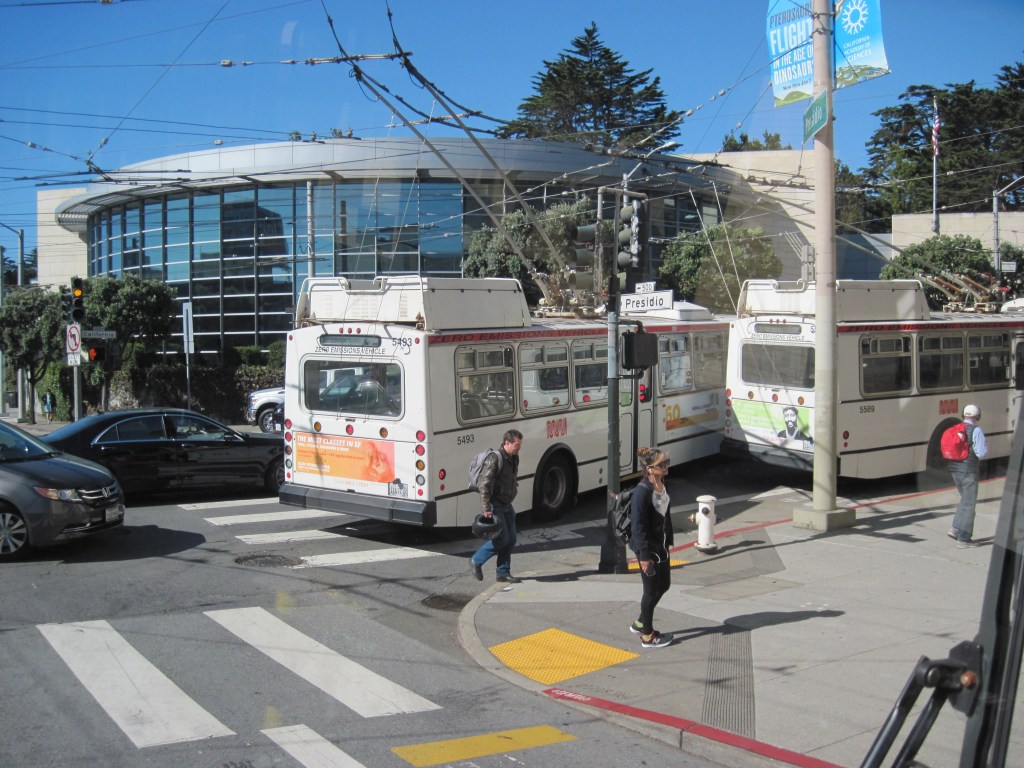
When a coach in front of me seems to be taking longer than usual to leave the zone ahead of me, I must remember the one block spacing rule and slow down also to keep a healthy space between buses. This is usually an issue on Mission Street, where multiple lines parallel each other for several miles. A 49 and 14 can share a zone because the bus stops can accommodate two coaches. It is okay if two coaches unload and load together. But if there is a third bus nearby, such as a 14R, it is important to keep spacing so that no confusion arises from intending passengers as to where to board when the third coach stops to pick up. Those who need extra time to board, need that space in time between coaches to see the line and number on the coach. And if a front door is placed at the top of the zone of the leading bus, there needs to be time to adjust to the spot where the second bus opens it’s front door.
In order to keep spacing even, sometimes the lead coach operator will come to the back of the bus and pull poles. This will allow the emptier bus a chance to fill up by picking up intending passengers at the next stop and even out the load between the two buses. On certain pull-outs on the 14 and 49 line, a pull-out coach may be behind its leader when they both arrive at the next terminal, such as City College on the 49. The leader coach, already in service, must make way for the newer coach that leaves the terminal first, even though they arrived behind the other coach already in service. This can happen in the morning during peak period, or in the afternoon before peak period. The newer buses have a poles down button the operator can push to make it easy for the following coach to get around. The older coaches require lowering the poles manually. And regardless of the type of coach, poles should be cradled before any coach moves. So the drama begins when the question of who should drop their poles to pass, and when.
On the 22 at the outbound terminal by Third Street, a pull-in coach arrives after its leader may stay awhile for a recovery break. On the 30 Stockton, the same situation used to occur at Beach and Broderick. Same goes for the 41, 45 at Greenwich and Lyon. Overcoming anger in trying to get around was solved if I pulled their poles and went around. But if I locked up their retrievers in the process, or caused a problem by touching their coach, I soon found this was not a good idea, and could result in payback. No, I must be the one to go around first by dropping my poles. If the other operator was indisposed and unavailable, I could always find out later what their preferences are. In the meantime, I got to go.
I would get so angry when an unattended coach had its’ poles up at the terminal and I had to go around. I would also not understand why an operator would leave the bus sticking way out in the traffic lane with its poles still on the wires so that a trolley could not pass. “What the hell are you doing?” was not a good way to start communication. “Is there anything I can do to help?” definitely got me out of there a lot faster. Whether a youngster locks up the rear door by letting out the air, or a defect with the lift prevents the front door from closing, it is a simple matter to either move the bus, or ask to drop the poles. Case closed and now I am free to move. Except when I am not.
I try not to rush when I am on my pull-in trip going home. I find if I have an expectation about when I am to check out, and the time changes due to delay, I have to accept this ‘nature of ’ my job as a driver. The end time is not always exact, and I can’t leave my job such as punching out on a time clock. This is what officeworkers and store clerks must realize when they take a driving job. I have learned it does not pay to make plans too close to my off time. Many a drama in the break room or dispatch office has been started because of an expectation that does not match the needs of the line. I would see how unattractive someone would look in appearing to be a whining baby about not getting their way. Only until I was in the same boat and being denied a day off myself! Ouch. Oh well, the nature of the beast.
But I tell you one thing. I will never let my vacation time go to zero. Nor will I let my sick time go to zero. I have found out the hard way, that when I need a day off, and I don’t have it, the ability to remain calm and professional becomes difficult. I have been told to never let them see you sweat. And running out of time off seems to be a good example. God made aspirin for a reason!
 The Dao of Doug: A Bus Driver's Perspective