On Mission Street. Old timers don’t mind being all alone on Mission. As a new operator I just could not fathom this. No coach visible in front looking up from Second Street to Tenth St., or looking up from 14th to 22nd. If I didn’t see my leader in front of me as I left the Ferry Plaza, I would hope for help from the 49 cutting-in at S. Van Ness, which is at 12th Street. The 49 can be a help or a curse. If the 49 has extra headway on Van Ness, then it too, is full to the aisles, and can be a drag all the way out to Ocean Ave. This makes for a very slow outbound trip to Geneva. And I still don’t understand why I have had such a difficult time getting over this. That is, being packed, stacked, and racked, without help and running late.
From the tranquil interior of the superintendent’s office, especially when I am in trouble, comes the directive that the skip stop rule does not apply when there are no unusual delays, and no coach one block behind with the same destination. My definition of unusual delay seems as subjective as how far I can stretch a rubber band. I have skipped stops, during certain runs on a particular sign-up, because of my fears about what happens when the coach gets loaded to capacity. Interestingly, there are no capacity limits stenciled-in on the front of the coach such as found on a tour bus. This remains a mystery. And when I get in to this fear mode, usually with anxiety creeping into my voice and shutting the door on people, trouble is not too far away.
But oddly enough, this is why I love the Mission as opposed to Chinatown. Mission is a four-lane road, although narrower than any standard midwestern town, in San Francisco, it is a blessing because this is wider than most of our streets. Mission Street is also flat, and has fewer people driving from out of town, so most motorists are cool in that they are familiar with how to get around the buses. Cars usually stop behind our coach when we are splitting the lane, and they can see the red light. The question most people ask me about how we drive is, “Why do we drive down the middle of the street?” And the answer is: “We are taught to drive that way!” This got a lot of laughs when I do my Driver Doug as a stand-up routine!
Coming in contact with car doors was costing the railway thousands of dollars a month in claims, so keeping a four foot right-side clearance became mandatory. This means splitting the lane down Mission Street, which is too narrow to accommodate a bus in the right lane without putting the right side at risk from doors, skaters, and bikes. Like any experienced San Francisco driving resident, they know we will soon be out of their way when the light goes green, and we pull off to the curb to pick up at our next stop.
This familiarity makes driving on the Mission, in my opinion, fun. Motorists seldom create problems, and the way is flat and wide enough to pass obstacles. Flat is good because it saves the knees and legs when braking. Especially if the coach is heavy. But the fear I have about running late and heavy and without help in front or behind is because of what begins to happen inside the coach with the passengers. “Say excuse me.” “How rude.” “Ouch, you stepped on my leg, my leg is broken.” “Front seats are for those with disabilities, move back.” “I have a disability, bitch.” Don’t tell me what to do mf.”
And the list goes on. Fights break out. Pickpockets flourish. The chances of going out of service increase. And I guess the wisdom of many operators is to let this happen because it saves emotional energy. I have such a deep core belief in demonstrating skill in my job I consider going out of service a failure. I believe I am not using my skills appropriately to avoid going out of service. When I get written up by a passenger for taking on the load of another bus, I also feel this emotional drain. Since my job is not that of a carpenter or builder, I cannot see my handiwork as a finished product. I cannot leave a legacy so to speak, by using superior building materials, or as such, putting in four or five nails per shingle instead of skipping nails and laying down faster.
All I can do for self satisfaction as a bus driver, is to avoid fights, going out of service, and not put a burden on the operator in the coach behind me. This is how I define my success. Unfortunately, their are no awards or praise forthcoming if I prevent a breakdown, or if I skip stops to keep the bus from overcrowding. In fact, my odds for safe driving or Operator of the Month go down. All I risk is a complaint from those who get passed up, or a complaint or accident report if a fight breaks out. And so I try to find a middle ground whereby those who get passed up don’t call 3-1-1, or those in my coach have just enough room to not step over one another.
And sometimes, when all alone on Mission, this becomes too challenging to find a compromise. Because if I pass up those on the corner, and there is no bus behind me, then I believe mass transit has failed to provide adequate service. Either way, service is lacking, and all I can do is try to let the folks riding I am trying to do the best I can.
This is where a good interior PA mic really helps. If they can hear me clearly when I am passing-up a stop to exit before the light, or between two corners, so I am losing more people than I gain, all is well. Interestingly, there usually is a God space to do this. Sure enough, I can find a break in the parked cars to open all my doors and let folks exit safely. There is an emergency clause in our rulebook which says we may pull to the nearest safe place to stop. I construe this emergency stop rule to mean that if I am overcrowded, even without unusual delay, this constitutes a safety violation, and that my skip stop and pass up is my highest priority. Unusual delay becomes regular delay when equipment and operators are in short supply.
With the installation of the drive cams on our front window, something interesting has happened. And the training inspectors, who are of my experience level and seniority, seem to have also been giving added grace by understanding that when the coach is full, certain flexibilities exist in picking up loads, and stopping. The biggest headache I have is trying to use the kneeler or lift when the coach is full. It does not seem practical or safe to pick up a wheel chair when the aisle is full. And the coach protests at having to rise when heavy, once we have lowered the kneeler. Also the wheelchair lift can get stuck if our air is too low.
If I had pixie dust to get intending disabled passengers to understand my point of view, it would be this: Yes, I want to pick up all those needing a lift, because I like the fact everyone can make their way around our city without a car. And yes, I like to feel good about myself by helping those that our less fortunate in mobility. Please be ready to board when the coach arrives, so I can see you. Let me help you by making sure you get on first. “Thanks.”
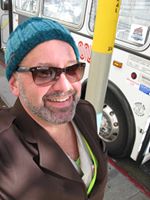
 The Dao of Doug: A Bus Driver's Perspective