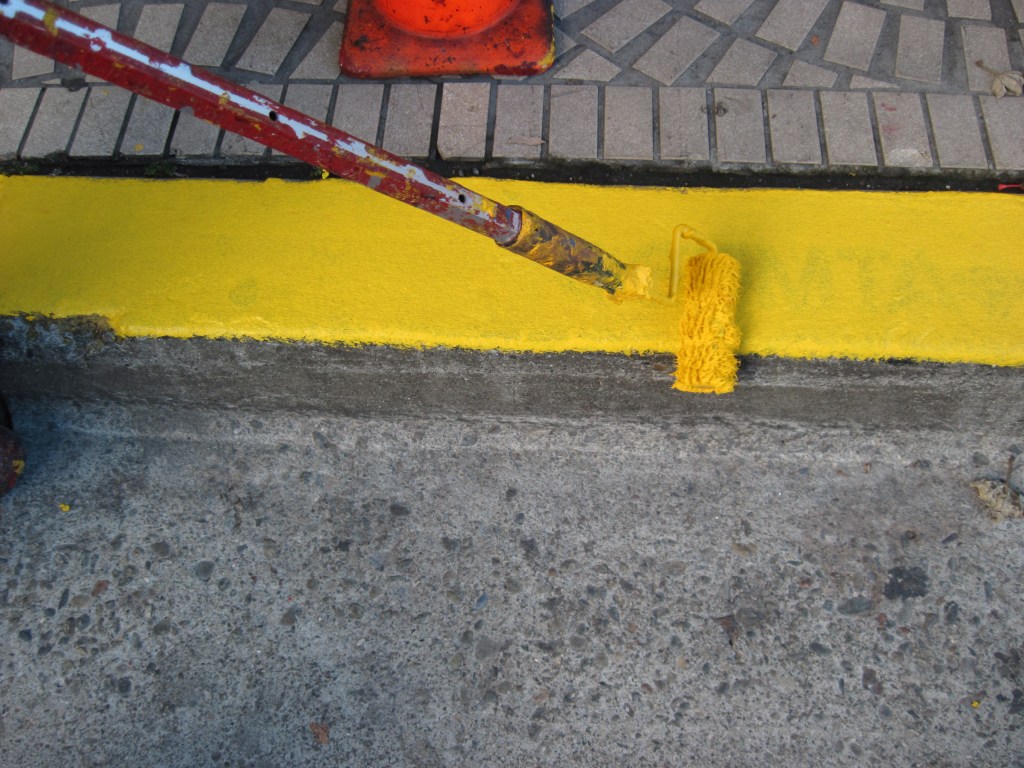
In the ebb and flow of traffic, the space cushion between vehicles goes up and down. As traffic turns from medium to heavy, the matter of inches can come in to play as to whether traffic comes to a standstill or not. When a limo or ride share is picking up or the motorist leaves the vehicle unattended for just the few seconds it takes to get to an ATM or get a coffee, the attitude of the car and it’s distance from the curb can determine if the lane is shut down and blocked. This then creates an abrupt left merge situation to lane two, and brings both lanes to gridlock. This setup for a backup is completely avoidable if the first parked vehicle would stay within 6 to 8 inches of the curb.
The pecking order of when and how delivery trucks set up to offload, also affects lane closure and gridlock. The first arriving number one truck may park in perfect order, but a second truck parks too close on the opposing traffic lane and makes for intense squeeze play that need not be if a longer gap is left open. Intending through vehicles build a backup line which prevents the oncoming lane from clearing truck one, thus preventing two way traffic from clearing. This occurs in a commercial zone where lots of cafes and shops line the street. Upper Haight in the Haight Ashbury and 18th Street between Delores and Guerrero are classic jam spots for the 33 Ashbury.
Once a delivery driver becomes familiar with his or her drop-off route, adjustments are made to the delivery schedule whereby no two vehicles create a rolling delay because they wait for the other delivery to clear, and go around the block to alter their drop off time. Experienced UPS and FedX drivers are good at this. Mainly because they have another address close by and can adjust. Trash trucks can also go around the block and work on other houses or businesses if other trucks block their trash can pickup. This usually works for smaller bakery trucks and bobtails. But fifty-three foot out-of-town tractor trailers from distribution hubs in the Central Valley can cause longer line delays.
The one line delay that can block both lanes in either direction is a loading dock zone. Fifty-three foot tractor trailer rigs attempt to back in to a dock perpendicular to a not-so-wide San Francisco street. These trailers take finesse and skill from the class A truck operator to make a pass in three moves maximum, else the blocked pedestrian, cycle, and vehicle traffic begin unsafe maneuvers. Office Max on Arguello near Geary, Big Lots on Mission near 30th, and the Whole Foods on 17th at Kansas are to name just a few. This just adds more delay to those patiently waiting in their lane. I have to pop the brake and relax and pretend I am watching a truck driver training video on how to back in to a loading dock.
Sixty-foot trolleys are being added to the 5 Fulton line* and it will be interesting to see how this works on Central Avenue by the Fulton Market grocery store. *editor’s note (2005-2006) A loading dock was placed on a small residential street with a trolley turn located on both corners, either side of complex which takes up the whole block. Full-length tractor trailers attempt to back in the dock whereby a space in parked cars is needed to access the dock by placing the tractor on the opposing curb to make the back-in.
The solution to this is to paint a red curb clear on either side of two residential driveways across from the dock. This means taking away parking space. Here’s the rub. Taking away parking requires a procedure that takes a long time. I cannot fathom why transit needs do not gain priority over the car. Especially in a city like San Francisco. A truck making delivery to a grocery store can block commuters on the bus for up to six minutes because they can’t back in to the dock because of a parked car across the street. Our event marker button on camera may help by taking a screenshot of the offending vehicle.
At the 45 terminal at Greenwich and Lyon, the red zone curb clear needed for the buses to wait their time to go downtown is not placed correctly on the block. Room for two more buses would solve the problem of coaches blocking driveways on the approach to the terminal. There are no houses on the terminal side, yet permission to move the red zone takes years to change. I hope the value of transit can be seen by all as we move in to the next generation of travel. I can’t understand why the planning department cannot use the eminent domain and public good to make the necessary changes for transit.
The battle cry goes up along Chestnut Avenue when bus zones need to be extended for longer trolleys. Everyone loves the fact that new larger equipment is to be added for service, but no one wants to sacrifice the three parking spaces necessary to increase the curb red zone. These delays add confusion to our General Sign Up and cause some operators to have to pull out from an alien division or extend a pull-out route from farther away from where our barn is or where we end our day.
The finale of long trailers in San Francisco occurs when a tractor trailer driver from out of town decides to go up 17th Street from Market to access Cole Valley, or takes Leavenworth from the Tenderloin to access 101 North over the Golden Gate Bridge. The loading stanchions for hooking and unhooking below the trailer scrap on the dramatic elevation change before or after crossing a steep grade. The trucks stall going uphill, or get wedged going downhill.
This recently happened when a truck got stuck crossing Union to go down Russian Hill. The only way to break free is to drag the tractor down the hill. The noise of the trailer’s hitching posts dragging on the street definitely awakens anyone in a three block radius! No alarm clock needed on this commute! Tour buses are also big offenders on Russian Hill. During Super Bowl 50, a beer truck got stuck on Jones and California by Grace Cathedral. Obviously this was a new driver on call for the extra work for the large visitor population we had hosting the Super Bowl. Tractor trailers at least have flexibility at the hitch joint. Buses are one solid mass and damage to the frame may result. I’d hate to be in their dispatcher’s office when this call comes in!
Also telling are when a new fleet of delivery trucks make to the streets. New employees are easy to spot by where and when they park. They must adapt their parking so as to not create a car jam so that cars waiting in the queue at a red barricade oncoming traffic stuck behind the newcomer. Passengers intending to board at a bus stop would also do well to adjust where they stand based on double parked vehicles nearby or next to the stop zone. While you may be standing where the bus usually stops, if other cars stand or stop in the zone or double park at the top of the key in front of the zone, this alters where we bus drivers’ can put our nose to the curb. Usually we make a flag stop: we don’t try to come to the curb and keep our coach parallel to the curb one lane away.
The simplest rule to keep the Zen is to leave a broad birth for smaller vehicles unable to see ahead, a space to move in front of my coach when they impatiently pass. I try to move to the right as much as possible so they can see the obstacle ahead, but many times this is unsafe for door openers and bicyclists. Even when passing a double parked truck, with my high beams flashing, oncoming motorists appear oblivious to my move and block me from returning to my lane. I remember I am the paid professional on the clock and a no worries attitude heals the block the fastest! I can find my Zen at any loading dock or any hill!
 The Dao of Doug: A Bus Driver's Perspective