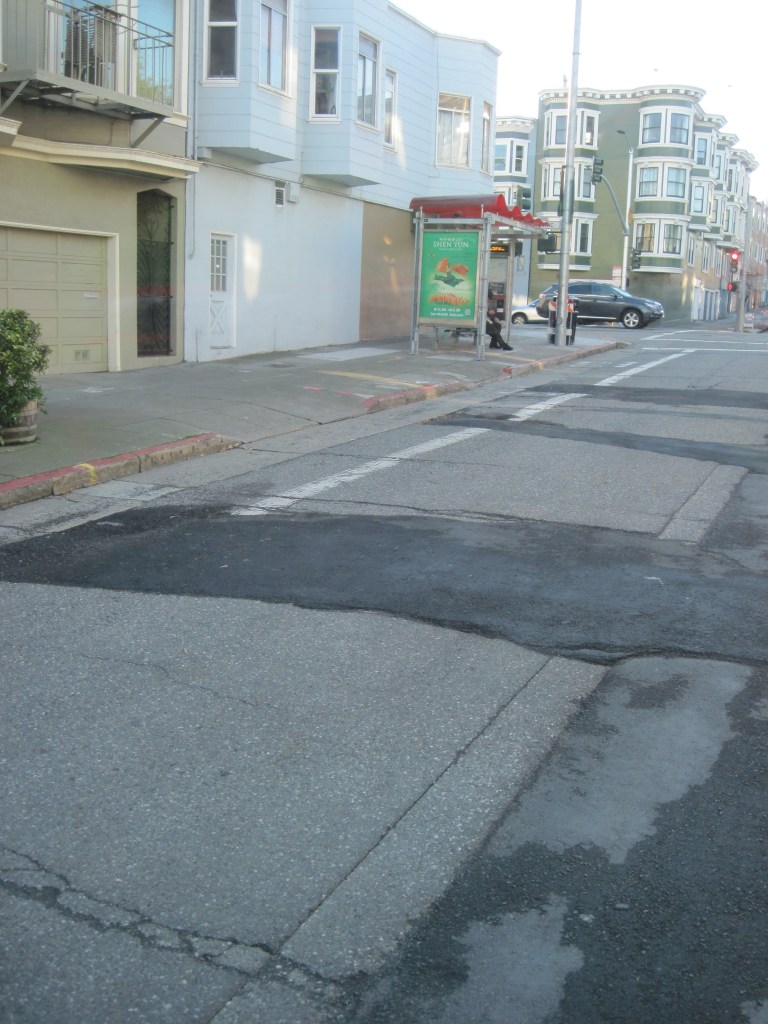
One of the nicest tricks to leaving the zone safely at a nearside bus stop is what my line trainer called the noodle. If done correctly, it reduces squeeze play merging, and the set up for this maneuver helps prevent sideswipes caused by lack of visibility from the rear as a car approaches, particularly if a car is turning right to pass the coach.
I had trouble in spelling maneuver, so I looked it up in my dictionary. My Webster’s Ninth New Collegiate Dictionary has several definitions (below) that fit this move. I have found it nice to have a dictionary handy when I write, because it clarifies what meaning I am trying to convey, and I take interest in all the other words I come across in trying to search for the correct spelling. I recall when I was in grade school, one of the best exercises I enjoyed the most was to use a dictionary in order for correct spelling. The teacher suggested, and I have never forgotten this, was to just open a dictionary and browse around. I encourage any students reading this manual to spend time poring over a dictionary. This is such a helpful creative endeavor that helps us clarify how to communicate and increase our vocabulary.
Our perceived fitness to communicate aids in directness and should not be an intimidator. Finding the simpler word is best for reaching the most, but I am amazed at how few people really know the definitions of the words they use, and how much learning is skipped when definitions are misapplied or not understood. This becomes apparent when listening to someone reading aloud. I was shocked to see how many people stunt their learning by glossing over mispronounced words they don’t have a clear meaning of what they are reading.
So, the definitions of maneuver, which apply to this technique are as follows. “1.b: To make a series of changes in direction and position for a specific purpose. 2. To manage into or out of a position or condition: manipulate a: to guide with adroitness and design b: to bring about or secure as a result of skillful management. – maneuverability; maneuverable, maneuverer.”
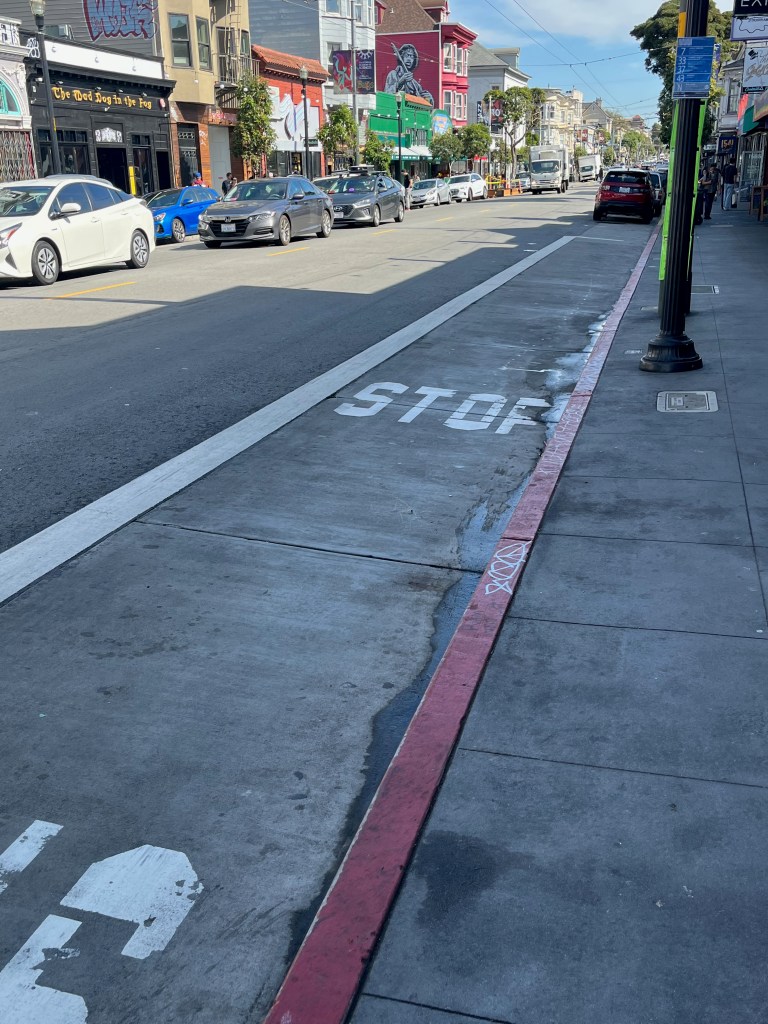
The Stop on Haight and Clayton Inbound for the 7, Outbound for the 33, was moved to far side! No more noodle! Whoop Yeah!
The set up for the noodle is important. When coming to a stop nearside, the bus is as close to a straight line parallel to the traffic lane as possible, so that visibility in the driver side rear mirror is maximized. This is in the rule book, so that the front door is close to the curb, within six inches, and the rear door or doors, are also within one foot of the curb. Many times this is very hard to do due to lack of room created by double parked vehicles, or cars standing in the zone. But the good thing about nearside stops, is they are usually clear. If any car is at the nearside corner, odds are they can easily move away. The car is almost always attended, and when they see the bus coming up behind them, they move. So when the nearside zone is clear, pulling the bus up parallel to the curb, helps those passengers departing, and gives maximum rear visibility
After boarding and alighting, and when the light turns green, or at a stop sign, the problem always becomes being let-in to traffic to proceed through the intersection. Keeping good car karma helps, by always allowing a turning oncoming car, or a car trying to pull out in to traffic, the space to move, and not to block them. Even in construction squeeze play, I have found that best man wins, or me first, usually adds more delay than spacing which allows for a smoother merge.
When beginning to move from the zone, the noodle involves, not using the turn signal and abruptly turning left into the traffic lane, but rather to slowly move forward, straight ahead, in the curb lane. So, if an accident report should ever result, I would not have to check the box turning left, or using the left turn signal. Any operator soon finds activation of the turn signal when merging left, almost always has the unintended consequence of vehicles speeding up to pass left, and to block the merge. The thought of getting ahead of a billboarding vehicle outweighs the smoothness created in allowing us to move ahead without stopping.
Billboarding is a professional driver’s term describing a blocked view. So by moving straight ahead, all cars can see that the bus is moving and clearing the zone and intersection. This also signals that the bus is finished with boarding, and no more delays will result in more people running to the door and stopping again.
If a car wants to race, that vehicle can easily pass the bus on the left as there is no conflict in the traffic lane. And this also helps, because now the bus is clearly, in the lead, in crossing the intersection for any secondary car, and the size of the bus usually stops any additional threats on the left. Because we are still parallel to traffic, we can see in our mirror any threat coming up from the rear. And as we get close to the far side crosswalk, we then move to the left, free and clear of any threat.
When I began to call the shots at when I could pull away, with clear visibility to my rear, and no threat on the intersection far side, I knew I had found the Zen of the noodle.

 The Dao of Doug: A Bus Driver's Perspective