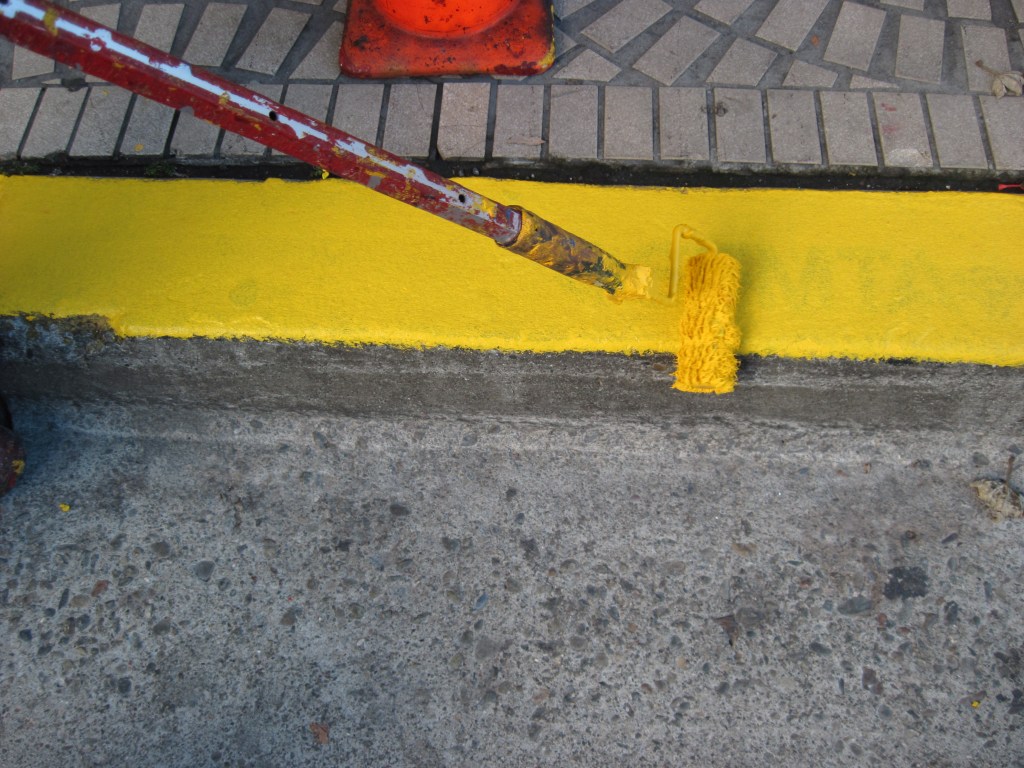
“Please move back. I need you to step back behind the yellow line while the coach is in motion.” I state, when the coach is full: Or, if someone does not have their fare ready and they are looking in their pockets or hand bag for change, I say, “I can’t see my mirrors.” The fare box is in a place such that we cannot see our curbside mirrors when someone is standing by the fare box.
I understand why you guys do this. You’re trying to lock your body in to the yellow hand rails so you can keep stable if the bus takes off from the curb. You are trying to pay and not hold up the bus, so I can go. Unfortunately, it is not a good idea to pull away from the curb without checking to see if there are runners coming up from the back, or if someone is smoking a cigarette or talking on a cell phone too close to the curb, and looking away from the bus. We have several blind spots from our seat, and this is one of them. Our rule is to not move until all fares are paid.
The good news is, some lines have enough time to follow this rule throughout the day. The 2 CIement has time all day, as does the 21 Hayes. The 31 Balboa and 41 Union are usually OK, as is the 45 Union, but some lines such as the 3 Jackson and 24 Divisadero only have the time to wait for someone to move back and sit in the morning.
The 1 California does not, even in the wee hours of the morning, or late at night. This glaring inequity surfaces as running hot. We are told over and over by managers and from the training department, operators are running ahead of schedule on the 1 California. For the first time since I began, I heard this innocent question asked at a safety meeting, “Why are we running hot?” No one answered.
I know why. It is because we don’t have the time to run on schedule and take recovery at the inbound, peak period terminal. If we wait too long to leave at Clay and Drumm on the 1, the standing load we will have in store for us begins at our first stop outbound at Davis and Sacramento.
Because the other terminal inbound at Howard and Main was removed, all persons great and small must walk from Embarcadero BART and Market Street to Embarcadero Building 3 to pickup the 1, so there is no load share to split outbound. The yellow line comes into play as we climb to Nob Hill past Chinatown. The operator of the lead coach with extra headway must skillfully negotiate drop-offs and pass-ups to split the load with his or her follower so the yellow line remains clear.
I lost my conscious contact with experience in projecting my confident vibe while working overtime last Saturday, on the 1 line, and I lost control over keeping the yellow line clear at Grant Street. I was overwhelmed by the number of intending passengers, and did not pass up Kearny as I had no coach directly behind me. I forgot to wait and see if my follower would turn the corner behind me at Davis. Big mistake.
Weekends have fewer coaches in service, and this makes pass-ups difficult. Keeping the front door closed is the only way to keep the front clear. If someone wants to get off, I need to find that out before I cross to the far side. I can kneel the bus and let them out nearside, so I don’t have to open the front door at the bus stop. This is scorned by those who direct us to follow the rules, but they are not facing the yellow line dilemma. They are sitting behind a desk and not a wheel. One can hope for a “caution and re-instruct” letter, and not time off.
I can also wait to make sure everyone is sitting down before I roll. The new buses have a new twist because the stairs are located in the aisle behind the second or third doors, and it takes a few moments for passengers to make their way to the back seats. The timing is such that, as they reach the stairs, I am ready to pull away, and this can throw off their balance, especially because they are putting their wallet away, or taking off a bag to get ready to sit. I love the 21 Hayes because I have the time to wait.
Not all lines afford this luxury. The 1 California does not. We ‘walk the baby’ and slowly start to move as the passenger adjusts to find a seat; or in most cases, when the bus is full, to stand and find a hand hold. It is already obvious to us who the newbies are because they are not ready at the fare box. We are aware of the chronics who never have a clipper card, and always pay cash.
When empty, near the terminal, the other problem is musical chairs” in which a person cannot decide which seat to take. Use of the rear interior mirror is essential in keeping out of the Superintendent’s Office. Our regular riders are smooth and smart on how to pass by the yellow line and sit. On “weekends, when most new operators work—out-of-towners—and others new to riding—make up a higher percentage of riders, and we must be on the lookout for these wild cards, and stack the deck with a good hand, so we don’t loose the trick.
You can’t teach an old dog a new trick, but you can teach a new dog an old trick. I don’t believe Muni wants new operators to learn the old tricks this old dog has, but I have continually found I have lost or forgotten old tricks, and I am amazed at relearning the rules I never took in to account in the years that passed by. Moving back has never been a problem for me on my coach, but moving forward has. Our new interior convex mirrors are great for a complete view of the rear. All hail the new Flyer trolleys!

 The Dao of Doug: A Bus Driver's Perspective