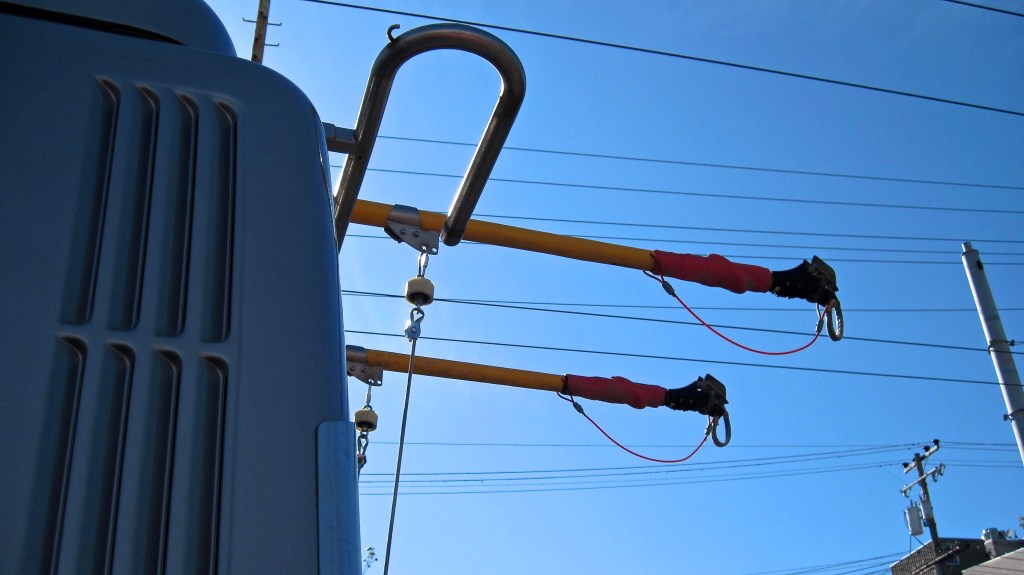
If you look up at the poles on the ETI Skoda coaches, you’ll see a black duct taped ball near the collector on the left pole. This is where the turn signal transmits to the doughnut on the wires before a switch to toggle the poles to a left, right, or center direction upon a diverge, usually before an intersection.
In a syncopative dance that defies predictability, certain coaches at certain switch locations fail to send a signal to the toggles to move the poles to another track. This can be confounding when using a switch not normally used, such as during a re-route when stalled traffic prevents safe space to get out and move the poles over to another track.
Currently, I am on the 41 Union as I write this chapter, and we have a re-route on Market because Beale Street is closed due to construction around our new Trans-Bay Terminal. This creates a backup because autos must divert and detour around the closure which creates more molasses on parallel streets to the Bay Bridge. All coaches heading for the East Bay connection at the Trans-Bay Terminal must also use Spear Street where this dastardly intermittent right turn switch is located mid-block for us 41 Union buses to go around the block on Mission to Main Street.
Some days, when the switch does not fire, I can come to a stop and wait to hear the click. For some reason, standing under the doughnut using turn signal and lever, does not a click to a right turn, make. Other times the click smoothly sounds off in the final middle third of the oval. Each switch has its sweet spot where the click can be heard. They aren’t all the same. Some switches activate right before you go under them, others in the middle where you would expect, and then some will wait until the last minute after passing the oval. These are the angry birds!
Angry birds are located on Post between Kearny and Grant, Sacramento by Presidio, Van Ness at Chestnut, and now this one on Spear before Mission. These inductive lever switches can be activated by turn signal or a dial lever on our dash. Needless to say, using a turn signal, and turning our inductive dial, are both employed at these dastardly duds. The question is, is it the coaches’ fault or the overhead? Some coaches make it and others do not.
Another surprise is on Union at Columbus outbound by Washington Square Park. The poles will click left, even though we want to go straight, out to the Presidio. A good guess is that a 30R Stockton passed by earlier to click left, and the switch never reset. These sticky toggles usually need ‘special sauce’ by the overhead crew to keep them smooth.
Sometimes it is the operator’s fault. Especially if we forget to reset the lever when we pass by the next inductive switch! I have learned I must keep my hand on the lever dial until I hear the click so I can then reset the lever to normal immediately! Otherwise, I dewire at the next switch because I did not reset the dial to normal. Distractions at a turn cause me to forget. Only upon the rude awakening of ca-chunk and shaking of wires and poles do I look down to see the L – N – R position of the inductive dial, which I forgot to return to ’N.’ ’N’ is the neutral position where we use our foot on the turn signal button to trigger a switch. This is when having a weak transmitter on a bus can make for a bad day. Continuous use of the lever and not the turn signal builds to a guessing game and erosion of confidence. This can get reflected in how I treat my passengers.
Unlike most vehicles, our turn signals are activated on buttons like the hi-beam button on the floor of a car. This makes for hands-free turn signaling so we can keep our hands on the wheel. Same is true for our announcement PA mic. We have four floor buttons, left turn, right turn, PA, and hi-beams.
Losing the Zen becomes apparent when I de-wire at a switch only to find I have not reset my inductive lever from the previous sticky tricky inductive switch! Sometimes even if our lever is set correctly, a switch which doesn’t fall into angry bird category, acts up.
Once on a ten hour straight through on the 14 Mission, my poles switched right on the silent switch, and I moved through a fresh green light outbound to the Mission from downtown. This switch was not considered an angry bird. After a flash of light, I feared a pole ripped off my roof, and got caught on the overhead special work. I got no warning light on my dash, and looked out to the back from my driver side mirrors, and saw no problem. My poles were not flailing aimlessly. I let momentum carry me past the middle of this very wide intersection, and came to rest in the safety of the bus zone at 12th and Otis.
My instinct was to bring the coach to rest at the first safe place out of traffic and harm’s way, crossing the intersection with this rule in an emergency protocol. I hopped out of the cockpit and was relieved to see my poles intact on the coach with no damage. Whew. I did the right thing, and wouldn’t need to go out of service and call the shop.
Much to my horror and dismay, I saw wires hanging in the middle of South Van Ness, and immediately realized my poles had switched, and the collector, probably from the right pole, got caught on the turn and grabbed the right turn track wires and ripped them from the anchoring cross-wire. Live wires were sparking in the middle of the street, and cars coming from the far side heading from Mission to Van Ness could not see the wires from their stop line a good distance from the damaged live wire.
I remember asking the passengers to wait for the next bus on the sidewalk, and to disembark as my coach was out of service. I called Central to cut the power, and secured my coach.
As I later found out, wearing my safety vest saved me from bigger consequences. I never saw the tape, but at Muni, when you don’t have to view the tape in a disciplinary hearing, it means you did good. I never heard or received the power off warning on my console, so I had no indication my poles were off track. I confirmed my inductive lever was set correctly.
It took the overhead crew 4 hours to repair the damage. Ouch. Power was cut to Van Ness for this time, and people trying to get home were inconvenienced. Interestingly, the operator I assumed who went through the switch before me, seemed unfazed by his delay on the line of over four hours, and made the point to tell me that it was probably a good thing he waited for hours after his shift was over. Curious I was, but made no comment. I guess he needed the overtime.
Even though my evacuation procedures were followed, I did major damage, I never got the opportunity to explain why asking passengers to alight in the middle of the intersection was not safe. The verdict I did not stop immediately was the rule violation I was to be charged with for dereliction of duty.
Another manager who passed by the scene apparently said I left the scene of the accident. I was trying to warn the oncoming 49 line not to pass through, but didn’t make it. He de-wired also, not knowing what happened. I put a cone in the street below the wires, far enough away not to get zapped.
I was not happy to learn our new collectors are one solid piece of metal, and without a breakaway feature. The shop did come to my rescue, by stating the shoes were incompatible with the new collector. This kept my Superintendent at bay.
The crew that came out to check my shoes thought is was funny I tore down the wires, but I wasn’t laughing. Why were they so joyful at my misery? It’s almost as if they knew it was a planned setup. I had gone through the switch twice before, and had the premonition to get out and check the poles. Sure enough, my intuition was correct, and I needed to move the poles over to prevent a de-wirement. Of all the times I would go through the switch, would I really have to get out every time to make sure I was on the straight track? That also seemed like too much work over a long period of time. I just had to have Faith. I kept calling in that the semaphore was not illuminating to show how the switch was set.
My conspiracy theories activated, and all I could think of was, who went through the switch before me? Did they activate the right turn, get out and drop their poles before going through the switch, move on battery power, and then put their poles back up on the wires? This would explain why the switch was set to the right for the next coach passing. That coach was mine. A booby trap was set, probably from a 49 pull out turning right on Van Ness. But I could not fathom any payback anger from the operator in question. The simplest answer is usually the most probably.
There was no reasonable explanation I could come up except for a bad switch and bad luck. I decided to wait and see; no use in ‘angry birds’ energy for something I could not prove. I also remembered, I too, went through the switch once without resetting it properly. I may have set this train of circumstances in motion by my own fault, even though now, I was paying the price. This helped my attitude immensely.
The crew that came out laughed sarcastically at my misfortune, and the thought they knew the operator who just pulled out with a fresh coach and was the last one to pass had me on the defensive, but I have learned that surrender is usually the best way to deal with any situation. I felt that investigating the matter to protect my name is a long and painful timeframe with wasted angry energy that could be avoided if I keep a play-as-you-go unfoldment to see what happens next. I kept the cause as myself, and not on the other operator. Time will tell.
I didn’t get in trouble, but lost expert operator pay and line trainer status. A new convenient efficiency rule allows for management to need no time frame to make an accident determination or serve a grade on an occurrence. I never got the paperwork, just a latent removal of extra pay months later.
I found out a new operator still on probation, had the same problem I had at the same switch, and got extended probation because of his hand placement on the wheel. When damage over a certain amount occurs, the operator’s feedback seems immaterial and the penalty applies without recourse. Blame the operator seems to be the default conclusion. After feedback much later from one of my line training students, it was a tough call and a no-win situation. Case closed.
As time went on, I moved to the 49 line and had the operator in question in front of me. He too, had a no-win situation. He was now a line trainer and had a student with him who was slowing the line and falling back on my time. I took it in stride and was able to manage my time without any consequence. Good, I thought, I am experiencing no backwash from a late leader. I didn’t harbor any blame or anger towards his delays at the terminal, and I saw him talking to an inspector who apparently was warning him about falling back with his student.
He was on the defensive about being written up for dragging the line. The inspector was monitoring our arriving and leaving times from North Point, and he may have had some paperwork or trouble in being with new hires as a line trainer. Wow. I never considered this to be a problem, as I was certainly not calling in on him for being late. At least my accident was a one shot deal. He was having to sit in it and deal with his schedule for his entire shift.
I’ll never really know if this was payback, or simply luck of the draw, but I have since learned to keep my mouth shut and not try to prove a losing point, but go with the flow. My lawyer-like intentions can rest. I certainly have seen other operators try this, and there is usually an underlying good reason why they are being railroaded. The faster I can see my part in causing my pain, the faster I get out and stay out of trouble.
I have since moved back to the Presidio Barn and haven’t had any angry bird switches to deal with. I am on a motor coach as the power in the wires has been turned off due to construction. Taking a breather from the trolleybus seems like a needed vacation!
 The Dao of Doug: A Bus Driver's Perspective